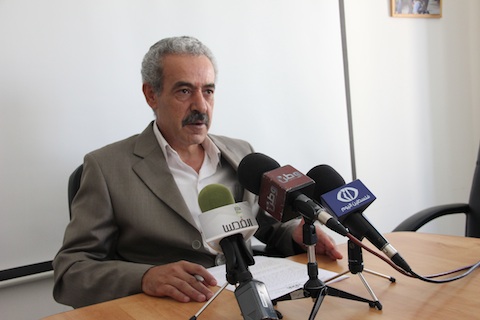


Ramallah – 16th July 2013: the Palestinian Center for Development and Media Freedoms (MADA) announced its semiannual report on media freedoms status in Occupied Palestine, during a press conference this morning at MADA’s headquarters in Ramallah.
The press conference was opened by the general director of MADA Mousa Rimawi:
“Media freedoms status in Occupied Palestine still raises concerns in terms of the numbers and types of violations committed against Palestinian journalists. Violations against Palestinian journalists are one of the highest globally, and are life-threatening, where the Palestinian journalists are concerned for their life and safety, especially those who cover peaceful demonstrations and the popular resistance activities against the occupation, settlement, and the apartheid wall. Regardless of the threat, Palestinian journalists never back down and continue to exercise their profession and duty, and they have earned many appreciations and awards”.
Rimawi added that Violations during the first half of 2013 have increased comparing to the same period in 2012, where MADA monitored 113 violation an increase of 11 violation comparing to 2012, Israel committed 78, and the Palestinian sides committed 35 violations.
Rimawi noted that the Israeli Occupation violations embodied five forms, namely: physical abuse, arrest, detention, prevention from coverage, and prosecution. And as usual physical assault on journalists formed the largest percentage of violations of the occupation with 43 attacks (54.4%).
Rimawi reassured that “The Israeli Occupation insistence to continue its attacks on media freedoms is due to its desire to blur the truth and hide its constant attacks on the Palestinian people’s rights is a main reason for the increase of its violations against media freedoms during the past years. Another reason for this increase is the official International community forgiving attitude towards the continues and rising Israeli violations against media freedoms”
As for the Palestinian Violations, MADA monitored 35 Palestinian violations of media freedoms during the first half of 2013, where arresting journalists was the leading type of violation with 16 cases of arrests, which is a higher number of arrests comparing to 2012.
Rimawi followed up on this, saying that “although the numbers of Palestinian violations in the past three years show a significant decline in this area, but the nature of the violations are still of concern, and indicates a problem with the lack of depth of the right to freedom of expression as a fundamental human right”.
Rimawi noted that most Palestinian violations have occurred in the Gaza Strip by 25 violations, approximately 71% of the whole. It should also be noted that the most were committed in the month of January, where the internal security services of Hamas government in Gaza arrested and interrogated 12 journalists.
Rimawi added: “In the West Bank MADA has touched an extent of improvement in the case of media freedoms, with an emphasis on the continuing patterns of troubling violations of impeding the evolution of the development of media freedoms, such as internet censorship and sentencing journalists to prison, as it happened in the case of Mamdouh Hamamrah, and the arrest of journalist George Canawati, for publishing or using Facebook”. Pointing out that the threat of murder of journalists by an unknown person raises the utmost concern, where the Palestine Public TV crew was threatened with murder and a bomb was placed outside the house of one of the crew members”.
Rimawi added: “What raises our concerns is resorting to torture of a number of journalists during their detention in the Gaza Strip, especially during January, returning to a method prohibited by international laws, the return to this style of torture is not only worthy of condemnation, but also to hold those responsible accountable. This type of violation disappeared during the past few years according to MADA’s reports”.
Rimawi stressed that the other factor that still leaves a negative impact on media freedoms is the lack of a legal environment appropriate to the work of the media in Palestine. Palestine lacks laws governing the work of the media, except for Press and Publications Law of 1995, which requires amendment so it can become appropriate to the developments that have occurred on the local media scene and the world, and to become in line with international standards. In addition the Jordanian Penal Code that is enforced in the West Bank since 1960 allows for the imprisonment of journalists and forms a burden on media freedoms and an obstacle to its development.
Rimawi added Palestinian media still faces many difficulties because of the absence of Access to Information law, which MADA recently drafted a law that is compatible with international standards, after hard work during the past two years.
At the end Rimawi thanked The Open Society Foundations for its support for this report, and thanked all Arab and International Organizations who stood by the Palestinian journalists, and supported his right to exercise his profession freely and safely.