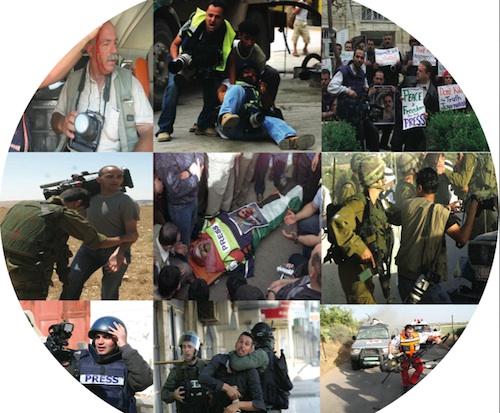


The high number of violations against Palestinian journalists remained steady during the month of July. Many journalists were subjected to numerous and various violations that contravene international conventions relating to human rights and freedom of opinion and expression. These have been monitored by the Palestinian Center for Development and Media Freedoms (MADA) throughout the month. These violations were committed both by the Israeli occupation forces and by various Palestinian actors in both the West Bank and Gaza.
Israeli Violations of Media Freedoms:
Israeli occupation police detained Press TV correspondent Ibrahim El-Husseini and Pal Media cameraman Ayman Eilian while filming Israeli excavations at the Al-Magharba Gate in Jerusalem on Monday, July 9.
The freelance photographer Haitham Khatib’s right hand was injured by a tear gas canister launched by the Israeli occupation forces while covering a weekly march in Bil'in on Friday, July 13.
Israeli security services insisted that Palestinian journalists undergo degrading strip searches before covering the visit by US Secretary of State Hillary Clinton to Jerusalem. Four journalists were refused entry when they objected to removing their clothing while seeking to attend Clinton’s press conference on Monday, July 16.
Palestinian Violations of Media Freedoms:
Palestinian security personnel attacked a group of journalists while covering a march organized in Ramallah, on Saturday, June 30.. The journalists attacked were Reuters photographer Saed Hawari, journalist Mahmoud Harebat, Alhayat Aljadeda newspaper photographer Issam Rimawi, and Quds Media Center photographer Ahmad Odeh. Freelance journalist Ahmad Musleh also reported being detained.
The internal security services of the Hamas government raided the cheif editor of Alsho'la newspaper Saher Aqraa’s house on Saturday, July 5. The preventative security service in Jenin summoned journalism student Mahmoud Mattar for an investigation on Sunday, July 22, after he wrote an article about the political situation. The public prosecutor in the Gaza Strip summoned the vice chairman of the journalists’ syndicate Tahsen Astal for an investigation.
The Mayor of Salfit north of West Bank, Tahseen Salameh, threatened the correspondent of radio Alshamal Ohod Alkofash in response to a report about taxis in Salfit on Monday, July 23.
Conclusion and Recommendations:
MADA condemns all violations against journalists in Palestine that put the lives of journalists at risk. MADA calls upon the appropriate international bodies to pressure the Israeli government to comply with all international conventions on human rights and freedom of opinion and expression.
MADA also renews its call for the implementation of the recommendations of the Independent Committee, which was established by Palestinian President Mahmoud Abbas to investigate claims that Palestinian security forces attacked and detained march participants and journalists.The marches were held on Saturday 30 June and Sunday 1 July to protest against a planned visit by Israeli Vice Premier Shaul Mofaz.
These recommendations are an important step towards achieving justice and promoting the rule of law, as well as guaranteeing freedom of expression and peaceful assembly. MADA also stresses the need to hold accountable any actor, Israeli or Palestinian, who attacks journalists or violates media freedoms in any way.
Details of Violations:
1 July- Palestinian security personnel attacked a group of journalists while covering a march organized to protest the suppression of demonstrators in a march held on Saturday, June 30 to potest a planned visit by Israeli Vice Premier Shaul Mofaz to Ramallah city. The journalists attacked were Reuters photographer Saed Hawari, journalist Mahmoud Harebat, Alhayat Aljadeda newspaper photographer Issam Rimawi, and Quds Media Center photographer Ahmad Odeh. Freelance journalist Ahmad Musleh also reported being detained.
Hawari told MADA Centre tha detective dressed in civilian clothes jumped on him while he was covering the march and tried to take his camera. Hawari said he resisted, but he was attacked and severely beaten. Hawari said: "I defended myself as a reaction and pushed him, so he threatened me, saying that he knows who I am and will beat me again. I was threatened in front of the demonstrators. I suffered bruising to the neck and I could not sleep because of the pain."
Issam Rimawi said one of the detectives in civilian clothes pushed him while he was covering the arrest of one of the demonstrators, and tried to take his camera. Rimawi said he refused and the detective was trying to push him away from the scene so that he could not cover the march.
For his part, Harebat told MADA: "I was standing with my colleagues during the march and when one of the detectives attacked my friend and colleague, Issam Rimawi, I rushed towards him and told the detective to leave him alone because he was a journalist and held a press identification. The detective did not respond to my request and attacked me too. He pushed me and attacked most of the journalists in the march with great violence. When we told him that we were journalists, his violence grew, as if he was targeting the press directly. My colleague, Ahmed Odeh, was also attacked and they confiscated his camera.”
The freelance journalist Ahmad Musleh reported that he was detained for half an hour at the police station in the city of Ramallah. He told MADA: "During the march, I saw detectives in civilians clothes walk among the demonstrators and arrest one of them, beating him violently. So I walked and stood aside although I wasn’t filming. One of the security men tried to take my camera, but I did not let him and I caught the camera firmly. In this moment, a young man showed a card to the detective and told him that we were press and human rights activists, we were doing our job and covering the events and he should not treat us in that way. After that he took us to the police station in Ramallah and took the camera, without seeing the pictures taken inside. A moment later, a large crowd of demonstrators gathered at the entrance to the police station and demanded that the security men release us. We were released, after the security forces took our names and copies of our identity cards. They didn’t beat us, but they shouted and pushed us back at the protest.”
(5 July) The internal security services of the Hamas government raided the house of the cheif editor of Alsho'la newspaper Saher Aqraa on Saturday. Aqraa told MADA that a man who identified himself as a the director of investigations at the internal security services called and asked him to come immediately to their Ansar area headquarters for investigation, but he refused and replied that the law prohibits summoning by phone. Aqraa added, “Shortly after another person called me and said that he is the director of investigations, and I have to go there immediately, but I refused to do so, as well. Then a unit of internal security and investigation personnel raided my house and searched it thoroughly, confiscating my wife’s laptop and a digital camera.”
(9 July) Israeli occupation police detained Press TV correspondent Ibrahim El-Husseini and Pal Media cameraman Ayman Eilian while filming Israeli excavations at the Al-Magharba Gate in Jerusalem on Monday. Husseini said to MADA, “I and my colleague Ayman Alian were preparing a report on the excavations near Al-Magharba Gate. This area is close to the Jewisch Quarter and is heavily guarded. It is controlled by cameras. While filming, a unit of Israeli police appeared and interrogated us. We explained that we are journalists preparing a report on the excavations in the city of Jerusalem and showed them our press cards. After that they asked us to go with them to the police station.” Once there, the police searched our press material and took our identity cards. After approximately half an hour they gave the journalists their cards and press materials and asked them to sign a document stating that they had not been harmed and none of their property was damaged. After signing, they were released.
(13 July) The freelance photographer Haitham Khatib received an injury to his right hand when a tear gas canister was thrown by the Israeli occupation forces. He was covering a weekly march in Bil'in on Friday, July 13. Khatib told MADA that during the march the occupation forces launched a large number of tear gas bombs at the demonstrators and journalists. He added, “The Red Crescent was not in the area during my injury, so my colleagues gave me first aid and put ice on my injury. I felt a small improvement, and luckily the injury is not very serious.”
(16 July) Israeli security services insisted that Palestinian journalists undergo degrading strip searches before covering the visit by US Secretary of State Hillary Clinton to Jerusalem. Four journalists were asked to remove their clothes for inspection before being admitted to Clinton’s press conference on Monday, July 16.
Al-Ayyam newspaper and Associated Press correspondent Abdel Raouf Arnaout told MADA that he had gone to report on the press conference at around 7pm, when Israeli security asked him and his fellow journalists, WAFA agency reporter Faiz Abbas, Al-Quds newspaper correspondent Mohammed Abu Khadir, and journalist Ziad Abu Ziad, to take off their clothes and undergo a search before entering. The journalists refused and left.
Arnaout added: "We protested and asked them to treat us the same as any other foreign and Israeli journalists, but Israeli security did not respond so we left and refused to follow their orders. The U.S. Consulate contacted us and expressed their regret for what happened and said that it was outside of their control."
Chairman of the Palestinian Photojournalists Committee Awad Awad told MADA Center that there were two media events. “The first, in the morning, was a photo opportunity involving the U.S. Secretary of State Hillary Clinton with Palestinian Prime Minister Dr. Salam Fayyad. When I went there, I was asked by Israeli security take off my clothes, but I refused and in the end they agreed to allow me to enter me without being subjected to this humiliating inspection. However, some other colleagues were subjected to such treatment. We reject the way in which Palestinian journalists were treated differently – we demand to be treated in the same way as Israeli and international journalists.”
These are not the first reports of Israeli security personnel seeking to subject Palestinian journalists to humiliating searches. For example, three female Palestinian journalists reported having to undergo degrading inspections while seeking to enter a press conference by Israeli Prime Minister Benjamin Netanyahu on 22 July 2011.
(22 July) The Preventative security service summoned journalism student Mahmoud Mattar for an investigation on Sunday, July 22, after he wrote an article about the political situation. A student of Al Najah University in Nablus, he said that he went on Sunday to the headquarters of Preventative security, where he was questioned about the reasons for writing the article. They threatened him by saying, “We will hang you and say that you committed suicide.” Then they asked him to return the next day. Matar added, "When I went there I stayed from 11:00 am to 5:00 pm. I was interrogated about the article and asked to write my email accounts on Facebook with the passwords. They also cursed and threatened me more.”
(23 July) Mayor of Salfit Municipality, Tahseen Salameh, threatened the correspondent of radio Alshamal Ohod Alkofash in response to a report about taxis in Salfit on Monday, July 23. Alkhofsh told MADA that she wrote a report on the taxi complex in Salfit and published it with both Maan News Agency and Al-Quds newspaper. She also made an audio report on the same subject that included the personal interviews that aired on the program "Ala Altawela" (on the table), a broadcast of the Maan Mix channel. She added, “Two hours before the show, Salameh called me and threatened me not to go on air, but I did not give in. During the presentation of the report, the program presenter Nizar al-Ghoul invited Salameh to give a response to the people's questions, but he answered by saying that I am instigating racism among the residents of Salfit and that I turn the people against him, too. Al-Goul responded by pointing out that the report includes questions from residents of Salfit themselves, not from me. Nonetheless, Salameh threatened to file a complaint against me."
(23 July) The public prosecutor in the Gaza Strip summoned the vice chairman of the journalists’ syndicate Tahsen Astal for multiple investigations after the journalist Yasser Abuhen claimed that the elections of the syndicate which elected Astal were contrary to public order. Astal told MADA that the public prosecutor interrogated him on three occasions about the syndicate and their elections, and then he was transferred to the General Attorney. Astal added, “They asked me to sign a pledge not to work with the syndicate, but I refused to do so, the Attorney General forbid me from traveling until the end of the investigation. He also told me that all members of the syndicate secretariat in Gaza would also be barred from traveling."