

Ramallah – 21th August 2026: On Wednesday, 19th August 2026, the Palestinian Center for Development and Media Freedoms (“MADA”) held the closing conference of the Project “We Heard It on the Radio: Strengthening the Voices of Young Journalists in Defense of Freedom of Expression and Human Rights”, implemented in partnership with Oxfam and with support from the Directorate-General for International Partnerships (Development Cooperation and Humanitarian Aid), at the Plaza Palestine Hotel in Ramallah.
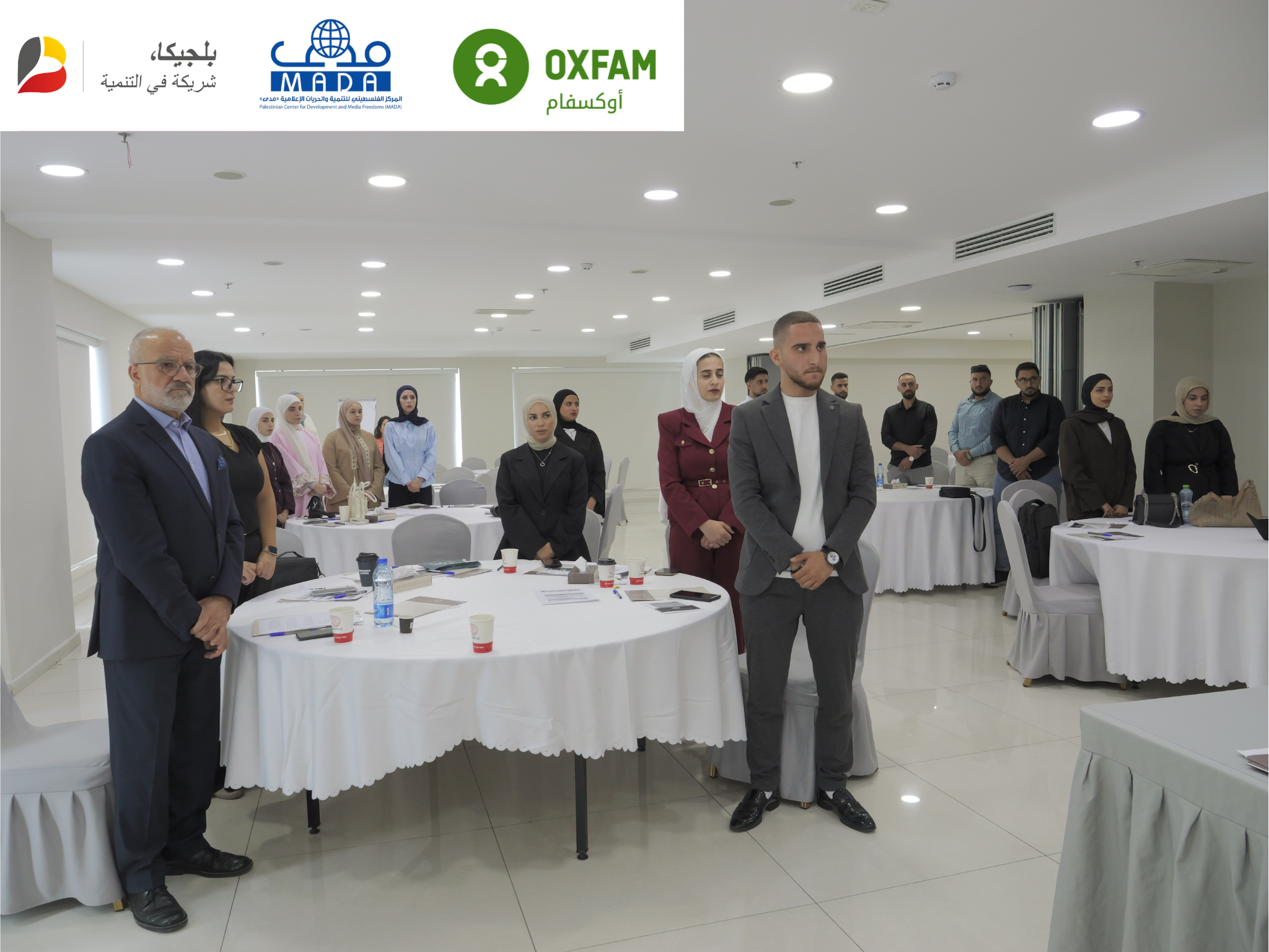
The conference, attended by a number of civil society organizations, academic and youth institutions, as well as a large number of young journalists, opened with the Palestinian national anthem, followed by a moment of silence in honor of the martyrs. The Acting Director of MADA, SHIREEN AL-KHATIB, then delivered a speech addressing the significance of the project, which spanned approximately one year amid a Palestinian environment marked by growing restrictions on freedom of expression and journalistic work, alongside political, economic, social, and digital challenges. She affirmed that press freedom is not merely a professional right of journalists, but part of society’s right to knowledge, expression, and participation, noting that the project focused on building young people’s journalistic, media, and digital skills, alongside strengthening rights-based and ethical awareness, with particular attention to youth in marginalized areas and gender equality.
AL-KHATIB explained that the project’s broader goal is to transform young people from mere consumers of information into content producers, rights advocates, and active participants in the public sphere, capable of using media for accountability, countering disinformation, and amplifying the voices of marginalized groups. She stressed the need to provide a safe environment for young journalists, particularly given the economic, geographic, technical, and legal obstacles, as well as the digital violence faced by young female journalists. She concluded that investing in youth extends beyond skills development to also building confidence and initiative and expanding civic space, calling for continued youth empowerment and the strengthening of freedom of expression, and for making media a tool for knowledge, accountability, participation, and change.
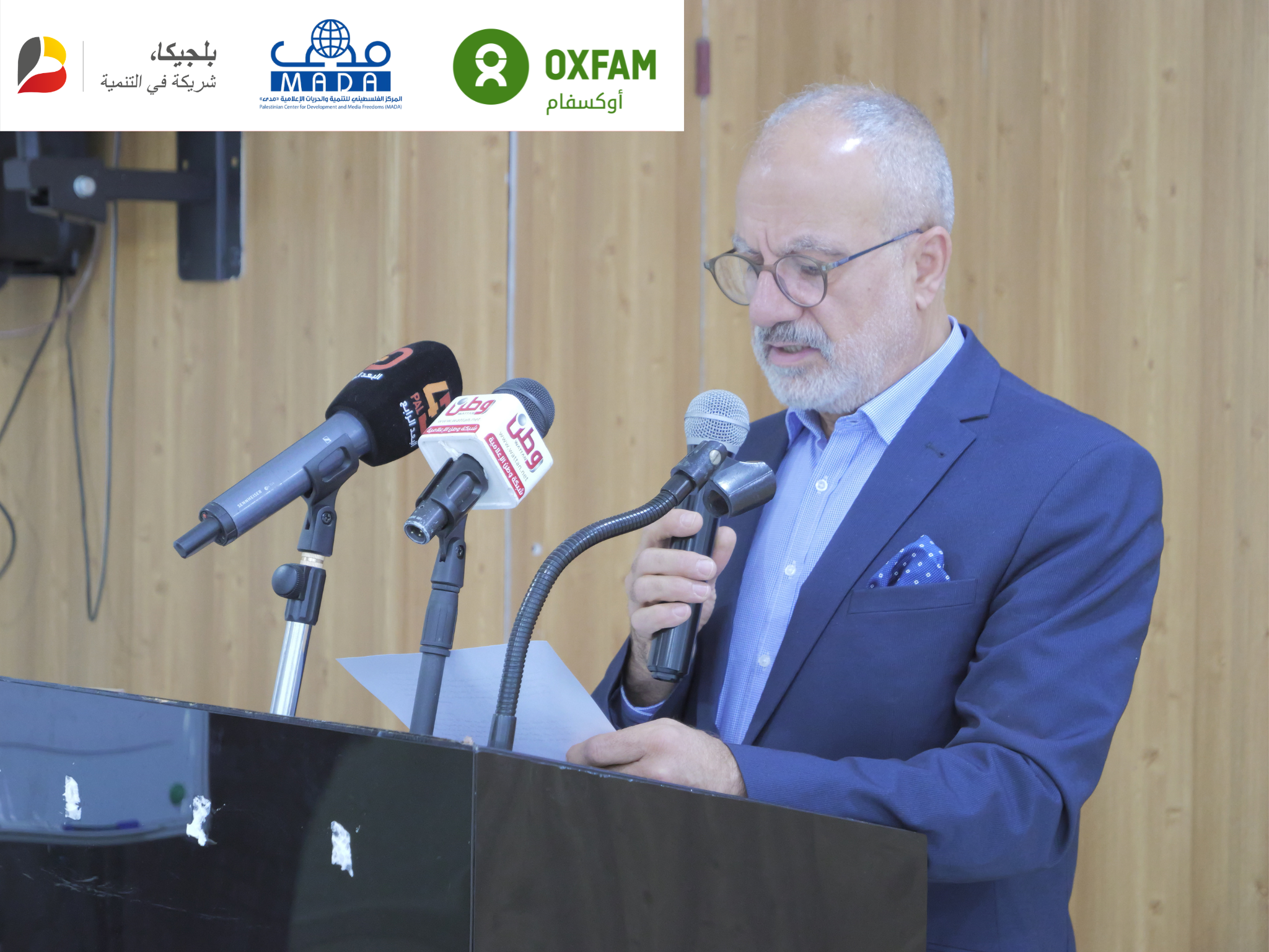
In his remarks, Dr. IMAD AL-HAWDALI, Dean of the Faculty of Media at Al-Quds Open University, affirmed that the cooperation agreement between Al-Quds Open University and MADA formed the basis of an academic and training partnership aimed at developing students' capabilities and reinforcing their belief in the importance of free and responsible media. Under the project, 25 male and female students from various university branches benefited from a training program covering modern journalism skills, content production, journalistic storytelling, interviewing techniques, and the use of media production tools, with a focus on freedom of expression and human rights.
Dr. AL-HAWDALI noted that the project culminated in the production of youth podcast episodes and policy papers addressing issues related to youth access to media and their role in promoting press freedom and freedom of expression on social media platforms, considering these outputs evidence of the students' capabilities and creativity. He concluded his remarks by emphasizing the importance of continuing the partnership between the university and MADA and empowering youth, considering them a fundamental force in building free and responsible media in service of society and the Palestinian cause.
The young journalists participating in the training program presented three policy papers prepared under the supervision of specialized researchers. The papers revealed a decline in youth presence in decision-making positions within media institutions, despite the growing reliance of the public—particularly young people—on digital platforms for news. The papers also uncovered a range of technical, economic, and legal challenges faced by young journalists, particularly in villages, refugee camps, and the Gaza Strip, limiting their ability to access information and carry out their media work.
Participating journalist SUHAIB AL-QATT presented his research paper on “The Impact of Marginalization on Palestinian Youth Access to Media and Information”, which concluded that journalists in villages, refugee camps, and the Gaza Strip are among the most marginalized groups, facing greater difficulties in accessing information due to a range of technical, economic, and legal challenges.
AL-QATT explained that weak internet infrastructure and limited availability constitute an obstacle to a broad segment of youth accessing information, limiting their ability to follow and comprehensively cover events. He also pointed to the economic challenges facing young journalists, noting that 65% of journalism graduates in the West Bank cannot find employment and face high unemployment rates, making it more difficult for them to enter and remain in the media job market. He called for the enactment of a law safeguarding journalists’ right to access information, alongside directing investment toward marginalized areas to address slow internet connectivity, particularly in villages and refugee camps.
The paper “The Role of Youth in Strengthening Media Freedom”, presented by participating journalist SAJIDA ABU ASIDA, demonstrated weak youth representation in decision-making positions within media institutions, with youth representation on boards of directors and editorial bodies not exceeding 14%, compared to approximately 85% of decision-makers at local radio stations in the West Bank and Gaza Strip being over the age of 45.
Conversely, the paper found that digital platforms have become the preferred source of news for Palestinian youth and the public at large, with 92% of young people preferring digital newsrooms and media institutions' pages over social media platforms, while 91% of the surveyed Palestinian public sample rely on digital platforms as their primary news source. The survey also showed that 64% of Palestinian youth trust the news of independent journalists and influencers more than they trust the narratives of official media institutions, indicating the extent of marginalization faced by young journalists in decision-making within media institutions.
Journalist NOOR ABU SALMI presented the third paper, titled “Freedom of Expression and Social Media in Palestine”, addressing the overlapping levels of restrictions limiting digital freedom of expression in Palestine, including the Israeli occupation, the Palestinian Authority, and social media platforms themselves. She noted that legal, political, and security challenges, combined with the occupation and unequal digital infrastructure, render the actual exercise of freedom of expression more fragile and complex.
Project Coordinator HADEEL MUBARAK addressed the key challenges faced during the project, as well as the multiple and varied dimensions of challenges confronting Palestinian youth as civil society actors and journalists in their role as a fourth estate. She also reviewed key highlights from the six podcast episodes that were filmed and produced, in addition to the main challenges faced by the production team during filming and production.
The conference concluded with a set of recommendations put forward by the journalists who benefited from the training program, most notably the design and implementation of advocacy and lobbying campaigns aimed at securing paid training opportunities for journalists, whether at media outlets or civil society institutions. Participants also recommended intensifying practical training to strengthen young people's skills for engagement in the labor market.
