

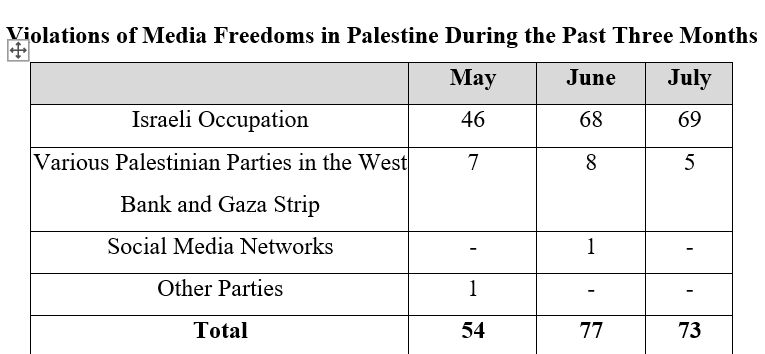
Ramallah – August 4, 2026: The Palestinian Center for Development and Media Freedoms (MADA) documented 73 (seventy-three) violations of media freedoms during the past month of July, across the West Bank, the Gaza Strip, and East Jerusalem, with the Israeli occupation responsible for the majority of these violations. The tally recorded a slight decrease compared to June, with a difference of 4 (four) violations, equivalent to approximately 5% (five percent).
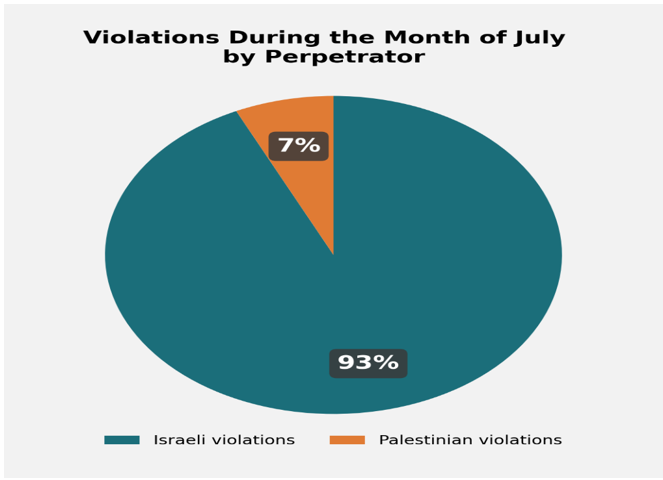
Despite fluctuations in the pace of violations, Israeli violations remained the most numerous and the most serious threat to the state of media freedoms in Palestine, constituting 93% (ninety-three percent) of the total violations recorded in July, while Palestinian violations in the West Bank and Gaza Strip accounted for 7% (seven percent) of the total. No violations were documented by social media platforms during the past month.
Israeli Violations:
MADA documented 69 (sixty-nine) violations during the past month of July, carried out by Israeli occupation forces and authorities, in addition to settlers. These included arrest and detention, prevention of media coverage, physical assaults against journalists, raids on their homes, and the closure of media institutions, in continuation of a policy targeting journalistic work and restricting media freedom.
Among the most prominent violations documented by the Center during the month were physical assaults affecting 14 (fourteen) journalists. These included an assault on four journalists through beating, pushing, and verbal abuse while covering an event organized by residents of the village of Abu Falah, northeast of Ramallah, to demand access to their land, which is threatened with confiscation. In addition, a reporter for the Quds News Network was pushed while covering the demolition of a house in the town of Jit, in Qalqilya governorate. Four other journalists suffered choking as a result of inhaling tear gas while covering a settler incursion into the eastern area of the village of Sarra, west of Nablus.
In the Gaza Strip, four journalists were injured during July while covering Israeli bombardment. Freelance journalist AMER AL-SULTAN was struck by shrapnel in his right foot while covering the targeting of a residential apartment in the Al-Shati refugee camp, west of Gaza City, while three other journalists sustained varying injuries while covering an Israeli bombardment that targeted residents’ homes in the Al-Sabra neighborhood, south of Gaza City.
Occupation forces also arrested journalist HASSAN ABDEL JAWAD from his home in the Al-Dheisheh refugee camp, before releasing him a week after his arrest. In a related incident, occupation forces detained an Al Jazeera crew for 30 (thirty) minutes in the “Khallet Al-Hummus” area, southwest of the city of Yatta, and detained three journalists on the bypass road east of the city of Jenin for half an hour, subjecting them to interrogation before their release.
The violations also included a raid by occupation police on the home of Jerusalemite freelance journalist AHMAD AL-SAFADI, who was handed a decision banning him from Al-Aqsa Mosque for a week, before the decision was later renewed for six months. Occupation forces also broke into the home of freelance journalist EHAB AL-ALAMI and searched it under the pretext of looking for a drone, in addition to raiding the headquarters of the Al-Huda Association in the city of Qalqilya, closing its affiliated radio station, and confiscating part of its equipment.
Israeli occupation forces also continued to obstruct the work of media crews and prevent them from covering the weekly settler marches in the Old City of Hebron, alongside several other field events and incidents. During July, MADA documented 27 (twenty-seven) instances of prevention of coverage targeting journalists and media crews, in addition to 15 (fifteen) instances of targeting with tear gas canisters aimed at pushing them away from event sites and preventing them from carrying out their journalistic work.
Israeli occupation authorities also renewed, on 23rd July, the administrative detention of writer and journalist LAMA KHATER for an additional four months, while journalist MUJAHED AL-SAADI was released on 14th July upon completion of his detention period.
Palestinian Violations:
MADA monitored 5 (five) violations committed by various Palestinian parties during the past month of July, comprising 1 (one) violation in the West Bank and 4 (four) violations in the Gaza Strip, carried out by unofficial actors.
In the West Bank, MADA documented a single violation, represented in the arrest of journalist SUHAIB ZAHDA by the Palestinian Preventive Security Service in Hebron, and his interrogation over posts he had published on social media platforms.
In the Gaza Strip, the crew of Watan TV was subjected to physical assault by several residents while preparing an episode of a television program in the Al-Nuseirat camp, resulting in injuries to all four crew members and damage to the equipment.
Details of Violations:
(2nd July) Israeli occupation forces arrested journalist and writer HASSAN MAHMOUD AL-FARARJA, 73 (seventy-three) years old, from his home in the Al-Dheisheh refugee camp south of the city of Bethlehem, and transferred him to Ofer Prison, before releasing him a week later.
According to a statement given to MADA by his wife, UMM GHASSAN, a unit of the occupation army stormed the family’s home at around 1:00AM on Thursday, gathering the family members and confining them inside one of the rooms, searching the house and rummaging through its contents, while journalist AL-FARARJA was taken to his bedroom and subjected to a field interrogation lasting around 15 (fifteen) minutes. The soldiers then handcuffed him, confiscated his personal phone, and arrested him, transferring him to an unknown location.
The journalist was transported by military vehicle to the “Gush Etzion” area south of the city of Bethlehem. Along the way, he was taken off the vehicle and transferred to an Israeli ambulance, where doctors conducted preliminary examinations and checked the medication he was carrying, given his chronic high blood pressure. He was subsequently transferred to a police camp in the “Telem” settlement, located northwest of the city of Hebron, where he was held in a cell for five consecutive hours before being brought before a police interrogator.
The interrogation focused on his journalistic work and his activity within the committees of the Health Workers’ Union. He was then transferred to Ofer Prison, west of the city of Ramallah, where he remained in detention throughout his arrest until his release on Thursday, 9 August. His personal phone remained confiscated.
It is worth noting that journalist AL-FARARJA has spent a total of 10 (ten) years in Israeli occupation prisons as a result of previous and repeated arrests. He also suffers from diabetes, a fact that raises serious concerns about his health condition amid his continued detention, particularly in light of repeated reports regarding healthcare conditions inside Israeli prisons.
(3rd July) Settlers assaulted a group of journalists through pushing and threats, and prevented them from covering an event organized by residents of the village of Abu Falah, northeast of Ramallah, to demand access to their land, which is threatened with confiscation.
According to a statement given to MADA by Al-Irsal website reporter KARIM KHUMAYSA, following Friday prayers, a group of journalists headed to the lands of the village of “Abu Falah”, including Al Jazeera reporter THARWAT SHUQRA, Anadolu Agency cameraman ISSAM AL-RIMAWI, AFP cameraman MOHAMMAD AWAD, and Reuters cameraman MOHAMMAD TURKMAN, to cover an event organized by residents aimed at reaching their land threatened with confiscation, following the establishment of a settlement outpost on it by settlers.
KHUMAYSA explained that as soon as residents and journalists arrived at the site, a four-wheel-drive “Tractoron”-type vehicle carrying three settlers arrived, and they began moving among the participants and photographing them, before making phone calls that summoned around 7 (seven) additional settlers. The settlers proceeded to surround the participants and demanded that they leave the area.
He added that after the residents refused to withdraw, the settlers approached the journalists and assaulted them by pushing, shouting, and threatening them, in an attempt to force them to leave the area and prevent them from documenting the event. Subsequently, around 10 (ten) masked settlers, who had been stationed near the settlement outpost carrying clubs, rushed toward the residents and journalists in an attempt to attack them, forcing the journalists to withdraw from the site for fear of being assaulted, which prevented them from completing their media coverage of the event.
(4th July) Israeli occupation forces prevented a group of journalists from covering the weekly march organized by settlers in the Old City of Hebron, obstructing their work and pushing them away from the scene.
According to a statement given to MADA by freelance journalist AMER ISMAIL AL-SHALUDI, at around 5:00PM on Saturday he headed to the area of Al-Shalala Street in the center of the Old City to cover the weekly march organized by settlers.
As the march began, Israeli occupation soldiers deployed heavily in the area and began harassing journalists and obstructing their work. Several soldiers pushed journalists away from the scene, and deliberately stood in front of camera lenses, completely blocking the field of view, preventing them from documenting the course of the march. Faced with these practices, the journalists were forced to leave the area after being effectively prevented from filming and carrying out their journalistic work.
Among the journalists who were subjected to obstruction and restriction were: independent journalists AMER ISMAIL AL-SHALUDI, TAHA ABU HUSSEIN, LUAY METHQAL AMR, and MUS’AB ABDEL SAMAD SHAWER, in addition to AHMAD AL-RAJABI, Anadolu Agency cameraman WISSAM AL-HASHLAMOUN, and Al Jazeera reporter MOHAMMAD SIDQI AL-ATRASH.
(4th July) Israeli occupation forces surrounded and detained an Al Jazeera crew for approximately 30 (thirty) minutes, obstructing their journalistic work and preventing them from covering the establishment of new settlement outposts southwest of the city of Yatta.
According to a statement given to MADA by independent journalist AMER AL-SHALUDI, an Al Jazeera crew comprising reporter MOHAMMAD SIDQI AL-ATRASH and cameraman LUAY AL-SAEED headed at around 2:30PM on Saturday to the “Khallet Al-Hummus” area southwest of the city of Yatta, to cover work being carried out by settlers to establish agricultural settlement outposts in the area.
While the two were inside their vehicle, a settler residing in one of the settlement outposts intercepted the vehicle and photographed it, before making a phone call. Minutes later, two Israeli occupation army patrols arrived, one positioning itself in front of the journalists’ vehicle and the other behind it, surrounding the vehicle and preventing it from moving.
The soldiers dismounted from their military vehicles and imposed a siege on the vehicle, preventing the journalists from leaving it or filming, while continuing to move around it for close to half an hour, which caused the two journalists fear and anxiety and obstructed them from carrying out their journalistic work.
After around 30 (thirty) minutes, occupation forces withdrew from the site, and the two journalists left the area without being able to complete their media coverage of the settlement expansion work.
(7th July) A soldier assaulted journalist RAGHAD ABU SAFIYA by pushing her to the ground and prevented her from covering the demolition of a house on Tuesday afternoon in the town of “Jit”, east of the city of Qalqilya, on the pretext that she was a “saboteur”.
According to a statement given to MADA by Quds News Network reporter RAGHAD SALAH ABU SAFIYA, 28 (twenty-eight) years old, she was present at 12:10PM on Tuesday in the town of “Jit”, east of the city of Qalqilya, to cover the demolition of a house there.
The journalist stood on the balcony of a house facing the house slated for demolition, and when occupation soldiers began gathering, they started shouting at her and at the homeowner to get her down from the balcony, claiming she was filming the soldiers, which was prohibited.
Although she was wearing press identification and had told the soldiers she was a journalist, the soldier attempted to take her phone, then pushed her to the ground, and threatened to confiscate her phone, delete everything on it, and detain her if he saw her covering events again, because she was a “saboteur”.
(7th July) Israeli occupation soldiers directly targeted several journalists with a stun grenade while they were covering a raid on a house in the city of Nablus, near the National Hospital, on Tuesday morning, obstructing their journalistic work.
According to a statement given to MADA by Quds News Network reporter ABDULLAH TAYSIR BAHESH, 29 (twenty-nine) years old, he was accompanying a group of journalists covering an occupation forces raid on a house near the National Hospital in the city of Nablus. The group included the Al-Ghad TV crew comprising reporter KHALED BADIR and cameraman SHADI JARARA’A, Xinhua News Agency cameraman NIDAL ASHTIYA, Palestine Post reporter MUJAHED TABANJA, Al-Najah TV cameraman AMEER SETEYYEH, and independent cameraman NASSER SHTAYYEH.
BAHESH explained that at 9:34AM, an Israeli border police officer threw a stun grenade directly at the journalists to push them away from the area, without any prior warning.
He added that occupation forces had, minutes earlier, fired tear gas canisters indiscriminately in the area, causing journalist KHALED BADIR to suffer choking, and he received treatment on-site.
(8th July) The crew of Watan TV was subjected to physical assault by several residents while preparing an episode of the television program “The Sole Survivor” in the Al-Nuseirat camp, central Gaza Strip, on Wednesday afternoon, resulting in injuries to one crew member, bruises and cuts, in addition to damage to the media equipment.
According to a statement given to MADA by Watan TV presenter MUSLEH ABU GHALI, the crew was recording an episode of the program “The Sole Survivor”, broadcast on Watan TV and its digital platforms, at around 11:30AM.
ABU GHALI explained that during filming, two individuals stormed the recording site without giving any reason, carrying sharp instruments, and began shouting, hurling insults, and assaulting those present, including the episode’s guest, who was subjected to verbal abuse.
The two individuals also physically assaulted crew members, namely cameraman ISLAM MANSOUR, coordination engineer AHMAD JABR, and director OSAMA AL-SAYYED, while journalist MUSLEH ABU GHALI sustained bruises and cuts to his right shoulder and face as a result of being attacked with a sharp instrument.
The assault also extended to the media equipment, damaging the camera and breaking the camera tripod.
ABU GHALI noted that several residents and displaced persons in the vicinity intervened shortly afterward and managed to end the assault, preventing the situation from escalating further.
This assault caused filming to stop and the episode to remain unfinished. The episode addressed the story of one of the sole survivors of the war on Gaza, amid the loss by thousands of families of all their members except for one.
(11th July) Israeli occupation forces prevented a group of journalists from covering the weekly march organized by settlers in the Old City of Hebron on Saturday afternoon.
Freelance journalist AMER SHALUDI stated to MADA that at around 4:00PM he headed, accompanied by Xinhua News Agency cameraman MAMOUN ISMAIL ZOUZ, Reuters photographer MOUSA AL-QAWASMEH, freelance journalist SAMI TAITI, freelance journalist LUAY AMR, Al Jazeera cameraman LUAY AL-SAEED, an Al-Ghad Al-Arabi TV crew comprising reporter RAED AL-SHARIF and cameraman JAMIL SALHAB, and freelance journalist AHMAD AL-RAJABI, to the Old City of Hebron to cover the weekly settler tour, which coincides with the closure of shops and the restriction of Palestinian movement in the area.
SHALUDI added that as the settlers exited from the entrance of Al-Shuhada Street toward the old market, occupation forces deployed heavily in the alleys of the Old City, and soldiers began demanding that journalists leave the area. When journalists attempted to approach to cover the settlers’ passage, the soldiers deliberately placed their hands over cameras to prevent filming, then pushed the journalists and forced them away, preventing them from completing their media coverage or capturing the images needed for the event.
(12th July) Three journalists sustained varying injuries while covering an Israeli bombardment that targeted residents’ homes in the “Al-Sabra” neighborhood, south of Gaza City, on Sunday afternoon.
According to a statement given to MADA by freelance journalist MOHAMMAD SAYED HASBALLAH, 29 (twenty-nine) years old, he headed, accompanied by Al Jazeera live cameraman AYMAN MAJED AL-HISSI, 32 (thirty-two) years old, and freelance journalist KHALED FUAD AL-SULTAN, 23 (twenty-three) years old, at around 4:25PM to the “Al-Sabra” neighborhood, following reports that occupation forces had issued a warning of an impending strike on a three-story residential building.
HASBALLAH added that the journalists arrived at the site and positioned themselves more than 500 (five hundred) meters away from the targeted building, taking fixed protective positions in preparation to document the bombing. However, an Israeli F-16 warplane struck the building with several missiles simultaneously, causing an explosion that destroyed the building, scattering debris and rubble over long distances.
The bombardment resulted in journalist MOHAMMAD HASBALLAH sustaining injuries to his left hand, in addition to bruises to his neck and back, while cameraman AYMAN AL-HISSI sustained injuries to his right hand and bruises to his back, and his vehicle, which bore press markings, was also damaged. Photojournalist KHALED AL-SULTAN sustained injuries near his right eye and to his hand and left foot.
The journalists stopped working due to their injuries, as they began bleeding until ambulance crews arrived at the scene and transported them to Al-Shifa Hospital, where they received treatment in the emergency department.
(12th July) A unit from the Israeli General Security Service (Shin Bet) raided the home of freelance journalist AHMAD AL-SAFADI in Jerusalem on Sunday morning, and took him to the “Al-Qishla” interrogation center, where he was handed a decision banning him from Al-Aqsa Mosque for a week, before the decision was later renewed for six additional months upon its expiry.
According to a statement given to MADA by freelance journalist AHMAD HUSSEIN AL-SAFADI, 54 (fifty-four) years old, a Shin Bet unit raided his home in Jerusalem at around 10:00AM, causing fear and panic among his wife and children. Members of the unit asked him to accompany them to the “Al-Qishla” interrogation center, where he was informed of a decision banning him from Al-Aqsa Mosque for a week, without any explanation of the reasons or justifications underlying the decision, before he was asked to leave the center.
On 19th July, journalist AL-SAFADI received a new decision issued by the “Al-Qishla” police center, banning him from Al-Aqsa Mosque for an additional six months, and prohibiting him from entering any part of the Al-Aqsa Mosque compound for the duration of the decision, with a warning that violating the decision would expose him to arrest and legal action.
It is worth noting that journalist AHMAD AL-SAFADI had previously been interrogated by occupation police, and a decision was issued banning him from Al-Aqsa Mosque for six months, which expired on 11th July 2026, just one day before his home was raided, and he was handed the first one-week expulsion decision, which was followed days later by a new decision banning him from Al-Aqsa Mosque for an additional six months.
(21st July) Israeli occupation forces obstructed the work of journalists and prevented two of them from covering the siege of a house in the town of “Sa’ir”, north of the city of Hebron, on Tuesday morning, and forced them to leave the area.
According to a statement given to MADA by freelance journalist YASSER THALJI, at around 7:00AM he headed, accompanied by fellow freelance journalist SARI ABDEL GHAFFAR JARADAT, to the “Wadi Al-Shark” area south of the town of Sa’ir, to cover occupation forces besieging a house and clearing its contents in preparation for its demolition, on the pretext of unlicensed construction.
THALJI explained that the two journalists attempted to approach the house to document Civil Administration crews clearing its contents, but an Israeli border police unit intercepted them, with its members shouting at them and pushing them, ordering them to leave the area and not approach the scene.
He added that members of the unit continued to restrict them and prevent them from carrying out their journalistic work, forcing them to move away from the site, which prevented them from completing their media coverage and documenting the clearance and demolition of the house.
(21st July) Groups of settlers obstructed the work of an Al-Ghad Al-Arabi TV crew and prevented it from completing its coverage of their incursion into the village of “Al-Tuwani”, east of the city of Yatta, on Tuesday morning, when one of the settlers assaulted the channel’s reporter, violently pushing him in an attempt to stop him from continuing his coverage.
According to a statement given to MADA by Al-Ghad TV reporter RAED AL-SHARIF, at around 10:30AM he headed, accompanied by the channel’s cameraman JAMIL SALHAB, to the village of “Al-Tuwani”, located east of the city of Yatta, south of Hebron governorate, to cover a settler incursion into the eastern outskirts of the village.
AL-SHARIF explained that as soon as the crew arrived at the site, they began providing live coverage, while settlers, under the protection of Israeli occupation forces, were attacking residents and young men in the area. During the live broadcast, a settler approached the correspondent and began provoking him and moving around him in an attempt to disrupt the broadcast and prevent him from continuing his media coverage.
He added that the settler, before leaving the scene, violently pushed him in front of Israeli occupation soldiers who were present at the site, without intervening to stop the assault or provide protection to the media crew.
Despite the assault, reporter AL-SHARIF continued the live broadcast, but the crew was later forced to leave the site for fear of further attacks, especially with additional settlers arriving in the area, which prevented the completion of media coverage of the event.
(25th July) Israeli occupation forces prevented a group of journalists and media crews from covering the weekly march organized by settlers in the Old City of Hebron on Saturday evening and obstructed their work by pushing them with their hands and forcing them to retreat a considerable distance, which prevented them from completing their coverage of the event.
According to a statement given to MADA by freelance journalist AMER AL-SHALUDI, at around 5:00PM he headed, accompanied by several journalists and media crews, to the Old City of Hebron to cover the weekly settler march.
SHALUDI explained that around twenty minutes after the journalists’ arrival, the march set off from the “Khallet Bani Dar” area toward the old market, coinciding with the deployment of large numbers of occupation soldiers in the area, who closed off all passages leading to the march route, then forced journalists to retreat a distance estimated at around 300 (three hundred) meters, from the old market area to the military gate erected in front of the old Hebron municipality building in “Al-Dabbouya” square.
He added that occupation soldiers assaulted several journalists by pushing them with their hands, and directed insults, obscenities, and threats at them, forcing them to retreat for fear of further assaults. This resulted in the field of view being almost completely blocked for media crews, preventing them from documenting the settlers’ march along the old market.
Occupation forces also detained the journalists alongside a number of Old City residents, who were forced to close their shops and remain behind the military gate, restricting the journalists’ movement and preventing them from carrying out their work freely and completing their media coverage, forcing several of them to leave the site due to the continued restrictions imposed by occupation forces.
Those who took part in covering the event included: freelance journalist AMER AL-SHALUDI, European Pressphoto Agency photographer HAZEM BADR, freelance journalist MUS’AB SHAWER, Reuters photographer MOUSA AL-QAWASMEH, freelance journalist SUHAIB AL-AWAIWI, an Al-Ghad TV crew comprising correspondent RAED AL-SHARIF and cameraman JAMIL SALHAB, freelance journalist TAHA ABU HUSSEIN, WAFA news agency photographer HAMZA HATTAB, and freelance journalist YASSER THALJI JARADAT.
(25th July) Israeli occupation forces assaulted a group of journalists with sound and tear gas grenades while they were covering a settler incursion into the eastern area of the village of “Sarra”, west of the city of Nablus, on Saturday evening, causing several of them to suffer choking as a result of inhaling the gas.
According to a statement given to MADA by Roya TV reporter HAFEZ MAHMOUD SABRA, 36 (thirty-six) years old, dozens of settlers, at around 5:30PM, stormed the eastern area of the village of “Sarra” under the protection of Israeli occupation forces, prompting a number of the village’s young men to gather in anticipation of any assault.
SABRA explained that as the young men began to gather, occupation forces fired tear gas and sound grenades intensively, causing a fire to break out in dry grass, before the village council’s firefighting crews managed to bring it under control. At the same time, occupation forces brought in military reinforcements comprising four military vehicles and a civilian vehicle, and soldiers began advancing to force everyone present, including journalists, to leave the area.
He added that occupation forces directly targeted journalists with tear gas and sound grenades, forcing them to retreat toward agricultural land located between two houses; however, the soldiers continued firing grenades toward them and toward the residents of one of the two houses, in an attempt to push them away from the scene and prevent them from continuing their coverage.
The assault resulted in several journalists suffering severe choking as a result of inhaling the gas, with some receiving field treatment inside ambulances, among them Roya TV reporter HAFEZ SABRA, Al-Ghad TV reporter KHALED BADIR, Quds News Network cameraman ABDULLAH BAHESH, and AFP journalist MOHAMMAD ATIQ.
Those who took part in covering the event included: a Roya TV crew comprising reporter HAFEZ SABRA and cameraman MAHMOUD FAWZI, an Al-Ghad TV crew comprising reporter KHALED BADIR and cameraman SHADI JARARA’A, FADI AL-ASA and MAHMOUD KHALAF from Al-Araby TV, MOHAMMAD AL-ATRASH and LUAY SAEED from Al Jazeera, Palestine Post reporter MUJAHED TABANJA, ABDULLAH SABRA and MOHAMMAD AL-KHATIB from Palestine TV, in addition to a number of foreign journalists.
(27th July) Israeli occupation forces raided the home of freelance journalist EHAB AL-ALAMI in the town of “Beit Ummar”, south of Hebron governorate, at dawn on Monday, and searched it on the pretext of looking for a drone. They also interrogated the journalist about his media work, before leaving after around an hour of searching and vandalism, without finding any drone.
According to a statement given to MADA by freelance journalist EHAB ISSA AL-ALAMI, a unit of the occupation army stormed his home in the Isaida neighborhood, north of the town of “Beit Ummar”, at around 1:30AM. Immediately upon entering the house, the soldiers confined the journalist and his wife to the living room, while the rest of the unit spread through the other rooms and began searching them.
AL-ALAMI explained that one of the occupation officers questioned him during the search about the nature of his journalistic work and asked him about the reason for the presence of protective body armor inside the house. After he explained that the armor was used during his field coverage of events, the officer claimed that the unit had come to search for a drone.
He added that when he denied the presence of any drone inside the house, the officer ordered the soldiers to continue searching the house, where they proceeded to rummage through and damage its contents, claiming they would find the drone by force. The search continued for about a full hour before the unit left the house without finding any drone or confiscating any equipment.
(28th July) Israeli occupation forces closed, at dawn on Tuesday, the headquarters of the Al-Huda Association for the Holy Quran and Sunnah in the city of Qalqilya, after raiding it and confiscating its contents, including part of the equipment of the radio station affiliated with the association, before handing its president a decision ordering the closure of the headquarters, on the claim that it supported “terrorist and military organizations”.
The association’s president, KHALIL KHUDER, 59 (fifty-nine) years old, told MADA that in the early hours of dawn on Tuesday, occupation forces stormed the association’s headquarters and its affiliated radio station without any prior notice, and carried out a comprehensive search, during which they confiscated all the devices and equipment found at both premises, including part of the equipment used by the radio station broadcasting from inside the association’s headquarters.
He added that occupation forces handed him a military decision ordering the complete closure of the association’s headquarters, claiming it provided support to “terrorist and military organizations,” without presenting any evidence or additional justification.
KHUDER noted that occupation authorities had previously pursued the association and its staff in 2007, but the case ended at that time with a ruling by the Israeli courts annulling the ban decision, which allowed the association to resume its activity and continue its work legally until the recent closure.
(29th July) Freelance journalist AMER ABDEL MOTI AL-SULTAN, 32 (thirty-two) years old, was struck by shrapnel in his right foot on Wednesday evening, while covering an Israeli bombardment that targeted a residential apartment in the “Al-Shati” refugee camp, west of Gaza City, and was transferred to Al-Shifa Hospital for treatment.
Journalist AL-SULTAN, who works with several news agencies and channels, told MADA that he headed, at around 10:20 pm, accompanied by several journalists, to the “Al-Shati” refugee camp to cover the bombing of a house whose residents had received a warning from Israeli intelligence to evacuate it within thirty minutes.
He explained that while conducting interviews with residents in the vicinity of the house, Israeli F-16 warplanes bombed the building, causing a violent explosion, with shrapnel and debris scattering over a distance exceeding 300 (three hundred) meters from the target site.
AL-SULTAN added that several shrapnel fragments struck his right foot, and he was transported by ambulance to the emergency department at Al-Shifa Hospital, where he received the necessary treatment. His injury was described as between minor and moderate, before he left the hospital after his condition stabilized.
(30th July) Israeli occupation forces detained three journalists on the bypass road east of the city of Jenin for around thirty minutes on Thursday afternoon, while they were documenting bulldozing operations in the area, obstructing their journalistic work and subjecting them to interrogation before releasing them.
WAFA news agency cameraman MOHAMMAD RASHID MANSOUR, 34 (thirty-four) years old, told MADA that at around 1:40PM on Thursday, he was accompanied by freelance journalist OBADA TAHAINEH and Palestine Post reporter AMR MANASRA on the bypass road east of the city of Jenin, near the American School roundabout, where they had stopped on the side of the main road to cover bulldozing operations being carried out by occupation forces on the hill facing the school, on its southern side.
MANSOUR explained that he remained inside the vehicle, while his two colleagues documented the bulldozing operations outside it using a camera and a mobile phone, noting that they were a considerable distance from the bulldozing site, were not present in a closed military zone, and were not obstructing traffic, but were simply carrying out their journalistic work in a normal manner.
He added that around two minutes after they had stopped, an Israeli military “Tundra”-type vehicle carrying four soldiers arrived at the scene. The soldiers asked them to get out of the vehicle, then checked their personal identification and subjected them to an interrogation focused on the nature of their journalistic work, the reason for their presence at the location, their ages, and their places of residence. One of the soldiers also took a personal photograph of journalist MOHAMMAD MANSOUR using his mobile phone, without giving any justification.
The journalists’ detention and interrogation continued for around thirty minutes, before they were released, with a warning against being present in the area again, on the pretext that it was located on a main, fast road, despite the fact that they had been stopped on the side of the road and their presence was solely for the purpose of carrying out their journalistic work.
(31st July) Members of the Palestinian Preventive Security Service arrested journalist and human rights activist SUHAIB ZAHDA on Friday morning, and subjected him to interrogation over posts he had published on social media platforms, before releasing him the following day.
According to a statement given to MADA by journalist SUHAIB ZAHDA, 43 (forty-three) years old, program coordinator at Radio France Internationale, he received a verbal summons by phone on Friday morning from the Preventive Security Service in the city of Hebron, requiring him to report for review and interrogation that same day, following his publication of social media posts calling for a protest against rising fuel prices and recurrent shortages in their availability in the West Bank.
ZAHDA added that he went to the agency’s headquarters at around 11:00AM, where he was detained and interrogated regarding these posts, and interrogators informed him that what he had published constituted an attempt to “inflame tensions in the street”.
He noted that the Preventive Security Service released him at around 4:39PM on Saturday, the first of August, after holding him for more than a day, without bringing him before the public prosecution or a court at any point during his detention.
