

Ramallah — May 9th, 2026. Israeli occupation forces and authorities continued their violations of press freedoms in both the Gaza Strip and the West Bank, despite the cessation of hostilities and its ongoing repercussions on the ground situation in both areas.
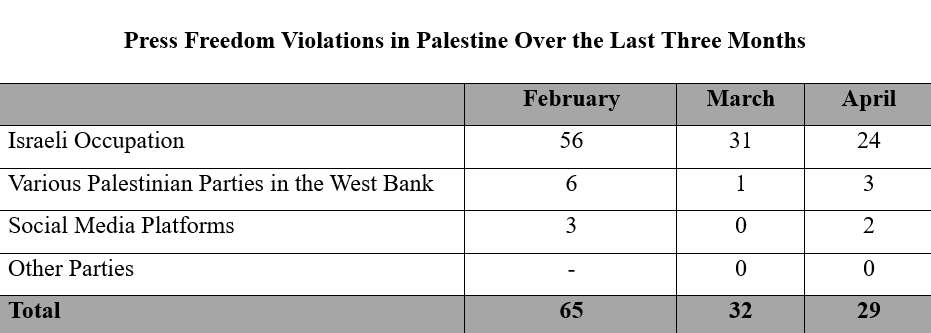
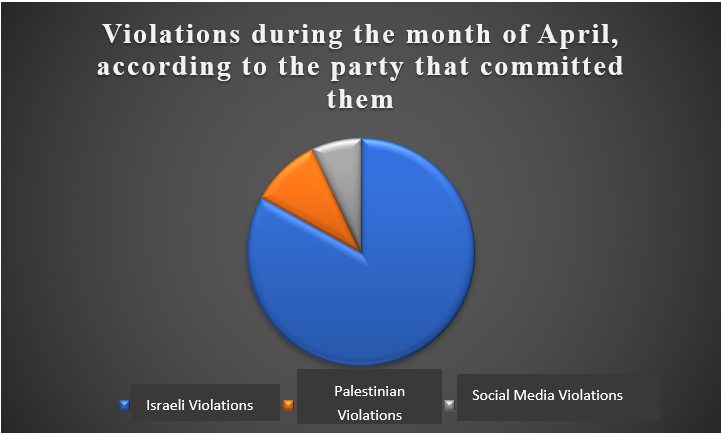
MADA Center documented a total of twenty-nine (29) violations against journalists and press freedoms during the month of April, representing a slight decline of 9%. Of these, twenty-four (24) violations were attributed to the Israeli occupation, distributed as twenty-two (22) in the West Bank and two (2) in the Gaza Strip, while three (3) assaults were carried out by Palestinian parties in the West Bank, and 2 violations were committed by social media platforms.
Israeli Violations:
Documented Israeli violations against press freedoms in Palestine declined during April, with MADA Center recording twenty-four (24) crimes and assaults carried out by occupation forces and authorities in the West Bank and Gaza Strip, accounting for approximately 83% of total violations during the month, compared to thirty-one (31) assaults documented in the preceding month of March.
Despite the decline in numbers, these violations continue to pose the greatest threat to press freedoms in Palestine. Israeli occupation forces killed two journalists: Al-Jazeera Live correspondent MOHAMMED SAMIR WASHAH, after being targeted by occupation drones west of Gaza City, and journalist ISLAM HISHAM QUNITA, an editor at the “Palestine Now” Agency, as a result of a strike that targeted him in the center of Gaza City.
During April, occupation forces detained five journalists while performing their field work. Al-Jazeera crew was detained at the entrance to the town of Bil’in for forty (40) minutes while covering the funeral of a martyr. Palestine News Network correspondent MUTASEM SAQF AL-HAIT and Anadolu Agency cameraman MOHAMMED AWAD were also detained for half an hour at the Ein Siniya checkpoint north of Ramallah while heading to cover local elections in the village of Sinjil. In another incident, Quds News Network correspondent ABDULLAH BAHSH and Palestine Post correspondent MUJAHID TABANJA were detained for approximately two hours in the town of Burqa, north of Nablus.
Occupation forces also prevented sixteen (16) journalists and media crews from covering events and various areas in the West Bank, with some of them repeatedly blocked on more than one occasion, as occurred with Xinhua Agency cameraman MAMOUN WAZWAZ and freelance journalists SARI JARADAT and MUSAB SHAWER. Al-Jazeera crew correspondent GIVARA AL-BUDEIRI and cameramen MOHAMMED AAROURI and WAEL AL-SALAYMA, along with Al-Jazeera Live journalist MOHAMMED SAMRIN, were prevented from covering the storming of Qalandia camp north of Jerusalem. Occupation soldiers also prevented Roya TV crew correspondent HAFEZ SABRA and cameraman MAHMOUD FAWZI, along with European Press Agency cameraman ALAA BADRANA, AFP cameraman JAFAR ISHTIYA, USIPA cameraman NASSER SHTAYYEH, and Anadolu Agency cameraman NIDAL SHTAYYEH from covering the raid around the Grand Mosque in Nablus, obstructing their work through threats to open fire.
In a related context, a unit of Israeli special forces severely beat freelance journalist SAIF AL-DIN QAWASMA while he was at his father’s shop in the town of al-Ram.
Palestinian Violations:
MADA Center documented three (3) Palestinian violations against press freedoms during April, representing 10% of total violations, all in the West Bank, compared to a single violation recorded in the preceding month of March.
In this context, Palestinian Intelligence prevented freelance journalist SARI JARADAT from traveling to the Hashemite Kingdom of Jordan, following his being summoned and interrogated upon his arrival at the Jericho rest stop.
Additionally, Watan Network editor-in-chief MUAMMAR ARABI and the Network’s Executive Director KHALED AL-FAQIH received death threats and threats of harm from unofficial Palestinian parties via phone calls to their personal phones, in connection with the network’s launch of a series of debates related to the 2026 local authority elections.
Social Media Violations:
MADA Center documented two (2) violations committed by social media platforms during the past month. The first involved Facebook banning Aseel Satellite Channel correspondent SAFINAZ AL-LOUH from posting on her account for one month. The second involved Google permanently deleting the official email account of freelance photographer Fadi Thabit on the grounds that it was used to support terrorism.
Details of Violations:
(2nd April) Facebook, owned by Meta, banned journalist SAFINAZ AL-LOUH from posting on her account for one month starting Thursday morning.
In her statement to the Mada Center, Aseel Satellite Channel correspondent, which broadcasts from Tehran, SAFINAZ BAKR AL-LOUH (40 years old) said she was surprised on Thursday morning to find her account, which she uses to publish content and news on Facebook, banned from posting for one month, a step she considered part of a policy of suppressing Palestinian content.
AL-LOUH added that she publishes content within the guidelines set by the company, but Facebook’s Administration and all social media platforms display hostility toward Palestinian content, having over many years suspended and closed hundreds of accounts and pages belonging to Palestinian journalists in a move to prevent content from being shared or reaching the outside world.
AL-LOUH affirmed that this policy aligns with the occupation’s policy and objectives of targeting Palestinian journalists, pursuing their publications and their lives, whether through killing, bombardment, arrest, or incitement against them.
(5th April) Palestinian authorities prevented journalist SARI JARADAT from traveling to the Hashemite Kingdom of Jordan, after he was interrogated by Palestinian Intelligence upon his arrival at the Jericho rest stop.
According to the statement of Anadolu Agency correspondent SARI ABD AL-GHAFFAR JARADAT to MADA Center, he arrived at the Jericho rest stop at approximately 10:00 AM on Sunday, heading toward the Karama border crossing with the Hashemite Kingdom of Jordan to travel abroad.
Upon entering the passport submission section on the Palestinian side, a security officer approached him and asked him to accompany him to a room belonging to the Palestinian General Intelligence. There, the journalist was subjected to an interrogation session regarding the nature of his journalistic work for several minutes. He was then informed that he was banned from traveling at the request of the Palestinian Intelligence security service in the Hebron office, and that he was required to go there to learn the reasons.
The journalist left the premises, refusing to appear at the security headquarters, as he considered it a violation of his personal freedom.
(8th April) Al-Jazeera Live correspondent MOHAMMED SAMIR WISHAH (39 years old) was killed after being targeted by occupation aircraft west of Gaza City on Wednesday evening.
According to the statement of AHMED WISHAH, the journalist’s brother, to MADA Center, the journalist finished work at 6:50 PM on Wednesday and left his workplace heading home in his Jeep Tucson to the Bureij camp in the center of the Strip.
While passing through the “Kuwaiti” intersection in the “Sheikh Ajlin” area west of Gaza City, a surveillance drone suddenly targeted his vehicle directly with a missile, causing it to catch fire, which resulted in the journalist’s immediate death. Rescue teams managed to extract his body from inside the vehicle with great difficulty; he arrived at Al-Quds Hospital in the city by ambulance, completely charred.
AHMED stated that his brother’s vehicle clearly displayed press markings, and that he was subjected to a systematic assassination by the occupation aimed at concealing the truth and silencing the voice and image being broadcast from Gaza, a new crime added to its crimes against our people and journalists in the Strip.
WISHAH confirmed that his brother the journalist had previously been subjected to incitement in numerous posts written by collaborators with the occupation on their social media pages, and that his brother had worked for many years covering events and following news, having produced hundreds of journalistic reports documenting the suffering of residents and displaced persons and covering the aggression against our people over the years.
(13th April) Journalist ISLAM HISHAM QUNITA (28 years old), an editor at the “Palestine Now” Agency, was killed as a result of a strike targeting him in the center of Gaza City on Monday evening.
According to the statement of OSAMA AL-ASHI, a friend of journalist ISLAM, to MADA Center, the journalist was a constant and regular presence at GAZA New café in the center of Gaza City to follow up on his journalistic work, where he prepared reports and articles and published them, taking advantage of the availability of electricity and internet services amid the power cuts that have affected the Strip for approximately two and a half years.
At around 9:00 PM on Monday, while he was at the café, an Israeli surveillance drone hovering overhead targeted him with a missile. He was struck by shrapnel that fell directly on various parts of his body and was killed immediately. The drone then fired another missile in the vicinity of the location.
Bystanders present at the scene attempted to extinguish the fire that broke out around where the martyr had been, until an ambulance arrived and transported his body to Al-Shifa Hospital.
(13th April) Occupation forces prevented a group of journalists from covering soldiers and settlers blocking the road leading to the Khirbet Umm al-Kheir school to prevent students from reaching it on Monday morning.
In his statement to MADA Center, Anadolu Agency correspondent SARI ABD AL-GHAFFAR JARADAT said that at approximately 8:00 AM on Monday, he went with freelance journalist MUSAB ABD AL-SAMAD SHAWER and Xinhua Agency cameraman MAMOUN ISMAIL WAZWAZ to the village of Khirbet Umm al-Kheir, east of the city of Yatta, south of Hebron governorate, to cover occupation soldiers and settlers blocking the road leading to the village school and preventing students from reaching it.
While the journalists were present, a unit of soldiers arrived and began speaking with the residents in the presence of the journalists, who were then instructed to stop filming entirely, forcing them to leave.
(13th April) Google permanently deleted the official email account of photojournalist FADI THABIT on Monday morning on the grounds that it was used to support terrorism.
In his statement to MADA Center, photojournalist FADI WAHID THABIT (36 years old), who works as a freelancer with several international agencies, said he was surprised to find his official email account closed on Monday morning while he was preparing some photo reports to submit via email to the media outlets he works with, as a message appeared indicating that the account had been closed and that he was unable to access it.
The journalist was shocked to receive the message, as this email account was his official channel of communication with the outside world, through which he markets his journalistic work. He also used it as an archive containing hundreds of reports, footage, photographs, and correspondence he had produced over more than fifteen (15) years of fieldwork. With this channel shut down by Google’s decision, he became unable to recover the archive or continue his work due to losing the means of communication with the international organizations he works with.
The journalist formally contacted Google’s Administration through an official letter to learn the reason for the closure and attempt to recover the account. A few days later, he received the official response stating that it could not be restored on the grounds of “using the email to support terrorism”, a false claim in line with the policy of suppressing Palestinian content and supporting the occupation in its moral and physical targeting of journalists in Gaza.
(15th April) Occupation soldiers prevented a group of journalists from covering the demolition of an industrial facility in the area of Beit Ula, west of Hebron, on Wednesday morning, obstructing their work.
According to the statement of freelance journalist MUSAB ABD AL-SAMAD SHAWER to MADA Center, at approximately 8:30 AM on Wednesday he went with Xinhua Agency cameraman MAMOUN ISMAIL WAZWAZ to the “Zu’atut” area west of the town of Beit Ula, west of Hebron, to cover the occupation’s demolition of an industrial facility in the area.
While the journalists were on the scene, soldiers approached and informed them they must leave and move away from the site, closing off the area entirely, which prevented the journalists from conveying the situation normally.
(17th April) Occupation forces prevented a group of journalists from covering farmers’ access to the “Ras al-Qadi” area north of the city of Halhoul in Hebron on Friday afternoon, obstructing their work, forcing them to leave, and declaring it a closed military zone.
According to the statement of freelance journalist MUSAB ABD AL-SAMAD SHAWER to MADA Center, at approximately 1:00 PM on Friday he went with Xinhua Agency cameraman MAMOUN ISMAIL WAZWAZ to cover farmers and peace activists reaching the “Ras al-Qadi” area north of the city of Halhoul, north of Hebron, where settlers have taken control of their lands and prevented them from accessing them.
Upon the journalists’ arrival, an occupation army unit reached the location, prevented the journalists from entering the area, and forced them to withdraw, as the forces continued suppressing the residents. After approximately one hour, the journalists were forced to leave along with the residents under occupation pressure, as the area was declared a closed military zone.
(19th April) A unit of Israeli occupation special forces severely beat freelance journalist SAIF AL-DIN QAWASMA and his father while he was at his father’s shop in the town of al-Ram and informed him that he was banned from working at prohibited outlets, including Al-Jazeera.
According to the statement of freelance journalist SAIF AL-DIN SAID QAWASMA to MADA Center, he arrived at approximately 3:00 PM on Sunday in the al-Ram area where his father’s shop is located. Upon entering the shop, a force of five special forces members stormed the premises and severely beat the journalist and his father with their hands and feet for several minutes, then dragged them outside.
The officer in charge of the unit, named DAOUD, arrived and asked the journalist about his place of work, telling him: “You are banned from working at outlets that have been prohibited, including Al-Jazeera”. The journalist responded that he works as a freelance journalist and has no specific affiliation with any media organization.
The force members, accompanied by the officer, brought the journalist back into the shop and searched it thoroughly before leaving. After their withdrawal, it became apparent that the journalist had sustained a wound to his right hand and a tear in his left leg as a result of the beating he endured.
(22nd April) Occupation soldiers detained an Al-Jazeera crew at the entrance to the village of Na’lin for forty (40) minutes and confiscated their identity cards after they had finished covering the funeral of a martyr in the town on Wednesday afternoon.
According to the statement of Al-Jazeera correspondent THAWRAT SHAQRA to MADA Center, the Al-Jazeera crew departed from the village of Bil’in, west of Ramallah, at 2:00 PM on Wednesday after completing coverage of the funeral of a martyr there.
Upon the crew’s arrival at the village entrance, occupation army forces detained the crew and confiscated their personal identity cards, ordering them to get out of the vehicle and stand on the side of the road.
The crew remained in detention for forty (40) minutes, during which a soldier shouted continuously at crew members whenever anyone moved from their position.
The soldiers returned the identity cards to the journalists and permitted them to leave after forty (40) minutes of detention.
(24th April) The Watan media network and its employees were subjected to a campaign of threats and incitement through phone calls received from various numbers, some of them Israeli, after the network launched a series of debates on local authority elections since the beginning of April.
According to the statement of Watan Network editor-in-chief MUAMMAR ARABI to MADA Center, the network launched a series of debates at the beginning of the month on the 2026 local authority elections, aiming to ensure equal opportunity among electoral lists and enable them to present their electoral platforms to the public clearly and transparently.
However, since the 9th of April, the Network began to face incitement, accusations of treason, and explicit death threats and threats of harm. Editor-in-chief MUAMMAR ARABI and the Network’s Executive Director KHALED AL-FAQIH received numerous phone calls on their personal phones, some carrying Israeli numbers, containing insults, death threats, and accusations of espionage. There were also calls from someone who identified himself as a member of Fatah movement and from Jerusalem.
The campaign continued until it was decided to file a complaint with the Attorney General detailing what had occurred, as well as submitting complaints to the Independent Commission for Human Rights and the Central Elections Commission.
(25th April) Occupation forces detained two journalists at the “Ain Siniya” checkpoint north of Ramallah for half an hour, conducting a field interrogation after binding their hands and blindfolding them, obstructing their work while they were heading to cover the local council elections in the town of Sinjil.
According to the statement of Quds News Network correspondent MUTASIM SAMIR SAQF AL-HAIT (37 years old) to MADA Center, at approximately 10:00 AM on Saturday, while passing through the “Ain Siniya” checkpoint north of Ramallah with his colleague, AFP photographer MOHAMMED AWAD, heading toward the town of Sinjil to cover the local council elections, they were stopped by occupation forces and ordered to exit their vehicle, before being taken to the military tower erected alongside the checkpoint.
Their hands were bound behind their backs and their eyes were blindfolded, and they were detained inside the tower for half an hour. During that time, they were subjected to a field interrogation focused on their identities, their employers, and the reason for their heading to the area.
Occupation forces released them without pressing any charges and without confiscating any of their journalistic equipment, and they were able to continue on their way thereafter.
(25th April) Occupation forces prevented two journalists from covering a settler march in the old city of Hebron on Saturday afternoon, obstructing their work and forcing them to move far away.
According to the statement of freelance journalist MUSAB ABD AL-SAMAD SHAWER to MADA Center, at approximately 3:00 PM on Saturday, he went with Anadolu Agency cameraman WISSAM ABD AL-HAFIZ AL-HASHLAMON to the old city of Hebron to cover the weekly march organized by settlers through the alleyways of the old city.
During the coverage, soldiers approached and ordered them to move away from the location, to walk ahead of them for a considerable distance, and not to approach them or the settlers, forcing them to leave the area.
(27th April) Occupation soldiers prevented an Al-Jazeera crew from continuing their coverage of occupation soldiers storming the Qalandia camp north of Jerusalem on Monday evening, shouting at them and pointing weapons at them.
According to the statement of Al-Jazeera TV correspondent GIVARA AL-BUDEIRI to MADA Center, the TV crew, consisting of the correspondent and cameramen MOHAMMED AAROURI and WAEL AL-SALAYMA, along with Al-Jazeera Live correspondent MOHAMMED SAMRIN, arrived at Qalandia refugee camp north of Jerusalem to cover occupation forces closing off the camp.
Journalist GIVARA began a live broadcast when a number of soldiers emerged behind her in one of the camp’s alleyways and attempted to harass her and obstruct her work. After the coverage ended, all the journalists moved to an area near the camp entrance. At that point, a force of soldiers emerged from between the alleyways, pointed their weapons at them, and began shouting: “No filming, turn off the cameras”. They ordered the journalists to walk ahead of them with weapons drawn, until they pushed them a considerable distance away from the camp. When the soldiers returned inside the camp, the journalists feared returning to resume coverage out of concern they would be attacked.
(27th April) Israeli occupation forces detained journalists ABDULLAH TAYSIR BAHSH and MUJAHID TABANJA on Monday afternoon for two hours and interrogated them while they were in the town of Burqa covering the uprooting of olive trees.
Freelance journalist ABDULLAH TAYSIR BAHSH (28 years old) told MADA Center that at exactly 1:05 PM on Monday, he and his colleague Palestine Post correspondent MUJAHID TABANJA, along with four farmers, were present in the town of Burqa, northwest of Nablus, covering the uprooting of olive trees by occupation soldiers.
While they were covering the event, an Israeli military vehicle stormed the location and four soldiers alighted. The soldiers ordered the farmers to leave. One soldier demanded journalist TABANJA’s phone and searched it; upon finding photographs of occupation soldiers, both journalists were subjected to a field interrogation focused on their identities, places of residence, the organizations they work for, and the nature of their work, in addition to other personal questions.
One of the soldiers pointed his weapon at journalist BAHSH and searched his personal bag after questioning him about the Palestinian local elections and accusing him of belonging to Hamas, which the journalist categorically denied, affirming he has no affiliation with any party or faction. The soldiers accused the journalists of possessing cameras to photograph soldiers, despite the fact that they had no filming equipment at the time.
The soldiers released the journalists after two hours of detention, and upon their release informed them that they must leave the country and go to Turkey or Jordan, without pressing any formal charges against them.
(27th April) Israeli occupation forces prevented a number of media crews from covering the raid around the Grand Mosque in Nablus on Monday morning, obstructing their work with threats to open fire.
According to the statement of Roya TV correspondent HAFEZ MAHMOUD SABRA (36 years old) to MADA Center, at approximately 10:00 AM on Monday he was in the old city of Nablus covering the repeated raids, and soldiers deliberately distanced journalists and prevented them from field coverage, forcing them to remain at distant positions that did not allow them to document the movements of the forces.
Among the journalists who were prevented from coverage were: Roya TV crew, reporter HAFEZ ABU SABRA and cameraman MAHMOUD FAWZI, European Press Agency cameraman ALAA BADRANA, AFP cameraman JAFAR ISHTIYA, USIPA cameraman NASSER SHTAYYEH, and Anadolu Agency cameraman NIDAL SHTAYYEH.
SABRA noted that occupation officers deliberately imposed strict restrictions on journalists’ movements during the raid, preventing them from filming or approaching the infantry forces in an attempt to obstruct media coverage and prevent documentation of what was happening on the ground, along with threats to open fire should they remain on the scene.
