

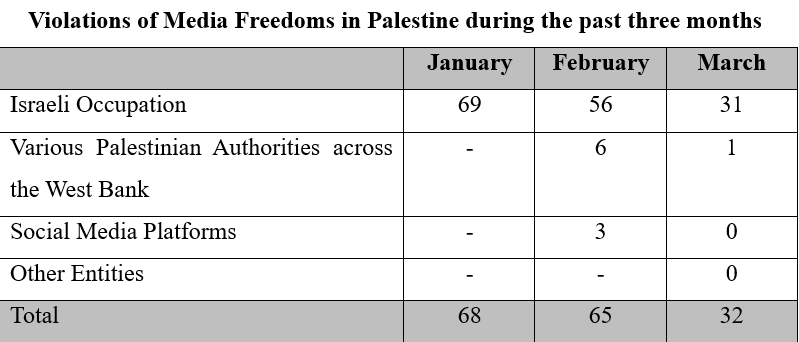
RAMALLAH – 06 April 2026: The month of March witnessed a significant decrease in the number of violations committed against media freedoms in Palestine compared to the previous two months (January and February), during which higher numbers were recorded (sixty-eight (68) and sixty-five (65) violations). This decline amounted to fifty-one percent (51%).
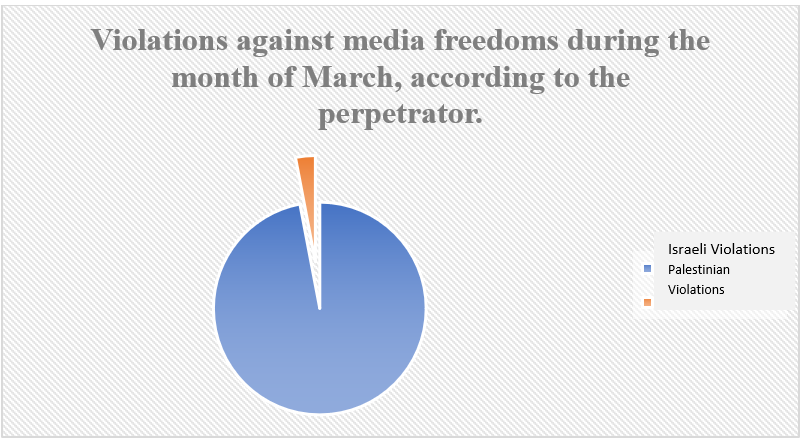
The Palestinian Center for Development and Media Freedoms “MADA” documented a total of thirty-two (32) violations against media freedoms during March, most of which occurred in the West Bank. The Israeli occupation committed thirty-one (31) of these violations, while Palestinian parties in the Gaza Strip committed a single (1) violation.
The overall decline in violations during March is attributed to the reduced pace of field activities and events in the West Bank compared to previous months, coinciding with the advent of the holy month of Ramadan, in addition to the repercussions of regional escalation linked to the American–Israeli war against Iran. This escalation resulted in the closure of Al-Aqsa Mosque, which has continued up to the date of issuing this report.
Despite this decrease in the number of violations, their nature remains highly dangerous. Last month witnessed the killing of Radio Qatar reporter AMAL SHAMALI in the Gaza Strip, as well as the death of MARWAN HARZ ALLAH, a prisoner in Israeli prisons who worked for Palestine TV. Other violations also occurred, including physical assaults, cases of arrest, and more.
Israeli Violations:
During the past month of March, the Israeli occupation committed thirty-one (31) violations against media freedoms in Palestine, most of which occurred in the West Bank. These constituted ninety-seven percent (97%) of the total violations recorded during the month. The most serious of these included the killing of Radio “Qatar” reporter, journalist AMAL SHAMALI, following a strike that targeted her tent in central Gaza after she had fled to a nearby tent. Additionally, the wounded prisoner MARWAN FATHI HARZ ALLAH (fifty-four (54) years old) died in Israeli prisons as a result of medical negligence; he had been working for Palestine TV.
Other violations took various forms, including physical assaults against Jerusalem-based journalists MUSTAFA AL-KHAROUF, FAYEZ ABU RUMAILA, MUSTAFA AL-KHATEEB, and MAYSAA AL-KHATEEB, who were pushed and beaten after being pursued by Israeli police and border guards while covering the prevention of worshippers from praying in the vicinity of Al-Aqsa Mosque. It was confirmed that CNN reporter MAYSAA sustained a broken arm, and that journalist FAYEZ ABU RUMAILA lost two (2) internal camera components.
Israeli soldiers also assaulted Roya TV cameraman MAHMOUD FAWZI, beating him after handcuffing and blindfolding him, taking him into Askar Refugee Camp, confiscating his journalistic equipment, and detaining him inside the camp for half an hour. Additionally, freelance journalist MUSAB QAFISHA was severely beaten after being arrested from his home in the city of Hebron and detained for twelve (12) hours at the “GUSH ETZION” Detention Center.
In the same context, Israeli forces arrested photojournalist ABDUL KARIM AL-ALAMI from his home in the town of Beitunia and confiscated his journalistic equipment; he was released the following day on bail amounting to one thousand three hundred (1300) shekels. Israeli forces also arrested journalist QUTAIBA HAMDAN from his home in the town of Ein Qiniya in Ramallah, and he remains held at the “BENYAMIN” police station. In addition, journalist and writer LAMA KHATER was arrested and sentenced to four (4) months of administrative detention. Likewise, freelance journalist AYSAR AL-BARGHOUTHI was sentenced to four (4) months of administrative detention after being arrested from his home in the town of Kafr Ein in Ramallah.
During the past month, Israeli forces detained Radio “KARAMA” reporter SALMAN ABU ARAM for half an hour in the area of “Zif” south of Hebron and prevented him from reaching the area of “KHALLET AMIRA” to cover attacks by settlers and Israeli soldiers against residents. Israeli police also detained freelance journalist MOHAMMAD ABU SNINA for three (3) hours at the “AL-QISHLA” Interrogation Center in Jerusalem, under the pretext of covering a gathering of worshippers in the “BAB AL-ASBAT” area.
Israeli forces targeted a group of journalists with tear gas in Askar refugee camp, including Roya TV reporter HAFEZ SABRA and cameraman MAHMOUD FAWZI, Quds News Network reporter ABDULLAH BAHASH, Palestine Post reporter MUJAHED TABANJA, and Al-Fajr TV reporter WALA FATAYER.
Israeli soldiers also prevented freelance journalist AMER AL-SHLOUDI on two (2) occasions from entering the Ibrahimi Mosque and its surroundings in the city of Hebron, under the pretext of banning journalists from entry, in order to prevent him from covering assaults by soldiers against civilians.
Palestinian Violations:
Palestinian violations against media freedoms declined during the past month of March to a single (1) incident in the Gaza Strip, compared to six (6) violations documented by MADA during the preceding month of February. This represents a decrease of eighty-three percent (83%).
The violation was limited to a verbal assault committed by security personnel at “NASER MEDICAL HOSPITAL” against cameraman, journalist, and CNN producer AMRO TABASH while he was present at the hospital covering the return of a number of children from medical treatment abroad.
Details of Violations:
(1st March): Israeli occupation soldiers prevented freelance journalist AMER AL-SHLOUDI from covering the soldiers’ assaults on civilians in the Old City of Hebron at noon on Saturday and forced him to leave the area immediately.
Freelance journalist AMER AL-SHLOUDI reported to the MADA Center that at approximately one o’clock (1:00) in the afternoon on Saturday, settlers began touring the streets of the Old City of Hebron, while groups of civilians were present in the market purchasing necessities during the month of Ramadan. Journalist AL-SHLOUDI headed to the area after receiving information about assaults by soldiers on civilians in the market. Upon his arrival to cover the events, one of the soldiers approached him shouting, pointed his weapon at him after cocking it, and demanded that he leave the area immediately. Journalist AL-SHLOUDI was forced to leave the area for fear of arrest or assault.
(2nd March): Israeli occupation soldiers assaulted a number of journalists and obstructed their work while they were covering the raid on the “Askar” Refugee Camp east of the city of Nablus on Monday afternoon. They also targeted them with tear gas canisters. Additionally, the soldiers detained a cameraman from “Roya” TV for half an hour and assaulted him physically, confiscating his journalistic equipment.
Roya TV reporter, journalist HAFEZ MAHMOUD ABU SABRA (thirty-six (36) years old), reported to the MADA Center that at approximately four o’clock (4:00) in the afternoon on Monday, he arrived at the main road leading to the alleys of the “Askar” Refugee Camp east of the city of Nablus, after Israeli occupation forces had stormed the camp, raided several homes, and turned some of them into military outposts. Civilians, along with paramedics and medical crews, were present at the scene.
Ten minutes after the journalist’s arrival, soldiers attempted to force demonstrators and those present to move away from the area. Within five minutes, they began firing sound bombs toward those present, which led to the complete evacuation of the street.
At approximately four thirty (4:30), a group of soldiers suddenly emerged from one of the alleys and attacked the journalists present with sound bombs. They were Roya TV cameraman MAHMOUD FAWZI (forty-one (41) years old), Quds News Network reporter ABDULLAH AL-BAHSH, Palestine Post reporter MUJAHED TABANJA, and Al-Fajr TV reporter WALAA FATTAYER. A soldier then arrested photojournalist MAHMOUD FAWZI, assaulted him physically, tied his hands, blindfolded him, and dragged him inside the camp.
During the period of detention, cameraman MAHMOUD was beaten inside one of the houses. The soldiers also wrote on his body and played songs while filming him, before an officer arrived at the area and informed him of a decision banning him from being present in the area.
During the assault, the soldiers confiscated the camera in his possession along with its memory card. He was later released after a period of detention lasting no less than half an hour (thirty (30) minutes).
At five ten (5:10) in the evening, the journalistic crew decided to withdraw from the area and evacuate the site following the end of the assault and detention.
(4th March): Israeli occupation forces arrested freelance journalist MUSAB QAFISHEH after raiding his home in the city of Hebron at dawn on Wednesday. He was taken to the detention center in the “Gush Etzion” settlement, where he underwent interrogation that included threats from the interrogator to stop his journalistic work or face arrest. He was released after a detention lasting twelve (12) hours.
According to the testimony of freelance journalist MUSAB KHAMIS QAFISHEH to the MADA Center, a force of occupation soldiers arrived at his home in the western neighborhood of Hebron at approximately three thirty (3:30) at dawn on Wednesday. The soldiers surrounded the house, and while calling for MUSAB, his father, who lives nearby, came out to find out what the soldiers wanted. The soldiers then attacked his father and physically assaulted him.
As soon as the journalist opened the door, the soldiers attacked him, dragged him into the courtyard of the house, and severely beat him with their hands and feet for several minutes after knocking him to the ground. The soldiers then demanded his identification card and transferred him to a military vehicle parked near the house after handcuffing him with metal restraints and blindfolding him with a piece of cloth.
The journalist was made to sit on his knees in the back of the military vehicle. As the vehicle began moving, the soldiers assaulted him by beating him with their hands and knees and also struck him with rifle butts on his head and various parts of his body. The beating continued until the vehicle reached a detention center in the “Gush Etzion” Settlement south of the city of Bethlehem. There, the journalist was taken to a yard where a number of detainees were present. He was then led to a search room where he was forced to undergo a strip search after being made to remove his clothes. He was then returned to the yard, where he remained for approximately one and a half (one and a half (1.5)) hours.
The journalist was later taken to another room. After the blindfold was removed, he saw an interrogator who began questioning him, saying: “Do you not want to stop your journalism work? You are always active and causing concern, and that is why you are here”.
MUSAB responded that he only knows his journalistic work, that he has practiced the profession for years, and that he does not violate any security aspects. The interrogator replied: “Leave journalism, and if you stop working in it, you will be at ease” and “It is better for you to work with me; next time it will be another arrest for you”.
The interrogation about the journalist’s personal status continued for about half an hour (thirty (30) minutes), during which the journalist was in pain from the beating he had endured, and there was blood on his face. He asked the interrogator why the soldiers had assaulted him, and the interrogator replied that he had not been with the soldiers and knew nothing about it. The journalist was then returned to the yard and later released along with the other detainees at approximately three o’clock (3:00) in the afternoon.
(10th March): Israeli occupation forces arrested freelance photojournalist ABDUL KARIM SHAKER AL-ALAMI (thirty-six (36) years old) at dawn on Tuesday after raiding his home in the town of “Beitunia” and confiscating all his journalistic equipment. He was released the following day on bail set at one thousand three hundred (1,300) shekels.
According to the testimony of freelance photojournalist ABDUL KARIM, occupation forces stormed the residential building where his family lives in the town of “Beitunia” at approximately two o’clock (2:00) at dawn on Tuesday. The soldiers broke down the door of the family home (his father’s house), searched its rooms, and confined the residents inside.
The soldiers, numbering approximately twelve (12), remained in the house for ten (10) minutes before taking the father with them toward the apartment of his son Abdul Karim in the same building. At that time, occupation forces were heavily deployed in the neighborhood, both in terms of personnel and vehicles.
The soldiers broke down the apartment door in the same manner, stormed the residence, and confined the journalist’s wife and children in one room. They then took journalist ABDUL KARIM to his office inside the home, searched his computer, and demanded that he hand over all tools related to his work, including cameras, microphones, memory cards, and all equipment used in filming and editing. They confiscated all of it before withdrawing from the house after arresting ABDUL KARIM and releasing his father.
The soldiers transported the journalist from his home for half an hour (thirty (30) minutes) to an unknown location. From there, he was transferred to the “Etzion” interrogation center near Hebron, where he was interrogated for two (2) hours about his journalistic work. He was then transferred to the “Binyamin” Interrogation Center near the “Ofer” camp.
On the following day, Wednesday, occupation forces released photojournalist ABDUL KARIM AL-ALAMI on bail amounting to one thousand three hundred (1,300) shekels. The confiscated equipment was returned to him, except for the drone.
(11th March): Israeli occupation soldiers obstructed the work of a group of journalists and prevented them from covering the takeover of a residential building in the “Al-Fawwar” refugee camp south of the city of Hebron on Wednesday morning. They also targeted them with sound bombs, forcing them to leave the area.
In his testimony to the MADA Center, freelance journalist LUAY MUHBASH AMRO stated that at ten o’clock (10:00) on Wednesday morning, he, along with photojournalist NIDAL ASHMAR AL-NETSHA and freelance journalist SAMEH JABER AL-TITI, went to the “Al-Fawwar” Refugee Camp south of Hebron to cover the occupation forces’ takeover of a residential building and their occupation of one of the apartments on its upper floors.
While the journalists were present in front of the building, a number of soldiers suddenly emerged from inside, shouting at the journalists and chasing them. The soldiers targeted them directly with a sound bomb, which forced the three journalists to leave the area and stop filming for fear of arrest or confiscation of their equipment.
(12th March): Radio “Qatar” reporter, journalist AMAL HAMMAD SHAMALI (forty-six (46) years old), was killed when shelling targeted her tent in the town of “Al-Zawayda” in the central Gaza Strip at noon on Monday.
According to the testimony of FATIMA SHAMALI, the sister of journalist AMAL, to the MADA Center, AMAL had been asleep inside her tent in one of the displacement camps in the “Al-Zawayda” area in the central Gaza Strip when Israeli occupation artillery, at approximately twelve o’clock (12:00) after midnight, suddenly and without prior warning shelled the cluster of tents with several projectiles, despite the fact that the field situation in the Strip had been calm.
When AMAL became aware of the danger, she moved with her children to a neighboring tent to seek shelter. As she entered the tent, a shell struck it, causing a direct head injury. She was killed instantly.
The journalist was transported by ambulance to Al-Awda Hospital in Nuseirat, where her death was immediately confirmed. Her daughter, mother, and brother were also injured.
FATIMA confirmed that her sister, the late AMAL, had been working since the first day of the war covering events and documenting attacks carried out against Palestinian cities and civilians for Radio “Qatar,” where she worked as a correspondent in the Gaza Strip and prepared news reports.
(14th March): Israeli occupation soldiers prevented freelance journalist AMER AL-SHLOUDI from entering the Ibrahimi Mosque in the city of Hebron on Saturday morning in order to cover the movement of civilians in the vicinity of the site, under the pretext of prohibiting journalists from entering, despite the fact that he was not carrying any journalistic equipment.
According to the testimony of freelance journalist AMER AL-SHLOUDI to the MADA Center, at approximately nine o’clock (9:00) on Saturday morning, he headed to the Ibrahimi Mosque area in the Old City of Hebron to document civilian movement there.
As soon as he reached the electronic entry gate, the soldiers stopped him and informed him that he was not permitted to enter. When he asked about the reason, one of the soldiers replied that “journalists are not allowed to enter the area”. The journalist responded that he was not carrying any journalistic equipment, but the soldier said to him: “You are here to film on your phone; you are not here to pray. Leave here”.
The soldier continued shouting at the journalist until he was forced to leave the area.
(17th March): A force from the Israeli occupation police assaulted a group of journalists by pushing, detaining, and confiscating equipment while they were present in the city of Jerusalem covering the prevention of worshippers from praying in the vicinity of Al-Aqsa Mosque on Tuesday evening.
According to the testimony of freelance journalist MUSTAFA AL-KHAROUF to the MADA Center, at approximately seven thirty (7:30) in the evening on Tuesday, a group of journalists, identified among them freelance journalist FAEZ ABU RUMAILA, CNN reporter ABEER SULEIMAN, Anadolu Agency cameraman MUSTAFA EYAD AL-KHATEEB, in addition to a foreign journalist working for the Chinese “Xinhua” Agency, headed to the “Bab Al-Sahira” area in the city of Jerusalem to cover Israeli police preventing worshippers from being present there and forcing them to leave due to the closure of Al-Aqsa Mosque for approximately twenty-one (21) days.
Security forces continued to pursue the worshippers and instructed them to head to the Friday Market area to perform prayers there. As the worshippers moved, the forces followed them to the same location. When prayers began, the journalists split into two groups to cover the event. However, police officers, border guards, and undercover units attacked the worshippers in an attempt to arrest them.
At that moment, members of the force attacked the foreign journalist and journalist FAEZ ABU RUMAILA, threw them to the ground, confiscated their cameras, and then detained journalist FAEZ ABU RUMAILA before later releasing him. At the same time, security personnel wearing reinforced protective gear on their hands attacked journalists MUSTAFA AL-KHAROUF and ABEER SULEIMAN, pushing them and attempting to knock them to the ground. This situation continued for approximately fifteen (15) minutes.
It was later found that undercover unit members had stolen two (2) internal camera components belonging to journalist FAEZ ABU RUMAILA, with an estimated value of approximately two thousand (2,000) shekels.
After the journalists left the site, it was found that journalist ABEER SULEIMAN had sustained a fracture in her hand as a result of being beaten by members of the force.
(18th March): Israeli occupation forces arrested freelance journalist QUTAIBA MOHAMMAD HAMDAN (thirty-three (33) years old) after raiding his home in the town of “Ein Qiniya” near Ramallah, searching it, and confiscating his mobile phone.
In his testimony to the MADA Center, MOHAMMAD HAMDAN, the father of the journalist Qutaiba, stated that at approximately four o’clock (4:00) at dawn on Wednesday, Israeli occupation forces, estimated at around ten (10) soldiers, raided the home of freelance journalist QUTAIBA HAMDAN in the town of “Ein Qiniya”, where he lives with his wife and daughter. The soldiers attempted to blow open the door before managing to open it, searched the house, confiscated his mobile phone, and searched his wife’s phone. They then asked him to get dressed and informed him of the decision to arrest him.
After one (1) week of detention, the family learned that Qutaiba was still being held at the “Binyamin” police station, where he remained under interrogation.
It is noted that occupation forces had previously arrested journalist HAMDAN in September 2024 after raiding his home, and he remained in detention for approximately eleven (11) months. He had also been arrested several times prior to that. HAMDAN works as a photojournalist with local institutions and holds a master’s degree in journalism. Following his previous release, he has suffered from health problems affecting his intestines and digestive system and had been awaiting a gastrointestinal endoscopy for treatment.
(19th March): A force from the Israeli occupation police arrested freelance journalist MOHAMMAD ABU SNEINEH after raiding his home in the city of Jerusalem, claiming that he had covered a gathering of worshippers in the Bab al-Asbat area. He was released after three (3) hours once the claim was proven false, on the condition that he returned to the police center for further questioning after three (3) days.
In his testimony to the MADA Center, freelance journalist MOHAMMAD ADLI ABU SNEINEH stated that at approximately five thirty (5:30) in the evening on Thursday, a force from the occupation police raided his family home in Jerusalem and asked him to accompany them to the “Al-Qishla” Police Station. They instructed him to bring his mobile phone, personal identification, and camera.
At the police station, the interrogator informed the journalist that he had been filmed several days earlier while present at a gathering with worshippers near the “Bab al-Asbat” area, and that this gathering had been prohibited.
After reviewing the camera footage, it was determined that the journalist had not been present at the site, and he was released after three (3) hours. However, he was instructed to return for further questioning on Sunday, corresponding 22 March.
The journalist went to the police station as scheduled, where one of the interrogators told him that he would be issued an order banning him from Al-Aqsa Mosque. The journalist expressed surprise, noting that he had already been issued a ban order dated 16 February 2026, which would remain in effect until 16 August 2026.
At that point, the interrogator asked the journalist to step outside the office briefly to verify the matter. After approximately fifteen (15) minutes, the interrogator returned his identification card and asked him to leave the police station. When the journalist inquired about his phone and camera, the interrogator informed him that they were still under examination and would be returned to him once the process was completed.
(23rd March): Israeli occupation forces arrested writer and journalist LAMA THEEB KHATER (forty-eight (48) years old) after raiding her home in the city of Hebron and took her to an unknown location.
According to the testimony of HAZEM AL-FAKHOURI, the husband of journalist LAMA, at approximately two o’clock (2:00) at dawn on Monday, a force from the Israeli occupation army, consisting of around ten (10) soldiers, raided the home of writer and journalist LAMA THEEB KHATER (forty-eight (48) years old) in the “Luza – Western Neighborhood” area of Hebron.
The soldiers confined the family members in the living room and asked journalist KHATER to bring her medication and mobile phone. They informed her that she was under arrest. She was then transferred to a military jeep, after which the forces took her to an unknown location. The force left the house after a few minutes. The journalist was not interrogated on site, and the house was neither searched nor were any of its contents confiscated.
On Monday, corresponding to thirtieth of March (30 March), journalist LAMA was notified of a decision placing her under administrative detention for four (4) months.
(25th March): Israeli occupation forces arrested freelance journalist AYSSER AL-BARGHOUTHI (thirty-nine (39) years old) from his home in the village of “Kafr Ein”, northwest of Ramallah, and took him to an unknown location. A few days later, he was sentenced to administrative detention for four (4) months.
According to the testimony of ASHRAF AL-BARGHOUTHI, the brother of journalist AYSAR, to the MADA Center, Israeli occupation forces raided the village of “Kafr Ein”, northwest of the city of Ramallah, at dawn on Wednesday and carried out a wide-scale arrest campaign in the village. At approximately two thirty (2:30) at dawn, soldiers stormed the home of journalist AYSAR AL-BARGHOUTHI, where they ordered him to get dressed and say goodbye to his family. He was then taken to one of the houses that the soldiers had turned into a military barracks and a field interrogation center.
At eight o’clock (8:00) in the morning, all detainees from the village were released except for journalist AYSAR.
The AL-BARGHOUTHI family was informed by the “HaMoked – Center for the Defence of the Individual in Israel” that their son, journalist AYSAR, was being held at the “Binyamin” Interrogation Center near the “Ofer” camp. The Prisoners’ Club also informed the family that he had been placed under administrative detention for four (4) months.
Journalist AYSAR AL-BARGHOUTHI works as a freelance journalist with several agencies and media outlets, including the Turkish “Anadolu” Agency.
(25th March): Israeli occupation soldiers detained radio reporter SALMAN ABU ARAM in the “Zif” area, south of Hebron, for half an hour, obstructed his work, and searched his vehicle while he was heading to cover confrontations between citizens, occupation soldiers, and settlers in the “Khallet Amira” area on Wednesday morning.
In his testimony to the MADA Center, radio reporyer SALMAN ABU ARAM stated that he headed at approximately ten o’clock (10:00) in the morning on Wednesday to the “Khallet Amira” area to cover confrontations between citizens on one side and occupation soldiers and settlers on the other.
When he arrived at the “Zif Triangle” area, north of Yatta city, south of Hebron Governorate, several soldiers were stationed on the road and had set up a temporary military checkpoint. The soldiers stopped the journalist’s vehicle, which displayed a “Press” sign, and asked him to show his personal ID.
After security checks, one soldier instructed him to stop the vehicle by the side of the road while aiming a weapon at him. Another soldier took the keys to his vehicle after forcing him to turn off the engine, while others searched the vehicle, removed the camera equipment, and questioned him about it.
The journalist waited inside his vehicle in the same location for approximately half an hour, after which a soldier allowed him to leave.
(27th March): Prisoner MARWAN FATHI HARZALLAH (fifty-four (54) years old) died in Israeli occupation prisons due to medical negligence. He was a resident of the “Ain” camp in Nablus and worked at the Palestinian Broadcasting Corporation office in Nablus. He had been detained while injured since the eighth of January (8 January 2026).
(30th March): Several security personnel at “Nasser Medical Hospital” in Khan Younis, southern Gaza Strip, verbally assaulted photojournalist AMRO AHMED TABSH and obstructed his work while he was covering the arrival of premature children returning from treatment abroad on Monday evening.
In his testimony to the MADA Center, photojournalist and producer for BBC English, AMRO AHMED TABSH (twenty-eight (28) years old), stated that he was on a journalistic assignment at “Nasser” Hospital in Khan Younis, southern Gaza Strip, at approximately six thirty (6:30) in the evening on Monday to cover the arrival of eight premature children after completing their treatment abroad.
During the coverage, he faced harassment from more than five hospital security personnel in civilian clothes, who demanded that he stop filming and coverage while verbally abusing him and attempting physical assault. The presence of citizens and journalists prevented the assault.
The security personnel also requested that the journalist present a “work facilitation” paper issued by the hospital administration. Despite presenting this official document, he was prevented from covering the event for some time, and the harassment continued in the presence of many journalists, citizens, and the children’s parents, under the observation of the hospital’s administrative director, ABU YOUSEF BARHOUM, who attempted to intervene and resolve the issue.
Journalist AMRO TABSH held the hospital administration and its security responsible for obstructing his work and disrupting his coverage, demanding redress, as he is a well-known journalist with a strong presence in covering local issues in the Gaza Strip, and no violations were committed by him during coverage.
