

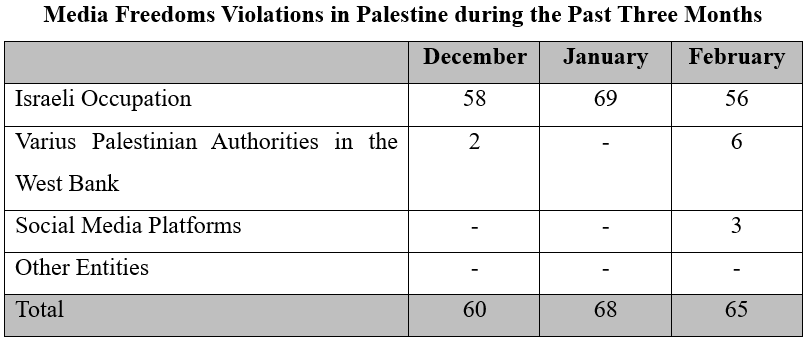
Ramallah – 7th March 2026 The Palestinian Center for Development and Media Freedoms (MADA) monitored and documented a total of 65 (sixty-five) violations against media freedoms in the West Bank and Gaza Strip during the month of February. The majority were committed by the Israeli occupation authorities. This marks a slight decrease compared to January, during which 68 (sixty-eight) violations were documented.
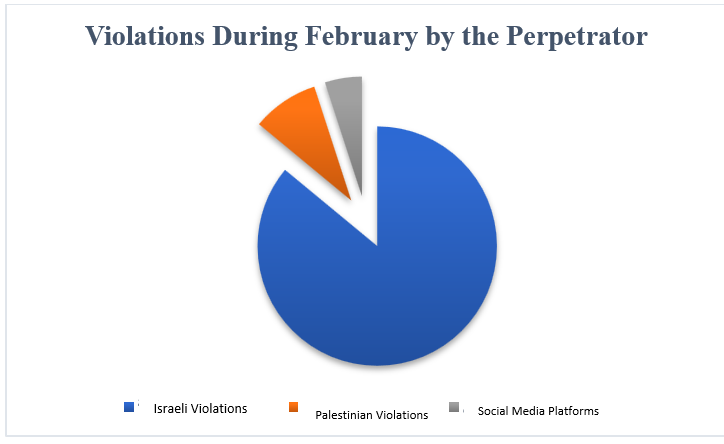
Despite this slight decline, Israeli violations remained the most numerous and the most serious in terms of their impact on media freedoms in Palestine, constituting 86% (eighty-six percent) of the total February violations. Palestinian violations in the West Bank and Gaza Strip accounted for 9% (nine percent), while social media platform violations represented 5% (five percent) of the total documented violations.
Israeli Violations:
Israeli attacks and violations against Palestinian journalists and media freedoms declined relatively during February, with 56 (fifty-six) violations recorded, compared to 69 (sixty-nine) violations in January.
The nature and scope of the violations did not differ from previous months, ranging from arrests and detentions to preventing coverage, closing institutions, and banning websites. Among the most prominent cases was the summoning of 8 (eight) Jerusalemite journalists, who were handed expulsion orders barring them from Al-Aqsa Mosque to prevent coverage during the holy month of Ramadan.
Occupation forces arrested independent journalist BUSHRA AL-TAWEEL at the “Ein Siniya” checkpoint while she was heading to an interview following a summons by Israeli intelligence. Independent journalist HATEM HAMDAN was also arrested while traveling from Tulkarm to Ramallah; his vehicle and journalistic equipment subsequently disappeared. Journalist MOHAMMAD ABU THABET was arrested following a raid on his home in the town of Beit Dajan, east of Nablus.
Occupation authorities released Jerusalemite journalist NISREEN SALEM after 7 (seven) days of detention, on condition that she pay a fine of 5,000 (five thousand) shekels and a bail of 5,000 (five thousand) shekels, be banned from Al-Aqsa Mosque for 7 (seven) days, and refrain from using social media.
Occupation forces detained the crew of Al Jazeera twice for 1.5 (one and a half) hours while covering settlers’ raids in the village of Mukhmas. Independent journalist WAFIYYA ABDEL HADI was detained at the Anab checkpoint and interrogated for 4 (four) hours regarding her work. Journalist AHMAD JALAJEL was detained for several hours after being arrested at Al-Aqsa Mosque while covering settlers’ incursions.
Journalist NAWAL HIJAZI was detained for 5 (five) hours at a checkpoint near Shu’fat and released upon payment of 5,000 (five thousand) shekels and a bail of 5,000 (five thousand) shekels pending a court date.
Israeli authorities designated 5 (five) Jerusalem-based online platforms as “terrorist organizations”: Al-Asima, Al-Bawsala, Al-Mi’raj, Maydan Al-Quds, and Quds Plus.
Occupation forces prevented 6 (six) media crews from covering events in various West Bank towns and cities, including crews from Roya TV, Palestine TV, Al-Araby TV (twice), Palestine Post, and Al-Ghad TV. Additionally, 22 (twenty-two) journalists and photojournalists were denied coverage, including:
NASSER ISHTAYEH, JAMAL RAYYAN, SARI JARADAT, MOAYYAD NASSAR, LOAY AMRO, YASSER THALJI, MUSAB SHAWER, MA’MOUN WAZWAZ, AMER ABDEEN, AMER AL-SHALODI, WISSAM AL-HASHLAMOUN, MOHAMMAD ATIQ, MOHAMMAD MANSOUR, HAMZA ZAYOUD, ALA BADARNEH, OBADA TAHAYNEH, ANAS HOSHIEH, NIDAL ISHTAYEH, HAMZA HAMDAN, LAITH JAAR, WAHAJ BANI MUFLIH, and THARWAT SHUQRA.
Occupation authorities also prevented journalist MOHAMMAD NAZZAL from traveling to Jordan after detaining him for 1.5 (one and a half) hours without explanation.
On 22nd February, Israeli authorities extended the closure order of the Al Jazeera office in Ramallah for 90 (ninety) days, marking the 12th (twelfth) consecutive extension. On 26th February, they renewed the administrative detention of journalist ABDULLAH SHTAT for 4 (four) months; he has been detained for 28 (twenty-eight) months. On 27th February, the occupation government extended the administrative detention of journalist OSAID AMARNEH for 6 (six) months; he has been detained since 27th August 2025.
Palestinian Violations:
MADA documented an increase in Palestinian violations against journalists and media freedoms, recording 6 (six) violations in February, compared to 0 (zero) in January. Of these, 4 (four) occurred in the West Bank and 2 (two) in the Gaza Strip.
In the West Bank, Palestinian police arrested journalist JIHAD BARAKAT, reporter for Al-Araby Al-Jadeed, and independent journalist RAMI SAMARA while they were covering a sit-in in central Ramallah organized by families of prisoners in Israeli prisons whose salaries had been cut by the Palestinian Authority. The journalists were physically assaulted during detention and released approximately 3 (three) hours later after signing pledges to abide by law and public order.
In Gaza, militias collaborating with the occupation, calling themselves the “Anti-Terrorism Apparatus – Popular Forces”, incited against journalist SAFINAZ AL-LOUH through a statement published on social media, threatening her with death. Investigative journalist MOHAMMAD OTHMAN, residing in Belgium, was also threatened and pursued by the so-called “Popular Forces” after publishing investigative reports exposing their abuses against civilians in Gaza, including acts carried out in coordination with occupation forces controlling the eastern part of the Gaza Strip.
Social Media Violations:
Social media companies continued policies restricting Palestinian content and targeting the Palestinian narrative. During February, MADA documented 3 (three) violations by social media platforms.
WhatsApp deleted the official channel of Quds News Network. Telegram banned the official channel of Al-Aqsa TV and deleted the official channel of Sawt Al-Aqsa Radio, completely removing the account and preventing it from publishing news.
Details of Violations:
(1st Feb) Israeli occupation forces assaulted a group of journalists by pushing and verbally abusing them on Sunday morning, obstructed their work, and prevented them from covering the raid on Balata refugee camp, forcing them to leave the area.
Roya TV reporter HAFEZ MAHMOUD ABU SABRA (36 (thirty-six) years old) stated to MADA that journalists arrived at approximately 10:30AM at the main entrance of Balata camp, east of Nablus, to cover the raid. Present were HAFEZ ABU SABRA, cameraman MAHMOUD FAWZI, independent journalist NASSER ISHTAYEH, and independent journalist JAMAL RAYYAN.
Occupation forces were heavily deployed along the main streets, including the market street and the area surrounding the main entrance extending toward Balata Street and the slaughterhouse area. For more than 20 (twenty) minutes, soldiers chased the journalists, pushed and insulted them, and forced them to leave immediately.
(1st Feb) Occupation forces detained the Al Jazeera crew twice on the same day, once for 1 (one) hour and again for 30 (thirty) minutes, after confiscating their car key and identification cards while they were covering settlers’ attacks in the village of Mukhmas.
According to Al Jazeera reporter MUNTASER MOHAMMAD NASSAR, the crew, comprising NASSAR and cameraman AHMAD ISMAIL AMRO, arrived at approximately 10:00AM in Mukhmas village, northeast of Jerusalem. During a live broadcast, Israeli soldiers arrived and ordered them to stop filming and leave immediately. After traveling approximately 200 (two hundred) meters, the journalists were stopped at a flying military checkpoint. Soldiers confiscated their IDs, press cards, and vehicle key, detaining them inside the vehicle for nearly 1 (one) hour.
They were later escorted to a bypass road, where they were detained again for 30 (thirty) minutes before being released.
(5th Feb) The occupation forces arrested independent journalist BUSHRA AL-TAWEEL (32 years old) on Thursday while she was passing through the “Ein Siniya” checkpoint north of the city of Ramallah.
According to a statement given by her mother, UMM ABD AL-TAWEEL, to the MADA Center, BUSHRA had headed on Thursday morning to the “Salem” military camp in the Jenin Governorate after being summoned by occupation intelligence via telephone to appear at 12:00 noon that same day.
Information indicates that as she approached the “Salem” camp, BUSHRA received a phone call from an occupation officer informing her that the summons had been postponed. This prompted her anger and protest during the call regarding such conduct. Subsequently, occupation forces began searching vehicles passing through the “Ein Siniya” checkpoint, particularly public transportation vehicles. AL-TAWEEL was stopped, arrested, and transferred to “Al-Maskobiyya” prison without her family being informed that she was undergoing any form of interrogation.
On 12th Feb., the occupation authorities issued a four-month administrative detention order against journalist AL-TAWEEL. It is noteworthy that she is a former prisoner who spent years in occupation prisons and was recently released as part of the prisoner exchange deal that followed the ceasefire agreement.
(5th Feb) The Israeli occupation forces arrested journalist HATEM MOHAMMAD HAMDAN (26 years old) on Thursday while he was traveling from the city of Tulkarm to his workplace in Ramallah.
According to a statement by his brother, AHMED HAMDAN, to the MADA Center, HATEM was driving his car from Tulkarm to his workplace in Ramallah on Thursday when contact with him was lost at approximately 5:00PM. The journalist disappeared along with his vehicle and all his personal belongings, and it was later confirmed that he had been detained by the occupation forces.
The following day, Friday, at approximately 4:30PM, the family learned that HATEM was being held at the “Beit El” center east of Ramallah. At 5:00PM, his brother AHMED received a phone call from a person identifying himself as an officer in the occupation army, informing him that HATEM had been arrested and that his detention could potentially last for several months.
On Wednesday, 18th Feb., attorney ADEL SAMARA informed the family that a four-month administrative detention order had been issued against the journalist. He is currently being held in “Ofer” prison, Section 22.
Regarding his personal belongings, including his car and mobile phones, the family was informed by the liaison office that the army denied having them or that they had been in his possession or seen with him.
(5th Feb) Occupation soldiers prevented two journalists from covering the demolition of a citizen’s home in the village of “Beit Awa” in the city of Hebron on Thursday morning. They obstructed their work and forced them to move a considerable distance away.
In his testimony to the MADA Center, photojournalist SARI JARADAT of the Anadolu Agency stated that at approximately 8:00AM on Thursday, he and freelance journalist MOAYED OMAR NASSAR headed to the village of “Beit Awa” southwest of Hebron, to cover the demolition by occupation forces of a citizen’s home near the wall.
During the coverage, two soldiers from the occupation army approached the journalists and, in a highly aggressive manner, ordered them to stop filming and leave the area. As a result, the journalists were compelled to withdraw a significant distance from the site for fear of being assaulted by the occupation soldiers.
(7th Feb) Occupation soldiers prevented a group of journalists from covering the weekly settlers’ march in the city of Hebron on Saturday afternoon. They obstructed their work by forcing them to move a considerable distance away, ultimately compelling them to leave the area.
According to freelance journalist LUAY MAHBASH AMRO in his testimony to the MADA Center, at approximately 1:00PM on Saturday he, along with Anadolu Agency cameraman SARI ABDUL GHAFAR JARADAT, Palestine Post Agency cameraman YASSER ABDUL MUNEM THALJI, Al-Hadath Newspaper reporter MUSAB ABDUL SAMAD SHAWER, and Xinhua News Agency cameraman MAMOUN ISMAIL WAZWAZ, headed to the Old City of Hebron to cover the weekly settlers’ march.
After the journalists arrived at the Old Market, occupation army forces began deploying throughout the area. Soldiers approached the journalists and ordered them to move away from the site and not to approach the road used by the settlers. The soldiers also brought in a military vehicle and deliberately parked it in the roadway directly in front of the journalists’ cameras. They then forced the journalists to retreat no less than 200 meters from the location, resulting in an almost complete obstruction of their view and ultimately compelling them to leave the scene.
(8th Feb) Occupation soldiers prevented a crew from Palestine TV from entering the Ibrahimi Mosque to cover a visit by a European diplomatic delegation on Saturday, claiming that the entry of cameras was prohibited. They obstructed the crew’s work, forcing them to leave.
In his testimony to the MADA Center, JIHAD AL-QAWASMEH, Director of the Palestine TV office in Hebron, stated that at approximately 12:30PM on Saturday, a Palestine TV crew consisting of the bureau director, television cameraman THAER FAQOUSA (40 years old), reporter WO’OUD AL-MASIMI, and freelance journalist AMER ABEDIN headed to the Ibrahimi Mosque area in the Old City of Hebron to cover the visit of a European diplomatic delegation.
Upon arriving at the main gate leading to the Ibrahimi Mosque, the diplomatic delegation and its accompanying members were permitted to enter the courtyard, while soldiers stationed at the entrance prevented the journalists from entering on the pretext that they had instructions prohibiting the entry of cameras. The soldiers further ordered the journalists to move several meters away, thereby obstructing their work and preventing them from carrying out coverage.
(8th Feb) Israeli occupation forces detained freelance journalist MOHAMMAD NAZZAL at the “Karama” (Allenby) Bridge, which connects the occupied West Bank and the Hashemite Kingdom of Jordan and is controlled by the Israeli occupation authorities, for approximately one and a half hours and prevented him from traveling to Jordan.
In his testimony, journalist NAZZAL stated that at approximately 9:00AM on Sunday, he was present at the Karama Bridge intending to travel to JORDAN when the Israeli side detained him for about an hour and a half, obstructed his travel, and prevented him from departing.
He was released at approximately 10:00AM without any reasons being provided for his detention or the disruption of his journey.
(8th Feb) On Sunday morning, occupation forces stopped freelance journalist WAFIYA ABDEL HADI at the “Anab” checkpoint east of Nablus, detained her, and subjected her to a field interrogation lasting more than an hour, during which they confiscated her vehicle keys and questioned her about her work and personal movements.
Freelance journalist WAFIYA RA’IQ ABDEL HADI (33 years old) stated to the MADA Center that occupation soldiers stopped the vehicle in which she and freelance journalist TUQA HANOUN were traveling at the Anab checkpoint east of Nablus at approximately 9:50AM on Sunday. The soldiers requested their identity cards and seized the car key to conduct a security inspection. She remained waiting inside the vehicle for between one hour and one and a half hours before being summoned again.
She was escorted to the side of the road and made to sit on the sidewalk, where one of the soldiers identified himself as the area commander and began asking a series of personal and professional questions. These included her full name, place of residence, the town of “Kafr Jammal”, her marital status, and her previous visits to Jordan, particularly in July of last year.
The interrogation further addressed the nature of her work as a freelance journalist, the entities with which she collaborates, and the reason for her presence in Nablus. She clarified that she had been heading to collect financial dues for media coverage of women’s activities related to psychological support.
The questioning also included inquiries about the type of her vehicle, the year it was purchased, and a request for her personal phone number, which she confirmed she refused to provide.
After the field interrogation concluded, her identity card and vehicle key were returned, and she was allowed to leave without any charges being filed. She also noted that she alone was interrogated and that her colleague TUQA was not questioned.
(8th Feb) Occupation police summoned journalist MOHAMMAD AL-SADEQ to the “Al-Qishla” investigation center on Sunday morning and informed him of a decision banning him from the Al-Aqsa Mosque for one week. However, after the initial period expired, the decision was renewed and extended for six months.
According to freelance journalist MOHAMMAD KAMEL SADEQ in his testimony to the MADA Center, at approximately 10:00AM on Sunday he received a phone call from the “Al-Qishla” investigation center in the Old City of Jerusalem, requesting that he report there immediately.
Upon his arrival at the police station, he was taken into the investigation department, where the investigator informed him that a decision had been issued banning him from Al-Aqsa Mosque for one week on the grounds that his presence there posed a security threat. The investigator told him that he merely wanted his response to the accusation and that the exclusion order had already been prepared. The journalist rejected the allegation and left the police station.
One week later, on 15th August 2026, journalist MOHAMMAD received a message via the WhatsApp application from the “Al-Qishla” center containing a decision extending his ban for an additional six months. The journalist added that occupation authorities had previously banned him from Al-Aqsa Mosque for eleven months during the past year, with that ban having expired on 15th Jan. 2026.
(10th Feb) Israeli occupation forces arrested freelance journalist MOHAMMAD RADWAN ABU THABET (46 years old) at dawn on Tuesday after raiding his home in the town of “Beit Dajan,” east of Nablus.
According to his brother, NUSAIR ABU THABET, in a statement to the MADA Center, a large force from the occupation army stormed the three-story family home in Beit Dajan at approximately 3:00AM on Tuesday. Soldiers then broke into the journalist’s apartment and began vandalizing and smashing furniture and destroying the contents of the house.
An officer conducted an on-site interrogation with the journalist regarding the nature of his journalistic work. The soldiers subsequently confiscated his mobile phones and led him away blindfolded to an unknown destination. It later became known that journalist MOHAMMAD RADWAN is being held in “Ofer” prison. His court hearing has been postponed three times, the most recent postponement occurring on 26th Feb.
(13th Feb) Occupation forces prevented media crews from covering a settlers’ attack on the village of “Talfit” in the city of Nablus on Friday, obstructing their work by firing metal bullets and gas canisters, which resulted in damage to the camera stand of the Al Jazeera crew.
AMID SHAHADA (37 years old), reporter for Al Araby TV, stated to the MADA Center that he was present with his colleague, television cameraman RABIE AL-MUNEER, as well as the AL JAZEERA crew reporter THARWAT SHAQRA and cameraman ABDULLAH MOHAMMAD in the village of Talfit, southeast of Nablus, on Friday morning to cover settlers’ assaults against residents of the village and the subsequent firing of tear gas and sound bombs by occupation soldiers.
While the AL ARABY TV crew was broadcasting live from the scene, soldiers disembarked from a military vehicle after approaching the village mosque and began shouting at the cameraman to cut the live broadcast and cease coverage.
Coverage continued for approximately two and a half hours despite ongoing obstruction by occupation soldiers, who repeatedly fired metal bullets and sound bombs at the media crews from an estimated distance of 100 meters, in addition to intensive use of tear gas throughout the broadcast period. The camera tripod (stand) belonging to the Al Jazeera crew was directly struck by a bullet, causing it to break and sustain damage.
(13th Feb) Occupation police banned journalist MAISA MAHMOUD ABU GHAZALEH from the Al-Aqsa Mosque for six months after summoning her to the “Beit Eliyahu” investigation center in the city of Jerusalem on Thursday morning.
Freelance journalist MAISA MAHMOUD ABU GHAZALEH stated to the MADA Center that at 10:00AM on Friday she received a phone call from the “Beit Eliyahu” police center in the Bab al-Silsila area of Jerusalem, during which the caller requested that she report to the center.
Upon her arrival, the investigator informed her that a decision had been issued banning her from Al-Aqsa Mosque on the grounds that there were confidential materials that could not be disclosed. The investigator further instructed her to return to the police center at a later time to learn the duration of the ban, while emphasizing that she was required to comply with the decision even without receiving an official document specifying its length.
The journalist attempted to contact the police for several days without success, until she received a call from the “Al-Qishla” investigation center on 22nd Feb. She was informed that the ban had taken effect from the moment of her initial summons and would remain in force until 13th August 2026, that is, for a period of six months.
(14th Feb.) Occupation police issued a decision banning freelance journalist MOHAMMAD ADLI ABU SNENEH from the Al-Aqsa Mosque for one week after summoning him to the “Al-Qishla” investigation center on Saturday evening.
In his testimony to the MADA Center, MOHAMMAD ADLI ABU SNENEH stated that he received a phone call from the “Al-Qishla” investigation center in Jerusalem at approximately 4:00PM on Saturday, 14 February, during which he was instructed to report immediately to the center.
Upon his arrival, the investigator informed him that a decision had been issued banning him from Al-Aqsa Mosque for one week on the allegation of “breaching public order,” an accusation the journalist rejected and denied. Before leaving the investigation center, police instructed him to return again the following day, 15th Feb. 2026, on the grounds that another ban order might be issued against him. He was further warned that if he violated the ban decision, it could be extended for an additional six months.
(14th Feb) Occupation soldiers prevented a group of journalists from covering the weekly settlers’ march in the Old City of Hebron on Saturday afternoon. They obstructed their work and forced them to retreat a considerable distance, preventing them from completing their coverage.
In his testimony to the MADA Center, freelance journalist AMER AL-SHALODI stated that at approximately 1:00PM on Saturday he, along with Anadolu Agency cameramen WISSAM ABDUL HAFEZ AL-HASHLAMOUN and SARI ABDUL GHAFAR JARADAT, Al-Hadath Newspaper reporter MUSAB ABDUL SAMAD SHAWER, and Xinhua News Agency cameraman MAAMOUN ISMAIL WAZWAZ, were present in the Old City area of Hebron near the gate of the Ibrahimi Mosque to cover the weekly settlers’ march.
As soon as the settlers emerged, large numbers of occupation army forces were deployed in the area. They prevented the journalists from covering the event and forced them to move approximately 100 meters away from the site. A military vehicle was also positioned to block the area and obstruct the journalists’ view, ultimately compelling them to leave the location without completing their work.
(15th Feb) Occupation police arrested photojournalist NISREEN SALEM and transferred her to the “Al-Qishla” police station in the Old City of Jerusalem. She was released a week later under stringent conditions.
According to a statement by her father, AHMED SALEM, to the MADA Center, occupation police arrested the photojournalist, who works for Al-Asima News Agency, at approximately 9:00AM on Sunday while she was present on Al-Zahra Street in Jerusalem. She was then transferred to the “Al-Qishla” investigation center in the Old City.
The journalist was taken into the interrogation department and charged with incitement based on the publication of a photograph on the Al-Qastal News website depicting soldiers conducting searches of citizens in Jerusalem. She denied the accusation and informed police that she had not published the photograph and that she had left her employment with AL-QASTAL two years earlier.
Her detention was extended by the police, and she remained in custody for eight days on the same charge, amid incitement against her on social media. She was brought before the court three times on the charge of “incitement”.
On 22nd Feb. 2026, the journalist was released pursuant to a decision requiring her to pay a fine of 2,000 shekels and post a judicial bond of 10,000 shekels pending a future court date. She was also prohibited from using social media for an unspecified period, placed under house arrest for one week, and banned from the Al-Aqsa Mosque for 180 days.
It is further noted that occupation authorities raided the offices of Al-Asima News Agency on 16th Feb.
(16th Feb.) On Monday, 16th Feb. 2026, Israeli occupation authorities issued a decision banning five electronic news websites in the city of Jerusalem, alleging that they constitute online networks affiliated with the Hamas organization.
The Minister of Security in the current right-wing government, Israel Katz, upon the recommendation of the General Security Service (Shin Bet), and after obtaining the approval of the State Attorney, signed an order classifying these platforms as “terrorist organizations” under the Anti-Terrorism Law. The decisions are based on emergency legislation permitting occupation authorities to ban any foreign or local media outlet deemed to undermine security. The order included the following online platforms: Al-Asima News, Al-Bawsala, Al-Miraj, Maydan Al-Quds, and Quds Plus.
This step comes as part of efforts to isolate the city of Jerusalem and the Al-Aqsa Mosque from media coverage and to obscure their news entirely from the world, amid the security conditions imposed by occupation authorities on the city. It follows earlier measures including the arrest of Jerusalemite journalists, the issuance of bans prohibiting them from entering Al-Aqsa Mosque, some lasting up to six months under unspecified security pretexts, the imposition of house arrest on certain individuals, and the prohibition on their use of social media.
This decision places additional pressure on Jerusalem-based journalists through surveillance, arrest, and prosecution should they engage with these banned news websites or publish any information concerning occupation violations in the city of Jerusalem.
Occupation authorities rely on the Anti-Terrorism Law issued in 1986, as well as emergency and national security regulations that allow them to classify any group, organization, or platform as a “terrorist organization”.
(17th Feb) Occupation soldiers prevented a group of journalists from covering the raid by occupation forces on the town of “Silat al-Harithiya” west of the city of Jenin, to demolish a home on Tuesday morning.
MOHAMMAD SAMIR ABED (30 years old), reporter for Quds News Network, stated to the MADA Center that at approximately 12:30PM on Tuesday he was present in a home belonging to the JARADAT family opposite the house of the late RA’FAT DAWASA, which was scheduled for demolition in Silat al-Harithiya. Occupation soldiers stormed the house and issued a warning ordering media crews to evacuate the third floor, where they were located, within one minute, despite all of them wearing clearly identifiable press attire.
The journalists left the house safely and proceeded to the town of “Al-Yamoun” west of Jenin, to document the raid there, where occupation forces deployed armored vehicles of the “Eitan” type into the town. At approximately 2:00PM, an “Eitan” armored vehicle began harassing them and attempting to run them over while they were positioned behind the armored units. These violations were repeated several times within a short period.
Journalists present at the scene included: freelance journalist MOHAMMAD ATIQ; WAFA News Agency cameraman MOHAMMAD MANSOUR; freelance journalist HAMZA ZAYOUD; the Palestine Post Agency crew consisting of journalist MASHAEL ABU AL-RUB and journalist AMRO MANASRA; European Pressphoto Agency cameraman ALA BADARNEH; the Al-Ghad TV crew, reporter KHALED BADIR and cameraman SHADI JARARAA; freelance journalist OBADA TAHAINA; Awda TV reporter ANAS HOSHEYA; freelance journalist NIDAL ISHTAYYEH; in addition to Quds News Network reporter HAMZA HAMDAN and Al Jazeera reporter LAITH JAAR.
(17th Feb) Militias cooperating with the occupation and active in the city of Rafah in the eastern Gaza Strip incited against journalist SAFINAZ BAKR AL-LOUH and threatened her with death through a statement published on social media on Tuesday evening.
In her testimony, AL-LOUH, reporter for Aseel TV (40 years old), stated that at 9:10PM on Tuesday a statement circulated on social media platforms and was also sent through her private messaging channels by a group calling itself the “Counter-Terrorism Apparatus – Popular Forces”, affiliated with militias cooperating with the occupation and operating in areas under occupation control. The statement contained a direct threat against her under the heading “Final Warning”.
The statement followed months of continuous harassment and pursuit by suspicious pages affiliated with the occupation, which demanded that she cease publishing news and covering events, particularly her reporting criticizing those militias, their leaders, and the crimes they commit against our people, especially in eastern Rafah.
Journalist AL-LOUH held those militias, their leaders, and the occupation authorities fully responsible for any harm that may befall her or her family. She called upon the Palestinian Journalists Syndicate, of which she is a member, to adopt a serious stand condemning these threats and to work to curb this assault on press freedom, emphasizing that exposing the crimes of such groups is a national duty embraced by all journalists in the Gaza Strip.
(18th Feb) The Palestinian Police arrested two journalists while they were covering a protest organized by the families of prisoners held in Israeli occupation prisons whose salaries had been cut by the Palestinian Authority. The protest took place in central Ramallah at noon on Wednesday. The two journalists were released several hours later after signing pledges to abide by the law and public order.
According to a statement provided to the MADA Center by JIHAD IBRAHIM BARAKAT (36 years old), reporter for the newspaper and website Al-Araby Al-Jadeed, he was present at approximately 12:00 noon on Wednesday, accompanied by freelance journalist RAMI SAMARA, at Al-Manara Roundabout in the city of Ramallah to cover the protest organized by the families of prisoners in Israeli occupation prisons whose salaries had been cut by the Palestinian Authority.
The Palestinian Police intervened after some demonstrators attempted to block the street by sitting on the ground. When the two journalists began filming, they were ordered to stop on the grounds that filming was “prohibited”. Journalist BARAKAT was also instructed not to photograph a specific police officer. BARAKAT inquired about the legal basis for prohibiting filming, and the response he received was simply “It is prohibited”. He therefore asked the officer appearing in the frame to step away from the protesters so that he could document the protest without including him.
Police officers then began harassing journalist RAMI SAMARA, and one officer placed his hand inside SAMARA’s pockets. SAMARA requested that he remove his hand, affirming that he was “not a thief”. When BARAKAT attempted to prevent the escalation out of concern that his colleague might be assaulted, a police officer said to him “Do you want to hit me?” BARAKAT replied that he had not assaulted anyone. At that point, one officer grabbed BARAKAT by the shoulders and twisted him forcefully, nearly causing him to fall to the ground. BARAKAT pushed the officer’s hand away, whereupon the officer accused him of striking him, after which he was detained and arrested.
RAMI SAMARA followed and attempted to film the arrest but was ordered to stop and complied. Moments later, one officer instructed another to detain RAMI as well.
The two journalists were taken to the city police station, where BARAKAT was shoved before ascending the stairs, causing him to fall to the ground. An officer forcefully twisted his arm and attempted to handcuff him with metal restraints. RAMI SAMARA was also pushed, and his camera fell from his hands. BARAKAT began shouting, prompting additional officers to approach from upstairs, questioning the reason for the shouting and accusing him of attempting to “gather people” around the incident. One officer threatened to assault him directly, including striking him in the face.
The journalists were subsequently placed in two separate rooms inside the police headquarters and instructed to sit in a designated corner without moving. They were prevented from using their phones, thereby hindering their ability to contact the journalists’ syndicate or their families. They were only allowed to see each other during the final half hour of their detention.
At approximately 3:30PM, an officer communicated with the station director, confirming that both parties, the journalists and the police officer, would not file mutual complaints. The journalists were asked to sign a pledge to abide by the law and public order. They agreed after being told that this was a routine procedure; however, they refused to apologize to the police officer, as they maintained there was no reason to do so. They were released two minutes after declining to issue an apology.
(18th Feb) Investigative freelance journalist MOHAMMAD AHMED OTHMAN (37 years old), originally from the Gaza Strip, was subjected to threats and harassment by a group calling itself the “Popular Forces” affiliated with militias cooperating with the occupation, prior to the publication of an inciting and threatening statement against him on Wednesday afternoon.
In his testimony to the MADA Center, OTHMAN stated that he received a threatening statement signed in the name of the “Counter-Terrorism Apparatus and the Popular Forces” affiliated with militias operating in the city of Rafah in cooperation with the occupation. The statement was circulated on militia-affiliated pages via the Facebook platform on Wednesday afternoon.
The statement contained explicit threats against the journalist and called for his pursuit by members of the militia inside the Kingdom of Belgium, where he has resided for several years, warning that his life was now in danger.
Journalist OTHMAN considered that the statement, which was sent and widely circulated through private messages and other communication channels by those groups, and the threats it contained came in response to investigative reports and news articles he had published on digital media platforms exposing the practices of these militias, including their assaults against members of our people, the abuse and killing of several individuals in cooperation with occupation forces controlling the eastern part of the Gaza Strip.
He affirmed that his mission is to reveal the truth and that the threats directed against him were neither the first nor will they be the last. He stated that he remains committed to his media mission in support of the population of the Gaza Strip, and that any threat to his life or the life of his family is the responsibility of those groups, their leaders, and those who support them.
(20th Feb) The company Telegram banned the official channel of Sawt Al‑Aqsa Radio and prevented it from publishing news, completely removing the account from the platform starting Friday afternoon without prior notice.
According to a statement provided by IYAD ABU RIDA, a publishing employee at Sawt Al-Aqsa Radio, he and his colleagues working in the radio’s electronic publishing department were surprised at around 2:30PM on Friday when publishing through the platform suddenly stopped and they were unable to access the account. Telegram had banned the channel without any prior warning and removed it from the platform, which led to a complete halt in publishing.
The channel had been publishing Palestinian news updates continuously and in a specialized manner. However, what the station described as policies targeting Palestinian content appeared to be present, despite the channel administration not violating the platform’s publishing rules, as news was posted in accordance with the platform’s known policies.
This was not the first time the radio station’s channel had been banned on Telegram. Closure operations have occurred more than five times over the past five years, which the station considered part of an ongoing effort to silence the free Palestinian voice and a step revealing the extent to which such platforms are involved in serving the occupation and participating in its hostile policies toward Palestinians in the occupied territories.
(20th Feb) The platform Telegram suspended publishing through the official channel of Al‑Aqsa TV from Gaza on Friday evening after the account was subjected to multiple hacking attempts.
Journalist MOHAMMAD ABU HAYA, an official in the digital media department at Al-Aqsa TV, told the MADA Center that operations on the channel stopped at around 2:40PM on Friday after the platform blocked the publication of content following hacking attacks targeting the account. As a result, the account’s operations were completely disrupted, and it became impossible to publish news updates to followers, who number more than 330,000 inside and outside Palestine.
ABU HAYA stated that this incident represents an attack on Palestinian content and is part of what he described as ongoing cooperation between digital platforms and the occupation, which seeks to combat the Palestinian narrative and obscure the truth in favor of its continued crimes, particularly in the Gaza Strip.
(20th Feb) Israeli occupation forces prevented a group of journalists and media crews from covering the movement of Palestinian citizens at the Qalandia Checkpoint on Friday morning, obstructing their work by pushing them and threatening them to leave the area.
According to a statement provided by MADA Center from THARWAT SHAQRA, a reporter for Al Jazeera, she was present at approximately 10:00AM on Friday along with the television crew of Alaraby TV, including reporter AMEED SHAHADA and cameraman RABI’ AL-MUNIR, as well as freelance journalist WIHAJ BANI MUFLEH, near the Qalandia checkpoint to cover the passage of Palestinians heading to the city of Jerusalem.
Border Police forces began deploying in the area and harassing the journalists by pushing them and preventing them from carrying out their coverage. Soldiers forcefully pushed journalist BANI MUFLEH and removed him from the location. They also threatened the journalists present at the site with detention if they did not leave the area, which forced the journalists to withdraw from the scene out of fear of being subjected to arbitrary measures by the police officers.
(21st Feb) The administration of the WhatsApp platform deleted the official channel of Quds News Network without prior notice on Saturday morning, despite the network’s reporters adhering to the platform’s publishing policies.
In his testimony to the MADA Center, MOHAMMAD AL-AMOUR, a reporter for Quds News Network in the Gaza Strip, stated that the network’s administration was surprised by the closure and deletion of its official channel by WhatsApp, which is owned by Meta Platforms. As a result, the channel’s staff and reporters were unable to access the page, leading to a complete halt in news publishing on the platform.
This arbitrary measure prevented approximately 32,000 followers from accessing the news broadcast by the network through its channel, particularly coverage related to events in Palestine in general and Gaza in particular, after the channel became unavailable on WhatsApp.
The channel was deleted despite the fact that the reporters working on it followed the platform’s publishing policies without violating any standards. The network considered that what happened comes within the context of targeting Palestinian content and obscuring the Palestinian narrative in favor of the occupation. It also noted that this is not the first time social media platforms have removed pages, accounts, and channels belonging to Quds News Network, describing it as a deliberate campaign to prevent publishing and an infringement on freedom of journalistic work.
(21st Feb) Israeli occupation soldiers targeted the crew of Al Jazeera with rubber-coated metal bullets and sound bombs, obstructing their work and preventing them from covering a settler raid on the town of Talfit, southeast of the city of Nablus, on Saturday morning.
According to THARWAT SHAQRA, an Al Jazeera reporter who spoke to the MADA Center, the Al Jazeera crew headed to the town of Talfit at around 11:00AM on Saturday to cover a settler attack on the area.
During the coverage, Israeli soldiers fired several rounds of metal bullets toward the crew, forcing them to move slightly away from the site and stand in an open area away from the clashes. At that moment, soldiers fired a sound bomb toward the crew. The bomb exploded next to them and caused the fracture of the cameraman’s arm. As a result, the crew was forced to leave the area for fear of being targeted again.
(25th Feb) Israeli occupation forces arrested journalist NAWAL HIJAZI while she was passing through a military checkpoint near Shuafat Refugee Camp. She was interrogated for several hours before being released on bail of 5,000 shekels pending a court date.
In her testimony to the MADA Center, HIJAZI stated that Israeli forces arrested her on Friday evening while she was passing through a military checkpoint near Shuafat Refugee Camp, which lies within the municipal boundaries of Jerusalem. Soldiers then transferred her to the Nabi Yaqub Police Station inside Jerusalem.
The journalist was interrogated about posts she had published on her social media accounts in 2024. The investigating officer claimed that the posts expressed solidarity with what he described as “terrorist organizations”.
HIJAZI was released after five hours of interrogation on the condition of paying a fine of 5,000 shekels and an additional unpaid bail of 5,000 shekels until a court hearing date is determined.
(25th Feb) Israeli police issued an order banning freelance journalist IBRAHIM AL-SINJILAWI from the Al-Aqsa Mosque for one week, renewable, after arresting him from the courtyards of the mosque on Wednesday evening.
According to AL-SINJILAWI’s testimony to the MADA Center, he was present at approximately 7:00PM on Wednesday in the courtyards of Al-Aqsa Mosque to photograph the atmosphere of the month of Ramadan and the Taraweeh prayers in Jerusalem.
A force from the Israeli police arrived at his location and arrested him. The journalist attempted to speak with the officers and presented his local and international press cards. However, one of the officers responded by saying: “We do not care about press cards”, and he was arrested.
During the arrest, one officer informed him that an order would be issued banning him from the mosque for six months. The journalist was taken with the force to the Beit Eliyahu Police Station near Bab al-Silsila. There, he attempted to inquire about the reason for his arrest, affirming that he had not photographed any police officers. Security forces refused to respond, and in the end the police issued an order banning him from the mosque for one week, renewable for an additional six months. The journalist then left the station without being formally interrogated.
(26th Feb) Israeli occupation police detained freelance photojournalist AHMAD JALAJEL for four hours after arresting him at the Al-Aqsa Mosque and released him on the condition that he remain banned from the mosque for one week.
In his testimony to the MADA Center, JALAJEL stated that Israeli police forces stormed the Al-Qibli Prayer Hall inside Al-Aqsa Mosque wearing their shoes on Thursday evening.
The photojournalist began documenting the raid, which angered the police. They arrested him and removed him from the prayer hall without allowing him to put on his shoes, then transferred him to the Al-Qishla Police Station near Bab al-Khalil. Despite presenting his press cards, the police refused to recognize them.
During his detention, officers searched his clothing, confiscated his phone and filming equipment, including his microphone and memory card, and handcuffed him. After four hours of detention and interrogation about his presence at Al-Aqsa Mosque, the police released him and returned his phone and belongings on the condition that he remain banned from Al-Aqsa Mosque for one week.
