

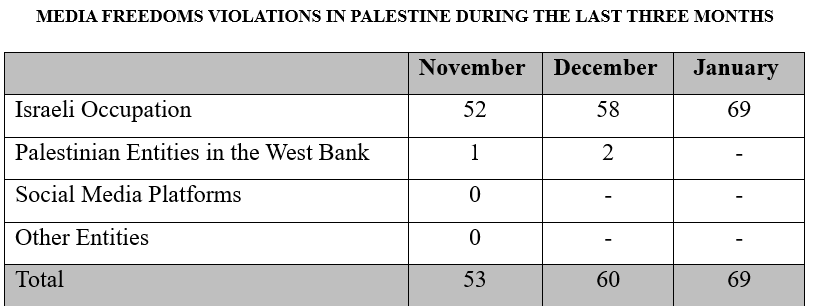
Ramallah –7 February The Palestinian Center for Development and Media Freedoms (MADA) documented during the first month of the year 2026 a total of 69 (Sixty-Nine) violations against media freedoms in the West Bank and the Gaza Strip, all of which were committed by the Israeli occupation forces. This represents an increase compared to 60 (Sixty) violations recorded during the previous month of December, marking a rise of %15 (Fifteen Percent). The violations were distributed as 64 (Sixty-Four) violations in the West Bank and 5 (Five) violations in the Gaza Strip.
Among these Israeli violations, MADA Center documented 3 (Three) cases of journalists killed in the Gaza Strip. Israeli occupation aircraft targeted their vehicle in central Gaza while they were on an official work assignment to film and produce journalistic stories and document the opening of a new shelter camp for displaced people established by the Egyptian Committee for Relief in Gaza, after killings had ceased during the last 2 (Two) months of the year 2025.
ISRAELI VIOLATIONS:
Israeli violations committed by the occupation army and forces during the first month of the year constituted %100 (One Hundred Percent) of all documented violations against media freedoms and journalistic crews in Palestine.
In addition to killings, violations included 6 (Six) physical assaults. Occupation forces assaulted KARIM KHAMAISA, reporter of Al-Ersal Network, MUTASIM SAQF AL-HEET, cameraman for Quds News Network, and freelance cameraman MOHAMMAD AWAD while they were covering the raid on Birzeit University.
A crew from Palestine TV, journalist AMIRA HAMOUDA, reporter of HAYAT Radio, and freelance journalist JAMAL RAYAN suffered suffocation due to tear gas while covering house demolitions in the Upper Ta’awun area in Nablus.
During January, occupation authorities arrested 6 (Six) journalists: Freelance journalist SALIM SUHAIL AL-SALMAN, arrested from his home and later placed under administrative detention for 4 (Four) months, Freelance journalist INAS KHALAWI, arrested after her home was raided in Idhna town, Hebron, on charges of “incitement on social media”, and released after 11 (eleven) days, Freelance journalist MOHAMMAD SHARAKA, sentenced to 4 (Four) months of administrative detention one week after his arrest, Journalist FAROUQ ALIYAT, arrested from his home in Deir Abu Da'if, east of Jenin, and sentenced to 6 (Six) months of administrative detention, ALI DAR ALI, reporter of Palestine TV, arrested after being summoned for interrogation and later released on bail of 1,000 (One Thousand Shekels), and Writer WALEED AL-HOUDALI, arrested after his home was raided in the Batn Al-Hawa neighborhood in Ramallah, and still detained in Ofer prison.
In a related context, occupation soldiers detained freelance journalist LOUAY MAHBASH, SARI JARADAT, cameraman for the Turkish Anadolu Agency, and YASSER JARADAT, reporter of Palestine Post, for approximately 12 (Twelve Hours) after pursuing them, confiscating their journalistic equipment and personal identification documents, and searching them while they were present east of the town of ad-Dhahiriya to cover settlers’ construction of a colonial road. Occupation forces also detained the crews of Al Jazeera TV, Al-Arabi Al-Jadeed TV, and Palestine TV for 9 (Nine Hours) while they were covering the raid carried out by occupation forces on the town of Al Mughayyir, northeast of the city of Ramallah.
During the past month, occupation soldiers directly targeted THARWAT SHIQRA, reporter of Al Jazeera TV, with a tear gas canister fired at her while she was covering the raid on the town of Kafr Aqab, north of the city of Jerusalem. The Palestinian Center for Development and Media Freedoms (MADA) also documented the prevention of 39 (Thirty-Nine) journalists and media crews from covering events in various governorates while reporting on different incidents.
In addition, Israeli occupation authorities extended the decision to close the office of Al Jazeera Network and ban its operations in Israel for 90 (Ninety) Days, pursuant to the new law known as the “Al Jazeera Law”. The renewed decision also included the YOUTUBE platform and prohibited broadcasting the channel’s content on the platform within Israel.
In a related context, the occupation court extended the detention of journalist ALI AL-SAMOUDI for the third time for 4 (Four) Months. Occupation authorities also transferred writer and political analyst SARI ARABI to administrative detention for 6 (Six) Months and renewed, for the third consecutive time, the administrative detention of imprisoned journalist ABDULLAH MUATAN for 6 (Six) Months.
Occupation authorities released Palestinian journalist SAMER KHUWEIRA after an administrative detention that lasted approximately 10 (Ten) Months without charge or trial. They also released journalist MUJAHED BANI MIFLEH, who had been held in administrative detention since the month of June of the year 2025.
Journalists Killed in September
|
Name of Journalist |
Date Killed |
Place of Work |
|
|
1- |
ABDUL RAOUF SHAATH |
21 January |
Agence France-Presse (Afp) |
|
2- |
ANAS GHANIM |
21 January |
Freelance Journalist |
|
3- |
SALAH QISHTA |
21 January |
Egyptian Committee for Relief in Gaza |
Details of Violations:
(01 January)
Israeli occupation forces arrested freelance journalist SALEEM SUHAIL AL-SALMAN (35 years old) at dawn on Thursday, after raiding his home in the southern neighborhood of Tulkarm city and confiscating his mobile phone along with the phones of several family members.
MARAH SALMAN, the journalist’s sister, told the MADA Center that occupation forces stormed her brother’s house at approximately 3:15AM on Thursday. Soldiers knocked violently on the door and demanded it be opened. When her brother did not open the door, the force moved to another entrance of the house, where journalist SALEEM opened the door for them.
The soldiers asked him whether he was “SALEEM”, and after he confirmed his identity, they confiscated his mobile phone and his wife’s phone and proceeded to assault him physically before arresting him and taking him outside the house.
During the arrest, occupation soldiers detained the journalist’s wife and children inside one of the rooms and prevented them from leaving, with soldiers stationed over them at all times. The soldiers also demanded the wife’s identification card, photographed it, and took photos of the room from the inside.
On 8th January, a court session was held for the journalist at Salem Military Court and was adjourned until 13 January, at which time he was sentenced to six months of administrative detention. On 18 January, the administrative detention order was confirmed for four months. He is currently held at “Salem” detention facility, which, according to what the journalist’s lawyer informed the family, is no longer merely a detention center.
(05 January)
Israeli occupation forces arrested freelance journalist ENAS MOHAMMAD KHALAWI (28 years old) at dawn on Monday after raiding her home in the town of Idhna, west of Hebron, and took her to an unknown location.
According to testimony provided by YOUSEF KHALAWI, the journalist’s brother, to the MADA Center, at approximately 1:30AM on Monday, a force from the Israeli occupation army raided the home of freelance journalist ENAS KHALAWI in the town of Idhna, west of Hebron. After smashing the main entrance of the house and detaining the family members in one room, soldiers confiscated the journalist’s phone, took her from her bedroom, and transferred her to an unknown destination.
The family later learned that their daughter, the journalist, had been transferred to the interrogation center at “Ofer” military camp, west of Ramallah, and then moved to “Hasharon” prison, where occupation authorities charged her with “incitement on social media”.
On 15 November, the occupation court released journalist ENAS KHALAWI from “Hasharon” prison after 11 days of detention, following a court session that approved her release on bail in the amount of 6,000 shekels in cash, and set the first court session for 03 February 2025.
(06 January)
Israeli occupation soldiers assaulted several journalists early Tuesday morning, beating, searching, and abusing them while they were present at Birzeit University, north of Ramallah in the central West Bank, to cover the occupation forces’ raid on the university and the dispersal of a student gathering held in solidarity with prisoners.
According to testimony by Al-Irsal Network reporter, journalist KAREEM KHAMAYSEH, to the MADA Center, he was present along with Quds News Network cameraman MOATASIM SAQF AL-HEET and freelance cameraman MOHAMMAD AWAD on Tuesday morning to cover the incursion of large numbers of occupation soldiers into the Birzeit University campus. The forces violently dispersed a student gathering held in solidarity with prisoners, during which clashes erupted between soldiers and students, including the use of live ammunition and tear gas, resulting in injuries among students.
When the journalists arrived near the university’s main entrance, approximately 20 meters from the main gate, they stopped their vehicle and began putting on their press vests and preparing their equipment—cameras and mobile phones—in preparation to head into the campus. At the same time, several occupation soldiers disembarked from a military jeep and walked past without signaling to or speaking with the journalists.
As soon as the journalists finished preparing their equipment and began filming, soldiers approached them and ordered them to stand by the roadside near their vehicle and hand over their journalistic equipment. The journalists refused and attempted to explain that they were present for media coverage, but the soldiers attacked them and confiscated one camera and two mobile phones.
One soldier began abusing journalist MOHAMMAD AWAD, ordering him to stand in front of the vehicle, forcibly spreading his legs by striking them, searching him, and then forcing him to kneel in front of the vehicle. The same was done to journalist MOATASIM SAQF AL-HEET, whom the soldier pushed toward the front of the vehicle and struck on the legs during the search. Journalist KAREEM KHAMAYSEH was pushed and searched at the rear of the vehicle. During the search, soldiers removed the protective vest from KAREEM KHAMAYSEH, but were unable to do so with MOATASIM SAQF AL-HEET.
After completing the search, which included pushing and kicking, the occupation soldiers ordered the journalists to leave the area immediately. When the journalists asked about their confiscated camera and phones, one soldier immediately raised his weapon, threatened to open fire, and ordered them to leave quickly.
The journalists were forced to leave the area and waited at a distance from the site of their detention. After approximately five minutes, the soldiers left the area, and the journalists returned to search for their equipment, which they found thrown under one of the vehicles.
(08 January)
Israeli occupation forces detained a group of journalists and media crews on Thursday morning while they were covering an introductory event at the Youth Village organized by the Sharek Youth Forum in the village of Kafr Ni'ma, west of Ramallah, obstructed their work, and forced them to leave the area.
In his testimony to the MADA Center, freelance journalist AHMAD SULAIMAN AYESH stated that at approximately 10:00AM on Thursday, a group of journalists arrived, including the Al-Araby TV crew, reporter AMEED SHAHADA and cameraman HAMZA TAHA; Raya FM reporter MOHAMMAD OTHMAN; Watan TV reporter MOHAMMAD TAMEEZI; freelance journalist HADI SABARNA; and Ultra Palestine reporter ASEEL SULAIMAN. The journalists arrived accompanied by a youth group from the Sharek Youth Forum to cover an introductory event at the Youth Village organized by the Sharek Foundation northwest of the village of Kafr Ni'ma, west of Ramallah, which had previously been taken over by settlers who vandalized its contents.
Immediately upon the arrival of journalists and participants, four Israeli military vehicles arrived. Soldiers deployed in the area and stormed the Youth Village where everyone was present. The soldiers informed the journalists that the area must be evacuated on the grounds that it was a closed military zone, prevented them from media coverage, and obstructed their work. After about 15 minutes, the soldiers brought a military order declaring the area completely closed, demanded that everyone present hand over their personal IDs for security checks, ordered them to line up behind one another, and then escorted them out to the area where vehicles were parked, forcing everyone to leave the site.
(08 January)
Israeli occupation soldiers targeted several journalists and media crews with tear gas on Thursday morning, causing suffocation while they were covering home demolition operations in the Upper Al-Ta'awun area of Nablus. The forces also obstructed the work of other journalists by preventing them from reaching the site.
Freelance journalist ABDULLAH TAYSEER BAHASH (28 years old) told the MADA Center that at approximately 10:15AM on Thursday, a number of journalists were present in the Upper Al-Ta'awun area of Nablus to cover demolition operations carried out by Israeli occupation forces. Those present included the Palestine TV crew, reporter MOHAMMAD AL-KHATEEB and cameraman SAOUD AL-QANI; Radio Hayat reporter AMEERA HAMMOUDA; and Al-Fajr TV reporter WALAA FATTAYER.
The journalists were positioned on one of the hills overlooking the demolition site, at a distance of more than 300 (Three Hundred) meters from a unit of the Israeli Border Police. There were no clashes taking place in the area, and no individuals were present in the vicinity other than the journalists.
During the coverage, Israeli occupation soldiers directly targeted the journalists by firing tear gas canisters toward them. Three canisters landed among the journalists, causing severe suffocation to the Palestine TV crew, journalist AMEERA HAMMOUDA, and freelance journalist JAMAL RAYYAN as a result of inhaling tear gas.
Medical teams from the Palestinian Medical Relief Society intervened and provided the necessary on-site treatment to the journalists without transferring them to the hospital.
Occupation forces also prevented journalists ABDULLAH BAHASH, MUJAHID TABANJA, and WALAA FATTAYER from reaching the site during the initial moments of the incursion and threatened to open fire if they advanced, thereby obstructing their work and preventing coverage.
(09 January)
A number of settlers assaulted journalist WAHAJ BANI MIFLAH and journalist AHMAD SAMARA, obstructing their work by attempting to steal filming equipment and harassing and provoking them while they were covering the forced displacement of Palestinian residents in the Ras Ein Al-Auja area of the Jordan Valley on Thursday afternoon.
Freelance journalist JAMAL BANI MIFLAH (26 years old) told the MADA Center that at approximately 1:30PM on Thursday, he was present in the Ras Ein Al-Auja area of the Jordan Valley with his colleague, freelance journalist AHMAD SAMARA, to cover displacement operations and violations committed against Palestinian residents by settlers. During the coverage, one settler directly harassed him and attempted to steal the cameras attached to his belt in a clear attempt to obstruct filming and steal journalistic equipment. He was, however, able to push the settler away.
The harassment by settlers continued, as the journalist was later subjected to pushing and provocation by several settlers who deliberately filmed him repeatedly using mobile phones in an attempt to intimidate and pursue him.
Journalist AHMAD SAMARA was also harassed by settlers, as one of them placed his mobile phone directly in front of the camera and attempted mockery and deliberate interference with the journalistic coverage.
(11 January)
Israeli occupation soldiers detained three journalists after chasing them, confiscating their journalistic equipment and identification cards, and subjecting them to searches while they were present east of the town of Ad-Dhahiriya to cover settlers’ construction of a settlement road on Sunday morning. Two of the journalists were released after the memory cards were confiscated from their cameras, while the third journalist was released after approximately 12 (Twelve) hours of detention.
According to testimony provided by freelance journalist LOUAY MAHBASH AMRO to the MADA Center, at around 10:00AM on Sunday, he, along with Anadolu Agency cameraman SARI ABD AL-GHAFFAR JARADAT, and Palestine Post reporter YASSER ABD AL-MONEIM JARADAT, arrived at the “Al-Deir” area east of the town of Ad-Dhahiriya, south of Hebron, to cover settlers’ construction of a settlement road on citizens’ land in the area.
Upon the journalists’ arrival, a group of local residents was holding a peaceful sit-in in front of the lands threatened with confiscation. Shortly thereafter, a force of the Israeli occupation army arrived at the site accompanied by a settler’s vehicle. Soldiers deployed in the area and began firing sound bombs and tear gas at participants in the peaceful sit-in.
The journalists continued covering the events from a distance. After approximately one hour, the three journalists attempted to leave the area. At that point, soldiers began chasing them and shouting at them, prompting the journalists to enter a nearby house in order to rest. Soldiers followed them into the house and demanded that the homeowner bring out what they described as “the three saboteurs”. Once the journalists exited, soldiers took them into the courtyard of the house, forced them to sit on the ground under shouting and threats at gunpoint, and confiscated their personal identification cards, press cards, and cameras.
After approximately ten minutes of on-site interrogation regarding their presence in the area and why they had “fled”, as alleged by the soldiers, the soldiers led journalist LOUAY AMRO and journalist YASSER JARADAT to a concrete wall near the house, where they were searched violently and informed that they were wanted by the Israeli General Security Service (Shin Bet). During this time, one soldier asked journalist LOUAY AMRO about his mobile phone, and he replied that he had lost it in the agricultural land where he had been present. A soldier then threatened him, stating that if even a single image of what had occurred was leaked, he would be arrested from his home.
The soldiers escorted the journalists to a nearby military vehicle and handcuffed them with plastic restraints. During this time, a settler arrived and photographed the journalists’ IDs using his mobile phone. After approximately ten minutes near the military vehicle, the soldiers released journalist LOUAY AMRO, while blindfolding journalist YASSER JARADAT with a piece of cloth and transferring him into the military vehicle.
When journalist LOUAY AMRO returned to the location where journalist SARI JARADAT was being held with one of the soldiers, the soldiers returned the cameras after confiscating their internal memory cards and warned the journalists that if they returned to the area, they would be arrested. Journalists LOUAY AMRO and SARI JARADAT left the area, while journalist YASSER JARADAT remained detained and was released at approximately 10:00PM the same day.
(11 January)
Israeli occupation forces targeted a number of journalists and media crews with sound bombs and tear gas and obstructed their work while they were covering an incursion by occupation forces into the Old City of Nablus on Sunday morning.
In his testimony to the MADA Center, freelance journalist ABDULLAH TAYSEER BAHASH (28 years old) stated that several journalists and media crews were present to cover the occupation forces’ incursion into the Al-Basha Street area in the Old City of Nablus. Those present included: Roya TV crew, reporter HAFEZ SABRA and cameraman MAHMOUD FAWZI; freelance journalist HATEM NAZZAL; Palestine Post reporter MUJAHID TABANJA; Al-Madina TV reporter MUSAB AL-KHATEEB; Radio Hayat reporter AMEERA HAMMOUDA; Al-Fajr TV reporter WALAA FATTAYER; freelance journalist SIDQI RAYYAN; Al Jazeera reporter LAITH JAAR; and Asdaa website editor AMEEN ABU WARDA.
At approximately 10:10AM, occupation forces fired several tear gas canisters toward Palestinian youths and journalists present at the site, resulting in journalist LAITH JAAR and journalist AMEEN ABU WARDA suffering from suffocation. They received on-site medical treatment.
At around 10:30AM, freelance journalist SIDQI RAYYAN entered the Old City to meet his colleagues, when occupation forces suddenly stormed the area, obstructing their work and causing him and journalist AMEEN ABU WARDA to mistakenly enter one of the houses. There, they were besieged for more than two hours. During the siege, occupation forces deployed a drone that hovered over the house, photographed the journalists, and confirmed their presence, before coordination took place with the International Committee of the Red Cross, the Palestinian Civil Liaison, and the Palestinian Red Crescent Society. Occupation forces later withdrew and allowed the journalists to exit.
At exactly 11:20AM, occupation forces targeted the media crews with sound bombs and rubber-coated bullets in a clear attempt to disrupt media coverage. At approximately 12:00 noon, occupation forces again targeted journalists with tear gas, resulting in most journalists suffering from suffocation. The condition of journalist LAITH JAAR deteriorated noticeably after being exposed to tear gas for the second time, requiring medical intervention.
At around 1:00PM, one occupation soldier threatened journalists via loudspeakers with the use of violence if they did not leave the area, forcing them to retreat for their own safety. Throughout the coverage, Israeli occupation soldiers deliberately targeted media crews with sound bombs, threatened them with weapons, and repeatedly attempted to obstruct their work by rapidly and dangerously advancing military vehicles toward the journalists.
(12 January)
Israeli occupation forces arrested journalist MOHAMMAD SABAH (SHARAKA) at dawn on Monday after raiding his home in the Jalazone Refugee Camp north of Ramallah. One week later, he was sentenced to four months of administrative detention.
According to testimony provided by ATTA SABAH, the journalist’s brother, to the MADA Center, approximately 30 occupation soldiers raided the home of freelance journalist MOHAMMAD AHMAD ATTA SABAH (33 years old) at 4:30AM on Monday in the Jalazone Refugee Camp north of Ramallah. Soldiers informed him that he was under arrest, searched the house, confiscated his mobile phones, and damaged awards and wall plaques he had received.
The soldiers arrested the journalist and prevented him from taking his crutches, which he relies on to assist him in walking due to several previous injuries. They left the house after approximately 15 minutes.
One week after his arrest, on 19 January, occupation authorities issued an administrative detention order sentencing the journalist to four months of detention. SABAH is currently held in “Ofer” prison. One lawyer was recently able to visit him and reassured his family regarding his condition.
It is worth noting that journalist MOHAMMAD SABAH sustained multiple fractures in 2022 after falling from the Separation Wall while on his way to Jerusalem to pray at Al-Aqsa Mosque. Following the fall, he was assaulted by occupation soldiers, resulting in several injuries from which he continues to suffer to this day, forcing him to rely on crutches to walk.
The journalist has previously been arrested, most recently on 23 October 2023, following a raid on his home in the Jalazone Refugee Camp. At that time, he was also injured and using a walking aid, yet occupation forces did not allow him to take his crutches. He spent approximately 12 months in detention.
(16 January)
Israeli occupation soldiers detained several media crews for approximately nine hours while they were covering an incursion by occupation forces into the town of Al-Mughayyir on Friday morning and prevented them from leaving the town after declaring it a closed military zone.
According to testimony provided by Al-Araby Al-Jadeed cameraman HAMZA AFFANEH to the MADA Center, Israeli occupation forces stormed one of the citizens’ tents (a rural encampment) at around 10:00AM on Friday in a mountainous area where foreign solidarity activists were present in the town of Al-Mughayyir, northeast of Ramallah. The following crews were present: Al Jazeera TV crew, reporter THARWAT SHAQRA and cameraman RAJI ASFOUR; Al-Araby Al-Jadeed crew, reporter AMEED SHAHADA and cameraman HAMZA AFFANEH; and later the Palestine TV crew, which arrived subsequently to cover the events. All were prevented from leaving the town while covering the developments.
During the incursion, settler shepherds stormed the Al-Khalayel and Al-Khalilah areas south of the town and opened fire in their surroundings in repeated attacks targeting residents and their property. This coincided with provocation and a direct assault by one settler against a family, while youths burned tires on the opposite side and soldiers and settlers fired live ammunition toward them.
Occupation forces reinforced the area with approximately four additional military patrols. The incursion coincided with residents exiting Friday prayers, during which soldiers fired live ammunition and tear gas canisters, resulting in the killing of the child MOHAMMAD AL-NA'SAN (14 years old), who was shot three times in the chest while leaving the mosque.
The occupation force that stormed the town fired toward settlers and the agricultural area where they were present, declared the town a closed military zone, and imposed a curfew, resulting in the detention of media crews until 7:30PM.
At approximately 4:00PM, media crews attempted to leave the town but encountered a temporary military checkpoint at the main entrance. Journalists presented their personal and professional IDs and explained that they were media crews wishing to leave for Ramallah. However, after more than ten minutes of delay, the officer informed them that they were prohibited from leaving or moving, as the area was a closed military zone. This forced the journalists to return to an elevated location in the town overlooking the checkpoint.
Media crews remained detained until 7:30PM, after occupation soldiers withdrew from the town.
(16 January)
Israeli occupation forces arrested freelance journalist FAROUQ ALIYAT at dawn on Friday after raiding his home in the town of Deir Abu Da'if, east of Jenin, and later sentenced him to six months of administrative detention.
According to testimony provided by the wife of detained freelance journalist FAROUQ OMAR ALIYAT (43 years old) to the MADA Center, a force of occupation soldiers stormed the family home in the town of Deir Abu Da'if at approximately 1:00AM on Friday.
The soldiers woke the family and ordered the journalist to prepare himself to accompany them, without providing any explanation for the arrest. Without searching the house or causing damage to its contents, the soldiers withdrew from the home and took the journalist to an unknown location.
The family later learned, through a post published by the Prisoners’ Club, that occupation authorities had sentenced the journalist to six months of administrative detention at the Salem Military Court on 28 January.
(19 January)
Israeli occupation soldiers prevented a group of journalists from covering events south of Hebron after imposing a security cordon on the area, obstructing their work and forcing them to leave the site.
According to testimony provided by freelance journalist MOHAMMAD AWAD AL-RAJOUB to the MADA Center, at approximately 1:30PM on Monday, he headed to the southern area of Hebron City along with Al-Hadath newspaper reporter MUSAB ABD AL-SAMAD SHAWER, freelance journalist SOHAIB FAWAZ AL-OYOWI, and Al Jazeera cameraman LOUAY ASHRAF AL-SAEED. At the time, occupation forces had begun imposing a security cordon and a movement ban in the area, and had started closing roads leading to it.
The journalists were present near one of the iron gates, where Israeli soldiers were deployed. Soldiers approached the four journalists and ordered them to retreat approximately 100 meters, before escorting them into the courtyard of MOHAMMAD ALI AL-MOHTASEB HOSPITAL and ordering them not to leave the area. This forced the journalists to leave the site and exit the area altogether, due to the impossibility of carrying out adequate media coverage and documentation of the event.
(20 January)
Israeli occupation forces prevented a group of journalists and media crews from covering a military operation south of Hebron City on Tuesday morning, obstructed their work, and threatened to confiscate their equipment, forcing them to leave and discontinue coverage.
In his testimony to the MADA Center, Reuters cameraman MAMOUN ISMAIL WAZWAZ stated that at approximately 9:00 on Tuesday, he headed with European Press Agency cameraman HAZEM JAMEEL BADR, Radio Al-Rabea cameraman and reporteer TAHA DAWOOD ABU HUSSEIN, Al-Hadath newspaper reporter MUSAB ABD AL-SAMAD SHAWER, the Al-Ghad TV crew consisting of reporter RAED SAMEER AL-SHARIF and cameraman JAMEEL AWWAM SALHAB, and the Al Jazeera crew consisting of reporter MOHAMMAD SIDQI AL-ATRASH and cameraman LOUAY ASHRAF AL-SAEED, to the southern area of Hebron City to cover the military operation being carried out by occupation forces. The forces had imposed a security cordon on the area and closed the roads leading to it for eight consecutive days.
While journalists and media crews were present near one of the gates erected in the area, around which occupation forces were heavily deployed, soldiers led by an officer approached the journalists and ordered them to immediately move away from the site, threatening to confiscate their cameras. The officer’s manner toward the journalists was aggressive, forcing them to withdraw from the area out of fear that their equipment would be confiscated. For the second consecutive day, occupation forces continued to prevent journalists from entering the southern area, which had been placed under a military-imposed curfew.
(20 January)
Israeli occupation forces arrested journalist ALI DAR ALI (42 years old) from the town of Burham, north of Ramallah, while he was passing through the Atara checkpoint, following a summons to report to Israeli intelligence.
According to testimony provided by SUJOUD, the wife of Palestine TV reporter ALI DAR ALI, around midday on Tuesday, the journalist received multiple phone calls from private numbers, which he did not answer. Subsequently, the callers contacted his family and sister, and it was revealed that the calls were from Israeli intelligence. An officer informed them that the journalist was required to report to the “Binyamin” center, established on the lands of the towns of Mikhmas and Jaba', in order to “close” his first arrest file. The journalist had previously been detained by occupation forces for more than one month and was released after paying a fine of 20,000 shekels. He continues to attend periodic court hearings.
Journalist ALI DAR ALI headed to meet Israeli police at the “Binyamin” center but was arrested at the Atara checkpoint and transferred to the “Binyamin” police station.
The journalist was interrogated for four hours on charges of “incitement and old social media posts”, after which he was transferred to “Ofer” prison. There, he was subjected to beating, humiliation, insults, and threats under harsh detention conditions, as detainees suffer from cold weather, a lack of blankets, insufficient food, and limited access to hot water during winter.
At dawn on 22 January, he was summoned, transferred via a prison transport vehicle while shackled at the hands and feet, and returned to the “Binyamin” center, where he remained in a waiting room for approximately four hours. He was then informed by an officer to bring clothes and a sum of 1,000 shekels. After paying the bail amount, the journalist was released, on the condition that he attend a court session on 08 February.
Following consultation with his lawyer, journalist ALI DAR ALI headed to the interrogation center by taxi. Due to congestion and traffic buildup at the Atara checkpoint, an Israeli occupation vehicle arrived, took the journalist after he exited the taxi, and transported him to the center, where an officer informed him that he was once again under arrest.
(21 January)
Israeli occupation forces arrested journalist and writer WALEED AL-HOUDALI (65 years old) at dawn on Wednesday after raiding his home in the Batn Al-Hawa neighborhood of Ramallah City, destroying its contents and abusing family members.
According to testimony provided by ATTAF AL-HOUDALI, the wife of writer and journalist WALEED AL-HOUDALI, to the MADA Center, a force of more than 20 (Twenty) Israeli occupation soldiers stormed the residential building where the family lives at approximately 1:30AM on Wednesday, after forcibly breaking its main entrance.
Fearing that the soldiers would blow up or break down the apartment door, the wife rushed to open the door and turn on the lights. Occupation soldiers then carried out extensive searches marked by violence and vandalism that lasted for nearly three continuous hours. They smashed bedrooms and furniture and caused widespread destruction inside the home under the pretext of searching for money and gold, despite the family’s repeated confirmation that none existed. During the searches, soldiers directed insults and obscene language at family members and treated them in a harsh and degrading manner.
During the raid, soldiers also assaulted AISHA AL-HOUDALI, the daughter of the writer, after she objected to the insults directed at the family. Soldiers handcuffed her, blindfolded her, forced her into a corner of the house, and poured water over her while she screamed.
The soldiers forced writer AL-HOUDALI out of his room wearing only shorts, despite the severe cold and his critical health condition at the time. He was suffering from an acute illness and has a heart condition, having undergone a cardiac catheterization procedure a short time earlier. Soldiers completely ignored his status as a journalist, despite repeated warnings from his wife about the danger to his life.
The soldiers also isolated AL-HOUDALI’s wife and daughter in a separate area of the house, while he remained with soldiers in the living room. The family was unaware whether he had been beaten or physically assaulted. After one officer reviewed his medical condition, his medications were brought so that he could take them with him should his arrest proceed.
During the raid, soldiers confiscated five large bags from his library containing books and personal papers. They also seized property ownership documents belonging to his wife’s brother, for whom she serves as legal proxy, in addition to confiscating three laptop computers, an iPad, and an external hard drive.
AL-HOUDALI suffers from an unstable health condition. He previously developed facial nerve paralysis (seventh nerve palsy) during an earlier arrest, from which he still suffers. He also has high blood pressure and underwent a cardiac catheterization only weeks ago.
It is noteworthy that Israeli occupation forces have arrested WALEED AL-HOUDALI multiple times over the past years. His most recent arrest prior to this incident was in 2019, when he spent four months in detention and was released while on hunger strike, coinciding with a broader prisoners’ hunger strike at that time.
On 28 January, the Israeli occupation military court at “Ofer” prison extended the writer’s detention on the pretext of so-called “incitement” on social media until 03 February. On Tuesday, the court session was subsequently postponed until 05 February.
(21 January)
Israeli occupation aircraft targeted three journalists with three missiles at noon on Wednesday while they were on an official work assignment to film and produce journalistic stories in the Nuseirat/Netzarim area in central Gaza Strip, resulting in their killing.
According to testimony provided to the MADA Center by journalist OSAMA AL-KAHLLOUT, who arrived at the crime scene within minutes of the strike, the three journalists were: Agence France-Presse (AFP) cameraman ABD AL-RAOUF SAMEER SHA'AT (28 years old); journalist with the Egyptian Committee for Gaza Relief SALAH QESHTA (37 years old); and freelance journalist ANAS GHANIM (28 years old).
At approximately 1:30PM on Wednesday, the journalists were carrying out an official mission to film, produce journalistic stories, and document the opening of a new camp to shelter displaced civilians. The camp was established by the Egyptian Committee for Gaza Relief near Al-Zahraa City in the Netzarim area in central Gaza.
While they were present at the site, an Israeli reconnaissance drone targeted a civilian jeep vehicle carrying the three journalists with three missiles, causing the vehicle to ignite and burst into flames. Civilians struggled to extinguish the fire as the journalists’ bodies were burning. Firefighting and ambulance crews later arrived, and after some time, the bodies of the journalists, severely charred, were recovered and transferred to several hospitals, including Al-Shifa Hospital in Gaza City and Al-Aqsa Martyrs Hospital in Deir Al-Balah.
The missiles directly struck the three journalists while they were carrying journalistic equipment, cameras, and a small aerial photography drone, all of which were completely destroyed, in addition to their personal mobile phones.
(26 January)
Israeli occupation forces prevented a number of journalists and media crews from covering the incursion into the town of KAFR AQAB, north of Jerusalem, on Monday morning. The forces obstructed their work and targeted them with tear gas canisters.
According to testimony provided by Al Jazeera TV reporter THARWAT ZEID SHAQRA to the MADA Center, at approximately 8:00 a.m. on Monday, a group of journalists and media crews headed to cover the Israeli occupation forces’ incursion into the town of Kafr Aqab, north of Jerusalem.
Immediately upon the journalists’ arrival, soldiers began harassing them by preventing them from advancing and repeatedly ordering them to move away from the area. During a live broadcast by journalist THARWAT SHAQRA, one soldier approached her and fired two sound grenades toward her, which exploded nearby, in an apparent attempt to force her to stop the live broadcast entirely.
Harassment by soldiers against journalists continued until approximately 4:00PM, when the media crews left the area due to the soldiers’ violence. In addition to the Al Jazeera reporter, those targeted included the Al Araby TV crew, reporter AMEED SHAHADA and cameraman RABEE' MUNEER; freelance journalist HADI SABARNA; and Al Jazeera Live reporter MOHAMMAD SAMREEN.
(27 January)
Israeli occupation forces prevented a number of journalists and media crews from covering incursions into towns north of Jerusalem for the second consecutive day on Tuesday morning, obstructed their work, and forced them to leave the area under threat of weapons.
According to testimony provided by Al Araby TV reporter AMEED SHAHADA to the MADA Center, at approximately 7:00AM on Tuesday, he headed with a group of journalists and media crews to cover, for the second day in a row, the Israeli occupation forces’ incursion into the towns of Kafr Aqab and Qalandia, north of Jerusalem.
The journalists were present in the Airport Road area, where occupation forces had closed the road and prevented civilians from moving. Upon the journalists’ arrival, occupation forces immediately began preventing them from advancing, ordered them to stop coverage and turn off their cameras, and demanded that they move away from the area. Journalists were forced to retreat to a distance that made effective coverage impossible.
Journalists repeatedly attempted to advance toward the area; however, each time, soldiers obstructed their work and prevented filming under threat of weapons. This ultimately forced the journalists to leave the area at approximately 3:00PM.
Those present during the coverage included: Al Jazeera TV reporter THARWAT SHAQRA; the Al Araby TV crew, reporter AMEED SHAHADA and cameraman RABEE' MUNEER; freelance journalist HADI SABARNA; freelance journalist MOATASIM SAQF AL-HEET; and Al Jazeera Live reporter MOHAMMAD SAMREEN.
(27 January)
Israeli occupation soldiers prevented journalist SALMAN ABU ARAM from covering a settler attack on the village of AL-HALAWA in the Masafer Yatta area on Wednesday evening and forced him to leave the area after declaring it a closed military zone.
In his testimony to the MADA Center, Radio Karama reporter SALMAN ABU ARAM (44 years old) stated that at approximately 8:00PM on Wednesday, he headed to cover a settler attack on the village of Al-Halawa in the eastern Masafer Yatta area, south of Hebron.
Upon his arrival in the village, Israeli occupation soldiers were already present and began shouting at him and a number of foreign activists to stop filming. Shortly thereafter, the army declared the area a closed military zone and ordered everyone to leave, forcing the journalist to depart for fear of arrest.
The journalist left the area accompanied by a doctor and a paramedic and was forced to walk approximately eight kilometers along rough terrain due to the unavailability of transportation. During their departure, groups of settlers were moving along the road and directing obscene insults at them.
(29 January)
On Monday, Israeli occupation authorities extended the closure of Al Jazeera Network’s office and the ban on its operations in Israel for an additional 90 days, pursuant to the new law known as the “Foreign Media Banning Law”, which has become widely referred to as the “Al Jazeera Law.” The new decision also included YouTube, banning the network’s broadcasts on the platform within Israel.
Under the decision, the presence and operation of Al Jazeera Network within Israel, Jerusalem, and the Golan Heights have become prohibited. The decision also authorizes the Israeli Minister of Defense to implement the ban in the West Bank without the need for an order from the military commander of the area.
The decision includes five subsidiary orders directed at parties connected to the network’s operations. These orders were sent to the network’s lawyers to enforce the ban and close the office in Israel; to companies providing broadcast services to the channel; to YouTube; to internet service providers; and to the property owners from whom Al Jazeera rents its office. All of these orders mandate blocking access to Al Jazeera’s electronic platforms and websites.
(30 January)
Several live rounds fired by Israeli occupation tanks positioned on citizens’ lands east of Gaza City struck the office of Al-Kofiya TV channel on Friday morning, while a number of journalists and staff members were inside, causing damage to the office.
According to testimony by AHMAD HARB, Director of Al-Kofiya TV’s Gaza office, at approximately 10:00 a.m. on Friday, while five channel employees were on duty, Israeli occupation tanks stationed east of Gaza City fired toward the channel’s office. Several metal bullets struck the office walls and penetrated the window glass, while employees narrowly escaped injury.
Those present in the office included reporter NAHED ABU HARBEED, cameraman AHMAD ABU JARAD, editor MO’MEN AWADALLAH, journalist RAWAN EID, and driver MAHMOUD HARBAN. All suffered from shock, as one of the bullets landed near them while they were carrying out their professional duties and following ongoing developments in the Gaza Strip.
(January – Date Unspecified)
A number of Arabic-language pages affiliated with the Israeli occupation incited directly against journalist and editor MAHMOUD HANIYYA throughout the month of January, constituting a direct threat to his life.
According to testimony provided by journalist and editor at Al-Resalah newspaper and its website, MAHMOUD ABD AL-KAREEM HANIYYA (36 years old), to the MADA Center, electronic pages operating under the names “A CHANCE TO LIVE” and “AL-MINKHAL” carried out direct incitement against him by publishing inciting posts accompanied by his personal photograph marked with a red circle. This incitement was linked to his journalistic writings and reports. The two pages are active on social media and are believed to be affiliated with collaborators with the occupation and among pages managed by Israeli occupation soldiers.
The page “A Chance to Live” published a tweet stating: “Your fate, HANIYYA, will be like that of your wife and son”, in reference to their killing during the war. The journalist considered this a direct and explicit threat to his personal life.
HANIYYA affirmed that the incitement aimed to prevent him from continuing his journalistic work and media writings through which he exposes crimes committed by the occupation against unarmed civilians in Gaza during the war.
This was not the first time the journalist has been subjected to such incitement. Accordingly, he held the Israeli occupation forces and their spokespersons fully responsible for his life and the lives of his family members, especially as the inciting posts published by these pages featured his personal photograph marked with a red circle, constituting an explicit and public threat of killing.
