

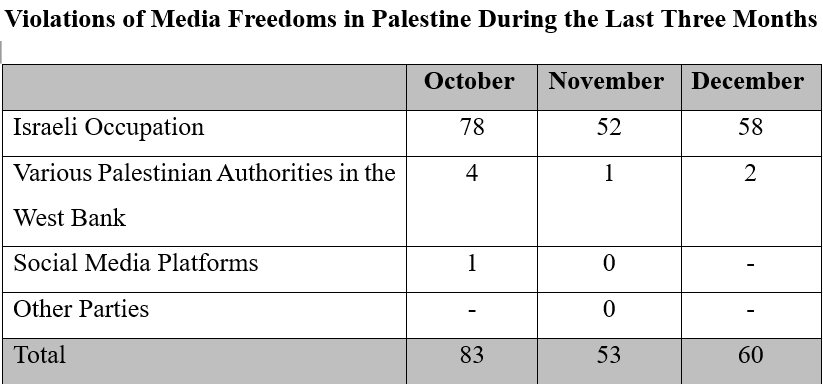
Ramallah – 7th Jan. 2026. The Palestinian Center for Development and Media Freedoms (MADA) documented during the past month of December a total of 60 (Sixty) violations against media freedoms in Palestine. This figure represents a slight increase compared to the number of violations documented in the preceding month of November, rising by 13%.
MADA documented during December 2025 a total of 60 (Sixty) violations against media freedoms (compared to 53 (Fifty-Three) violations in the previous month). The Israeli Occupation and settlers committed 58 (Fifty-Eight) of these attacks, while Palestinian Parties were responsible for only 2 (Two) violations.
Israeli Violations:
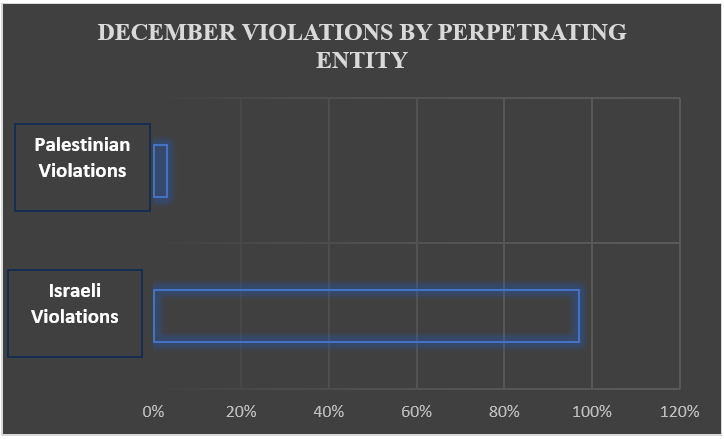
The number of Israeli violations against Palestinian media freedoms increased during the last month of 2025, accounting for 97% (Ninety-Seven percent) of the total documented violations. The Palestinian Center for Development and Media Freedoms (MADA) documented a total of 58 (Fifty-Eight) attacks committed by the Israeli occupation and settlers, noting that the previous month had witnessed 52 (Fifty-Two) Israeli attacks.
Among the most prominent violations documented this month was the killing of journalist MAHMOUD WADI, who was targeted by reconnaissance drone fire while preparing a video report on the destruction in Khan Younis. Journalist MOHAMMAD ESLAIH was injured by shrapnel to his left foot, while the body of freelance journalist HEBA AL-ABADLA was recovered from under the rubble after 2 (Two) years of disappearance. Journalist MAJDI AL-OMRANI also sustained injuries to his left foot caused by shrapnel from the explosion of a quadcopter drone in central Gaza City.
In addition, the Al Jazeera crew, reporter CHRISTINE RINAWI, cameraman HAMZA AFFANEH, and Al Jazeera Mubasher reporter RAGHAD SALAMEH, suffered suffocation after tear gas canisters were fired at them while they were covering events in the city of Tulkarm. Furthermore, Al Jazeera crew consisting of reporter THARWAT SHAQRA and her photojournalist cameraman was subjected to more than one attack during separate coverages. The crew, along with 3 (Three) other journalists, suffered suffocation from tear gas while covering the raid on the town of Kafr Aqab. The same crew members were also subjected to verbal abuse and prevented from coverage while reporting on the raid of the town of Bil'in.
In another incident, an officer from the occupation forces assaulted journalist MOHAMMAD TURKMAN by beating him while he was conducting live coverage of a settler attack against residents in the town of Deir Dibwan, causing the camera stand to fall to the ground and break. In a separate case, occupation police assaulted photojournalist WAHBI MAKKIYEH while he was in the Bab Al-Amoud area and handed him a summons to report to the Al-Qishla Center, after which a decision was made to ban him from Al-Aqsa Mosque for 7 (Seven) days. This ban was later extended during a subsequent interrogation to 6 (Six) months, until 15 June 2026.
Settlers also assaulted journalist NAWRAS DIAB by beating him while he was passing near the Za’atara checkpoint on his way to Jericho to travel to Jordan. In addition, occupation soldiers verbally and physically assaulted media student SOHAIB AL-QAT from Al-Quds Open University during his detention at the Al-Murabba’a checkpoint, which lasted approximately 22 (Twenty-Two) hours.
During last December, occupation forces arrested writer and researcher SARI ARABI after raiding his home in the village of Rafat in Ramallah. They also arrested journalist ASHWAQ AWAD from her home in the town of Beit Umar in Hebron, where she was beaten inside the military jeep, resulting in a fracture to her left hand.
Occupation forces also detained the Palestine Television crew, reporter AHMAD SHAWER, cameraman BASHAR NAZZAL, and driver AYMAN AL-HARSH, for half an hour while passing through one of the checkpoints in Qalqilya, and searched them during the incursion into the city. Additionally, Israeli authorities summoned by phone Quds News Network reporter HAMZA HAMDAN, interrogating him for 1.5 (one and a half) hours at the DCO headquarters in Tulkarm regarding his journalistic work.
Moreover, MADA documented 25 (Twenty-Five) cases of prevention of media coverage targeting journalists. The most notable included preventing the Al-Ghad crew from covering the raid on Al-Ahli Hospital in Hebron and forcing them to leave the site. Occupation soldiers also prevented freelance journalist AMER AL-SHALLOUDI and Anadolu Agency cameraman ABDUL HAFIZ AL-HASHLAMOUN from covering the weekly settler march near the Ibrahimi Mosque in Hebron. During the second settler march, occupation forces prevented Xinhua News Agency cameraman MA’MOUN WAZOUZ, Al-Hadath newspaper reporter MUSAB SHAWER, and freelance journalist AMER AL-SHALLOUDI from coverage and forced them to move a long distance away.
Occupation soldiers also prevented journalists SALEH HAMD and MOHAMMAD SAMREEN from covering the raid on Al-Am’ari Refugee Camp, and a military jeep obstructed their work by attempting to run them over.
On the other hand, Israeli authorities renewed the closure of the Al Jazeera office in Ramallah for 14 (fourteen) days, noting that the previous closure order had ended on 3 December, while no new order has been issued to close the Jerusalem office since the expiration of the last closure decision on 27 November.
In a separate context, Israeli authorities revoked a substantive court decision to release journalist MUJAHID BANI MIFLEH, a reporter for Ultra Palestine, from the town of Beita on 25 December, extending his detention for an additional 2 (Two) months after he had already spent 6 (Six) months in administrative detention over two periods. The first period lasted 4 (Four) months, while his detention was extended for a second time for 2 (Two) months under a substantive order.
Additionally, on 23 December, Israeli authorities decided to extend the administrative detention of imprisoned journalist AHMAD AL-KHATIB from the town of Beitunia, west of Ramallah, for an additional 6 (Six) months. He has been detained since 23 June.
Palestinian Violations:
Palestinian attacks and violations against Palestinian journalists and media freedoms recorded during the month of December showed a slight increase compared to the number of violations documented in the preceding month of November. During December, a total of 2 (Two) violations were recorded, committed by the Palestinian security services in the West Bank, compared to 1 (One) violation documented during the previous month of November.
The Palestinian violations, which constituted 3% (Three percent) of the total documented violations, were limited to summoning journalist MUATH GHANNAM by the Preventive Security in the Tubas Governorate and interrogating him regarding his journalistic work, the entities he works with, and the mechanism through which he receives payment for his work, for a duration of 2 (Two) hours. In addition, members of the Palestinian Police deleted the interview conducted by journalist HAMZA HAMDAN with one of the families of martyrs and prisoners, as well as the photos stored on his phone, during his coverage of a protest vigil held by the families of martyrs and prisoners in the city of Tulkarm.
Details of the Violations:
(02/12) The freelance photojournalist MAHMOUD WADI was killed, and journalist MOHAMMAD ESLAIH was injured by shrapnel from a reconnaissance drone strike that targeted them in the center of the city of Khan Younis while they were present to prepare a video report on the destruction in the area on Tuesday afternoon.
According to the testimony of freelance journalist MOHAMMAD ABDUL FATTAH ESLAIH (40 years old) to MADA, he was present alongside freelance photojournalist MAHMOUD ISSAM WADI (28 years old) at approximately 11:30AM on Tuesday in central Khan Younis, south of the Gaza Strip, an area considered safe and not under Israeli control, to prepare a video report on the destruction in the city.
The photojournalist MAHMOUD WADI was operating a drone when, suddenly and without prior warning, an Israeli reconnaissance aircraft fired a missile at the two journalists. This resulted in the immediate killing of MAHMOUD WADI, while MOHAMMAD ESLAIH sustained injuries to both his right and left legs from missile shrapnel. He also suffered bruises to various parts of his body after being thrown by the blast and hitting the ground. An ambulance arrived minutes later and transported him to Nasser Hospital west of the city.
(02/12) Israeli occupation soldiers prevented the Al-Ghad TV crew from covering the raid on Al-Ahli Hospital in the city of Hebron on Tuesday evening, obstructed their work, and forced them to leave the site immediately.
According to the testimony of Al-Ghad reporter journalist RAED “MOHAMMAD SAMIR” AL-SHARIF, he headed at 11:00PM on Tuesday, accompanied by the channel’s cameraman JAMEEL AZZAM SALHAB, to Al-Ahli Hospital in Hebron to cover the Israeli occupation forces’ storming of the hospital compound, under the pretext of pursuing a young man who allegedly carried out a vehicular attack near the western entrance of Hebron and fled toward the city after being shot.
While the crew was present covering the incident, an officer approached them and asked about the reason for their presence. The reporter informed him that they were carrying out journalistic work. The officer responded: “You must leave here immediately, and if we kill the person we are looking for, then come and film him”. The crew left the site immediately thereafter.
(04/12) A group of settlers assaulted freelance journalist NAWRAS DIAB near the Za’atara checkpoint south of Nablus on Thursday morning, while he was traveling along the road leading to the city of Jericho to participate in the ARIJ Forum.
Freelance journalist NAWRAS MOHAMMAD DIAB (26 years old) told Mada that at approximately 7:30PM on Thursday he was heading to Jericho to travel via the Karama Crossing to Jordan in order to participate in the eighteenth ARIJ Forum. Upon reaching the vicinity of the Za’atara checkpoint south of Nablus, he was surprised to find settlers blocking the road and attacking Palestinian vehicles. Approximately 20 (twenty) masked settlers directly attacked the vehicle in which the journalist was traveling, throwing stones in a frenzied manner in an attempt to block the road and prevent the vehicle from retreating and returning to Nablus.
The attack took place in full view of Israeli occupation soldiers and Israeli police who were present at the scene but did not intervene to stop the assault, while settlers were setting fires at several points along the road.
The journalist was trapped on the road for more than 1.5 (one and a half) hours due to the complete closure imposed by settlers, before he was forced to turn back and take long agricultural roads toward villages south of Nablus, passing through the Itma–Qabalan–Juris–Qusra route, until he was finally able to leave the area safely.
(04/12) Israeli occupation forces detained the Palestine Television crew for half an hour and searched its members while they were passing through one of the military checkpoints erected inside the city of Qalqilya during the incursion into the city on Thursday morning.
According to the testimony of Palestine Television reporter AHMAD ABDUL MALEK SHAWER (38 years old) to MADA, a number of occupation soldiers stopped the Palestine Television vehicle at 9:00AM on Thursday. The vehicle was carrying him along with his colleagues, photojournalist BASHAR NAZZAL and driver AYMAN AL-HARSH, while traveling on Nablus Street inside Qalqilya, where occupation forces had set up a checkpoint.
The soldiers demanded the identity cards of all crew members, and after learning that they worked for Palestine Television, ordered them to park the vehicle on the side of the road and remain inside it. They interrogated them about their destination and the nature of their work.
After a prolonged wait, journalist SHAWER asked a female officer supervising the inspection about the reason for the delay. She responded: “You have an issue with the Shin Bet”. When he asked whether the matter concerned him personally, she replied: “Yes”.
The crew was detained inside the vehicle for approximately half an hour and was not allowed to exit despite their requests. After the inspection concluded, the soldiers returned their identity cards and ordered them to turn back, stressing that they were “prohibited from covering”.
(06/12) Israeli occupation forces prevented a group of journalists from covering the weekly settlers’ march in the Old City of Hebron on Saturday afternoon, obstructing their work by forcing them to move away approximately 200 meters and sealing off the area completely.
Freelance journalist AMER MOHAMMAD AL-SHALLUDI told Mada that at approximately 2:00PM on Saturday, he headed along with Anadolu Agency cameraman WISSAM ABDUL HAFIZ AL-HASHLAMOUN and Xinhua News Agency cameraman MA’MOUN ISMAIL WAZOUZ to the Old City of Hebron to cover the weekly settlers’ march.
While the journalists were present in the Old Market area, occupation forces arrived at the scene, completely closed the area, and forced the journalists to move away by an estimated distance of 200 (two hundred) meters. Military vehicles also blocked the road in front of the journalists present at the site, forcing them to leave the area.
(09/12) Freelance journalist MAJDI AL-OMRANI was injured by shrapnel to his left foot after his tent in central Gaza City was targeted by a bomb dropped by an Israeli quadcopter drone on Monday evening.
In his testimony to MADA, journalist MAJDI MANSOUR AL-OMRANI (43 years old) stated that at 8:00PM on Monday he was with his family inside the tent where they had taken refuge in Al-Zahraa camp near Al-Omari Mosque in central Gaza City. While browsing the internet and following up on his journalistic work, an Israeli quadcopter drone flying at low altitude suddenly and directly dropped a bomb on his tent, which exploded at the entrance, causing shrapnel to scatter and injure him.
The journalist sustained injuries to his left foot and was transported by civilians in a small cart to the Baptist Hospital in the city, where he received treatment for two days before being discharged. He continues to suffer from pain in his left foot, as shrapnel remains lodged inside it, and he requires surgical intervention to remove it.
AL-OMRANI also indicated that all of his children sustained varying degrees of injuries, and that his tent was destroyed and burned as a result of the explosion, leaving him and his family without shelter.
(09/12) Israeli occupation soldiers prevented two journalists from covering the raid on Al-Am’ari Refugee Camp in the city of Ramallah on Tuesday morning. A military jeep also obstructed their work by attempting to run them over and threatening them with weapons.
According to the testimony of Agence France-Presse cameraman SALEH HAMAD (39 years old) to MADA, he and freelance journalist MOHAMMAD SAMREEN were present in one of the alleys of Al-Am’ari Refugee Camp at approximately 9:50AM on Tuesday, after undercover occupation forces infiltrated the camp, followed by additional military forces that stormed the area and opened heavy fire, resulting in several injuries.
While the journalists were covering the events, a military patrol attempted to run them both over as they were moving together. The military jeep approached them at point-blank range as they pressed themselves against a wall. At that moment, one of the soldiers opened the jeep door and pointed a handgun at them, threatening them and demanding that they leave the area and stop journalistic coverage.
Minutes later, SAMREEN was forced to leave the initial location, while HAMAD moved to another area via a side road. However, the same military jeep followed him again, and the same soldier opened the door and pointed an M16 automatic rifle at HAMAD, ordering him not to move within the camp and to cease journalistic coverage.
(12/12) Israeli occupation police and members of special forces violently assaulted photojournalist WAHBI MAKKIYEH while he was present at Al-Aqsa Mosque to cover Friday prayers. He was later handed a summons for interrogation and issued a decision banning him from Al-Aqsa Mosque and its surroundings for seven days.
In his testimony to MADA, freelance photojournalist WAHBI KAMEL MAKKIYEH (40 years old) stated that at approximately 11:00AM on Friday he headed to Al-Aqsa Mosque to cover Friday prayers. Upon his arrival at the main gate (Bab Al-Amoud), police forces stationed at the site checked his personal identification and allowed him to enter. Subsequently, the officer in charge of policing Al-Haram Al-Sharif objected to his entry, while a force consisting of seven members from the police special forces arrived, assaulted him, handcuffed him, and escorted him to Al-Qishla Police Station in the city.
At the station, members of the force assaulted him with severe beatings and interrogated him on charges of assaulting and resisting police officers. He was released after one hour of interrogation on the condition that he return to the same police station for questioning on 16th Dec. 2025.
On the specified date, the journalist reported to the station as instructed, where the same charges were brought against him and he was handed a decision banning him from Al-Aqsa Mosque and its surroundings for seven days, ending on 21st December 2025, with a further interrogation session scheduled for the date of expiry. During the final interrogation session, a decision was made to extend his ban from Al-Aqsa Mosque for six months, until 15 June 2026.
(13/12) Israeli occupation forces prevented a number of journalists from covering the weekly settlers’ march on Saturday and forced them to move a long distance away to obstruct their work, compelling them to leave the area.
Xinhua News Agency photographer MA’MOUN ISMAIL WAZOUZ stated that at approximately 1:00PM on Saturday he was present with freelance journalist AMER MOHAMMAD AL-SHALLUDI and Al-Hadath Newspaper reporter MUSAB ABDUL SAMAD SHAWER in the Old City of Hebron to cover the weekly settlers’ march. Upon the arrival of occupation forces providing protection to settlers, the journalists were prevented from covering the event and were forced to move far away to a point where visibility was no longer clear, which ultimately compelled them to leave the area.
(15/12) The Preventive Security in the Tubas Governorate summoned journalist MUATH MAZEN GHANNAM (24 years old) on Monday morning via a phone call and interrogated him regarding his journalistic work, the entities he works with, and the mechanism through which he receives payment for his work. He left the headquarters after 2 (Two) hours of interrogation.
In his testimony to MADA, freelance journalist MUATH MAZEN GHANNAM (24 years old) stated that he received a phone call from the Preventive Security in the Tubas Governorate on Sunday, 13th December 12, during which he was informed of the need to report to the headquarters the following day.
The journalist headed to the headquarters at 9:00AM on Monday, where he underwent an interview that lasted until 11:30AM.
During the interview, officers questioned the journalist about the nature of his media work and the entities he cooperates with. He explained that he works independently as a freelancer and collaborates with a number of media networks, in addition to submitting journalistic materials to several journalists and media institutions.
He was also questioned about how he receives his financial dues for his work. He clarified that this is done either through direct meetings with colleagues or by sending payments via service vehicles. He was asked to provide the agency with phone numbers of the entities he works with, in addition to submitting samples of his journalistic work.
(15/12) Israeli intelligence interrogated journalist HAMZA HAMDAN for approximately 1.5 (ONE AND A HALF) hours regarding his media work at the DCO headquarters in the city of Tulkarm on Wednesday afternoon, after he had received a phone summons 2 (Two) days prior to the interrogation.
In his testimony to MADA, Quds News Network reporter HAMZA MAHMOUD KHADER HAMDAN (24 years old) stated that he received summons via a phone call and text messages from an unknown number. The sender identified himself as Captain FAKHRI, the regional commander of Israeli intelligence in the Shuwayka suburb north of Tulkarm and requested that the journalist report to the DCO headquarters at 12:00PM on Wednesday, 17th December. On the following day, Tuesday, he received another message from the same number informing him that the reporting time had been brought forward to 11:00AM on the same day.
Journalist HAMDAN headed to the DCO headquarters on Wednesday, 17th December 2025, at 11:15AM, where he waited for approximately 10 (Ten) minutes at the gate before being allowed to enter. Upon entry, he was subjected to full security inspection procedures, including a thorough manual body search and screening using inspection devices.
He was then escorted to a room inside the headquarters, where he waited for 15 (Fifteen) minutes before all of his personal belongings, including his mobile phone, were confiscated and placed in a secure locker.
The journalist was later transferred to the office of the officer who had summoned him, where the interrogation began. It initially focused on his personal information and educational background, before shifting to questioning about his journalistic work, including the nature of his work as a freelance journalist, the media outlets he works with, and the mechanism through which he receives payment.
He confirmed that during the interrogation, which lasted 1.5 (one and a half) hours, the Israeli intelligence officer recorded a written statement. He was then informed that the interrogation had concluded, his personal belongings were returned to him, and he was allowed to leave.
(16/12) Israeli occupation authorities renewed the closure of the Al Jazeera office in Ramallah for 14 (fourteen) days, noting that the previous closure order had ended on 3 December, while no new order has been issued to close the Jerusalem office since the expiration of the last closure decision on 27th November.
According to the testimony of the Al Jazeera Ramallah Office, journalist WALID AL-OMARI, the Knesset recently approved a new law titled “Closure of Foreign Media Outlets That Harm State Security (Law Valid Until the End of 2027)”. This law replaced the temporary emergency regulation enacted during the war, commonly known as the Al Jazeera Law, which expired with the commencement of the ceasefire in Gaza and the end of the state of emergency.
The renewal of the closure for 14 (Fourteen) days appears to be linked to the issuance of the new law, as no new closure order has yet been issued under its provisions.
The Israeli Knesset approved, in its second and third readings, an extension of the amended emergency law known as the Al Jazeera Law for an additional 2 (two) years, converting it into a permanent law without tying it to the existence of a state of emergency, as had been the case when it was first enacted as a temporary order in April 2024. Under this law, the Al Jazeera Network’s office was closed and its operations were banned in Jerusalem and Israel starting on 5 May 2024.
The law grants the Minister of Communications, SHLOMO KARHI, the authority to extend the closure of Al Jazeera offices until the end of 2027. It also allows him, in coordination with the Prime Minister, to order the closure of foreign television channels and the confiscation of their equipment at any time if they are deemed to pose a threat to state security, without the need for a state of emergency such as wartime conditions and without a judicial court order.
(19/12) Israeli occupation forces prevented journalists and media crews from covering an event organized in protest against the establishment of settlement outposts in the Al-Ladayn area between the villages of Kafr Qaddum and Beit Lid, east of the city of Tulkarm. They obstructed journalistic work by declaring the area a closed military zone and using tear gas canisters to disperse those present, resulting in journalists suffering from suffocation.
Al Araby TV reporter journalist CHRISTINE KHALED RINAWI (36 years old) told MADA that at approximately 12:00PM on Friday she was present as part of the Al Araby TV crew to cover the protest event, which coincided with Friday prayers.
Occupation forces deliberately prevented journalists from reaching the event site, declared the area a closed military zone, and then began firing tear gas canisters heavily toward those present, causing a number of journalists to suffer from suffocation.
During coverage, soldiers pushed journalist RINAWI and forcibly removed her while she was attempting to conduct live interviews, forcing her to keep moving and preventing her from stopping or continuing coverage, until all journalistic crews were completely expelled from the area.
RINAWI explained that she was accompanied by television cameraman HAMZA AFFANEH, along with journalist RAGHAD SALAMEH from Al Jazeera Mubasher, and that all of them suffered from suffocation due to inhaling tear gas. She noted that they were transferred to an ambulance vehicle and provided with field medical treatment.
Occupation forces continued to disperse the gathering by force and prevented journalists from remaining in the vicinity of the event or returning to the site, forcing them to leave the area on foot for an estimated distance of approximately 4 (four) kilometers, in a clear violation of press freedom and field reporting.
(20/12) Israeli occupation soldiers prevented two journalists from covering the weekly settlers’ march near the Ibrahimi Mosque in the city of Hebron, obstructed their work, and forced them to move a considerable distance away from the site.
According to the testimony of freelance journalist AMER AL-SHALLUDI to MADA, at approximately 11:00AM on Saturday he was present with his colleague, Anadolu Agency cameraman WISSAM ABDUL HAFIZ AL-HASHLAMOUN, in the Old City of Hebron near the Ibrahimi Mosque to cover the weekly settlers’ march.
Immediately after the settlers arrived, large numbers of occupation soldiers were deployed in the area. They prevented the journalists from covering the event and forced them to move 100 (One Hundred) meters away from the site. A military vehicle was also positioned to block the area and obstruct visibility, preventing journalistic coverage.
(22/12) Israeli occupation forces detained media student SOHAIB SHAWQI AL-QAT while he was passing through the Al-Murabba’a checkpoint on Monday afternoon. He was physically and verbally assaulted, interrogated about his studies and media activities, and released after approximately 22 (Twenty-Two) hours, during which he was subjected to mistreatment.
Media student at Al-Quds Open University SOHAIB SHAWQI AL-QAT (20 years old) stated that he was on his way home at approximately 3:45PM on Monday in a public vehicle. Upon reaching the Al-Murabba’a checkpoint in the town of Madama, occupation soldiers stopped the vehicle and checked the passengers’ identity cards, including his.
A soldier asked him directly for his name, after which he was ordered to exit the vehicle. His hands were tied, and he was seated on the roadside for an unspecified period.
He was later transferred by military vehicle to a military post near the village of Tell, where he was detained inside a metal caravan under extremely cold conditions. Soldiers forced him to sit on the ground, opened the windows despite the harsh weather, and alternated the air-conditioning between cold and hot air, causing him severe headaches and physical exhaustion.
During detention, soldiers repeatedly assaulted him physically and verbally with insults and humiliation. He indicated that soldiers beat him every time they entered or exited the caravan.
Throughout the detention, soldiers interrogated him intensively about his media activities, questioning him about the materials he documents, particularly his filming of confrontations in his village between residents on one side and settlers and occupation forces on the other, and his publication of such content on social media. They accused him of “incitement” and questioned him about his professional future, including his purpose in studying media and whether he planned to work with Al Jazeera. He stated that he informed interrogators of his desire to travel abroad and continue his studies.
Occupation forces released AL-QAT at 2:00PM on Tuesday, 23rd December, after detention lasting approximately 22 (Twenty-Two) hours, during which he was not permitted to drink a single drop of water.
(23/12) A number of journalists and media crews suffered from tear gas inhalation after being prevented from covering the raid on the town of Kafr Aqab, north of Jerusalem, on Tuesday morning. Soldiers pushed them away from the area and fired stun grenades and tear gas canisters toward them.
According to the testimony of Al Jazeera reporter THARWAT ABDUL RAHIM SHAQRA to MADA, at approximately 10:00AM on Tuesday a group of journalists, including the Al Araby TV crew consisting of reporter FADI AZIZ AL-ASSA and photojournalist RABEE’ HASSAN MUNIR, the Al Jazeera crew consisting of reporter THARWAT ABDUL RAHIM SHAQRA and photojournalist ABDULLAH, in addition to journalists MOHAMMAD TURKMAN, Quds News Network cameraman MU’TASIM SAQF AL-HAYT, and photojournalist MOHAMMAD AWAD, headed to the Kafr Aqab area to cover the Israeli occupation forces’ raid, the complete closure of the area, and the execution of raids, demolitions, and confiscations.
Before the journalists reached the site, occupation forces intercepted them and prevented them from advancing closer to the scene. After a short period, the journalists managed to move slightly forward; however, two soldiers advanced to within 5 (five) meters of the journalists’ location and fired stun grenades and tear gas canisters toward them, resulting in cases of suffocation and forcing the journalists to retreat several meters.
Approximately 3 (Three) hours after the initial assault, a soldier arrived shouting at the journalists, ordering them to leave and claiming that young men were near the journalists throwing stones at soldiers. After an argument, the soldier ordered the journalists to move to the courtyard of a restaurant not exceeding 30 (thirty) meters in area and instructed them not to leave it. The journalists began live broadcasting from there. After about half an hour, due to the narrowness of the space, the journalists were forced to leave the courtyard toward the street. At that point, soldiers attacked them again by firing stun grenades and tear gas canisters. One soldier also approached and shouted at journalist THARWAT SHAQRA, holding her responsible for the journalists’ return to the street and ordering her to leave the area immediately, forcing her to withdraw and stop coverage. Journalists remained in the area until 6:00PM.
(24/12) Members of the Palestinian police deleted a journalistic interview and photographs taken by journalist HAMZA HAMDAN with one of the families of martyrs whose salaries had been cut, during his coverage of a protest vigil for the families of martyrs and prisoners in the city of Tulkarm on Wednesday morning.
According to the testimony of Quds News Network reporter HAMZA MAHMOUD HAMDAN (24 years old) to Mada, at 9:00AM on Wednesday he was present in front of the post office building in central Tulkarm to cover the protest vigil, which took place in the presence of Palestinian police officers.
The journalist conducted an interview with one of the families of prisoners whose salaries had been cut. A police officer approached him and asked which outlet he worked for, to which he replied that he was an independent journalist. The officer then asked him to move slightly aside.
After the journalist completed his work, the police officer returned and ordered him to open his mobile phone, proceeded to delete the interview he had conducted, and also deleted the photos from the phone’s trash folder. The officer warned him against covering any future activities at the site, threatening him with legal accountability if he did so.
(25/12) Israeli occupation forces arrested writer and researcher specializing in political issues and Islamic thought SARI ARABI from his home in the village of Rafat, Ramallah district, at dawn on Thursday.
According to the testimony of his brother FADL ARABI, Israeli occupation forces raided the family home at 2:00AM on Thursday and carried out a search, while the commanding officer held a mobile phone displaying an old photograph of his brother SARI ARABI.
Soldiers proceeded to the second floor, where SARI ARABI resides, arrested him, and took him outside the house to an unknown location.
The family contacted the Prisoners’ Club and its legal department, which confirmed that he is being held at Ofer military camp prison and that no information about his condition would be available for at least 1 (One) week.
(25/12) Citizens, in cooperation with Civil Defense crews and an engineering team from the Egyptian Committee, recovered on Thursday the body of journalist HEBA ASHRAF AL-ABADLA (34 years old), a freelance journalist and media activist, nearly 2 (two) years after she was targeted while inside a house in the city of Khan Younis, south of the Gaza Strip.
In his testimony to MADA, ASHRAF AL-ABADLA, the journalist’s father, stated that his martyred daughter HEBA was present with her mother inside a house belonging to the Al-Astal family in the Al-Satr Al-Gharbi area of Khan Younis when a warplane fired a missile directly at the house without prior warning in December 2023. The strike destroyed the house on top of its occupants, and no one was able to retrieve them throughout nearly 2 (two) years of war.
AL-ABADLA added that family members, accompanied by Civil Defense teams and engineers from the Egyptian Committee, were able, after long hours of work using heavy engineering machinery, to remove the rubble of the house. They recovered the bodies of the martyred journalist HEBA, her mother, and 15 (fifteen) martyrs from the AL-ASTAL family, including children and women. All the bodies had been torn apart due to the intensity of the explosion and had also turned into skeletal remains as a result of the prolonged period spent under the rubble.
(26/12) Israeli occupation forces assaulted a group of journalists by firing tear gas canisters directly at them from a drone while they were covering a protest rejecting the establishment of a settlement outpost on the shared lands between the towns of Beit Lid and Kafr Qaddum, east of Tulkarm, immediately after Friday prayers. The attack caused suffocation among the journalists, who received on-site medical treatment.
In his testimony to MADA, Quds News Network reporter HAMZA MAHMOUD HAMDAN (24 years old) stated that immediately after Friday prayers, while he and a number of journalists were present to cover the protest opposing the settlement outpost on the shared lands between Beit Lid and Kafr Qaddum, east of Tulkarm, Israeli occupation forces fired tear gas canisters toward participants as soon as the prayer ended.
As the intensity of the gas increased, the journalists were forced to withdraw from the protest site and move toward the mountainous Al-Ladayn area overlooking the protest location in Beit Lid, in order to distance themselves from direct targeting.
At approximately 1:00PM, occupation forces deployed a drone above the area where the journalists were present. The drone hovered for about 10 (ten) minutes before once again directly dropping large quantities of tear gas canisters onto the journalists.
HAMDAN added that the targeting affected a group of journalists, namely: HAMZA MAHMOUD HAMDAN, the Al Jazeera crew consisting of reporter LAITH JAAR and cameraman HATEM HAMDAN, journalist RAGHAD SALAMEH, and journalist MOHAMMAD ATIQ. All of them suffered from suffocation and received on-site medical treatment from a Beit Lid ambulance present at the scene.
(26/12) Israeli soldiers physically assaulted journalist MOHAMMAD TURKMAN while he was providing live coverage of a settler attack on the town of Deir Dibwan, east of Ramallah, on Friday.
In his testimony to MADA, journalist MOHAMMAD TURKMAN (28 years old) stated that at approximately 1:10PM on Friday he was present in Deir Dibwan after dozens of settlers attacked the outskirts of the town in the presence of occupation forces, resulting in injuries among residents.
TURKMAN was conducting a live broadcast of the raid for Al Jazeera Mubasher, standing alongside ambulance crews at the closest possible point to the scene, while residents of the town had gathered behind him to follow developments.
At that time, an Israeli military patrol entered the area where residents and ambulance crews were present and began firing tear gas canisters to disperse them, before withdrawing for a few minutes and then returning to the same location.
The patrol stopped, and an officer and a soldier disembarked and headed toward journalist Turkman and the ambulance crews, while Turkman was still live on air. Due to the ongoing live broadcast, the officer spoke calmly and asked the journalists and ambulance crews to leave the area. However, as soon as Turkman ended the live broadcast on his phone, the officer advanced toward him and signaled to a number of accompanying soldiers, estimated at between 4 (Four) and 5 (Five) soldiers, who approached the journalist from behind.
The officer pressed his head against the journalist’s head and began pushing him while shouting: “You’re not filming; there’s nothing to film here”.
The officer and soldiers then began beating him with their hands and feet, although TURKMAN managed to pull away from them.
During his attempt to escape, Turkman’s camera stand fell to the ground. One of the soldiers picked it up, completely broke it, and threw it onto the street before the soldiers withdrew from the area.
(27/12) Israeli soldiers prevented an Al Jazeera TV crew from covering the raid on the village of Bil’in, west of Ramallah, on Sunday afternoon, obstructed their work, and verbally abused them with insults and obscene language in order to force them to leave the area.
According to the testimony of Al Jazeera reporter THARWAT ABDUL RAHIM SHAQRA to MADA, the crew, consisting of the correspondent and cameraman ABDULLAH, headed at 2:00PM on Saturday to the village of Bil’in, west of Ramallah, to cover the raid via live broadcast.
As soon as the journalists stopped and prepared their cameras for broadcasting, a force consisting of 4 (Four) military jeeps arrived. One soldier opened the door of a military jeep and, speaking Arabic, addressed the cameraman, saying: “Turn off the camera immediately; filming is prohibited”. Reporter SHAQRA attempted to speak with the soldiers to understand the reason for the ban, but their response was: “Leave here immediately”.
Another soldier then disembarked and advanced toward the cameraman, saying: “If you don’t leave here immediately, I will step on your head”, while directing obscene insults at the crew until they were forced to leave the area.
(27/12) Israeli occupation forces prevented an Al Jazeera TV crew from covering the raid on the village of Kafr Ni’ma on Saturday morning, claiming that they were filming soldiers’ faces. The forces obstructed their work and forced them to leave the area.
In her testimony to Mada, Al Jazeera correspondent THARWAT ABDUL RAHIM SHAQRA stated that at approximately 11:00AM on Saturday, the Al Jazeera crew, consisting of the reporter and a photojournalist, headed to the village of Kafr Ni’ma in the Ramallah area to cover the raid by occupation forces. While the crew was present, 3 (three) soldiers arrived at their location and ordered them to leave, claiming that they were filming their faces. After an argument, the soldiers ordered the crew to move far away to the point that visibility of events in the village became unclear, forcing the crew to leave.
(27/12) Israeli occupation forces prevented a group of journalists from covering the raid on the town of Qabatiya, south of Jenin, on Saturday morning. They forced the journalists to retreat to imaginary boundaries and threatened them via loudspeakers with live fire if they did not evacuate the area.
According to the testimony of Quds News Network reporter MOHAMMAD SAMIR ABED (30 years old) to MADA, at 10:00AM on Saturday he, along with a group of journalists, headed to Qabatiya to cover the military operation announced by occupation forces on Friday evening.
At approximately 10:20AM, while journalists were present near the Directorate of Education in the town, a military vehicle advanced toward them. The officer ordered the journalists to retreat and move away an estimated 200 (Two Hundred) meters from the area.
The officer asked, “Who is responsible among you?” Journalist ALAA BADARNEH stepped forward and responded. The officer informed him of the need not to cross what he described as an “imaginary line” imposed in the area, threatening the journalists with “another way of dealing” if it was crossed.
At 1:40PM the same day, while journalists were present near the municipal roundabout for coverage, a military vehicle addressed them via loudspeaker, directly threatening to shoot anyone remaining at the site and ordering them to evacuate the area within 4 (Four) minutes.
Journalists present during the coverage included: MOHAMMAD SAMIR ABED, MOHAMMAD ATIQ, European Pressphoto Agency cameraman ALAA BADARNEH, Reuters cameraman MOHAMMAD TURKMAN, Al Jazeera Mubasher cameraman ABADA TAHAYNEH, Palestine Post reporter MASHAAEL ABU AL-RUB, Xinhua cameraman NIDAL ISHTAYEH, AFP cameraman ZEIN ISHTAYEH, WAFA cameraman MOHAMMAD MANSOUR, Associated Press cameraman MAJDI ISHTAYEH, and photojournalist ALI ISHTAYEH.
(30/12) Israeli occupation forces arrested journalist ASHWAAQ AWAD at dawn on Tuesday after raiding her family home in the town of Beit Ummar, north of Hebron, and took her to a nearby military camp.
According to the testimony of MOHAMMAD AWAD, the journalist’s father, to MADA, at 2:00AM on Tuesday large occupation forces raided their home in Beit Ummar, placed all family members in one room, and a female soldier entered ASHWAAQ’s room and conducted a physical search.
Her phone was confiscated, and the commanding officer informed the family that their daughter was under arrest because she “causes problems”. When her father asked what problems, his daughter had caused, the officer refused to answer. The force left the house after half an hour.
At 7:30AM, the journalist’s father received a call from her phone. It appeared that an officer was nearby. She told him that her left hand had been broken as a result of being beaten inside the military vehicle that transported her from the house to a camp in a settlement built on the lands of Beit Ummar. She also asked that her medications be brought to her, as she suffers from diabetes and continuous stomach pain, before the officer ordered her to hang up.
( /12) Israeli warplanes destroyed the home of freelance journalist MOHAMMAD ABU AL-QAMASAN during the military operation in the Sheikh Radwan neighborhood in September 2025. He only became aware of the destruction after the ceasefire in the Gaza Strip came into effect.
According to the testimony of freelance journalist MOHAMMAD AHMED ABU AL-QAMASAN (25 years old) to MADA, he left his home in the Sheikh Radwan neighborhood for the southern Gaza Strip in September 2025 due to forced evacuation orders issued by occupation forces to residents.
After the ceasefire came into effect, the journalist returned to inspect his home, only to find that Israeli warplanes had destroyed it during the military operation in the city, rendering it uninhabitable.
( /12) Israeli warplanes destroyed the home of journalist DUAA MOSLEH in the Al-Karama area, north of Gaza City, on Wednesday evening, 21st May 2025.
In her testimony to MADA, radio presenter and program host at Sawt Al-Quds Radio, journalist DUAA HASSAN MOSLEH (40 years old), stated that at 4:00PM on Wednesday she was on a journalistic assignment when she received a call from a neighbor informing her of an occupation threat to bomb a residential building in the Al-Karama area, north of Gaza City—the same building in which her apartment was located.
The journalist immediately left her work and headed home. Before she arrived, an Israeli F-16 warplane carried out a violent airstrike that completely destroyed the building. When she arrived, the house had been reduced to rubble. Her children, however, had managed to evacuate safely before the bombing, but she lost all the furniture, personal belongings, and memories inside the home, without being able to retrieve any of them.
Since that time, the journalist has been left without shelter for herself and her family. She is currently living in a small tent unfit for humane living conditions and endures daily suffering as a result.
