

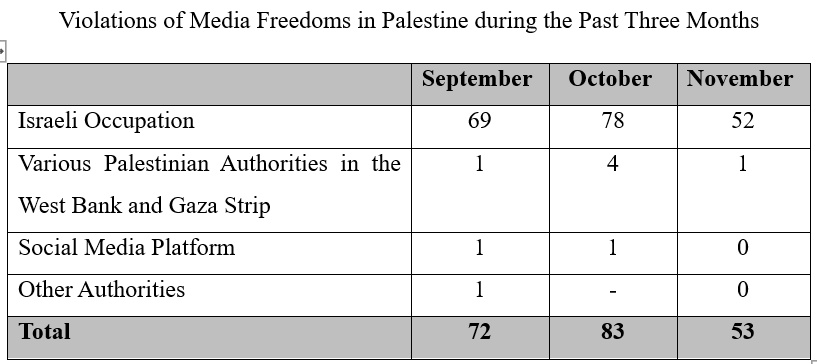
Ramallah – 5th Dec. 2025 The Palestinian Center for Development and Media Freedoms (MADA) documented a total of fifty-three (53) violations against media freedoms in Palestine during the past month of November. The Center documented eighty-three (83) violations during the preceding month of October, marking a decrease of thirty (30) points, or 36%.
This decline in the number of violations is primarily due to the reduction of incidents in the Gaza Strip following the implementation of the truce and the cease-fire between the Israeli and Palestinian sides as of October 11, despite numerous breaches of the agreement. Nevertheless, no journalist was documented as having been killed during the month.
According to field researchers at MADA, Israeli occupation violations constituted the majority of incidents recorded in May, totaling fifty-two (52) out of fifty-three (53) violations, while Palestinian authorities in the West Bank committed a single violation.
ISRAELI VIOLATIONS
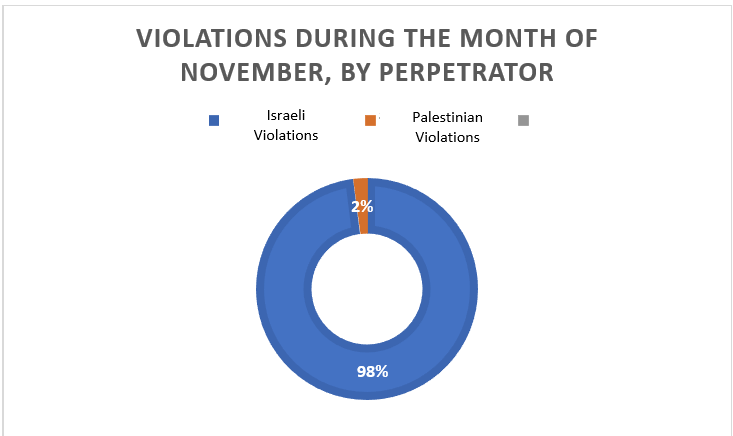
The number of Israeli violations and assaults against journalists and media freedoms decreased in November compared to the number documented in October. A total of fifty-two (52) offences and violations were recorded in November, committed by Israeli occupation forces and settlers in the West Bank and the Gaza Strip, constituting 98% of all documented violations, compared to seventy-eight (78) offences and violations recorded in the previous month.
During November, the nature of Israeli assaults underwent some changes, most notably the absence of any documented cases of journalists being killed. However, serious physical violations that endangered journalists’ lives and threatened media freedoms in general continued, albeit at a lower rate than before. MADA documented nine (9) physical assaults against journalists, eight (8) of which occurred in the West Bank. Notably, some journalists were subjected to multiple or compounded assaults within a short period.
Among the most severe injuries was that of Al Jazeera cameraman FADI YASSIN, who was struck by two metal bullets in both legs while covering a solidarity gathering organized by residents of Nur Shams Camp on Tuesday afternoon. Also of considerable severity was the injury sustained by Reuters photographer RANEEN SAWAFTEH, who was directly assaulted and brutally beaten by settlers in the town of Beita. She suffered severe fractures and fragmentation of her right elbow joint, serious fractures in her hand, and multiple bodily injuries. Doctors determined that she requires an artificial elbow joint due to the extent of bone fragmentation.
At the same event, Xinhua cameraman NAEL BUAITEL sustained a fracture in his right foot, while LOAY SAEED, MOHAMMAD AL-ATRASH, and NASSER SHTAYYEH suffered bruises in various parts of their bodies as a result of settlers beating them with sticks. Israeli soldiers also assaulted Al-Ghad TV cameraman SHADI JARAR’AH and Al-Fajr TV reporter YAZAN HAMAYEL after detaining them during coverage in the city of Tubas.
Reuters freelance journalist IBRAHIM HAJJAJ was wounded and bruised in various parts of his body following a strike targeting civilians in the Zeitoun neighborhood south of Gaza City. He was only twenty (20) meters away from the site of the explosion, which sent stones and shrapnel flying, injuring his right leg and back. The blast threw him several meters into the air, causing a head concussion and additional bruises.
In addition to physical violations, MADA recorded twenty-seven (27) instances of coverage denial targeting numerous journalists and media crews on multiple occasions while covering different events across the West Bank, twenty-four (24) of these incidents occurred in the Hebron governorate. Those affected included Al-Hadath Newspaper reporter MUSAB SHAWAR, Xinhua cameraman MA’MOUN WAZWAZ, freelance cameraman AMER AL-SHALLOUDI, photojournalist YOUSRI AL-JAMAL, cameraman HAZEM BADR, Al Jazeera reporter MUNTASIR NASSAR and cameraman AHMAD AMR, freelance journalist SARI JARADAT, Al-Ghad TV reporter RAED AL-SHARIF, cameraman JAMIL SALHAB, among others.
Occupation forces also detained seven journalists during the past month. Al-Ghad TV cameraman SHADI JARAR’AH and Al-Fajr TV reporter YAZAN HAMAYEL were detained in Tubas for an hour. Iranian TV reporter KHALED SABARNAH was detained at a flying checkpoint in Bethlehem after soldiers saw his press equipment in the vehicle. Journalists HESHAM ABU SHAQRA and SAMER ROWAISHED were detained for several hours in the Jabba area of Bethlehem, subjected to body searches despite carrying press gear, before being allowed entry. This was the second detention for ABU SHAQRA, who had previously been held in Huwara for nine hours, during which some of his equipment was confiscated.
In an unprecedented incident, occupation forces raided the home of freelance journalist IHAB AL-ALLAMI in Beit Ummar to prevent him from leaving and covering the army’s incursion into the town. Soldiers also deleted footage from the phone of journalist YASSER THALJI in Hebron’s Old City and prevented him from covering the settlers’ weekly march. Similarly, occupation soldiers deleted footage from journalist MUJAHID TUBANJEH’s phone while he was covering an olive-harvesting event east of Nablus. Journalist MOHAMMAD NAZZAL was also targeted with live metal rounds during his coverage of an incursion into the city of Qalqilya.
Additionally, the Israeli Ministry of Foreign Affairs published an inciting post against Palestinian journalist MU’TASIM DALOUL on its official account on platform X, accusing him of working for terrorist organizations.
MADA also documented the destruction of the homes of two journalists in the Gaza Strip during Israeli bombardment; the journalists only learned of this after returning to the sites of their homes last month.
In the same context, an Israeli military court issued a two-year prison sentence against detained photojournalist RAMEZ AWAD, from the village of Jifna north of Ramallah.
PALESTINIAN VIOLATIONS
The number of documented Palestinian violations decreased in November to a single violation, compared to four (4) violations recorded in the preceding month of October, representing a 25% decrease. Palestinian violations accounted for 2% of all documented incidents.
This violation consisted of the Preventive Security Service’s arrest of Palestine Post reporter MOHAMMAD MASHARQA, who was referred to the prosecutor’s office and the Dura Magistrate Court in the city of Hebron. He was released after one week on a bail of five-hundred (500) Jordanian dinars.
DETAILS OF THE VIOLATIONS
(4th Nov.)
An Israeli occupation soldier deleted media files from journalist MUJAHID TABANJA’s phone on Tuesday morning while he was east of Nablus covering an olive-harvesting event and prevented him from continuing his coverage.
“Palestine Post” reporter MUJAHID TABANJA (26 years old) told MADA that he arrived in the Azmout area east of Nablus at 8:30AM on Tuesday together with Reuters photographer RANEEN SAWAFTEH to cover an olive-harvesting activity. He was fully wearing press gear, vest and helme, both marked “PRESS”. Several soldiers were present in the area but did not initially prevent them from working.
While he was filming one of the soldiers approaching him, the soldier asked him in Hebrew to stop filming and questioned why he was using his phone to record. The soldier then took the phone from his hand, browsed through all media files related to the event, and deleted them completely including the items stored in the “Recently Deleted” folder. He then handed the phone to an officer who inspected it briefly without speaking, returned it to him, and said in Hebrew: “Take the phone and leave; I don’t want any filming here”.
(8th Nov.)
A number of Palestinian journalists, foreign supporters, and farmers were injured on Saturday morning during a violent assault carried out by armed Israeli settlers while they were covering an olive-harvesting event in the Jabal Qamas area of Beita, south of Nablus.
According to the testimony of the Journalists’ Syndicate representative AYMAN AL-NOUBANI to MADA, fourteen (14) people, including five (5) journalists, were injured after dozens of heavily armed settlers attacked journalists and farmers. All injured individuals were transported to the Beita Emergency Center for first aid before some were transferred to hospitals due to the severity of their injuries.
Al Jazeera cameraman LOAY ASHRAF SAEED (27 years old) told MADA that around 10:30AM on Saturday he was broadcasting live from Beita to cover the olive harvest. After concluding the first live segment, a group of settlers emerged from a nearby tent and launched an attack. Present at the time were Reuters photographer RANEEN SAWAFTEH, Al Jazeera reporter MOHAMMAD AL-ATRASH, Xinhua cameraman NAEL BUAITEL, and US SIPA Agency cameraman NASSER SHTAYYEH.
As the attack intensified, the journalists fled toward the mountain. During the escape, settlers threw large stones at them. The terrain was extremely rough, hindering their movement and causing them to fall multiple times while trying to get away.
Journalist RANEEN SAWAFTEH was unable to escape and was subjected to a direct and brutal beating by settlers, resulting in a severe fracture and fragmentation of her right elbow joint. She was later transferred to An-Najah National University Hospital, where doctors determined she required an artificial elbow joint due to extensive bone fragmentation. She also sustained serious hand fractures and multiple bodily injuries.
Xinhua cameraman NAEL BUAITEL suffered a fracture in his right foot and was later transferred to the Arab Specialized Hospital in Ramallah for further treatment.
Al Jazeera cameraman LOAY SAEED sustained bruises and contusions across his body after falling while fleeing, while Al Jazeera reporter MOHAMMAD AL-ATRASH and US SIPA cameraman NASSER SHTAYYEH sustained multiple bruises after being beaten by settlers using their hands and sticks.
All injured journalists were taken to the Beita Emergency Center for initial treatment before some were transferred to other hospitals due to the seriousness of their injuries.
(7th Nov.)
Israeli occupation forces prevented the reporter and director of Karama Radio from covering settlers’ takeover of an archaeological site in the Masafer Yatta area on Friday morning and obstructed his work, claiming the area was a “closed military zone”. They threatened him and all civilians present with arrest.
In his testimony to MADA, Karama Radio reporter and director SULEIMAN ABU A’RAM (44 years old) said that around 10:00AM on Friday, he headed to Khirbet Huraybat Al-Nabi in eastern Masafer Yatta to cover the settlers’ takeover of an archaeological site on private Palestinian land.
As he began his live broadcast, Israeli soldiers arrived at the site at the same time as several local residents. The soldiers ordered him to stop broadcasting and informed him that the area was a “closed military zone” where no one was allowed to be present. They threatened to arrest anyone who remained, forcing him to leave the site.
(8th Nov.)
Settlers prevented a group of journalists from covering the settlers’ weekly tours in the city of Hebron on Saturday morning and obstructed their work by standing in the middle of the road to block their view and covering their camera lenses with their hands.
According to freelance journalist AMER AL-SHALLOUDI, a group of journalists gathered around 11:00AM near the old municipal square in Hebron to cover the settlers’ weekly march. Settlers gather in a building that they seized several months earlier. As the settlers passed through the center of the Old City toward the entrance leading to the closed Shuhada Street, soldiers intervened, ordering the journalists to move 100 meters away from the site.
The soldiers then moved military vehicles into the middle of the road to completely block the view and stood directly in front of the journalists, placing their hands over camera lenses to force them to stop filming. The journalists eventually had to leave the location without completing their coverage.
Journalists present at the scene included: Freelance journalist AMER MOHAMMAD AL-SHALLOUDI, Reuters cameraman MA’MOUN ISMAIL WAZWAZ, Radio Al-Rabea cameraman and reporter TAHA ABU HUSSEIN, and Al-Hadath NEWSPAPER reporter MUSAB ABDEL-SAMAD SHAWAR.
(9th Nov.)
The Preventive Security Service arrested journalist MOHAMMAD MASHARQA after summoning him by phone for an interview at its headquarters, on the pretext of “incitement against the Palestinian Authority”. His detention was extended twice, and he was released after one week on a bail of 500 Jordanian dinars, following his appearance before the Dura Magistrate Court in Hebron.
According to the testimony given to MADA by Palestine Today reporter MOHAMMAD ISMAIL MASHARQA (40 years old), he received a phone call from the Preventive Security Service at around 10:00AM on Sunday requesting that he report to their headquarters in Hebron for an interview.
When he arrived as instructed, his belongings, including his mobile phone, were taken from him. He was placed in a solitary cell on the first floor, where he remained the entire day. That night, he underwent an interrogation session about the nature of his journalistic work and his social connections, under the accusation of inciting against the Palestinian Authority, an accusation he completely denied. He informed the interrogator that they had his phone and unlocked it for them to verify.
He returned to the cell and remained there until Tuesday morning, 11th Nov. 2025, when he was transferred to the Dura Magistrate Court. He was presented before the prosecutor, who charged him with “insulting the authorities”, in the presence of his lawyer. His detention was extended for 48 hours, and he was returned to the same cell at the Preventive Security headquarters in Hebron. Later that day, he underwent another interrogation session on the same topics.
On Thursday morning, 13th Nov. 2025, he appeared again before the magistrate judge in Dura, who ordered his detention for an additional five days on the same charge filed by the prosecutor. He was then returned to the headquarters and moved to mass incarceration, where he remained until his next hearing on Thursday, 18th Nov. 2025, during which the judge ordered his release on a 500-dinar bail.
He reported that he was not subjected to any mistreatment during his detention. He was released from the Preventive Security headquarters on Thursday evening, although his mobile phone was retained for further examination. On 30th Nov., he went to the headquarters and retrieved his phone.
(15th Nov.)
Israeli soldiers prevented a group of journalists from covering settlers’ weekly tours in the Old City of Hebron on Saturday afternoon, obstructing their work by threatening them with weapons and pushing them 200 meters away from the events, forcing them to leave the area.
In his testimony to MADA, Al-Hadath Newspaper reporter MUSAB SHAWAR said that at around 1:00PM, on Saturday, he headed to the Old City of Hebron together with Al-Ghad TV reporter RAED AL-SHARIF, the channel’s cameraman JAMIL AZZAM SAHLAB, and freelance journalist AMER MOHAMMAD AL-SHALLOUDI to cover the settlers’ weekly tours.
While SHAWAR was conducting an interview with a merchant near the old municipal square, a group of settlers began shouting. Soldiers then intervened, stopped the filming, and prohibited the four journalists from remaining in the area. They continued pushing them back for approximately 200 meters, forcing the journalists to leave the site as they could no longer cover the event.
(18th Nov.)
Al Jazeera cameraman FADI YASSIN was injured by two metal bullets in the legs, and Israeli soldiers detained photojournalist MAHMOUD FAWZI for about 45 minutes during their coverage of a solidarity gathering organized by residents of Nur Shams Camp on Tuesday afternoon to demand their return to their homes.
Al Jazeera cameraman FADI ABD AL-RAHIM YASSIN (47 years old) told MADA that he arrived at Nur Shams Camp in Tulkarm at 1:00PM on Tuesday, where residents had begun gathering in front of the Camp’s main gate and chanting to demand their right to return to their homes after being forcibly displaced for ten months. He was preparing for a live broadcast scheduled for 1:30PM.
A few minutes before going live, FADI moved among the citizens, being the last journalist to blend in with his colleagues within the crowd. While filming shots for the news report, he was struck by a bullet in the back of his leg without seeing it fired but noticed blood beside him. Seconds later, another bullet hit his second leg from the front, and he clearly saw the entry and exit wound. He attempted to stand several times before collapsing, after which he received first aid and was transported to Thabet Thabet Governmental Hospital, then transferred to Al-Zakah Hospital.
He was injured by live rounds in both legs. The first injury in the right leg was less severe, whereas the second bullet in the left leg caused muscle laceration and reached the bone, requiring a surgical operation lasting about one to one-and-a-half hours to reconstruct the tissue and close the wound with internal and external sutures.
Roya TV cameraman MAHMOUD FAWZI ISMAIL (40 years old) told MADA that he arrived at the location shortly before 1:00PM to cover the gathering. Journalists were spread out normally around the area, while Israeli soldiers stood near the gate without intervening initially.
Moments after the event began, metal bullets were fired at citizens and journalists. MAHMOUD tried to move to a safer area, but a group of soldiers quickly advanced toward them. One soldier grabbed him directly and ordered him to move away. MAHMOUD attempted to inform him that he was a journalist, he was wearing a press vest and helmet clearly marked “PRESS”, but the soldier forced him to sit on the ground and prohibited him from touching his camera. Another soldier detached the battery from the camera and placed it aside. Each time MAHMOUD tried to stand, the soldiers ordered him to sit again.
He was detained for 30–45 minutes before soldiers allowed him to leave and retrieve his camera.
(19th Nov.)
Israeli soldiers detained two journalists for several hours in the Jub’a area south of Bethlehem on Tuesday morning, obstructing their work by stopping them, searching them, and inspecting their IDs.
In his testimony to MADA, the Arabic-language “Turkish Channel” reporter SAMER ANWAR ROWEISHAD said that at around 9:30AM on Tuesday, he headed with Reuters cameraman MA’MOUN WAZWAZ and Anadolu Agency cameraman HESHAM KAMEL ABU SHAQRA to the Jub’a area south of Bethlehem to cover settler attacks on residents.
Upon arrival, the three journalists walked roughly 200 meters from a gate blocking the road, several soldiers approached and ordered them to stop. After inspecting their IDs, the soldiers allowed cameraman MA’MOUN WAZWAZ to proceed, while journalists ABU SHAQRA and ROWEISHAD were detained in the area. They were subjected to a body search despite carrying press equipment clearly identifying them as journalists and were told to remain for a “security check”. The two journalists waited in the area for several hours before being allowed to enter, without the soldiers speaking to them.
(19th Nov.)
Journalist IBRAHIM SAEED HAJJAJ (23 years old), a freelance contributor to Reuters, was injured with wounds and bruises across various parts of his body after an Israeli airstrike targeted a gathering of civilians in the Zeitoun neighborhood south of Gaza City on Wednesday evening.
In his testimony to MADA, IBRAHIM HAJJAJ stated that he left his workplace at around 5:00PM on Wednesday. While passing through the Asqoula intersection in the Zeitoun neighborhood, Israeli F-16 warplanes suddenly bombed a group of civilians. He was only 20 meters away from the blast site, causing stones and shrapnel to fly and strike him in the right leg and back, in addition to other injuries. The force of the explosion hurled him several meters into the air before he fell to the ground, where he suffered a concussion and further bruising.
As a result of his injuries, the journalist briefly lost both vision and hearing and remained among the scattered debris before losing consciousness. An ambulance arrived and transported him to Al-Ma’madani Hospital in the city, where he received treatment and underwent the necessary medical examinations.
(20th Nov.)
Israeli soldiers prevented a group of journalists from covering the closure of the town of Beit Ummar south of Hebron on Wednesday morning, obstructing their work and forcing them to leave the area for fear of being subjected to violations.
According to the testimony of Xinhua cameraman MA’MOUN WAZWAZ to MADA, at around 8:00AM on Wednesday he and several journalists, Al-Hadath reporter MUSAB ABDEL-SAMAD SHAWAR, Reuters cameraman YOUSRI MAHMOUD AL-JAMAL, and photojournalist HAZEM JAMIL BADR, headed to Beit Ummar north of Hebron after Israeli forces closed the town and arrested dozens of residents.
Upon arriving at one of the blocked roads on the western side of the town, sealed with piles of dirt, the journalists proceeded on foot. When they reached a distance of about 300 meters, an Israeli military vehicle arrived, and soldiers disembarked, pointing their weapons at the journalists as they advanced toward them without saying a word. The journalists were forced to retreat, with soldiers continuing to advance, prompting them to leave the area out of fear for their safety.
(20th Nov.)
A force of Israeli soldiers raided the home of journalist IHAB AL-ALLAMI in the town of Beit Ummar and prevented him from leaving to cover the army’s raid on the town, citing a military decision to close the area completely.
According to the testimony of independent journalist IHAB AL-ALLAMI to MADA, Israeli forces raided Beit Ummar at dawn on Wednesday and entered his home in the center of the town at around 2:00AM, after positioning themselves in a house near his. As the soldiers entered, he was preparing to go out to cover the incursion. The soldiers requested his ID, and he handed them his press card.
After checking it, one of the officers told him: “You are not allowed to leave the house. There is a military order to close the area completely”. The force then left the home.
(21st Nov.)
Israeli forces detained photojournalist HISHAM ABU SHAQRA for about nine hours and confiscated his equipment while he was heading to the town of Huwara on Friday morning to cover settler attacks there. This obstruction prevented him from carrying out his work.
According to the testimony of HISHAM KAMEL ABU SHAQRA (36 years old), a cameraman for the Anadolu Agency, he headed on Friday to Huwara south of Nablus to cover a settler attack on a car repair shop. However, Israeli soldiers suddenly stopped him before he reached the location. They conducted a physical search of him, searched for his vehicle, checked his mobile phone and its contents, and then transferred him to a military camp in the Gerizim Mount area after handcuffing him and blindfolding him. They also confiscated his press equipment and inspected the agency’s media files and materials.
The journalist remained detained in the camp for nine hours before being released at the Awarta checkpoint and having his equipment returned at around 5:00 p.m. Upon checking, he found that two camera memory cards and a DJI Osmo 360 camera were missing.
(21st Nov.)
Israeli soldiers detained journalist KHALED SABARNEH at a flying checkpoint in the Al-Manshiya area of Bethlehem for two hours on Friday afternoon, after noticing his press equipment inside the vehicle while he was heading to the town of Beit Ummar.
According to the testimony given to MADA by KHALED ALI SABARNEH (55 years old), a reporter for Iranian Television, he was heading on Friday toward Beit Ummar north of Hebron around 12:00PM. When he passed through a flying checkpoint in the Al-Manshiya area of Bethlehem, soldiers asked for his ID and family name because he is the uncle of a child who had been killed the previous week. They stopped him and searched his vehicle, discovering his press equipment, and kept him at the side of the road at the checkpoint.
Throughout the detention, soldiers repeatedly questioned him about the reason for his presence and told him that the final decision depended on orders from the command, and that he would be released once a decision was issued. After two hours of waiting, around 2:00PM, he was informed that no official instructions regarding his case had arrived, and he was allowed to pass and released.
None of the journalist’s equipment or personal belongings were damaged, and no physical assault occurred. The soldiers limited their actions to inspection and monitoring.
(22nd Nov.)
Israeli settlers, assisted by Israeli soldiers, obstructed the work of several journalists and media crews in the town of Beit Ula west of Hebron on Saturday morning. They assaulted the journalists, damaged their vehicles, and prevented them from covering an olive-tree planting activity in the town.
According to the testimony of Al Jazeera Live reporter AHMAD MOHAMMED HALAIKA, a group of journalists and media crews headed at around 11:00AM on Saturday to cover an activity involving plowing the land and planting olive trees in an area seized by settlers west of Beit Ula. The journalists were: Roya TV team: reporter MOHAMMED ISMAIL AL-ADDAM and cameraman SHADI ISMAIL ZMAIRA, Al Jazeera reporter MONTASER NASSAR and cameraman AHMAD AMRO, Freelance journalist SARI SHARIF JARADAT, Al-Hadath Newspaper reporter MUSAB ABDULSAMAD SHAWAR, and Al-Ghad TV team: correspondent RAED “MOHAMMED SAMEER” AL-SHARIF and cameraman JAMIL AZZAM SALHAB.
Upon the arrival of several journalists’ vehicles to the area, a settlers’ vehicle blocked their way and rammed the front of journalist MOHAMMED AL-ADDAM’s car. Two armed settlers stepped out, pointing their rifles and shouting insults at the journalists, ordering them to leave. One settler struck the car door twice with the butt of his rifle, while the other hit the rear trunk cover, causing a puncture.
Journalist AL-ADDAM and the rest of the journalists were forced to retreat about 700 meters as the settlers’ vehicle advanced toward them.
At the same time, two settlers accompanied by three Israeli soldiers reached the vehicle of journalist AHMAD HALAIKA. The soldiers took his ID and inspected it, while the settlers searched his vehicle in full view of the soldiers. After about 15 minutes, the soldiers ordered HALAIKA to leave the area.
All journalists ultimately left the site without completing their coverage as soldiers began firing a barrage of tear gas canisters toward the citizens who had gathered there.
(23rd Nov.)
The Israeli Ministry of Foreign Affairs published an inciting post against Palestinian journalist MU’TASIM DALOUL on its official account on X on Sunday evening.
According to his testimony to MADA, MU’TASIM AHMAD DALOUL (43), a reporter for the British Outlet Middle East Monitor, stated that the occupation authorities renewed their incitement against him through social media, this time officially, via a post issued by the Israeli Foreign Ministry on X at 4:45PM on Sunday. The post accused him of belonging to “terrorist organizations”, promoting their propaganda, and claimed he was residing in Poland and spreading “Palestinian propaganda” from there.
DALOUL refuted these allegations, stressing that they constitute a new wave of incitement. He confirmed he is inside the Gaza Strip and has not left it at all. He explained that his publication of news, posts, and opinions aims to convey the suffering of the people of Gaza under occupation and war, the negative impact of the ongoing violence, and what he described as two years of deliberate atrocities committed by the occupation, expressed through his writings for international audiences.
This was the second incident of incitement against the journalist in less than a month, as Israeli officers had also targeted him at the end of October. DALOUL had lost his wife and several of his children in an airstrike targeting his home earlier in the war.
He further stated that such incitement places his life and the lives of his remaining family members in grave danger, exposing him to potential targeting at any moment, especially as the incitement originates from high-level official bodies in the occupying state, aiming to silence his voice. DALOUL emphasized that he is a Palestinian journalist from Gaza and does not belong to any faction or political organization.
(27th Nov.)
Israeli soldiers detained two journalists inside a military outpost for one hour and physically assaulted them while they were in the city of Tubas to conduct an interview with the director of the Palestinian Red Crescent Society on Thursday afternoon.
According to the testimony provided to MADA by Al-Ghad TV cameraman SHADI YASSER JARAR’A (35), he was present with his colleague, Al-Ghad reporter KHALED BDEIR, and Al-Fajr TV reporter YAZAN HAMAYEL between 11:30 and 11:45AM, in Tubas, preparing to conduct an interview with the director of the Red Crescent Society, when they were surprised by an Israeli military force arriving at the location.
The soldiers ordered the journalists to step back, and they complied. However, the soldiers then shouted for their ID cards. One soldier told journalist KHALED BDEIR: “Take the camera and go,” and pointed to cameraman SHADI, saying: “You—come with us”. SHADI added that soldiers then detained him and YAZAN together, cuffing their hands, blindfolding them, and placing them inside a military jeep.
The two journalists were transferred to a military outpost. Upon being taken out of the vehicle, they were forced to walk a distance to the site and were subjected to several kicks and blows by the soldiers along the way. They remained detained for an hour before being released.
(28th Nov.)
Israeli settlers prevented media crews from covering the weekly protest organized by local residents in Tarqumiya against settler seizure of their lands. Israeli soldiers assisted the settlers by firing stun grenades to obstruct coverage on Friday morning.
According to the testimony of Al Jazeera reporter MONTASER NASSAR to MADA, he arrived at 9:00AM on Friday with Al Jazeera cameraman AHMAD AMRO, Al-Hadath reporter MUSAB ABDUL-SAMAD SHAWAR, and Xinhua cameraman MA’MOUN MAHMOUD WAZWAZ to the Sha'b Abu Ra'iya area in the northern part of Tarqumiya to cover the weekly protest against settler land takeover.
As soon as the residents and press crews reached the area, several Israeli military jeeps arrived accompanied by settlers. One settler approached and blocked the main camera screen of the Al Jazeera team, preventing them from filming and obstructing their view. Other settlers did the same to the rest of the journalists, forcing them to retreat about 200 meters from the protest site.
During this time, soldiers fired stun grenades toward the residents and media crews. One grenade landed near the Al Jazeera team during a live broadcast, prompting the journalists to withdraw as the soldiers continued firing tear gas, eventually forcing them to leave the area without completing their coverage.
(29th Nov.)
Israeli soldiers targeted freelance journalist MOHAMMAD NAZZAL with live ammunition and chased him for several minutes before he was able to escape while covering an Israeli military incursion in the city of Qalqilya on Friday evening.
According to the testimony of MOHAMMAD AHMAD NAZZAL (28) to MADA, he was present at 9:23PM on Friday on Nablus Street in Qalqilya, riding an electric bicycle to cover the military incursion. He was surprised by an Israeli force that brandished weapons at him, shouting: “Stop… stop.”
Upon seeing them, he abandoned his bicycle and attempted to retreat. However, the soldiers fired live ammunition directly at him and pursued him for several minutes before he managed to escape to a safe location, narrowly escaping death.
(29th Nov.)
Israeli soldiers prevented two journalists from covering the weekly settlers’ march in the Old City of Hebron, obstructed their work, and deleted footage from journalist YASSER THALJI’s camera after closing the Old Market area on Saturday afternoon.
Freelance journalist AMER MOHAMMAD AL-SHLLOUDI told MADA that he and YASSER THALJI JARADAT went at 3:00PM on Saturday to cover the weekly settlers’ march in the Old City of Hebron.
While the journalists were in the Old Market area, Israeli soldiers closed the shops and restricted movement in the area. During this time, one soldier approached journalist YASSER JARADAT, claimed that he was being filmed, then took his phone and deleted the recorded materials.
Afterward, the soldiers forced the journalists to retreat a considerable distance from the location of the soldiers and settlers. The two journalists eventually left shortly afterward due to their inability to continue coverage.
(Date unspecified) – The home of journalist MOHAMMAD ASAAD in the Shuja’iyya neighborhood of Gaza City was destroyed by Israeli forces during the ongoing attacks in eastern Gaza over the past months, even after the ceasefire came into effect.
According to the testimony of MOHAMMAD ASAAD (40 years old), a cameraman for Safa News Agency, Israeli soldiers planted several explosive vehicles near his home in Shuja’iyya. They detonated these explosives, destroying an entire residential block in the neighborhood. His home, along with dozens of neighboring houses, was completely destroyed by the blast.
The journalist is now homeless, having lost all of his furniture and personal belongings, and is currently living in a small tent unsuitable for habitation.
(Date unspecified) – The home of AHED AWNI FARWANA (50 years old), Secretary-General of the Journalists’ Syndicate in Gaza, was also destroyed by Israeli forces during the large-scale military operation in July in the Shuja’iyya neighborhood of eastern Gaza.
FARWANA told MADA that he had evacuated his home following orders issued by Israeli forces before July. Afterward, Israeli forces demolished the entire residential block, including his multi-story home, leveling it completely.
He could not return to his home to check on it after the ceasefire because it is located in a “yellow zone” still under Israeli control. However, he was able to view images showing his home destroyed. He currently lives in a small tent that does not meet his daily living needs.
