

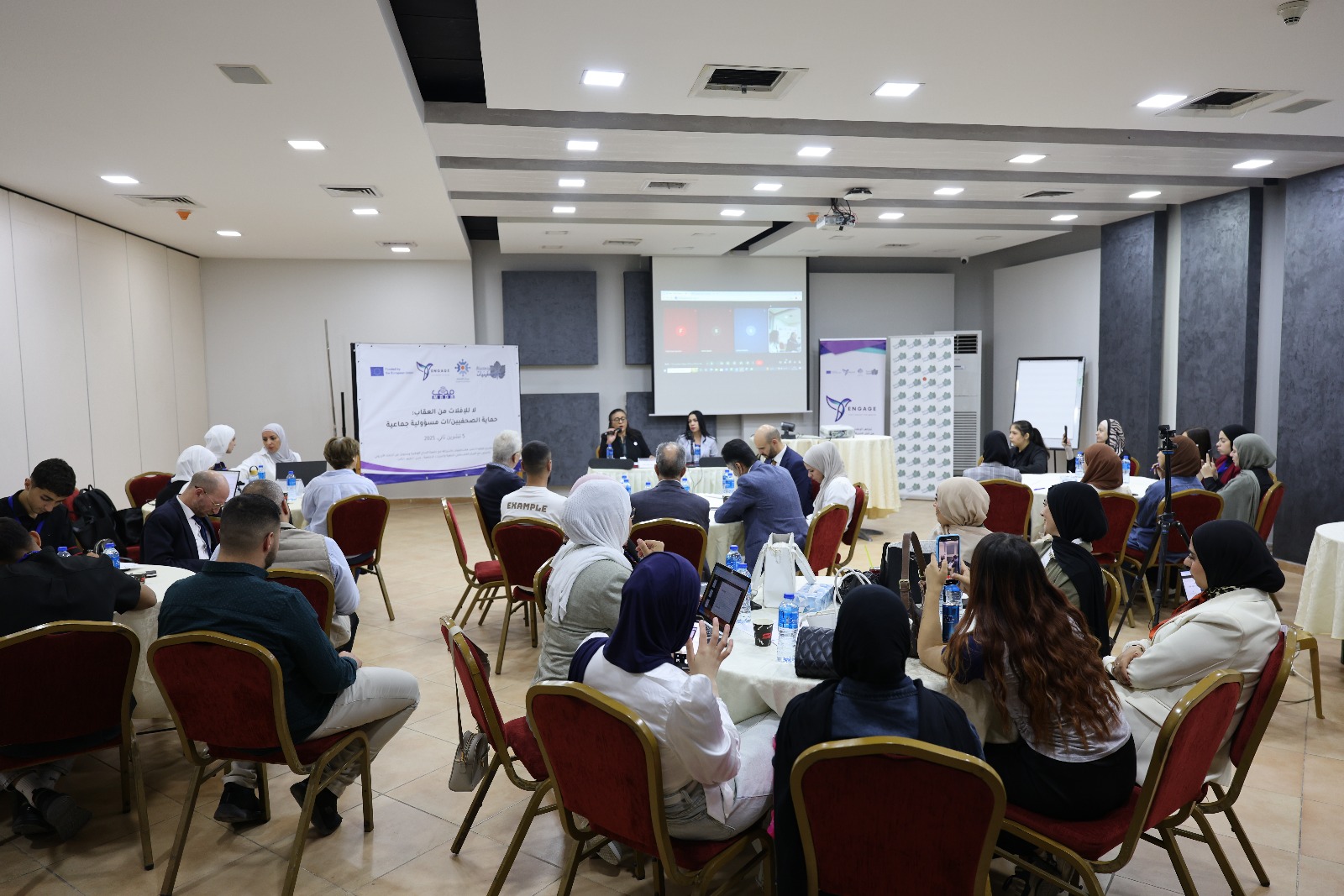
Ramallah – November 7, 2025 The Civil Coalition for the Protection of Freedom of Expression and Digital Rights in Palestine organized a workshop, on Wednesday November 05, titled “No to Impunity: Protecting Journalists is a Collective Responsibility”, held at the Red Crescent Society Hall in Al-Bireh City. The event was attended by a large number of representatives from civil society organizations, human rights and media institutions, as well as students from media departments at Palestinian universities.
The event was organized in partnership with the MADA Center for Media Freedom, Falestiniyat Association, and the Media Center at An-Najah National University, with support from the European Union under the Engage Project activities.
The workshop opened with remarks from Ms. WAFA’ ABDUL RAHMAN, representative of the Falestiniyat Association, who welcomed the attendees and highlighted the significance of this occasion and the importance of addressing impunity, with a focus on the ongoing violations in the Gaza Strip. She was followed by Ms. SHIREEN AL-KHATIB, Acting Director of the MADA Center, who discussed the current state of journalistic work and the escalation of violations against journalists, particularly emphasizing the rising number of journalists who have been killed during the genocidal war on Gaza since October 2023.
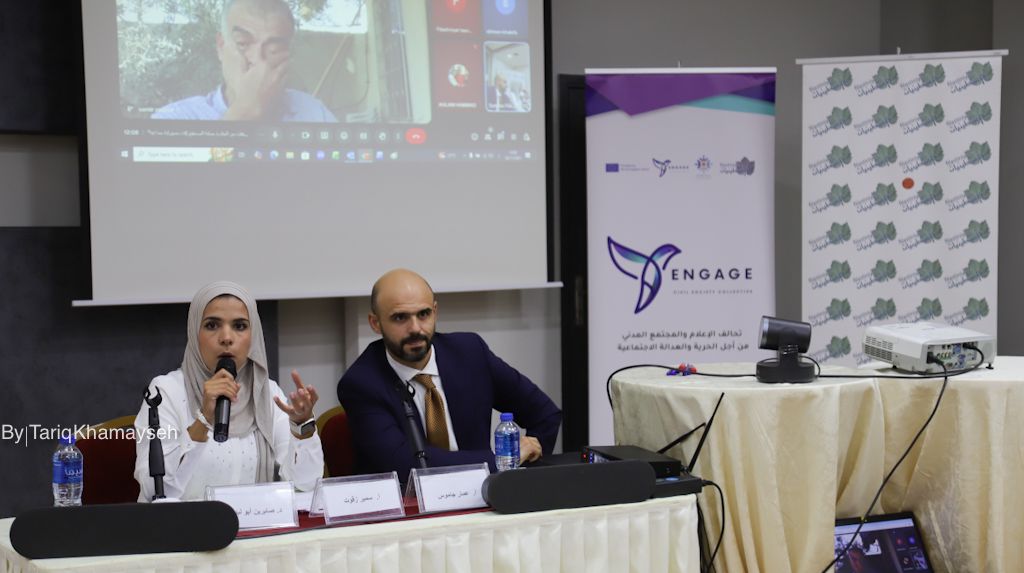
Mr. SAMIR ZAQOUT from the Al-Mezan Center for Human Rights shed light on the historical and complex trajectory of impunity in the Palestinian context and the ongoing human rights efforts to open a path toward international justice despite political complicity and legal obstacles. He stressed that accountability is no longer merely a legal issue but also a matter of international and moral will, requiring continued human rights and media pressure to leverage recent developments at the International Criminal Court (ICC) and translate them into practical steps that end decades of impunity and open genuine prospects for justice and redress for Palestinian victims.
In turn, Mr. AMMAR JAMOUS, legal researcher at the Independent Commission for Human Rights, highlighted the human rights and legal dimensions of combating impunity, an approach that fully aligns with MADA’s vision that justice cannot be achieved without genuine and credible accountability grounded in accurate and independent documentation of violations against journalists. He pointed out that the challenges discussed, ranging from the paralysis of the international justice system to weak support for local human rights institutions, underscore the need for unifying efforts between journalists and legal advocates to strengthen evidentiary tools and turn media-based documentation into genuine political and moral pressure on the international community to end impunity in Palestine.
Dr. SABRIN ABU LABDEH, Project Coordinator at the Coalition for the Independence of the Judiciary and the Rule of Law (Istiqlal), deconstructed the legal frameworks governing impunity in both the Israeli and Palestinian contexts, clearly revealing the gap between legal provisions and the actual application of justice. Her intervention emphasized the urgent need to activate international accountability mechanisms, particularly before the International Criminal Court, while also reforming the Palestinian legal system to ensure respect for media freedom and judicial independence. She stressed that confronting impunity requires genuine integration between human rights and media efforts to build a culture of accountability that excludes no one.
The floor was then opened for participants’ remarks, questions, and discussion. Several key recommendations emerged from the session:
- Pressuring the United Nations and its member states to ensure implementation of the UN Resolution of December 18, 2013, on ending impunity, and monitoring states’ commitments to providing a safe environment for journalists.
- Establishing a unified Palestinian legal-media body to monitor and document occupation-related violations and build an international coalition to defend media freedom.
- Launching a wide-scale international advocacy campaign to expose the occupation and its crimes.
- Urging Palestinian and international human rights and media organizations to intensify efforts in documenting violations and sharing data through UN mechanisms related to freedom of expression and human rights.
- Creating a blacklist of Israeli journalists who incited or promoted genocide, to pursue their accountability before European and international courts.
- Activating individual complaints before international and domestic courts on behalf of relatives of martyred journalists.
- Establishing a compensation fund for local journalists who are victims of violations.
