


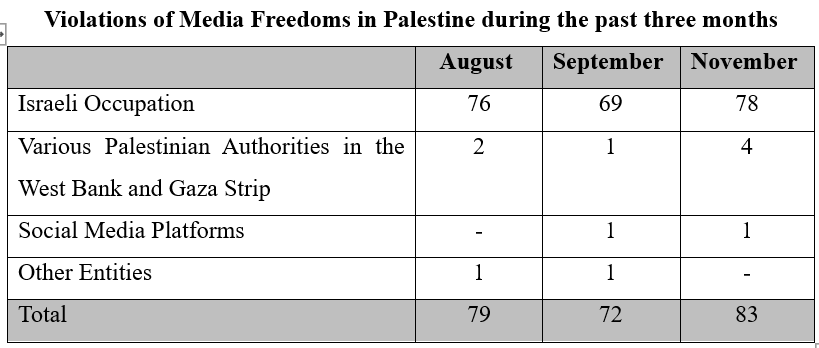
Ramallah – November 3rd, 2025 The Palestinian Center for Development and Media Freedoms (MADA) monitored and documented a total of eighty-three (83) violations against media freedoms in the West Bank and the Gaza Strip during the past month of October, the majority of which were committed by the Israeli occupation. This represents an increase of seventeen percent (17%) compared to a total of seventy-two (72) crimes and violations documented during the preceding month of September.
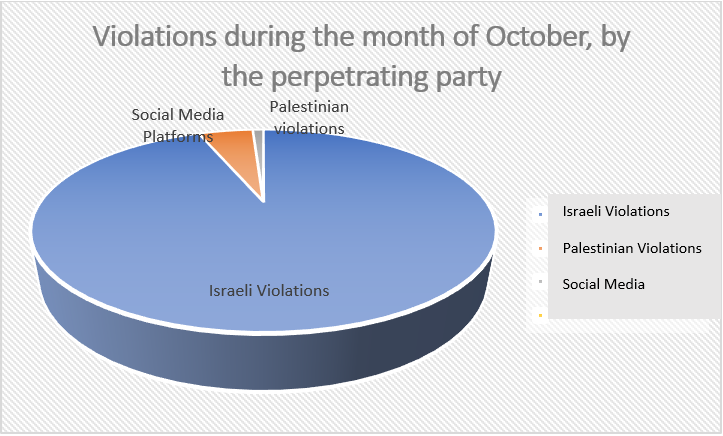
The violations recorded during October were distributed as follows: seventy-eight (78) violations committed by Israeli entities, four (4) violations committed by various Palestinian parties in the West Bank, and one (1) violation committed by social media companies.
The number of documented violations rose despite the cessation of the genocide in the Gaza Strip, following the announcement of both the Israeli and Palestinian sides’ approval of the terms and implementation mechanisms of the first phase of the ceasefire agreement, which came into effect on Wednesday, the 9th of October.
Israeli Violations:
During the past month of October, the occupation forces and authorities committed a total of seventy-eight (78) crimes and assaults against media freedoms, distributed as fifty-four (54) violations in the West Bank and twenty-four (24) in the Gaza Strip. These accounted for ninety-four percent (94%) of all documented violations, marking an increase of thirteen percent (13%) compared to the Israeli assaults recorded during the previous month of September.
Most of these violations are classified as serious assaults on media freedoms in general. The majority of violations in the West Bank occurred while journalists and media crews were covering olive-harvesting activities during which settlers attacked citizens and prevented them from reaching their lands under the protection of occupation soldiers. Meanwhile, home demolitions constituted the majority of violations in the Gaza Strip.
In addition to the killing of two (2) journalists, the MADA Center monitored and documented a total of eleven (11) physical assaults, eight (8) of which occurred in the West Bank. Occupation soldiers also arrested freelance journalist MUSAB QAFISHA, releasing him several hours later after beating, kicking, and abusing him. The occupation forces further prevented twenty-eight (28) journalists from media coverage in the West Bank and targeted another eight (8) with live bullets, stun grenades, and tear gas to obstruct their coverage of various events in the area.
Moreover, fifteen (15) journalists in the Gaza Strip were able to confirm the fate of their homes, which had been demolished or bombed by the occupation forces after the ceasefire agreement took effect in the Gaza Strip.
Additionally, the spokesperson of the Israeli army incited against journalist MO'TASEM DALLOUL in the Gaza Strip through a post on his official account on platform (X), labeling him a “terrorist” and “liar” in his media coverage.
In a separate context, on October 28th, the occupation authorities extended the administrative detention of journalist and editor 28, 2025, after the storming of his home in the town of Beita, south of the city of Nablus.
Palestinian Violations:
The number of documented Palestinian violations against media freedoms during the past month of October rose to four (4) violations, compared to a single (1) violation recorded during the previous month of September — an increase of three hundred percent (300%).
These Palestinian violations, which constituted five percent (5%) of the total documented violations during the past month, were distributed as follows: three (3) violations occurred in the West Bank, and one (1) violation was documented in the Gaza Strip.
In the West Bank, the Palestinian Preventive Security Organization arrested journalist SAMI AL-SA’I while he was present on one of the streets of the city of Tulkarm. He was referred to the Public Prosecution on charges of “inciting sectarian strife”, based on a post he had shared on the social media platform Facebook. The journalist was subjected to physical abuse, humiliation, and mistreatment, as his hands were painfully and degradingly bound behind his back. He was released on a personal bail of five thousand (5,000) Jordanian dinars after three (3) days of detention.
In the Gaza Strip, freelance journalist SALEH AL-JA’FRAWI was killed by gunfire from an armed group while covering clashes between the group and security forces affiliated with the government in the Tel Al-Hawa neighborhood, south of Gaza City.
Social Media Violations:
The violations committed by social media platforms against media freedoms during the past month of October were limited to a single (1) violation. This occurred when the application WhatsApp, owned by the company Meta, permanently deleted and blocked the account of ISMAIL ABU OMAR, an editor at Al Jazeera TV, on the pretext of violating the platform’s publishing policies.
List of Media Martyrs During the Month of September
|
Name of Journalist |
Date Killed |
Place of Work |
|
|
1- |
SALEH ALJAFARAWI |
12th oct. 2025 |
Freelance Journalist |
|
2- |
AHMED ABU MTAIR |
19th Oct. 2025 |
PMP Satellite Broadcasting Company
|
|
3- |
MOHAMMED ALMINERAWI |
29th Oct. 2025 |
Palestine Newspaper |
Detailed of Violations:
(October 1st)
An Israeli reconnaissance drone bombed a tent adjacent to the journalists’ tent in the courtyard of Al-Aqsa Martyrs Hospital in the central Gaza Strip at noon on Wednesday, causing damage to the tent and to journalists’ equipment.
According to the testimony of photojournalist ATIYA DARWISH to the MADA Center, at approximately 2:50PM in the afternoon on Wednesday, October 1st, an Israeli reconnaissance drone bombed a tent next to the journalists’ tent inside Al-Aqsa Martyrs Hospital in the city of Deir Al-Balah in the central Gaza Strip. The tent was heavily damaged, and several journalists who were inside narrowly survived.
As a result of the explosion’s intensity, some press vests were damaged, broadcast cables belonging to some SNG vehicles were destroyed, and the internet and power lines supplying the tent were cut off. Journalists and their families experienced fear and shock due to their close proximity to the site of the bombing.
It is worth noting that this was not the first time tents or gatherings adjacent to the journalists’ tent and broadcast vehicles in the courtyard of Al-Aqsa Martyrs Hospital were bombed; since the war began two (2) years ago, Israeli shelling has targeted tents near the journalists’ area more than ten (10) times.
(October 3rd)
Israeli occupation soldiers verbally insulted and physically assaulted freelance photojournalist AMJAD ABU AMSHA, breaking his press equipment while he was evacuating southward near the Nitsarim area on Friday afternoon.
According to AMJAD ABU AMSHA (aged twenty-eight – 28) in his testimony to MADA, he was walking on foot on Friday, displaced from Gaza City toward the south. Around 3:30PM in the afternoon, while passing near Nitsarim, he was stopped by occupation forces stationed along Al-Rasheed Street, unaware of their presence. The soldiers called on him and five (5) other civilians to halt and fired shots near their feet to force them to stop.
ABU AMSHA was carrying a backpack containing his press equipment. Upon reaching the soldiers’ position, they began beating him severely on different parts of his body. One of the soldiers then ordered him to identify himself and open his bag. When he took out his equipment, a press vest, a camera, two (2) lenses, and two (2) phones, a soldier said, “You are a journalist”, before hurling insults and curses at him, assaulting him again with rifle butts, breaking his press gear and his personal phone. The soldiers then ordered him to head further south.
After arriving in the city of Deir Al-Balah, ABU AMSHA went to the emergency department at Al-Aqsa Martyrs Hospital to receive treatment for wounds to his left hand and bruises on his back caused by the severe beating.
(October 4th)
Freelance journalist MOHAMMED NAZZAL was injured in the foot and sustained bruises and a hairline fracture in his left hand after fleeing from occupation soldiers and falling to the ground while covering an Israeli military raid on the city of Qalqilya at dawn on Saturday.
In his statement to MADA, MOHAMMED AHMAD NAZZAL (aged twenty-eight – 28) said that at around two o’clock 2:00AM on Saturday, he was in the Jaljuliya Street area of Qalqilya, where Israeli forces stormed the city from the southern entrance amid heavy firing of stun grenades and tear gas, while chasing young men in the area, causing injuries and property damage.
The journalist was forced to withdraw from the area for fear of being directly targeted since he was alone. While fleeing, he tripped and fell, injuring his left hand and foot. He was taken to Darwish Nazzal Governmental Hospital in Qalqilya, where medical examinations and X-rays revealed bruises and a hairline fracture in his left hand, along with superficial wounds to his foot.
(October 4th)
Occupation forces prevented Karama Radio reporter SALMAN ABU ARAM from covering the detention of several citizens in the village of Zweidin in Hebron and obstructed the radio’s live broadcast on Saturday evening.
According to ABU ARAM (aged forty-four – 44), a reporter and director at Karama Radio, he went at around six o’clock (6:00) in the evening from Yatta in southern Hebron to the Bedouin village of Zweidin in the eastern area of Yatta to cover the detention of several citizens by occupation soldiers after they were attacked by settlers.
He began a live broadcast approximately one hundred (100) meters from where the soldiers and detainees were located. While broadcasting, one of the soldiers approached and ordered him to move farther away, which he complied with. However, two (2) other soldiers followed him, began yelling at him, forcibly stopped the live broadcast, and ordered him to leave the area immediately. Fearing an assault, the journalist withdrew.
(October 4th)
Occupation soldiers obstructed the work of a group of journalists covering a settlers’ march in the Old City of Hebron on Saturday afternoon and assaulted one of them by shoving him, though his colleagues managed to prevent him from falling.
According to SARI JARADAT, a reporter for Quds News Network, at around three o’clock (3:00) in the afternoon on Saturday, he, along with WISSAM ABDEL HAFIZ AL-HASHLAMOUN (cameraman for Anadolu Agency), MUSAB ABDEL SAMAD SHAWER (reporter for Al-Hadath Newspaper), and freelance journalist YASSER THALJI, went to the Old City of Hebron to cover the weekly settlers’ march held under the protection of Israeli occupation forces.
While the journalists were with a group of international activists near Al-Laban Market, soldiers ordered them to move back. They complied, but moments later, one of the soldiers advanced, shouted at them to retreat again, and, during the exchange, forcefully pushed SARI JARADAT in the chest, causing him to stumble backward. His fellow journalists caught him before he hit the ground, after which they were compelled to leave the area.
(October 5th)
The WhatsApp application permanently closed the account of ISMAIL ABU OMAR, an editor at Al Jazeera TV, on the pretext of violating the platform’s publishing policies.
In his testimony to the MADA Center, Al Jazeera editor and journalist ISMAIL ABU OMAR (aged forty-two – 42) stated that he was surprised on Sunday when WhatsApp, owned by Meta, shut down his news channel, which he uses as an official platform for publishing urgent and field Palestinian news, especially regarding events in the Gaza Strip, and which had over twenty thousand (20,000) followers. When he tried to access the channel, he received a message reading, “This channel has been deleted for violating publishing rules”.
ABU OMAR confirmed that since the channel’s establishment, he has adhered to all the rules and publishing policies set by social media management, which he noted treat journalists in Gaza with double standards.
(October 6th)
Journalist ARAFAT AL-KHOUR sustained injuries and bruises across various parts of his body as a result of an Israeli airstrike that targeted the Al-Sabra neighborhood in the Gaza Strip at noon on Monday.
In his testimony to MADA, ARAFAT AL-KHOUR (aged forty-eight – 48), a producer for Abu Dhabi Channels in the Gaza Strip, said he was present in the Al-Sabra neighborhood, south of Gaza City, at noon on Monday to document the destruction of his home and those of other residents in the area. During his work, an Israeli reconnaissance drone fired a missile that landed near him. The shrapnel caused injuries and fractures to his right foot, left thigh, head, and face, along with bruises in various parts of his body and near the spinal column in his back after he was thrown into the air by the explosion’s force and slammed to the ground.
He was transported to the field hospital in the Al-Saraya area for treatment. Due to the severity of his injuries and his inability to move, he remains incapable of resuming his journalistic work.
(October 6th)
An Israeli soldier targeted Al-Ghad TV reporter DIYA’ AHMAD HUSHIYA with a stun grenade during a live broadcast, while occupation soldiers prevented two (2) other journalists from covering the raid on the town of Al-Qubeiba, northwest of Jerusalem, on Monday morning.
According to DIYA’ AHMAD HUSHIYA (aged forty-two – 42), a reporter for Al-Ghad TV, he was present at around ten o’clock (10:00) on Monday morning in the town of Al-Qubeiba, northwest of Jerusalem, covering an Israeli military raid on the town. The occupation forces had closed its entrances, deployed large numbers of soldiers and military vehicles, and positioned some soldiers on rooftops, while turning an unfinished building into a temporary military outpost.
While HUSHIYA was on-site with photojournalist AMEER HAMAYEL, two (2) Israeli soldiers approached them and ordered them to move away from the area. He refused to leave, as the area had not been declared a closed military zone and he was carrying out his journalistic work lawfully and peacefully.
HUSHIYA explained that as the forces were withdrawing from the town, he was broadcasting live while wearing his press vest and press ID when a soldier deliberately targeted him with a stun grenade thrown directly at him, an assault that appeared on the live broadcast.
(October 6th)
Occupation soldiers detained the Palestine TV crew for approximately eight (8) hours and physically assaulted and tortured the male journalists inside a sewage pit while they were covering the Israeli army’s raid on Jenin Refugee Camp on Monday morning.
Photojournalist TARIQ HUSNI ABU ZAYD (aged forty-two – 42) from Palestine TV told MADA that on Monday morning he was in the Al-Zahra neighborhood, adjacent to the Jenin Camp, to cover the ongoing Israeli assault alongside the television crew consisting of reporter AMNA BALALU and driver MOHAMMAD ABU SURIYA.
At around twelve o’clock (12:00) noon, a force from the Israeli army arrived from inside the camp and demanded the crew’s identification cards. ABU ZAYD handed them his ID, press union card, and Palestine TV card. The soldiers ordered the male journalists to lie on the ground, bound their hands, and searched them before informing them that they were “under arrest”.
The soldiers placed black adhesive tape over the crew’s eyes and led them into the Jenin Camp, where they were thrown into a sewage pit. They were later moved to a nearby building where the soldiers began torturing them using various methods, including severe beating, pouring water on their heads, and striking their legs and abdomen, while simultaneously interrogating them about their affiliations and media connections. The interrogation also included questions about Al Jazeera, Palestine TV, Hamas, terrorism funding, Iranian support, and weapons.
After some time, an Arabic-speaking officer arrived and took over the interrogation using psychological torture methods. He repeatedly played a loud song at a high volume, and whenever the journalists asked him to lower the sound, he beat them and forced them to listen again.
The crew was released at eight fifteen (8:15) in the evening. The soldiers continued to beat them as they walked and forced them to pass near the sewage area while mocking and laughing at them. Journalist AMNA BALALU was not subjected to physical torture or interrogation, but she remained handcuffed and detained alongside them, as the torture was inflicted only on the male journalists.
After their release, the crew went to Jenin Governmental Hospital, where TARIQ and driver MOHAMMAD received painkiller injections due to the injuries they sustained during detention.
(October 7th)
Israeli warplanes bombed the home of journalist and writer FATHI SABBAH in the Tel Al-Hawa neighborhood of Gaza City, two (2) days before the announcement of the ceasefire in the Gaza Strip.
According to FATHI MOHAMMAD SABBAH (aged sixty-three – 63), in his testimony to MADA, on Saturday, October 7th, before the occupation’s official announcement of the ceasefire, Israeli warplanes targeted a residential building in Tel Al-Hawa, resulting in the complete destruction of his apartment, which was turned into rubble.
Currently, the journalist and his family are living in a small tent in the Mawasi Khan Younis area, where they had taken refuge months earlier. He no longer owns a home or any shelter to protect himself and his family.
(October 10th)
The occupation forces and their machinery destroyed the home of journalist MAHMOUD ABU RADHI in the Al-Fukhari neighborhood in early October. He discovered the destruction of his home after the withdrawal of the occupation forces and the start of the ceasefire on Friday.
According to MAHMOUD ABD AL-LATIF ABU RADHI (aged thirty-six – 36), a journalist at the Government Media Office in Gaza, in his testimony to the MADA Center, immediately after the end of the aggression and the withdrawal of the occupation forces from the Khan Younis area, following the implementation of the ceasefire, he went on Friday morning to check on his home in the Al-Fukhari neighborhood, east of Khan Younis in the southern Gaza Strip. There, he was shocked to find that his house had been completely leveled to the ground by Israeli bulldozers.
ABU RADHI added that he had been following satellite imagery updates that still showed his house standing as of early October; however, when he went to his neighborhood, he found his home demolished along with dozens of others in the area.
He confirmed that he lost all his household belongings, furniture, clothing, bedding, and many personal possessions. He and his family are now homeless, continuing his journalistic work and daily life from inside a tent in the Mawasi Khan Younis area under extremely harsh living conditions.
(October 10th)
Occupation forces and settlers attacked several journalists using metal bullets and tear gas canisters, while settlers burned vehicles belonging to citizens, including one owned by a journalist, in the town of Beita, south of Nablus, on Friday. The attack occurred during coverage of a solidarity event supporting Palestinian olive harvesting.
According to freelance journalist SAJA SHAKER AL-ALAMI (aged thirty-two – 32), in her testimony to the MADA Center, she was present at around nine thirty (9:30) in the morning on Friday in Qummas Mountain in Beita to cover the event in support of Palestinian farmers picking olives. Settlers and occupation forces were positioned nearby, and Israeli forces launched a surveillance and filming drone over the area. Shortly after, a military force arrived, restricting the movement of farmers and activists before settlers attacked the area. This sparked confrontations during which occupation forces fired large amounts of tear gas and rubber-coated metal bullets toward residents and activists.
Journalist WAHAJ BANI MIFLAH was hit directly in the leg by a tear gas canister, causing internal bleeding, while AL-ALAMI suffered severe suffocation while documenting his injury. Both were transported to the Beita Emergency Center for medical treatment.
Photojournalist JAAFAR ZAHEH HUSSEIN ISHTAYYEH (aged fifty-seven – 57) from Agence France-Presse (AFP) stated that he also went to Beita that morning to cover the event. Residents and international activists gathered in the southeastern area of the town. During the coverage, settlers attacked farmers on the northern mountain, setting fire to a citizen’s vehicle and assaulting elderly farmers.
While documenting this attack, a group of settlers hurled stones at ISHTAYYEH, causing bruises to his back and left hand. He was forced to withdraw from the area. When he returned later, he found his car completely destroyed. The settlers attacked him again and set his car on fire with a Molotov cocktail, while Israeli forces prevented him from approaching it.
Al-Fajr TV reporter YAZAN HAMAYEL (aged twenty-five – 25) stated that at around twelve thirty (12:30) in the afternoon on the same day, he was standing on one of the hills in the Al-Wad area to cover the scene of a car burning caused by settlers. He climbed a small hill to go live for the television channel and suddenly noticed a masked individual dressed in black, holding a long metal pipe, standing near a foreign activist. At first, he thought the person was a local resident defending the area, but it later became clear he was a settler, who then attacked HAMAYEL, attempting to strike him with the metal rod.
While trying to escape, HAMAYEL fell to the ground, resulting in torn ligaments in both ankles, tissue damage in his left hand, and multiple bruises and cuts across his body.
The town of Beita had witnessed repeated settler assaults against farmers and international activists the previous Thursday, which heightened tensions and prompted residents to protect their lands during the olive-harvest season.
(October 10th)
The occupation forces destroyed the home of journalist SHADI SHAMIA in Gaza City using booby-trapped vehicles. He was able to see the destruction only after the ceasefire took effect and Israeli soldiers withdrew from the city.
According to SHADI SHAMIA (aged forty-one – 41), a reporter for Al Jazeera, in his testimony to the MADA Center, at around twelve o’clock (12:00) noon on Friday, immediately after the announcement of the ceasefire, he left his displacement location in the central Gaza Strip and headed to Gaza City to inspect his home and prepare a report on the destruction in the northern part of the city.
Upon arrival, he was shocked to find that his home no longer existed, having been completely destroyed and reduced to rubble. He documented the scene, noting that the occupation used booby-trapped vehicles, known as “robots”, to demolish his house and neighboring homes.
The journalist had left his home about a month earlier due to the expansion of Israeli military operations in Gaza City. He and his family had fled to central Gaza amid bombings and forced evacuation orders.
(October 11th)
The occupation forces destroyed the home of journalist IYAD ABU RIDA during the latest assault on the towns east of Khan Younis in the southern Gaza Strip. He learned of his home’s destruction only after the ceasefire took effect and he was able to return to it. In his testimony to the MADA Center, IYAD HASSAN ABU RIDA (aged forty-one – 41), an editor at “Sawt Al-Aqsa” Radio, stated that on Saturday, October 11th, he went to the town of “Khuza’a” east of Khan Younis to check on his home after the ceasefire agreement came into effect. The occupation forces had previously invaded the area, designated as a red zone and inaccessible, during the month of May.
Upon arriving in the area, he witnessed the extent of the devastation it had suffered. His home had been completely reduced to rubble after being demolished by military bulldozers and vehicles. Inside, he lost all his furniture and personal belongings.
(October 12th)
Journalist SALEH AMER AL-JA’AFRAWI (aged twenty-seven – 27), a freelance cameraman working with several media networks and platforms, was killed by gunfire from an armed group while covering clashes in the “Tel Al-Hawa” neighborhood south of Gaza City on Sunday.
In his testimony to the MADA Center, AMER AL-JA’AFRAWI, the father of the journalist, stated that SALEH left his home at 7:00AM on Sunday wearing his press vest and headed to the “Tel Al-Hawa” and “Al-Sabra” neighborhoods south of Gaza City to document the destruction following the withdrawal of occupation forces and the enforcement of the ceasefire agreement. About four hours later, after 11:00AM, contact with SALEH was lost for unknown reasons.
Around 1:00PM, the area where the journalist had gone for coverage witnessed armed clashes between a militant group and security forces affiliated with the Gaza government, joined by members of the Palestinian resistance. The clashes erupted after accusations from the security forces that the militants were a gang supported by the occupation.
Until that time, SALEH’s family had received no information about his whereabouts. His ailing mother, who is undergoing treatment in Egypt, posted an urgent appeal on social media to learn the fate of her son, whose communication had been cut off in the area of the clashes.
At around 6:20PM, a group of citizens found him dead inside a house near the “Jordanian Hospital” in “Tel Al-Hawa” neighborhood. He was still wearing his press vest. His body was transferred to Al-Shifa Hospital, where examination revealed multiple gunshot wounds, one of which had penetrated his head from the front. His body also showed signs of torture, and his hands had been bound.
According to eyewitnesses, security sources, and family members, SALEH was killed by masked armed groups after being abducted. His father confirmed that he had no connection with any of the parties involved in the clashes. For two years during the war, he had worked to cover Israeli bombardments and attacks and had repeatedly received direct threats from the occupation forces and their spokespersons, including an explicit death threat, because of his bold journalistic reporting.
(October 13th)
The Preventive Security Organization arrested freelance journalist SAMI AL-SA’I at noon on Monday while he was in one of the streets of Tulkarm city. He was referred to the Public Prosecution and then to court on charges of “inciting sectarian strife”. He was released on a personal bail after being detained for three days.
According to the field researcher of the MADA Center, journalist SAMI SAEED AL-SA’I (aged forty-six – 46) was detained at around 12:00PM on Monday by individuals affiliated with the Preventive Security Service while he was in the city of Tulkarm, without explanation of the reasons and without presenting an official arrest warrant. His lawyer was only able to check on his health during a visit at the Preventive Security headquarters and informed the family that he would be presented to court on Wednesday for the beginning of his legal proceedings. The family sent him clothes through the lawyer upon his request.
The journalist was brought before the Public Prosecution in Tulkarm on Wednesday, October 15th, and interrogated on charges of “inciting sectarian strife and defaming the Authority” due to his social media posts. The Public Prosecution referred the journalist to the Tulkarm Magistrate’s Court and requested an extension of his detention for 15 days. The court approved the 15-day extension to complete the investigation.
The journalist was released the following day, at 6:00PM on Thursday, after a clear delay from the concerned authorities, on an unpaid personal bail of 5,000 Jordanian dinars. According to his lawyer, a court session would be scheduled later, as he faced charges of “inciting sectarian strife” over a post on his Facebook page. During his detention, the journalist was subjected to beating and humiliation; his hands were tied painfully behind his back, and one Preventive Security officer, whose identity is known to SAMI, forcefully pressed his fingers into the journalist’s chest, causing severe pain, while also directing insults and accusations of collaboration with the occupation.
It is worth noting that journalist SAMI AL-SA’I had previously been arrested several times by Palestinian security agencies over his opinions and journalistic writings.
(October )
The occupation destroyed the home of MOHAMMED AL-ASTAL, reporter for “Ajyal Network” in the Gaza Strip, located in central Khan Younis, southern Gaza. The journalist only learned of the destruction after the ceasefire agreement came into effect.
According to his testimony to the MADA Center, journalist MOHAMMED IMRAN AL-ASTAL (aged fifty – 50) stated that on Friday, he went to inspect his home in the “Al-Katiba” area in central Khan Younis after the ceasefire agreement took effect. Upon arrival, he found that the area’s features had completely changed due to the extensive destruction. His two-story house had been leveled to the ground, turned entirely into rubble along with all its contents. Until May, the house had remained standing, but afterward, he received no information about it, as he and his family had been forcibly displaced to the “Mawasi” area of the city. He now lives without shelter, with his family, practicing his journalistic work and daily life in a small tent that does not meet his family’s basic needs.
(October )
The occupation forces destroyed the home of journalist ASHRAF AL-MUBAYYED during the demolition of houses in the “Shuja’iya” neighborhood east of Gaza City. He learned of the destruction only after he managed to reach the area following the start of the ceasefire.
In his testimony to the MADA Center, ASHRAF MAMDOUH AL-MUBAYYED (aged forty-seven – 47), reporter for “Palestine TV”, stated that he managed to reach his home on Sunday in the “Shuja’iya” neighborhood, east of Gaza City, following the implementation of the ceasefire agreement and the withdrawal of occupation forces, to check on it.
Upon arrival, he was shocked to find that his two-story home had been completely destroyed and reduced to rubble, all traces of it had disappeared. It was evident that the occupation forces had used armored vehicles to demolish the houses, as the destruction had affected all homes in the neighborhood.
AL-MUBAYYED confirmed that following the assault and the destruction of his home, he and his family have been living in a tent in the Mawasi Khan Younis area, where they had sought refuge about a month and a half earlier following Israeli evacuation orders.
(October )
Occupation warplanes destroyed the home of journalist JEVARA AL-SAFADI in Gaza City following the large-scale offensive carried out by the occupation during September and October, which forced him to flee to the central Gaza Strip. In his testimony to the MADA Center, JEVARA TALAL AL-SAFADI (aged thirty-nine – 39), a cameraman for “Al-Kofiya TV Channel”, stated that he went to Gaza City as soon as the ceasefire took effect to check on his home, only to find it completely destroyed. The occupation’s warplanes had bombed his four-story house in Gaza City with several missiles, demolishing it entirely and turning it into rubble and debris.
AL-SAFADI had left his home in Gaza City for central Gaza a few days before the assault began, after Israeli drones dropped leaflets declaring Gaza a military zone and ordering residents to leave their homes. A few days after he left, the occupation forces invaded the city and destroyed residential buildings, including his home, where he lost all his furniture, belongings, memories, and dreams.
(October )
The occupation’s bulldozers and military vehicles destroyed the home of journalist HAMOUDA AL-SIR during the assault it launched on the city of Khan Younis between August and October. He learned of the destruction of his home after the occupation forces withdrew from the city.
In his testimony to the MADA Center, journalist HAMOUDA ABDULLAH AL-SIR (aged forty-one – 41), who works in the satellite monitoring department at “Al-Aqsa TV”, stated that he went to the “Al-Satar Al-Gharbi” area north of Khan Younis to check on his home after the ceasefire took effect and the occupation withdrew, only to find it had been reduced to rubble by Israeli bombardment.
Bulldozers belonging to the occupation, which had invaded Khan Younis, had leveled his four-story home and the neighboring houses to the ground. The journalist has since become displaced, living in a tent in Mawasi Khan Younis.
(October )
Occupation warplanes destroyed the home of journalist AMER AL-FARRA during the assault on the town of “Al-Qarara” north of Khan Younis, southern Gaza Strip. The journalist had already been displaced from his home to Mawasi Al-Qarara in May 2025.
According to his testimony to the MADA Center, AMER YAHYA AL-FARRA (aged thirty-nine – 39), reporter for “Al-Youm TV (Syria)”, stated that he had evacuated his home in Al-Qarara based on an evacuation order issued by the occupation forces prior to the large-scale offensive on Khan Younis in May 2025. His home remained standing until the end of August 2025.
As the bombardment of the town intensified, he lost all contact with the area and could not reach it due to the dangerous field conditions. However, after the ceasefire agreement came into effect in September and the withdrawal of occupation forces and machinery, the journalist went to inspect his home and found it had been turned into rubble following an airstrike by occupation warplanes, which completely destroyed it. He lost all his possessions and furniture inside.
(October )
The occupation destroyed the home of journalist IMAD ZAKOUT in the “Jabalia Refugee Camp” in northern Gaza during the large-scale military operation in the north between September and October, reducing it to rubble.
In his testimony to the MADA Center, IMAD ZAKOUT (aged forty-four – 44), Director of “Sawt Al-Aqsa Radio”, stated that immediately after the war ended on October 11th, he went to Jabalia Camp to inspect his home, from which he had been displaced months earlier, only to find it completely destroyed and reduced to rubble. The occupation forces had used dozens of explosive vehicles to demolish the houses in the camp. The journalist and his family have since become homeless, living in a tent in the central Gaza Strip. He lost all his household furniture and personal belongings as a result of the destruction.
(October )
Occupation bulldozers destroyed the home of journalist and political analyst EYAD AL-QARRA in the town of “Abasan Al-Kabira” south of the Gaza Strip between August and October 2025. He was able to inspect the home after the war ended and the ceasefire came into effect.
In his testimony to the MADA Center, writer, journalist, and political analyst EYAD IBRAHIM AL-QARRA (aged fifty – 50) stated that he went to his home north of Abasan Al-Kabira on October 12th, 2025, to check on it after the ceasefire took effect and the occupation withdrew from the eastern part of the city. He was shocked by the massive destruction that had befallen his home and hundreds of nearby houses. The occupation had altered the features of the town, and his house was no longer standing, it had been turned into rubble by bulldozers along with all its furniture. Even the land surrounding the house had been damaged by shelling.
The area where his home once stood has been classified by the occupation as dangerous, preventing him from returning or setting up a tent there. He remains displaced with his family in Mawasi Khan Younis, continuing his professional work from his place of displacement.
(October )
The occupation forces destroyed the home of journalist AHMAD AL-KHOULI during the assault on Gaza City between September and October. He only learned of this after the war had ended.
In his testimony to the MADA Center, journalist AHMAD AL-KHOULI (aged thirty-seven – 37), who works in the editing department at “Al-Aqsa TV”, stated that the occupation destroyed his home in the “Al-Nasr” neighborhood of Gaza City through explosive demolitions that targeted entire residential blocks between September and October. His home, along with hundreds of others, was completely destroyed and turned into a pile of rubble.
He discovered this upon returning to Gaza City two months after being forcibly displaced to the southern Gaza Strip. After the ceasefire took effect, he went to the site of his home only to find it reduced to ruins as a result of the explosions caused by the booby-trapped vehicles used by the occupation in its demolitions. The area had become barren and entirely uninhabitable.
Having lost his home and all his furniture in the destruction, the journalist and his family now live in a small tent under extremely harsh living and psychological conditions that lack even the most basic necessities of life.
(October )
The occupation destroyed the home of journalist MOHAMMED HISHAM ABU RAS (aged forty-five – 45), who works as a director in the news department of “Al-Aqsa TV”, during the assault it launched on Gaza City between September and October 2025.
According to his testimony to the MADA Center, MOHAMMED HISHAM ABU RAS, director in the news department at “Al-Aqsa TV”, stated that his family’s four-story home was leveled to the ground by the occupation after an attack using explosive vehicles that targeted residential blocks in the “Tel Al-Hawa” neighborhood, west of Gaza City.
The journalist had evacuated his home weeks before its destruction following Israeli evacuation orders calling on residents to leave their homes and move to the southern Gaza Strip. After the ceasefire took effect, he returned to check on his home only to find it had been turned into rubble, losing all its contents and furniture. He and his family now live without a home or shelter.
(October )
The occupation destroyed the home of journalist MOHAMMED AL-HUMS in the “Al-Nasr” neighborhood west of Gaza City during the assault on the city. He learned of this while in the area preparing a report on the destruction after the war ended.
According to his testimony to the MADA Center, journalist and editor MOHAMMED ADNAN AL-HUMS (aged thirty-six – 36), who works with “Al-Aqsa TV”, stated that he had been displaced from his home in “Al-Nasr” neighborhood to the central Gaza Strip following the evacuation orders issued by the occupation prior to the large-scale assault on Gaza City between September and October. After the occupation withdrew, he went to “Al-Nasr” neighborhood to prepare a report on the destruction of the residential blocks there, only to find that Israeli warplanes had bombed the residential building that housed multiple apartments, including his own.
The airstrike completely destroyed the building, turning it to ashes. The journalist lost all his furniture and possessions that had been inside his home.
Top of Form
Bottom of Form
(October 17th)
The Israeli occupation forces detained a number of journalists for about half an hour, while journalist HAMZA HAMDAN was held for nearly two hours, during which he was severely beaten and mistreated, as he was covering an olive-harvesting event in the “Sahl Rameen” area east of Tulkarm on Friday morning.
According to the testimony provided to the MADA Center by HAMZA MAHMOUD HAMDAN (aged twenty-four – 24), a reporter for “Quds News Network”, he was present on Friday in the “Sahl Rameen” area east of Tulkarm to cover an olive-harvesting activity, accompanied by his colleague, freelance journalist HATEM HAMDAN, journalist DIANA KHWEILED, and journalist ENAS ABU JABAL, along with a number of international activists and local residents.
About half an hour after their arrival, a settler came to the area and attempted to provoke those present. They ignored him and moved him away from the site without any confrontation. He remained there for about thirty minutes before withdrawing toward a nearby settlement outpost. About half an hour later, an Israeli military force arrived at the location and advanced toward the journalists.
The soldiers began checking the journalists’ identification cards and the passports of the foreign activists. One soldier inspected HATEM HAMDAN’s ID and press card, then allowed him to leave. However, the soldiers detained journalists ENAS ABU JABAL and DIANA KHWEILED while examining their documents. HATEM HAMDAN boarded the bus to leave the area, but the soldier did not ask for his ID, only his name. A few minutes later, the soldier returned, ordered him to get off the bus, and moved him away from everyone, placing him in a nearby area under the sun, where he remained for about half an hour.
Shortly afterward, the soldiers released the international activists but kept journalist HAMZA HAMDAN, journalist ENAS ABU JABAL, and one local resident detained. About fifteen minutes later, the resident and ENAS ABU JABAL were released, while HAMZA HAMDAN remained in custody.
The soldiers blindfolded the journalist and tied his hands behind his back with plastic restraints. They then placed him inside a military jeep and removed him three times consecutively. During one of these instances, the soldiers deliberately pushed him to the ground in an area full of stones and grass, causing scratches and pain across different parts of his body.
They ordered him to kneel inside the jeep, where the soldiers began brutally assaulting him, striking his back, chest, abdomen, and head. All of the soldiers present participated in the beating; one even sat on his back and forcefully pushed him down inside the jeep. The assault lasted for about ten to fifteen minutes before the soldiers transferred him to a high area in “Sahl Rameen”. There, they dragged him by his clothes, causing him to fall and hit his head on stones, and continued beating him while tightening the plastic restraints, which left marks on his wrists.
When the soldiers decided to release him after two hours of detention, one of them used a sharp tool to cut the plastic restraints, stabbing the journalist’s hand in the process and causing it to bleed. The soldier then removed the blindfold and ordered him to leave immediately.
HAMZA HAMDAN was forced to walk nearly one kilometer until he reached the main road, where he sat under an olive tree waiting for an ambulance, as army and settler vehicles continued to pass nearby. Upon arrival, the ambulance transported him to Rafidia Hospital in Nablus, where medical examinations confirmed his condition to be stable.
(October 18th)
The Israeli occupation forces targeted a group of journalists with sound bombs, tear gas, and metal bullets on Saturday morning while they were present in the village of Kobar, north of Ramallah, to cover an olive-harvesting event.
According to the testimony of freelance journalist MOHAMMAD AWAD, who was the first to arrive at the location, residents of the town of Kober, north of Ramallah, headed around eight o’clock (8:00) on Saturday morning to their lands to pick olives, accompanied by the journalists: MU’TASIM SAQF AL-HEIT (cameraman for Quds News Network), freelance journalist MOHAMMAD TURKMAN, ISSAM RIMAWI (cameraman for Al-Hayat Al-Jadida newspaper), JIHAD BARAKAT, RAMI SAMARA, and KAREEM KHMAYSEH (reporter for Al-Irsal News Network).
A soldier requested journalist Awad’s press card and began questioning him about his work and the reason for his presence in the area. When the residents arrived, an argument broke out between them and the soldiers, after which the soldier returned the press card to journalist Awad.
The residents and journalists encountered two soldiers setting up a temporary checkpoint who prevented them from advancing, but as the residents continued forward, the soldiers withdrew to the “military gate” located a few meters from the village entrance to block the farmers’ movement. When the residents, accompanied by the press crews, reached the gate, the soldiers, who had arrived on a military all-terrain vehicle, began threatening to open fire if anyone approached and ordered them to leave. The soldiers then began firing live ammunition randomly and throwing tear gas canisters.
After large military reinforcements arrived, the press crews withdrew from the area, while journalist MOHAMMAD TURKMAN remained until the end and was the last to leave.
Later, a settler known locally as “GHAZAL” arrived at the area accompanied by Israeli police. He reached the military gate, after which journalist Turkman left the scene. The events in the area continued for nearly two to two and a half hours.
(October 19th)
A journalist was killed and another wounded when an Israeli reconnaissance drone bombed a beach chalet in Al-Zawayda, in the central Gaza Strip, on Sunday evening. The chalet was being used by several Palestinian journalists affiliated with the PMP satellite broadcasting company.
In his testimony to the MADA Center, ISMAIL JABR, a cameraman for PMP, stated that around four forty-five (4:45) on Sunday evening, he and several of his colleagues were inside a beach chalet in Al-Zawayda, monitoring live broadcasts of field events — including Israeli bombings and violations of the ceasefire — for a number of television channels serviced by the company.
Suddenly, a missile fired by a reconnaissance drone struck directly among the journalists without warning, resulting in the killing of AHMAD ABU MUTEIR, a satellite broadcast engineer for the company, and AMMAR AL-ZA’ANIN, the child of photojournalist MOHAMMAD AL-ZA’ANIN, instantly.
Journalist ISMAIL JABR sustained injuries to both legs and arms, with shrapnel wounds to his head and back. He was transported by ambulance to Al-Awda Hospital in central Gaza to receive treatment.
Photojournalists BASEM AL-ARAJ, AHMAD AWKAL, MOHAMMAD NASSAR, and AJAB AL-SHARAFI, all members of the company’s crew, survived the bombing as they were also present at the location.
The company’s broadcast vehicle, clearly marked with the words PRESS and TV, was damaged and rendered inoperative due to shrapnel from the missile. Several journalists’ cars were also damaged, in addition to the destruction of several cameras and satellite transmission cables.
(October 19th)
Israeli occupation soldiers prevented a group of journalists from covering settler attacks on the town of Turmus Ayya, north of Ramallah, at the beginning of the olive harvest season, and targeted them with tear gas grenades.
Freelance journalist MOHAMMAD TURKMAN told the MADA Center that press crews arrived in the town around nine thirty (9:30) on Sunday morning to cover the olive harvest, after settlers had assaulted local residents and forced them to leave their lands.
The journalists documented a settler assaulting a woman and striking her on the head while she was picking olives, causing serious injuries. Due to the danger of the situation, the journalists withdrew to a safer area, as they were only a few meters away from about thirty to forty (30–40) settlers. They continued coverage from a distance, during which one of the settlers set fire to a resident’s vehicle. A few minutes later, the settlers left and Israeli soldiers arrived. When the journalists approached the scene to cover the burning vehicles, the soldiers fired tear gas grenades directly toward them, forcing them to leave the area around (10:10) in the morning.
Among the journalists present were MOHAMMAD TURKMAN, MOHAMMAD AWAD, ISSAM RIMAWI, JIHAD BARAKAT, RAMI SAMARA, MU’TASIM SAQF AL-HEIT, and KAREEM KHMAYSEH.
October 23rd)
Israeli occupation soldiers prevented journalists from covering the olive harvest season and stopped residents from reaching their lands in Wadi Sa’ir, east of Hebron, on Thursday morning. The soldiers conditioned allowing the farmers access to their land on the journalists leaving the area.
According to the testimony of journalist MONTASER NASSAR to the MADA Center, a group of journalists, MONTASER NASSAR (Al Jazeera reporter) and cameraman AHMAD AMRO, HADI SABARNA (Wattan Agency), SARI SHARIF JARADAT (Quds News Network), MA’MOUN WAZWAZ (Reuters), and HAZEM BADR (Associated Press) — arrived around nine o’clock (9:00) Thursday morning to the Wadi Sa’ir area to cover the olive harvest, which has seen repeated settler attacks and restrictions preventing residents from accessing their lands.
During coverage, Israeli soldiers arrived and tried to stop the journalists from filming, ordering them to withdraw. After an argument, the soldiers told them that residents would only be allowed to reach their land if the journalists left, forcing the press crews to leave the area.
(October 25th)
Israeli occupation soldiers prevented a group of journalists from covering the settlers’ weekly march in the Old City of Hebron on Saturday, obstructing their work and forcing them to retreat to a distant location.
In his testimony to the MADA Center, journalist SARI SHARIF JARADAT (38 years old) from Quds News Network said he arrived at around two o’clock (2:00 p.m.) on Saturday with MOSAB ABD AL-SAMAD SHAWER (Al-Hadath newspaper), TAHA ABU HUSSEIN (34 years old, Radio Al-Rabaa), freelance journalists AMER AL-SHALOUDI and YASER THALJI, to cover the settlers’ weekly march held every Saturday in the Old City.
Upon their arrival, Israeli forces spread throughout the area, ordered the journalists to stop filming, and forced them to move far away from the site, which prevented them from continuing their coverage.
(October 28th)
The spokesperson for the Israeli army incited against journalist MO’TASEM DALOUL on Tuesday evening through his official account on platform X (formerly Twitter), labeling him a “terrorist” and claiming his media posts were “racist and false”.
According to the testimony of MO’TASEM AHMAD DALOUL (43 years old), reporter for the Middle East Monitor (MEMO), to the MADA Center, the Israeli army spokesperson NADAV SHOSHANI posted in English on his official account inciting against him, describing him as “a terrorist, not a journalist,” and accusing him of spreading the “racist and false Palestinian narrative” to the international audience through his writings and posts, which reach hundreds of thousands worldwide.
DALOUL stated that his publications reflect the Palestinian cause and the harsh reality under occupation, portraying on-the-ground realities and Israeli crimes against unarmed civilians in Gaza. These posts, he said, have received significant Arab, regional, and international engagement, which angers Israeli officials and settlers, who deem them “racist”.
DALOUL added that such incitement poses a serious threat to his life and the safety of his family. He had previously been targeted by incitement in 2018 by individuals linked to the occupation and survived an assassination attempt while covering the Great March of Return protests along Gaza’s eastern border, when an Israeli sniper shot him in the chest. He spent weeks in intensive care at the time.
He also noted that at the beginning of the October War, Israeli forces bombed his home, killing his wife and three of his children, while he miraculously survived.
(October 29th)
MOHAMMAD WAHID AL-MUNIRAWI (38 years old), an editor and journalist at Palestine Newspaper, was killed during an Israeli airstrike that targeted his tent in Al-Nuseirat Refugee Camp in central Gaza on Wednesday morning.
According to his brother ABD AL-HADI AL-MUNIRAWI, who testified to the MADA Center, Mohammad had been living in a tent in the Al-Sa’afin area north of Al-Nuseirat, where he had taken refuge about two months earlier.
Around five forty (5:40) a.m. on Wednesday, Israeli forces violated the ceasefire agreement and launched heavy airstrikes across the Strip. One drone strike hit directly on the journalist’s tent, reducing it to ashes. Mohammad and his wife’s mother were killed instantly, while his wife and children narrowly survived.
Rescue and ambulance teams arrived at the site and transferred him to Al-Awda Hospital in Al-Nuseirat, where his death was officially confirmed.
The journalist was working at the time of his death, preparing daily reports for the newspaper from inside his displacement tent after being forced to leave Gaza City following evacuation orders by the occupation.
(October 29th)
Israeli occupation forces detained several journalists and activists on Wednesday afternoon in the Ain al-Hilweh area of the northern Jordan Valley while they were covering repeated settler attacks in the region.
According to Quds News Network reporter MO’AZ GHANNAM (24 years old), a group of journalists, LAITH JA’AR (28 years old, Al Jazeera reporter), cameraman FADI YASIN, WALAA FATAIR (Al-Fajr TV), and MO’AZ GHANNAM, along with a number of activists, headed to the area around two thirty (2:30 p.m.) to document settler assaults and displacement attempts against residents.
Israeli soldiers approached them, confiscated the journalists’ and activists’ ID cards for inspection, which lasted about twenty minutes. They then handcuffed journalist LAITH JA’AR and activist AYMAN GHAREEB, transferring them to a nearby military camp where they were detained.
They were later informed by Shin Bet that an arrest order had been issued against them. Both remained seated on the ground for about an hour and a half before being blindfolded and transported to Bardala Camp in the northern Jordan Valley, where they were held for another hour before being released without explanation.
When journalist JA’AR asked one of the officers for the reason for their arrest and release, the officer replied simply: “Just because we can”. They were freed around four o’clock (4:00PM) after about two hours in detention. They were not subjected to physical assault or interrogation, only ID inspection and temporary detention.
(October 30th)
Israeli occupation forces arrested freelance journalist MOSAB QAFISHA from his home in Hebron early Thursday morning. He was handcuffed, blindfolded, and physically assaulted during detention and field interrogation before being released several hours later.
According to his testimony to the MADA Center, around one o’clock (1:00AM) Thursday, Israeli soldiers raided his home in the 'Aisi neighborhood, west of Hebron. As soon as he opened the door, the soldiers ordered him to bring his ID and phone and step outside.
They tied his hands and feet with metal restraints, blindfolded him, and violently threw him onto the floor of a military vehicle, causing his head to strike a metal surface and inflict pain to his forehead.
Inside the vehicle, soldiers sitting on both sides kicked him repeatedly. The jeep later stopped, and the soldiers took him out into a gravel yard, where he was kept seated for about an hour. An officer then began questioning him, which he later realized took place inside the “Ad-Daboya” settlement in central Hebron.
The officer accused QAFISHA of “incitement” and questioned him about his previous arrest by the Palestinian Authority. At the end of the interrogation, the officer warned him that “he might be arrested next time” without giving a reason. He was released near Bab al-Zawiya, in central Hebron, around four o’clock (4:00 a.m.), after approximately three hours in detention.
