

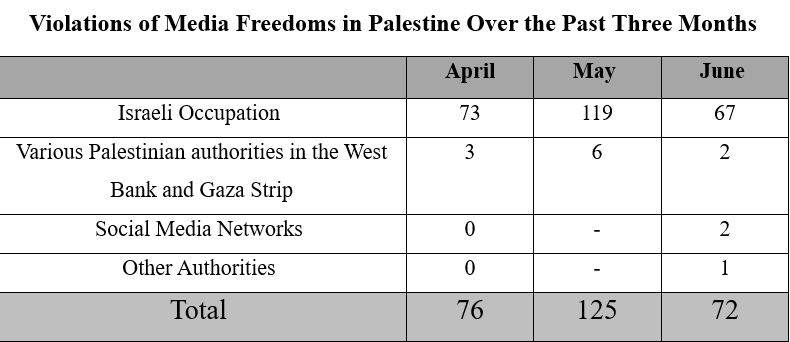
Ramallah – 06 July 2025 The month of June 2025 witnessed a significant wave of assaults on media freedoms in Palestine, the majority of which were committed by Israeli occupation forces and authorities. Despite a 42% decrease in the number of documented violations compared to the previous month, this reduction does not indicate any improvement in the overall state of media freedom in Palestine. The ongoing genocidal war in the Gaza Strip remains the primary obstacle to any potential progress in this regard.
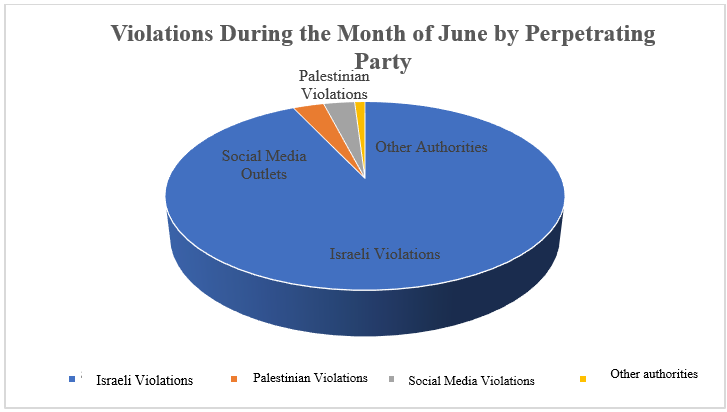
The MADA Center monitored and documented a total of seventy-two (72) violations against media freedoms in Palestine during the month of June. Israeli occupation forces were responsible for the vast majority, committing sixty-seven (67) violations, including serious crimes and assaults. Additionally, two violations were committed by unofficial Palestinian entities in the Gaza Strip, two others by the company Facebook, and one further assault was carried out by another party.
Israeli Violations:
During the month of June, Israeli occupation forces and authorities escalated their assaults against journalists and media outlets in Palestine, in what appears to be an ongoing attempt to suppress coverage and conceal the violations committed against Palestinian civilians, journalists, and media freedoms amid the genocidal war on the Gaza Strip, now entering its 21st month.
In June alone, Israeli forces committed a total of sixty-seven (67) violations, including crimes and assaults targeting journalists and media institutions. While this number reflects a 44% decrease compared to May—which witnessed 119 documented violations—this decline does not signify any genuine improvement in the state of media freedoms. Notably, Israeli forces killed ten (10) journalists during this period.
Following the killings, physical assaults constituted approximately 22% of all Israeli violations documented in June (15 incidents), including twelve (12) injuries caused by shrapnel from missile strikes in Gaza, some of which posed a severe threat to the lives of the journalists involved.
Prevention of media coverage and the targeting of journalists to forcibly remove them from reporting locations also accounted for 22% of the violations. In addition, arrests and detentions represented 16% of the total: Israeli forces arrested three journalists in the West Bank and detained eight others—including entire media crews—while they were reporting in various cities and governorates.
Moreover, Israeli soldiers damaged or destroyed equipment belonging to four journalists and media teams, either partially or completely. A missile strike also destroyed a workspace used by Al Arabiya TV staff after targeting a nearby building in central Gaza City. Homes belonging to seven (7) journalists were demolished by Israeli missiles, and in the West Bank, Israeli forces raided the home of a journalist and threatened to arrest him should he broadcast footage of the missile attacks.
Palestinian Violations:
The number of documented Palestinian violations against media freedoms declined by 67% in June compared to the previous month. Only two (2) violations were recorded, both committed by unofficial entities in the Gaza Strip. This marks a decrease from six (6) violations documented by MADA in May.
The recorded incidents in June were limited to the Gaza Strip and included the following:
- A group of young men physically assaulted journalist MOHAMMAD SALAMEH while he was covering the arrival of wounded individuals and martyrs at Nasser Medical Complex, despite having obtained prior permission from the hospital administration to conduct his coverage.
- An armed group claiming affiliation with the Al-Qassam Brigades severely beat journalist OMAR ABED RABBO, striking him on the head and various parts of his body. The assault was reportedly in response to his critical posts on social media.
Social Media Violations:
During the month of June, the MADA Center monitored and documented a total of two violations committed by the Facebook platform, owned by Meta.
The first violation involved the suspension of the personal account of journalist MUTHANNA AL-NAJJAR, who has approximately 300,000 followers, without prior warning and without any clear explanation from the platform.
In the second case, Facebook also shut down the personal account of journalist OSAMA AL-KAHLOUT, following a message he received the day before the suspension, stating that he had violated the platform’s publishing standards.
List of Journalists Martyred in May
|
Name of Journalist |
Date Killed |
Workplace |
|
|
1- |
ISMAIL BADAH |
05/06/2025 |
Palestine Today |
|
2- |
SULAIMAN HAJJAJ |
05/06/2025 |
Palestine Today |
|
3- |
SAMEER ALRIFAI |
05/06/2025 |
Shams News Agency |
|
4- |
AHMED QALJA |
05/06/2025 |
Associated with Al-Araby TV |
|
5- |
MOMEN ABU ALOUF |
09/06/2025 |
Associated with Al-Jazeera |
|
6- |
HAMED ALASTAL |
09/06/2025 |
Wafaa Al-Muhsinin Organization |
|
7- |
AMEEN FATHI HAMDAN |
22/06/2025 |
Freelance Journalist |
|
8- |
MAHMOUD ISSA ABU SHARBI |
25/06/2025 |
Associated with Al-Araby TV |
|
9- |
HANAN AQILAN |
25/06/2025 |
Media Department at the Prosthetics Center |
|
10- |
ISLAMI ABU HATAB |
30/06/2025 |
By Palestine Platform |
Details of Violations:
(01/06): Israeli occupation forces demolished the home of journalist RAMI ABU TAIMA, located in the southern Gaza Strip, following its razing during a military operation initiated by the occupation forces in the town of Al-Fukhari, east of Khan Younis city, at the beginning of June.
According to a statement provided to the MADA Center by Al-Jazeera reporter, journalist RAMI SALIM TAIMA (forty-three years old (43)), he received a call from one of his neighbors while at his workplace inside the journalists’ tent at Nasser Medical Complex in Khan Younis. The neighbor informed him that his house in Al-Fukhari town had been destroyed during an incursion by occupation machinery and bulldozers into the town.
One of the journalist’s neighbors had gone to inspect the houses after the withdrawal of occupation forces, only to find that bulldozers had completely razed all homes, including his own. He was unable to return to his area due to its extreme danger.
The journalist had vacated his home due to its proximity to border areas since the outbreak of the war, relocating with his family to the outskirts of Khan Younis, where they currently reside in a tent.
(01/06) The management of the Facebook application, owned by Meta, permanently disabled the personal account of journalist MUTHANNA AL-NAJJAR on Sunday morning without prior warning and without providing any reasons for the closure.
In his statement, journalist MUTHANNA SULEIMAN AL-NAJJAR (forty years old (40)), a reporter for Al-Hadath newspaper, expressed his surprise on Sunday morning when he was unable to log into his Facebook account, contrary to usual practice. He discovered that the platform’s administration had permanently disabled his account without any prior notice or explanation. A message appeared informing him that he could no longer access his account as it was deactivated.
To date, the journalist remains unaware of the actual reason behind the closure of his official account, which he has used for years to publish news and video reports. His account had approximately three hundred thousand (300,000) followers prior to being disabled. Furthermore, his page had reached two million (2,000,000) viewers and followers during the previous month.
The journalist regarded this measure as part of a broader campaign to suppress Palestinian content and restrict journalistic work, highlighting a clear bias by Facebook’s management in favor of the occupation. He emphasized that he strictly adheres to all publishing and privacy standards and carefully selects every word published via his account.
(01/06) Journalist MOHAMMAD SALAMEH was violently assaulted by a group of individuals without any clear reason while covering the arrival of wounded individuals and martyrs at Nasser Medical Complex on Sunday evening.
According to his testimony, journalist MOHAMMAD ASHRAF SALAMEH (twenty-seven years old (27)), an associate at TRT World, was present at around 7:00PM near the complex to carry out his journalistic duty, reporting on the casualties resulting from Israeli airstrikes. He had obtained prior authorization from the hospital administration to conduct coverage.
While documenting the injury of a child inside the intensive care unit, he was suddenly attacked by a group of more than six (6) individuals, reportedly members of a local family in Khan Younis. They assaulted him with their hands in a severe and sustained beating, causing him to lose consciousness. Due to the nature of the assault, he was unable to identify his attackers.
Citizens nearby managed to rescue the journalist from the assailants and transported him to the emergency department at the hospital, where medical examinations confirmed multiple bruises across various parts of his body.
(01/06) Photojournalist MOHAMMAD ABU ZAID narrowly survived an artillery shelling that struck near the tents of displaced civilians in western Khan Younis, in the southern Gaza Strip, while covering the shelling and its aftermath on Sunday evening.
According to his account, SUBHI MOHAMMAD ABU ZAID (twenty-one years old (21)), a cameraman for Algerian TV, left the journalists’ tent at Nasser Medical Complex around 7:30PM and headed westward to cover the Israeli artillery bombardment, which had caused numerous injuries.
While documenting the incident, an Israeli artillery shell landed very close to his location, scattering shrapnel in all directions. Though he escaped direct injury, the nearby tents were hit, resulting in additional casualties. The journalist took cover until the shelling ceased and then resumed his coverage.
(01/06) Israeli soldiers detained a crew from Al-Ghad TV for thirty minutes (30 minutes) and prevented them from covering a settler raid on a Palestinian village in Masafer Yatta, south of Hebron Governorate. The team’s work was obstructed on Sunday morning under the pretext that the area had been declared a “closed military zone”.
According to JAMIL SALHAB, a cameraman for Al-Ghad TV, the crew—comprised of reporter RAED AL-SHARIF and cameraman SALHAB—arrived at Khallet Al-Dabe’a village in the Masafer area east of Yatta at approximately 10:00AM to cover the storming of the village by Israeli settlers, who had seized one of the homes.
Shortly after their arrival, a large contingent of Israeli forces entered the village and declared the area a “closed military zone”. The soldiers prevented the crew from filming, physically searched them, and detained them for a period of time. The commanding officer confiscated their identification cards, searched their vehicle, and after approximately thirty (30) minutes, ordered them to leave the area and not return.
(02/06) Israeli warplanes destroyed the home of journalist MOHAMMAD MANSOUR in the town of Jabalia, following a phone call from an Israeli intelligence officer to the journalist’s brother, instructing the family to evacuate the house in advance of an airstrike on Monday afternoon.
According to a statement provided to the MADA Center by MOHAMMAD THEEB MANSOUR (thirty-nine years old (39)), a reporter for Alam Radio, one of his brothers received a phone call at approximately 12:30PM from a person identifying himself as an officer in Israeli intelligence. The officer instructed them to evacuate the journalist’s residence to prepare for its bombing.
Within thirty (30) minutes, Israeli F-16 warplanes launched an airstrike that leveled the four-story home located on Old Gaza Street in Jabalia, in northern Gaza. The house, which had been sheltering numerous displaced families, was reduced to rubble within minutes. Although all individuals managed to escape, they were unable to retrieve any belongings or clothing. The journalist and his family were left homeless, sitting in the streets without shelter.
(02/06) Israeli soldiers detained a crew from Palestine TV for approximately thirty (30) minutes inside their vehicle near the town of Yatta, south of Hebron, after repeatedly intercepting them and obstructing their coverage of a field visit by the Minister of the Wall and Settlement Affairs on Monday morning.
According to journalist JIHAD AL-QAWASMI, Director of the Palestine TV southern bureau, the crew—which included himself, photojournalist THAER FAQOUSA, and reporters IYAD AL-HASHLAMOUN and AREEN AL-AMLEH—headed to the area of Khallet Al-Dabe’a, in Masafer Yatta, around 10:00AM, to conduct interviews related to the minister’s visit.
Upon arriving at the entrance of At-Tuwani village, an Israeli military jeep intercepted them and informed them that the area had been declared a “closed military zone”, forbidding their presence. The crew was forced to leave and redirected to Susiya village, where the official delegation had arrived.
However, just before entering Susiya, they were again stopped—this time by an Israeli police vehicle. One officer stepped out, questioned the crew’s presence, and claimed that a military order prohibited entry into the village, though no official document was presented. The officer then threatened them with arrest and ordered them to leave immediately.
The crew left the area and traveled to the northern entrance of Yatta (Zaif), where they caught up with the minister’s convoy and conducted several interviews. Later, they decided to return to At-Tuwani village to speak with local residents. On their way back, near Khallet Al-Miya, their vehicle was intercepted by a white D-Max pickup truck carrying four masked Israeli soldiers. The soldiers demanded their identification, and after ten (10) minutes, ordered the crew to follow them to a nearby military post located on a hilltop.
The crew was detained inside their vehicle for approximately thirty (30) minutes, after which the soldiers returned their press cards and explicitly ordered them not to return to At-Tuwani, instructing them to leave the area immediately.
(03/06) Israeli forces detained the crew of Agence France-Presse (AFP) for over one hour in the town of Sebastia, northwest of Nablus, and obstructed their work until all identity cards were checked and cleared.
In his testimony to the MADA Center, SALEH HAMED, a video journalist with AFP, stated that he was present on Tuesday in Sebastia with several members of the Agency’s crew, including photojournalist JAAFAR ASHTIYEH and French correspondent Louis, on a reporting assignment near the town’s historic “Columns Street”.
During their assignment, an Israeli military jeep, carrying three soldiers and one settler, intercepted their vehicle. The soldiers demanded identification documents from the crew and held them at the scene.
The team remained detained for over one hour, during which time the ID cards of LOUIS and JAAFAR were returned. However, SALEH’s ID was withheld for additional screening before eventually being returned.
After completing their checks, the soldiers ordered the crew to leave the area.
(03/06) BBC Arabic terminated its contract with its Gaza reporter journalist AHMAD AL-AGHA on Tuesday, following a media smear campaign led by several British outlets, despite his year-long role in covering the war from the ground.
In his statement to the MADA Center, AHMAD AL-AGHA (thirty-six years old (36)) said he was surprised on Tuesday to receive an email from the Arabic section of the British Broadcasting Corporation (BBC) informing him of the termination of his role as reporter in the Gaza Strip. The email stated that he would no longer represent the channel in the field, and that the existing contract had been voided, ending all journalistic cooperation with immediate effect.
The decision came in the wake of an intensive defamation campaign launched by several pro-Israeli British media outlets, most notably The Telegraph, which published a report in April criticizing his journalistic coverage and expressing strong disapproval of his views—both in interviews and on social media. The report alleged that his content was biased against the Israeli occupation and presented a narrative sympathetic to Palestinians.
AL-AGHA considered the report a direct act of incitement against him, aligning with the broader context of occupation practices which include targeting, detaining, and injuring journalists in Gaza without legal justification.
He emphasized that his dismissal occurred while he was hospitalized, receiving treatment at Nasser Hospital after being injured during an Israeli airstrike that targeted a journalist tent near the hospital while he was reporting live for BBC Arabic.
AL-AGHA rejected the claims made in The Telegraph’s article, describing them as baseless and detached from reality, affirming his full commitment to the editorial standards and guidelines of the BBC. He clarified that his reporting simply reflected the realities of the war and the grave violations against unarmed civilians in Gaza—facts widely covered by international media outlets.
(05/06) Four journalists were killed and three others seriously injured when Israeli aircraft bombed a gathering of journalists in the courtyard of the Baptist Hospital in Gaza City on Thursday morning. According to Al Jazeera reporter ANAS AL-SHARIF, who was at the scene, an Israeli reconnaissance aircraft directly bombed a gathering of journalists in the courtyard of the Baptist Hospital at approximately 10:25AM on Thursday, killing three journalists immediately and a fourth the following day.
Three others were seriously injured by shrapnel from the bombing while they were covering the news. A number of journalists were inside a tent in the courtyard of the Baptist Hospital, while others were outside when the aircraft directly and without warning fired a missile, hitting them directly. Several were blown to pieces, while others were blown to pieces by the force of the explosion.
Minutes after the attack, rescue crews from the Baptist Hospital arrived at the scene, where they rescued the journalists from the smoke and dust and transported them to the emergency room.
Palestine Today cameraman ISMAIL BADAH, reporter and editor SULEIMAN HAJJAJ, and editor at Shams News Agency Samir Al-Rifai were killed, while cameraman Al-Arabiya TV associate AHMED QALJAH died the next day from serious injuries sustained from shrapnel wounds to the head and chest. Palestine Today reporter IMAD DALLOUL sustained serious injuries to the head, chest, and various other parts of his body. Al-Arabiya TV cameraman IMAM BADR sustained moderate injuries to his feet. Al-Aqsa TV news editor MAHMOUD AL-MAGHAZI suffered a sprained right foot, and his injury was described as minor. The shelling also damaged all of the journalists’ equipment, including their cell phones, laptops, cameras, and personal belongings. The tent in which some of them were staying was also destroyed.
(06/06) Israeli warplanes bombed the home of freelance journalist ABDEL RAHIM MOHAMMAD KHADER (twenty-three years old (23)) while he was stationed at the press tent inside Al-Ahli Baptist Hospital (Al-Maamadani) in Gaza. The airstrike completely destroyed the house, reducing it to rubble and killing everyone inside, including members of his family, on Friday afternoon.
In his testimony to the MADA Center, journalist ABDEL RAHIM KHADER stated that between 12:30PM and 1:00PM on the first day of Eid al-Adha, he was present in the journalist tent at the Baptist Hospital in Gaza City when he received a phone call from a neighbor informing him that his four-story home, located in the Al-Jurn area of Jabalia, northern Gaza, had been bombed.
He rushed to the location with a rescue team, only to find the house flattened to the ground, its rubble bearing the remains of approximately forty (40) people, all family members or displaced relatives who had sought refuge there—including his parents, siblings, and extended relatives. Despite efforts to rescue survivors, the lack of rescue equipment, the hazardous conditions, and the absence of medical capacity meant that only six (6) bodies were retrieved. The remaining victims remained trapped under the ruins.
(06/06) Journalist NOHA ABU ROUK was wounded by shrapnel in the neck after an Israeli drone strike targeted a displaced persons’ tent near her own, in the Al-Mawasi area of Khan Younis in southern Gaza, during the early hours of Thursday.
According to her testimony to the MADA Center, NOHA SULEIMAN ABU ROUK (thirty-nine years old (39)), a journalist with Al-Istiqlal Newspaper, said she was sleeping with her family in their tent in Al-Mawasi, Khan Younis, at approximately 1:15AM when an Israeli reconnaissance aircraft bombed a nearby tent housing displaced civilians.
The targeted area immediately caught fire, and shrapnel was scattered widely. ABU ROUK was struck in her left shoulder, and was swiftly transported by ambulance to Nasser Medical Complex, where doctors determined that the shrapnel had lodged near her neck, making surgical removal too dangerous and potentially life-threatening.
Since the incident, she has been suffering continuous pain, compounded by severe shortages of medical supplies and surgical expertise that have made it impossible to proceed with a safe operation.
(08/06) A group of armed individuals, claiming affiliation with Al-Qassam Brigades, assaulted journalist OMAR ABD RABBO due to his critical social media posts about the situation in Gaza. The assault resulted in bruises to his legs, shoulder, and head, following the raid on his location in Al-Nuseirat refugee camp on Monday evening.
In his testimony to the MADA Center, OMAR ABDEL FATTAH ABD RABBO (thirty-six years old (36)), a reporter and editor at Al-Manara Media Agency, stated that at approximately 8:30PM on Monday, a group of six (6) masked and armed men stormed the place where he was staying in Al-Nuseirat camp. The assailants claimed to be members of Al-Qassam Brigades.
The group surrounded the premises, detained all those inside, and confiscated their personal phones. Upon identifying the journalist, they approached him, and despite his presenting his press ID, they violently beat him without any explanation.
The journalist was thrown to the ground, where he was interrogated in a threatening tone. He recounted being asked: “Is Hamas present?” “Is security present?” To which he answered, “Yes.”
They then asked: “Will you continue writing online?”
This question was repeated three (3) times as the beating continued.
The group demanded his mobile phone and password. When he refused to provide it, one of the masked assailants struck him on the head with a pistol, causing him to lose balance and experience severe pain, prompting him to surrender the device and password.
The attackers left the scene in full view of local residents, stomping on his press ID before departing.
Abdul Rabbo later sought medical care at Al-Awda Hospital in Al-Nuseirat, where he received treatment. Medical staff documented bruises to his shoulder, legs, back, and head. However, hospital administration refused to issue a written report or medical certificate detailing his condition.
It is worth noting that the journalist had previously received threats linked to his social media posts criticizing the general conditions in the Gaza Strip.
(09/06) Martyrdom of photojournalist MOMEN MOHAMMAD ABU AL-OUF (21 years old), a freelance associate at Al Jazeera Network and the Turkish Anadolu Agency, in a targeted airstrike launched by an Israeli reconnaissance drone in central Gaza City on Monday evening.
According to NOURA AL-ATTAL, MOMEN MOHAMMAD ABU AL-OUF’s mother, her son was on a journalistic assignment around 11:30PM on Monday, accompanying several paramedics from the medical services to cover an Israeli airstrike on a residential apartment in Al-Haddad Building in central Gaza City.
While documenting the evacuation of wounded and deceased individuals from the targeted site, the journalist was directly targeted by a missile fired from a reconnaissance drone, leading to his immediate death along with three paramedics. The strike mutilated his body, which was transported by ambulance to Al-Ahli (Baptist) Hospital in Gaza City.
AL-ATTAL explained that her son had been deliberately targeted just days after a campaign of incitement against him by Israeli forces. He had received direct threats from the Israeli army spokesperson, AVICHAY ADRAEE, and several Hebrew-language media outlets following his coverage of a widely circulated video showing a young girl attempting to escape the flames during the bombing of the Fahmi Al-Jerjawi School in Gaza City, after all her family members had been killed. The footage drew significant attention in both local and international media, sparking outrage from the occupation authorities, who reportedly sent him multiple threats via phone.
(09/06) Martyrdom of freelance photojournalist HAMED ISMAIL AL-ASTAL (24 years old), Head of the Media Department at the “Wafaa Al-Muhsineen” Foundation for Relief of the Needy and Affected in Gaza, in an airstrike targeting a tent west of Khan Younis on Monday evening.
According to testimony given to the MADA Center by HAMED NOUFAL, a cousin of the martyr, journalist HAMED AL-ASTAL was visiting the “Hayat” displacement camp west of Khan Younis at around 7:10PM on Monday when an Israeli reconnaissance drone launched a missile toward the tents. Shrapnel from the strike scattered into nearby tents, and AL-ASTAL was directly hit in the head and back, leading to his immediate death.
Rescue teams arrived at the scene minutes later and transported him by ambulance to the nearby Kuwaiti Field Hospital.
(09/06) Destruction of journalist MAHMOUD AL-FARRA’s home in Khan Younis by Israeli airstrikes. AL-FARRA had vacated the property some time ago. He learned of the destruction through a phone call from neighbors on Monday morning.
In his testimony, journalist MAHMOUD RAGHEB AL-FARRA (41 years old), Head of Public Relations at the Government Media Office in Gaza, said he was in his tent in the Mawasi area of Khan Younis on Monday morning, where he had relocated after being forcibly displaced from his home in Khan Younis due to Israeli evacuation orders. He received calls from neighbors informing him that his four-story residential building in central Khan Younis, southern Gaza Strip, had been hit and destroyed by an Israeli airstrike.
(10/06) Israeli occupation forces assaulted journalists and media crews by firing tear gas canisters and live ammunition during their coverage of the raid on the city of Nablus, which resulted in the obstruction of their work and caused some of them to suffer from tear gas inhalation and shrapnel injuries in the early afternoon of Tuesday.
ABDULLAH MAHMOUD SABRA, a television cameraman for “Palestine TV”, aged twenty-five (25), reported to the MADA Center that he was present at exactly twelve o’clock (12:00PM) on Tuesday afternoon in the city of Nablus, conducting a live broadcast of the Israeli forces’ incursion into the city. During the coverage, Israeli forces began firing tear gas canisters at demonstrators. He was exposed to the gas and suffered from inhalation due to his inability to put on his protective mask in time. He was subsequently transferred to the hospital to receive medical treatment.
On the same day, Al Jazeera reporter LAITH BASSAM JA’AR, aged twenty-eight (28), along with the channel’s cameraman FADI YASSIN, were present in the vicinity of Martyrs’ Roundabout in central Nablus to document the moments following the assassination of two Palestinian youths. At exactly one o’clock (1:00PM) in the afternoon, Israeli forces advanced toward them and directly launched tear gas canisters, causing them to suffer from suffocation. Despite their efforts to evacuate the area, they were unable to do so. Simultaneously, they were targeted with live fire, and a bullet fragment struck the journalist’s camera tripod (stand).
Independent journalist MOHAMMAD ZUHAIR SAYEH reported facing repeated difficulties entering the Old City during the raid. He was directly targeted by snipers with stun grenades and was prevented from covering the events multiple times. One soldier aimed a laser light at his head and then opened fire, causing a bullet to strike a nearby surface and fragment, resulting in a minor injury to his hand. Despite the injury, he refused to stop his coverage after receiving first aid from his colleagues, who disinfected and bandaged the wound.
The journalist confirmed that all press crews present were prevented from covering the events. These included the Al Jazeera team—reporter LAITH JA’AR and cameraman FADI YASSIN; the Al-Ghad TV team—cameraman SHADI JARAR’AH and reporter KHALED BDEIR; the Al-Araby TV team—reporter AMEED SHEHADEH and cameraman RABEE’ MUNEER; and Al Jazeera associate journalist MOHAMMAD ATIQ.
(13/06) Israeli warplanes bombed the home of journalist AMJAD AL-QUDRA in the Al-Mahatta neighborhood in central Khan Younis on the afternoon of Friday. The following day, he went to check on his home after hearing the sound of explosions in the area, only to find it completely destroyed.
According to the testimony of journalist AMJAD BASSAM AL-QUDRA, aged thirty-seven (37), an editor at the Safa News Agency, he went on Saturday (June fourteenth) (14/06) to his neighborhood in Al-Mahatta, central Khan Younis, despite the severe danger, following the intense airstrikes carried out by Israeli forces in his residential area on Friday afternoon (June thirteenth) (13/06/2025). Upon arrival, he was shocked to discover that the airstrike, the sound of which he had heard from his displacement location in Al-Mawasi, Khan Younis, had directly targeted his five-story home, which had been completely flattened and reduced to rubble.
The journalist and his family had been forcibly displaced from their home approximately three (3) weeks prior, following an evacuation order issued by the occupation forces demanding that all residents of Khan Younis relocate immediately to the Al-Mawasi area ahead of an impending military operation and ground incursion aimed at demolishing homes and infrastructure.
( /06) Israeli warplanes bombed the home of journalist MOHAMMAD AL-AMOUR and the adjacent homes by dropping an explosive barrel in the Al-Fukhari area east of Khan Younis during the first week of June.
In his testimony to the MADA Center, journalist MOHAMMAD IMAD AL-AMOUR, aged twenty-three (23), a reporter for Quds News Network, stated that he, along with several neighbors, managed to reach the Al-Fukhari area east of Khan Younis following a sudden and limited withdrawal of Israeli military vehicles from the eastern parts of the city. They had informed him via phone that his home and the neighboring houses were completely destroyed after an Israeli aircraft dropped an explosive barrel, demolishing dozens of homes, including the one he resided in with his family. At the time, he was stationed at the journalists’ tent near Nasser Medical Complex in western Khan Younis. He had been forcibly displaced from his home approximately one (1) month earlier under an evacuation order by the occupation forces, relocating to Al-Mawasi, Khan Younis.
(13/06) Israeli occupation forces targeted journalists and media crews with live ammunition while they were present near the Deir Sharaf checkpoint west of Nablus, during their coverage of the comprehensive closure imposed on the entrances to the West Bank on Friday morning.
According to the testimony provided to the MADA Center by NASSER SULEIMAN SHTAYYEH, a cameraman for the American agency US Sipa, aged fifty-four (54), he headed around ten o’clock (10:00AM) on Friday morning, accompanied by independent journalist JAMAL AL-RAYAN, to cover the closure of military checkpoints in the city of Nablus, as the Israeli army had imposed a security cordon on West Bank cities. Their coverage included the Checkpoint 17 and Beit Furik checkpoint, before they moved between eleven thirty (11:30AM) and twelve o’clock (12:00PM) to the Deir Sharaf checkpoint, where there was a heavy military presence. Also present were Palestine TV reporter KHALIL ABU ARAB and Quds News Network reporter ABDULLAH BAKHSH.
As the journalists attempted to approach the iron gate near Deir Sharaf checkpoint, Israeli soldiers directly fired live ammunition at them. Most of the bullets landed near journalist JAMAL AL-RAYAN in the street, despite their clear identification as press, as they were all wearing protective press vests.
Minutes later, Israeli soldiers ordered all journalists and media crews to leave the area immediately.
(14/06) Journalist BASEL ABU TAWAHINA sustained moderate injuries to his pelvis and chest as a result of an Israeli airstrike that targeted a group of civilians in central Gaza Strip on Saturday evening.
In his testimony to the MADA Center, Al-Aqsa TV reporter BASEL MOHAMMAD ABU TAWAHINA, aged forty-three (43), stated that he was present around six o’clock (6:00PM) on Saturday at a relative’s home in the city of Deir al-Balah when an Israeli reconnaissance drone targeted a group of civilians with a missile.
The journalist rushed to the scene to cover the aftermath of the strike. As he approached the bodies of the martyrs lying on the ground, the aircraft fired a second missile. Shrapnel from the explosion struck him in the pelvis and chest, causing injuries, and he collapsed to the ground.
An ambulance arrived and transported him to Al-Aqsa Martyrs Hospital in Deir al-Balah to receive medical treatment.
ABU TAWAHINA added that just minutes before the airstrike, he had returned from his reporting duties, having completed coverage and a report on the hardships faced by displaced persons amid the ongoing war.
(21/06) Israeli occupation forces detained the crew of Al-Fajr TV in Nur Shams Refugee Camp for one (1) hour and prevented them from covering the demolition operations being carried out in the camp on Saturday afternoon. They were then allowed to resume coverage for only half an hour (0.5 hours).
Al-Fajr TV reporter RU’AA ARAFAT DREIDI, aged twenty-one (21), reported to the MADA Center that she was present around three o’clock (3:00PM) on Saturday afternoon along with fellow reporter YAZAN HAMAYEL and cameraman MOHAMMAD AL-FAR in the wooded area overlooking Nur Shams Camp, covering the demolitions being carried out by Israeli forces, broadcasting live on social media platforms.
Three Israeli soldiers approached them and halted the live broadcast. They spoke in Hebrew to cameraman MOHAMMAD AL-FAR, stating: “No filming”.
The soldiers escorted the crew to a location away from their equipment, inspected their personal identification cards, and ordered them to gather in an area near the woods. They were held there for approximately one (1) hour before being permitted to resume coverage for only thirty (30) minutes to complete the live broadcast. Afterward, they were released, with soldiers warning: “We do not want to see you here again. Filming soldiers or standing near civilians is forbidden”.
21/06) The tent used by Al-Ghad TV journalists was struck by a bullet fired indiscriminately by Israeli military vehicles near Nasser Medical Complex in southern Gaza Strip on Saturday afternoon.
According to the testimony of Al-Ghad TV reporter IBRAHIM QANNAN, he was present around twelve o’clock (12:00PM) on Saturday afternoon inside the channel’s tent near Nasser Medical Complex in western Khan Younis, together with cameraman MAZEN AL-BREEM, preparing a news report.
During the report preparation, a bullet fired randomly by Israeli military vehicles operating in various areas of southern and northern Khan Younis hit their tent. The bullet lodged between the fabric and the wall of the tent. The journalists narrowly escaped certain injury.
(22/06) AMEEN FATHI HAMDAN, a former photojournalist with Al-Kitab Channel, aged forty (40), was martyred as a result of an Israeli airstrike that targeted his home in the central Gaza Strip on Sunday evening.
According to the testimony provided to the MADA Center by BILAL ABU NADI, the journalist’s brother-in-law, AMEEN was at home in the town of Al-Zawaida, in central Gaza Strip, with his wife and their two daughters at approximately two o’clock (2:00PM) on Sunday afternoon when an Israeli F-16 warplane fired a missile at their residence. The strike completely demolished the house, leveling it to the ground and resulting in the deaths of all four family members.
Rescue teams from the Civil Defense and ambulances arrived at the scene within minutes. Due to a severe lack of equipment and resources, it took approximately two (2) hours to retrieve the bodies of journalist AMEEN HAMDAN, his wife, and their two daughters from beneath the rubble. They were transferred by ambulance to Al-Aqsa Martyrs Hospital in Deir al-Balah.
(22/06) A unit of Israeli occupation soldiers stormed the home of freelance journalist MOATH AMARNA at dawn on Sunday and interrogated him in the field, accusing him of broadcasting video footage of rocket launches. The journalist was threatened with arrest if he did not comply.
Freelance journalist MOATH AMARNA reported to the MADA Center that around three o’clock (3:00AM) on Sunday morning, a group of Israeli soldiers raided his home in Dheisheh Refugee Camp in the city of Hebron, detaining the entire family in one room while they searched the premises.
During the raid, the soldiers escorted AMARNA to the bathroom and conducted an on-the-spot interrogation about his journalistic activities. A commanding officer told him: “You are a journalist and the country is at war. You are not allowed to film missiles”.
AMARNA denied having published any such footage, to which the officer responded: “We are here today to give you a yellow card. Next time, it will be a red card—and you know what that means”, explicitly threatening him with arrest.
After approximately thirty (30) minutes, the soldiers withdrew from the house, leaving behind a scene of ransacked belongings.
(23/06) Israeli occupation forces arrested photojournalist AHMAD AL-KHATIB, aged thirty-eight (38), after storming his home in the town of Beitunia at dawn on Monday.
According to his wife, IRSAAL AL-KHATIB, Israeli soldiers raided the apartment building where the journalist lives at approximately four o’clock (4:00AM) on Monday. They mistakenly entered the home of a neighbor on the third floor before knocking forcefully on AHMAD’s door, prompting him to open it.
Three (3) soldiers entered his apartment. Without conducting a search or confiscating any items, they ordered AHMAD to accompany them and proceeded to arrest him. He is currently being held at Huwwara Interrogation Center.
He was brought before a court on Monday, (June thirtieth) (30/06), where it was ruled that he be placed under administrative detention for a period of six (6) months.
(24/06) The social media platform Facebook permanently disabled the personal account of journalist OSAMA AL-KAHLOUT after he received a notification the previous day alleging a violation of the platform’s publishing standards.
In his testimony to the MADA Center, OSAMA SHARIF AL-KAHLOUT, a reporter for Al-Hadath and Al Arabiya channels, aged forty (40), said that on Monday afternoon, (June twenty-third) (23/06/2025), he received a warning from Facebook, owned by Meta, informing him that he had violated the platform’s content standards.
The following day, Tuesday, he attempted to access his account but found it disabled. A new message appeared stating that his account no longer existed, revealing that it had been permanently shut down with no option to log in again.
AL-KAHLOUT stated that to the best of his knowledge, he had not breached any of the platform’s guidelines. He only published news reports and field updates, deliberately avoiding terminology that could be flagged as violations. He added that this action falls within the broader effort to suppress Palestinian content and reflects a clear bias in favor of the occupation, especially amid ongoing war crimes against civilians and attempts to silence journalists in Gaza. With all media offices in Gaza destroyed in the early days of the war and foreign media barred from entry, many journalists have resorted to using social media platforms to share information with the world.
He contacted Facebook via email seeking clarification and a process for account restoration but received no response. He confirmed this was not the first time his accounts had been removed—over the past few years, his social media accounts have been closed more than eight (8) times, similar to many other journalists and activists.
(25/06) Photojournalist MAHMOUD ISSA ABU SHARBI, aged thirty-three (33), a freelance associate at Al-Araby TV, was martyred on Wednesday afternoon as a result of an Israeli airstrike targeting the residential building where he lived in western Gaza City.
According to a statement given to the MADA Center by ANAS ABU SHARBI, the journalist’s cousin, Mahmoud was in his apartment near Ansar Prison in western Gaza City at approximately twelve ten (12:10PM) on Wednesday when Israeli warplanes targeted the building. The strike resulted in his immediate death.
MAHMOUD ABU SHARBI had previously been displaced from his home in northern Gaza several months earlier following an Israeli evacuation order that required residents to vacate their homes immediately.
Since the beginning of the war, he had worked extensively covering and documenting field events for Al-Araby TV. He had previously sustained a severe injury in September of the year (2024), when Israeli warplanes bombed a building he was in, resulting in the amputation of his leg. The injury ended his active fieldwork, and in the months before his death, he had been in and out of hospitals undergoing multiple surgeries. Despite his critical condition, he was denied travel abroad for treatment due to the closure of border crossings.
June twenty-fifth (25/06): Journalist HANAN AQILAN, aged twenty-seven (27), who worked in the Media Department at the Prosthetics Center affiliated with the Gaza Municipality, was martyred on Wednesday evening as a result of an Israeli airstrike on her home in Al-Shati Refugee Camp.
According to a statement given to the MADA Center by her sister, IMAN AQILAN, HANAN was inside her family home in Al-Shati Camp, west of Gaza City, at approximately four forty-five (4:45PM) on Wednesday when an Israeli F-16 warplane launched a missile without prior warning. The strike caused the house to collapse entirely, burying her body beneath the rubble.
Ambulance and rescue teams arrived shortly after the bombing, but due to the limited resources available to Civil Defense teams under siege and amid the ongoing war, they were only able to retrieve her remains several hours later. Her body was found in fragments and was transported to Al-Shifa Hospital in Gaza City.
Before her death, HANAN AQILAN was known for producing short documentary films highlighting the war and the suffering of civilians and displaced persons.
(26/06) Journalist MUJAHID TBANJEH was arrested by Israeli occupation forces after they stormed his home in the city of Nablus at dawn on Thursday. He was interrogated by an officer regarding his journalistic work at Huwwara checkpoint, accused of “incitement,” and released after eight (8) hours of detention.
According to his testimony to the MADA Center, journalist MUJAHID MUAWIYAH TABANJEH, aged twenty-five (25), a reporter for the Palestine Post website, reported that at precisely two o’clock (2:00AM) on Thursday, Israeli soldiers raided his family home in the Khallet al-'Amud neighborhood of Nablus as part of a wide-scale incursion across several residential areas.
The soldiers specifically asked for the journalist, who was not present at the time. They contacted him by phone, ordering him to return home immediately. Upon his arrival, the soldiers began beating him, preventing him from saying goodbye to his mother. He managed to do so nonetheless, after which he was assaulted again and arrested.
The soldiers forced him into a humiliating position, bending him over and dragging him violently into a military jeep while continuing to strike him. The dragging was so forceful that it tore his trousers.
He was transferred to Huwwara Detention Center, where he was placed in a small, poorly equipped room for approximately four (4) hours before undergoing interrogation by a regional officer. During the interrogation, he was threatened and warned against publishing what the officer described as “inciting” content. He was also instructed not to collaborate with “unofficial” or unknown media organizations.
He was released at approximately eleven forty-five (11:45AM) the same day, after a total of eight (8) hours in custody.
(27/06) Israeli occupation soldiers detained journalist MOHAMMAD ATIQ for two (2) hours at Deir Sharaf checkpoint west of Nablus on Friday afternoon. During the detention, he was interrogated about his journalistic work and threatened with arrest and death if he filmed soldiers.
According to MOHAMMAD ALI ATIQ, aged thirty-two (32), a freelance journalist working with Agence France-Presse (AFP), he and his colleague MOHAMMAD ABED were en route to Qalqilya around twelve o’clock (12:00PM) when their vehicle was stopped at Deir Sharaf checkpoint. Approximately six (6) soldiers and a military vehicle were present at the checkpoint.
The soldiers searched the journalists, checked their identification cards, and upon verifying their identities, ordered Atiq to step out of the vehicle. His colleague Abed was told to leave the area and not to wait.
The soldiers instructed ATIQ to sit on the curb facing the wall. He remained in that position for two (2) hours during which a field interrogation was conducted, questioning him about his work and the type of content he films. No formal charges were made.
The soldiers issued a clear warning: filming soldiers is prohibited. One of them threatened ATIQ with arrest and even death should he attempt to film again, claiming that there are no laws protecting journalists and that the Israeli government does not recognize journalism as a legitimate profession.
(27/06) Three (3) members of Al Arabiya TV crew were injured in Gaza following an Israeli airstrike targeting a building near the facility they were using as a makeshift headquarters in central Gaza City. The strike also destroyed all their journalistic equipment.
According to journalist MOHAMMAD BASHIR HAMMOU, aged thirty-seven (37), a freelance reporter for Al Arabiya, he was present at around four o’clock (4:00PM) on Friday, along with the channel’s cameraman MAMDOUH QASEM AL-SAYYED, aged forty-two (42), and their driver MOHAMMAD ABDULLAH ABU HAJAR, aged forty (40), broadcasting live from a satellite uplink point.
Shortly after the broadcast ended, Israeli F-16 warplanes struck a residential building directly opposite their location. The blast hurled debris and shrapnel toward them.
All three (3) crew members sustained injuries: journalist HAMMOU suffered moderate wounds to his left leg and neck; cameraman MAMDOUH sustained injuries to his left foot and bruises on his back; and driver ABU HAJAR sustained multiple bruises across his body. They were transported to Al-Shifa Hospital for medical treatment.
The facility used by the team sustained significant damage. All equipment was destroyed, including the broadcast camera, an external transmission device, a laptop, internet cables, protective gear, and the vehicle, which was rendered completely inoperable.
(27/06) Al Jazeera cameraman AYMAN AL-HISSI was wounded in his left foot, left hand, and back by shrapnel during an Israeli airstrike in Gaza City on Friday afternoon.
In his statement to the MADA Center, photojournalist AYMAN MAJED AL-HISSI, aged thirty-two (32), said he was in his vehicle—marked clearly with press insignia—near the Thai Restaurant on Al-Wehda Street around three o’clock (3:00PM) on Friday, covering ongoing Israeli airstrikes.
While documenting the event, an Israeli F-16 fighter jet fired a missile at a nearby residential apartment. The resulting explosion sent shrapnel flying, injuring him in the left foot, left hand, and back. He suffered significant bleeding and remained trapped inside his badly damaged vehicle for several minutes until an ambulance arrived and transported him to Al-Shifa Hospital, where he was admitted to the emergency department.
AL-HISSI confirmed that the injuries severely hindered his ability to continue filming and documenting events, forcing him to suspend his journalistic work.
(28/06) Israeli occupation forces arrested journalist and editor at Ultra Palestine MUJAHID MOHAMMAD BANI MUFLEH, aged thirty-seven (37), from his home in the town of Beita, south of Nablus, at dawn on Saturday.
According to his wife, NUHA AL-SHARAFA, who spoke to the MADA Center, a large contingent of Israeli soldiers raided her father’s house—which is adjacent to her husband’s residence—at approximately three thirty (3:30AM) without knocking on the door.
The soldiers asked about her husband MUJAHID and requested his ID card. When he was unable to produce it quickly, they began smashing his home office, scattering books and papers in a chaotic manner. They then demanded his laptop, ordered him to open it, and proceeded to photograph his social media pages.
The arrest was violent. The soldiers pushed him aggressively and refused to allow him to change out of his sleepwear or put on other clothes. MUJAHID suffers from chronic diabetes, and his family has no information on his whereabouts or condition following the arrest.
(28/06) Israeli warplanes destroyed the residential building where journalist AHMAD ABU JUMAA, Director of the Palestine Al-Hadath news agency, lived in Al-Tuffah neighborhood in eastern Gaza, after he received a phone call from an Israeli intelligence officer ordering the immediate evacuation of the premises on Saturday evening.
According to journalist AHMAD BASSAM ABU JUMAA, aged thirty-seven (37), he received a call from an Israeli intelligence officer at approximately four o’clock (4:00PM) on Saturday instructing him to evacuate the five-story residential building, which housed around fifty (50) people.
ABU JUMAA and other residents managed to flee the building quickly. Just moments later, Israeli F-16 warplanes fired two missiles at the structure. Massive explosions rocked the area, shrapnel flew through the air, and the building was reduced to rubble.
(29/06) Israeli occupation soldiers detained Roya TV cameraman MAHMOUD FAWZI for approximately one (1) hour while he was in the town of Sebastia on Sunday morning, preparing a news report on the repeated military incursions into the area.
According to cameraman MAHMOUD FAWZI ISMAIL, aged thirty-nine (39), who spoke to the MADA Center, he arrived in Sebastia, northwest of Nablus, at approximately eleven ten (11:10AM) to film a report on the town’s historical significance and ongoing Israeli raids.
While filming, a group of Israeli soldiers suddenly approached him, ordered him to turn off his camera, lower it, and sit on the ground. He initially tried to step away from the location, but the soldiers raised their weapons at him and threatened him.
They confiscated his identification card and detained him for about one (1) hour. At approximately twelve o’clock (12:00PM), his ID was returned, and the soldiers ordered him to leave the area.
(29/06) Journalist HATEM SALMI was injured by shrapnel to the back of his head while documenting life among displaced families in Al-Tuffah neighborhood, east of Gaza City, on Sunday evening.
According to journalist HATEM ABDEL NASSER SALMI, aged thirty-eight (38), in his statement to the MADA Center, he was filming near civilian homes in Al-Tuffah at around four o’clock (4:00PM) on Sunday for Filcam for Media Production, a documentary film company. The film was focused on the lives of internally displaced persons during the war.
Suddenly, an Israeli F-16 warplane fired a missile at one of the nearby homes without warning. The explosion sent shrapnel and rubble flying in all directions. A piece of shrapnel struck SALMI on the back of his head, causing him to bleed profusely.
He was immediately transported to Al-Ahli Arab Hospital (also known as the Baptist Hospital) for urgent medical treatment.
(30/06) Photojournalist MOHAMMAD NABIL SKEIK (40 years old) was injured by shrapnel in the upper back, causing heavy bleeding, after an Israeli drone strike targeted a tent only meters away from the journalists’ tent near Al-Aqsa Martyrs Hospital in central Gaza on Monday evening.
According to SKEIK’s statement to MADA Center, he was inside the journalists’ tent at 11:30PM editing a television report for PMP Media and Broadcast Production. A drone strike hit a nearby tent about 20 meters away, scattering shrapnel and debris throughout the area. The rear window of the PMP satellite broadcast vehicle was also shattered.
As SKEIK attempted to exit the tent to assess the situation, he discovered he was bleeding from the upper back due to shrapnel. He was transported on a stretcher to the emergency department of Al-Aqsa Martyrs Hospital where he received treatment. Doctors were unable to remove the shrapnel due to lack of medical resources, and he remains under observation.
(30/06) Israeli soldiers targeted several journalists with live ammunition multiple times while they were covering home demolitions near Duwar Al-Hisan, behind the government hospital in the city of Jenin, on Sunday afternoon.
Photojournalist NASSER SULEIMAN SHTEIYEH (54 years old), working for US SIPA Press, told MADA Center that around 3:30PM he arrived at the scene to document the demolition. As he approached, an Israeli soldier stationed on a rooftop shouted at him to retreat and fired live bullets in his direction, threatening to kill him despite his distance and clearly marked press gear.
SHTEIYEH moved to a second location northwest of the hospital, where he again came under fire. Later, he and fellow journalists JAMAL AL-RAYAN (freelance) and TARIQ ABU ZAID (Palestine TV) climbed a multi-story building to document the scene from above. As they stood on the emergency staircase, they were targeted again with live bullets, forcing them to evacuate.
The journalists reported being targeted multiple times over the span of 40 minutes, despite wearing full press vests and staying at a distance from soldiers.
(30/06) Photojournalist ISMAIL HUSSEIN ABU HATAB was killed, and journalist BAYAN ABU SULTAN was injured when an Israeli airstrike hit Al-Baqa Café, west of Gaza City, on Monday afternoon.
Journalist and eyewitness MAJDI QREIQA told MADA Center that at approximately 2:50PM, he was about 100 meters away when an Israeli airstrike targeted the café, a popular location for students and journalists due to its internet and electricity access.
Upon arriving, QREIQA found journalist BAYAN ABU SULTAN bleeding from shrapnel wounds to her face, head, and right shoulder. He helped her exit the area. Inside the café, he found the body of photojournalist ISMAIL ABU HATAB lying in blood around 10 meters from the strike site.
Emergency teams arrived shortly afterward. ABU SULTAN was taken to Al-Shifa Hospital, where her condition was described as moderate. ABU HATAB’s body was also transported there, and his death was confirmed.
QREIQA noted that journalists frequently use cafés in Gaza as makeshift newsrooms due to the lack of power and internet. He emphasized that these areas, although far from active combat zones, have repeatedly been targeted.
He also mentioned that ABU HATAB previously exhibited his Gaza war photography in a tent-based gallery in Los Angeles, USA, showcasing civilian suffering and war crimes against displaced people.
