


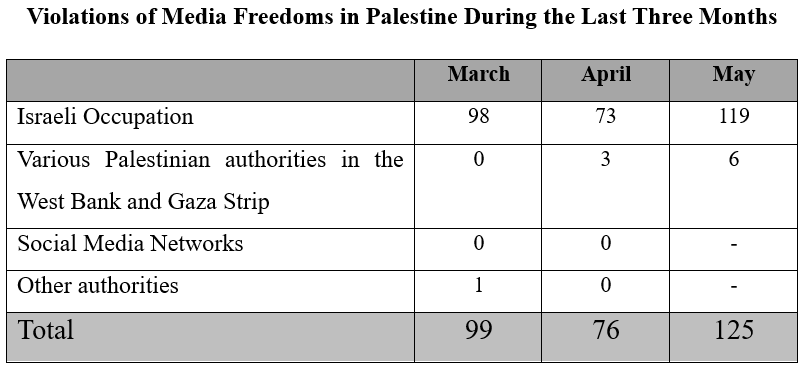
Ramallah – 07 June 2025.The month of May 2025 witnessed a significant increase in the number of violations against media freedoms in Palestine compared to the preceding month of April. The number of violations documented by the Palestinian Center for Development and Media Freedoms “MADA” reached a total of one hundred twenty-five (125) violations, compared to a total of seventy-six (76) documented during the previous month, marking an increase of sixty-four percent (64%).
This rise in the number of violations during May was mainly due to a significant increase in Israeli violations in particular. The total number of violations documented during the month of May amounted to one hundred twenty-five (125), distributed as follows: one hundred nineteen (119) Israeli violations, including eighty-two (82) in the West Bank and thirty-seven (37) in the Gaza Strip, while various Palestinian parties in the West Bank and Gaza committed six (6) violations, four (4) of which occurred in the West Bank and two (2) in the Gaza Strip.
Israeli Violations:
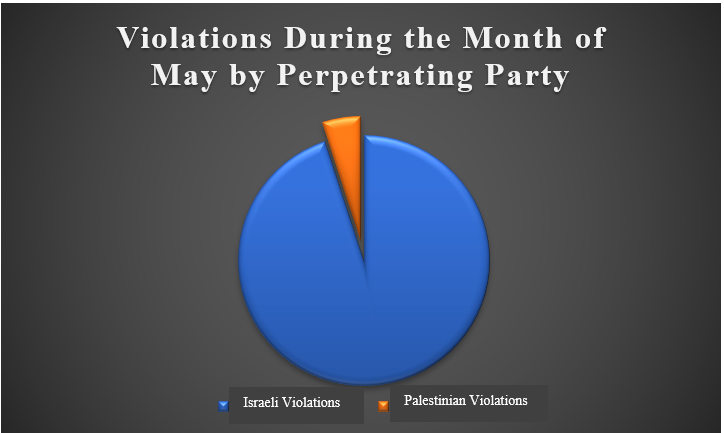
Israeli violations witnessed a significant increase during the past month of May, totaling one hundred nineteen (119) crimes and assaults against media freedoms, compared to a total of seventy-three (73) violations documented during the previous month of April. This marked an increase of sixty-two percent (62%) or forty-nine (49) more violations. Israeli violations constituted ninety-five percent (95%) of the total documented violations during the past month.
With the continuation of the war of extermination in the Gaza Strip, the killing of journalists remains the most serious threat to the lives of journalists and the state of media freedoms in Palestine. The occupation forces cold-bloodedly killed a total of fifteen (15) journalists, six (6) of whom were killed when their homes were targeted by shelling, raising the number of journalist martyrs since 7 October 2023 to two hundred fifty-five (255).
Despite the gravity of direct killings, Palestinian journalists continue to be subjected to physical assaults during field coverage. During the past month of May, MADA monitored and documented a total of twenty-seven (27) cases of physical assault, nineteen (19) of which occurred in the West Bank. The most severe and dangerous of these was the brutal and savage beating of photojournalist ISSAM AL-RIMAWI by settlers while he was conducting field coverage between the villages of Al-Mughayyir and Abu Falah in Ramallah, despite wearing his press uniform. This resulted in a skull fracture and a brain concussion after being struck on the head in a near-fatal blow. He remains hospitalized at the Palestine Medical Complex at the time of this report.
Additionally, four (4) journalists were injured by shrapnel from an Israeli airstrike on the courtyard of the “European Hospital” in the Gaza Strip while they were in a press tent continuing their coverage. Another four (4) journalists were also injured by shrapnel during the coverage of various events. Six (6) journalists suffered from gas inhalation in the West Bank, five (5) of whom were covering the storming of Jenin city by occupation forces.
MADA documented the arrest of two (2) female journalists: journalist THARWAT SHAQRA, who was arrested in Jerusalem after appearing as a guest on Al Jazeera channel and was released after six (6) hours; and “Sada News” reporter HANEEN QAWAREEQ, who was released after eight (8) days of detention.
Occupation forces and settlers detained a total of fifteen (15) journalists during the past month of May. Three (3) journalists were detained by settlers while covering the storming of Al-Mughayyir near Ramallah and were threatened with death and slaughter if they returned to cover events. Occupation forces detained five (5) journalists near the town of Turmusayya, north of Ramallah, and prevented them from covering the settlers’ invasion of the town, despite the presence of press markings on their vehicle. Two (2) journalists were brutalized by occupation soldiers during their detention and were subjected to beating, insults, and profanities.
Border Guard forces interrogated Al Jazeera cameraman LOUAY OSAID after detaining, beating, and assaulting him for six (6) hours during his coverage of the settlers’ storming of the Ibrahimi Mosque in Hebron. He was subsequently issued a summons to report to a military camp near Hebron. Israeli police also interrogated cameraman AHMAD JALAJEL and journalist ROSE AL-ZARO at the “Russian Compound” (Al-Maskubiya) detention center—despite knowing their identities—regarding their journalistic work after they were detained in the Bab Al-Amoud area in Jerusalem, even though they were not on assignment at the time.
In addition to the aforementioned violations, MADA documented thirty-one (31) violations involving the prevention of coverage, and seven (7) violations of targeting journalists and media crews to obstruct coverage. There were also four (4) cases of equipment confiscation or destruction, along with the destruction of ten (10) homes by missile and drone strikes in the Gaza Strip.
Palestinian Violations:
The number of Palestinian violations increased during May compared to the preceding month of April, rising from three (3) violations to six (6). Palestinian violations accounted for five percent (5%) of the total documented violations.
These violations were distributed as follows: four (4) in the West Bank and two (2) in the Gaza Strip. Freelance journalist MOHAMMAD AL-SAYEH was injured in his left hand and in his foot by stones, while Associated Press cameraman MAJDI ISHTAYYEH was hit with a stone in the left wrist while covering the storming of downtown Nablus by occupation forces.
The Palestinian Intelligence Service interrogated journalist MUJAHID TABANJA for four (4) hours at its headquarters in Nablus regarding his journalistic work. The same service summoned journalist WAFAA KHASHEEB (AL-AROURI) for interrogation after her return from travel, following her criticism of the Palestinian Authority on social media. Prior to that, the intelligence services had attempted to prevent her from traveling to attend media events in the Kingdom of Morocco.
In the Gaza Strip, photojournalist MUHANNAD QESHTA was assaulted—beaten, insulted, and had his phone, which he uses for his journalistic work, broken—by a citizen while covering scenes of the bodies of martyrs and the wounded in a massacre committed by occupation forces west of the city of Khan Younis.
List of Media Martyrs in the Month of May
|
Name of Journalist |
Date of Martyrdom |
Workplace |
|
|
1. |
YAHYA MUNIR SOBEIH |
7 May 2025 |
Sabaq 24 Agency |
|
2. |
NOUR AL-DIN MATAR ABDO |
7 May 2025 |
Sharq News Agency |
|
3. |
NIDAL ABU AMSHA |
10 May 2025 |
Freelance Journalist |
|
4. |
HASSAN ABDEL-FATTAH ESLAIH |
13 May 2025 |
Alam 24 News Agency |
|
5. |
HASSAN MARZOUQ SAMOUR |
15 May 2025 |
Voice of Al-Aqsa Radio |
|
6. |
AHMAD ANWAR AL-HELOU |
15 May 2025 |
Quds News Network |
|
7. |
NOOR ZIAD QANDIL |
18 May 2025 |
Al-Thurayya Media Center |
|
8. |
KHALED AHMAD ABU SEIF |
18 May 2025 |
Al-Manar Productions |
|
9. |
ABDUL-RAHMAN TAWFIQ AL-ABADLEH |
19 May 2025 |
Al-Nahar News Agency |
|
10. |
MOHAMMAD AMIN ABU DAQQA |
20 May 2025 |
Nour Media Agency |
|
11. |
BILAL MAHER ALHATOUM |
23 May 2025 |
Voice of Al-Aqsa Radio |
|
12. |
HASSAN MAJDI ABU WARDA |
25 May 2025 |
Barq News Agency |
|
13. |
MUTAZ MOHAMMED RAJAB |
28 May 2025 |
Quds TV |
|
14. |
HASHEM ADLI ALBARSH |
29 May 2025 |
Nama’ Radio |
|
15. |
YOUSEF ALNAKHALA |
31 May 2025 |
National Media Company |
Details of Violations:
(02/05) Israeli occupation soldiers targeted RUAA DREIDI, a reporter for Al-Fajr TV, with a fragment of a metal bullet in her thigh while covering the Israeli military raid on Nur Shams refugee camp in the city of Tulkarm around noon on Friday. She sustained a shrapnel wound to her left thigh.
In her testimony to the MADA Center, journalist RUAA DREIDI stated that she arrived at approximately 12:00PM on Friday to an open area near the “San Maurice” Hotel overlooking the Nur Shams camp, where she was monitoring residents moving their personal belongings following Israeli announcements of plans to demolish several homes in the camp.
About ten minutes after she arrived, Israeli soldiers emerged and began firing live ammunition indiscriminately in various directions. She was then directly targeted and struck by a bullet fragment in the left thigh.
She was transferred to the government-run Thabet Thabet Hospital for medical treatment, where it was confirmed that she suffered a laceration in the thigh.
(02/05) Israeli occupation forces assaulted and mistreated two journalists they detained in Tulkarm city while they were covering a protest against demolition orders targeting homes in Tulkarm and Nur Shams camps. The journalists were beaten and subjected to physical searches on Friday, 2025.
Journalist HAMZA MAHMOUD HAMDAN (24 years old), a reporter for Quds News Network, reported to the MADA Center that he was present at 2:25PM near Jamal Abdel Nasser roundabout in central Tulkarm to cover a protest against the Israeli announcement of plans to demolish 106 homes in the two camps — homes that have been abandoned for around 97 days.
After completing coverage, HAMDAN was conducting an interview with a displaced resident when several Israeli military vehicles approached. Soldiers disembarked and stormed the area, demanding IDs and mobile phones from journalists and others present.
The soldiers led him to one of the military vehicles, searched him physically multiple times, and then transferred him to a two-story building used by the Israeli army as a military post in Tulkarm for the past two and a half months. He was held in an open courtyard on the rooftop under direct sunlight, with his eyes blindfolded and hands cuffed behind his back.
His detention lasted approximately five hours, during which he was repeatedly searched and subjected to psychological pressure by being blindfolded and unblindfolded multiple times. At around 7:00PM, his restraints and blindfold were removed, and he was released.
Independent journalist FADI ABDEL RAHIM YASSIN (46 years old) also reported being present at the same site around 9:00AM on Friday. After civilians entered the camps without coordination with the Israeli military, he accompanied them to cover the unfolding events. He documented the situation for about 20 minutes before Israeli forces arrived and began dispersing people from the camp and its surroundings.
An officer approached and instructed him and the other journalists not to film the soldiers and to stay at least 100 meters away. He complied and withdrew after completing his documentation.
He returned home, which is about 50 meters from the camp. Soon after, the occupation forces re-entered the nearby neighborhood, pursuing residents. YASSIN stepped out into the street and stood with other residents. As the forces neared, local youths fled. A soldier demanded YASSIN call them back, but he refused. The soldier then threatened to arrest him instead, but YASSIN held his ground.
At around 12:00PM, the soldier asked for YASSIN’s ID and mobile phone. Upon recognizing him as a journalist, the soldier questioned: “Aren’t you the journalist who was filming earlier?” YASSIN confirmed and explained that an officer had merely instructed them to step back, not to stop filming.
The soldier proceeded to open and inspect the journalist’s phone. Upon finding pictures of soldiers, he claimed this was prohibited. He then forced YASSIN to stand facing the wall opposite his home, thoroughly searched him, and confiscated all his belongings: wallet, cigarettes, lighter, keys, etc., which he threw to the ground while continuing to search the phone.
YASSIN was then taken inside the camp, his hands bound behind his back with plastic cuffs, and forced to sit on the ground with his head touching the pavement. He was later transferred to a military outpost across from Tulkarm camp, where he was blindfolded and made to sit on an indoor staircase for over two hours, receiving blows from soldiers passing up and down the stairs.
He remained in this condition until approximately 7:10PM, when he was finally released.
( /05) Israeli occupation forces demolished the home of journalist HUSSAM AL-KHATIB in the Shaboura neighborhood of Rafah at the beginning of May. He discovered the destruction after examining satellite imagery.
In his testimony, HUSSAM JAMAL AL-KHATIB (40 years old), an editor in the news department at Al-Aqsa TV, stated that he regularly monitors satellite imagery via the internet to check on his house located in the Madaris Al-Arab area of the Shaboura neighborhood, in central Rafah, southern Gaza, where Israeli forces maintain a blockade preventing access.
As of May 1st, his home was still standing. He later heard powerful explosions in the vicinity and, upon reviewing the most recent satellite images, he saw that the area — including the entire residential block containing his home — had been demolished. His home no longer appeared in the images, and the satellite footage clearly showed it had been completely reduced to rubble.
(03/05) Israeli warplanes (F-16) bombed the home of journalist AMMAR QUDEIH with a missile, completely destroying it and all its contents on Saturday evening.
In his testimony, AMMAR KHALIL QUDEIH (43 years old), Director of Al-Risalah newspaper and its website alresalah.net, said that around 6:30PM on Saturday, an Israeli F-16 warplane fired a missile at his three-story family home in Abu Taima neighborhood, Abasan al-Kabira, east of Khan Younis in southern Gaza. The home was flattened and reduced to rubble, with all furniture destroyed—fortunately, no injuries occurred.
QUDEIH, who had been displaced to western Khan Younis due to the forced evacuation orders imposed by the Israeli military on eastern Khan Younis residents, learned of the strike through a call from a neighbor who informed him of the destruction.
He and his family had left the house months ago and returned only during the truce in January 2025, before leaving again when the war resumed in March 2025.
(03/05) Two Israeli settlers detained a group of journalists in the town of Al-Mughayyir, obstructing their work and threatening to kill or slaughter them if they returned.
In his testimony, freelance journalist MOHAMMAD TURKMAN reported to the MADA Center that he, along with journalist AHMAD AL-KHATIB, KAREEM KHAMAISAH (reporter for Al-Irsal Network), and a local citizen, were in Al-Mughayyir near Ramallah at approximately 4:00PM Saturday to prepare a report on the repeated Israeli incursions into the town.
After finishing their report, they learned of the demolition of two tents on the town’s outskirts by Israeli forces and headed to cover the event. They were surprised by a young settler, no older than 15, herding sheep, who immediately called the settlement’s security guard. As the journalists attempted to leave, two settlers arrived—one armed with an automatic rifle.
The journalists, who were in a civilian vehicle (not marked as press), were stopped. The settlers questioned their identities and activities. Despite presenting local and international press credentials, the settlers screamed, threatened to summon the police, and held the journalists for about 15 minutes.
During the detention, the settlers threatened to shoot and slaughter them, yelling: “Whoever comes here, we will slaughter him” while hurling curses. They were released with a clear threat of death if they returned.
(04/05) Several journalists were targeted with tear gas grenades by Israeli forces, leading to suffocation injuries for some and others being hit by stones during coverage of a military incursion into central Nablus on Sunday.
Freelance journalist MOHAMMAD ZUHAIR SAYEH (39 years old) reported to the MADA Center that he and other media crews were present around 2:00PM in Hattin Street covering the Israeli raid on a commercial shop. Journalists identified included: HAFIZ ABU SABRA and MAHMOUD FAWZI (Roya TV), ABDULLAH SABRA (Palestine TV), SHADI JARAR'AH (Al-Ghad), SIDQI RAYAN, MAJDI SHTAYYEH (Associated Press), WALAA FATAYYER (Al-Fajr Radio), and AMEERA HAMOUDA (Hayat Radio).
They were stationed between demonstrators and soldiers when Israeli forces targeted them multiple times with tear gas and chased them out of the area.
At around 3:15PM, as forces withdrew and reinforcements arrived via Faisal Street, the journalists found themselves amid intense stone-throwing. Journalist SAYEH was struck in the left hand and foot, received field treatment, and later went to Rafidia Hospital due to a severe ligament injury. Cameraman MAJDI SHTAYYEH was also hit in the wrist and taken to the hospital.
ABDULLAH MAHMOUD SABRA (25 years old), a Palestine TV cameraman, reported that a tear gas grenade landed near him, causing him to suffocate and briefly lose balance as he could not wear his mask. Colleague SHADI JARAR’AH pulled him to an ambulance where he received field treatment.
(04/05) Israeli forces bombed the apartment of the brother of journalist RAMI HASSAN ABU SHAMALA, which is located beneath his own in western Khan Younis, early Sunday. The strike partially destroyed the apartment and damaged RAMI’s unit.
In his testimony, RAMI HASSAN ABU SHAMALA (45 years old), a cameraman for Al Jazeera English, said that at approximately 12:40AM, an Israeli helicopter fired a missile at his brother BASIL’s apartment in the Al-Amal neighborhood. The strike killed BASIL’s wife and seriously injured his daughter. RAMI’s family was unharmed, but their apartment sustained severe damage, including a large crater in the ceiling and partial destruction of the structure.
RAMI was on duty in the journalists’ tent at Al-Aqsa Martyrs Hospital in Deir al-Balah when the strike occurred and was informed by relatives and neighbors.
(04/05) Photojournalist MUHANNAD QISHTA was physically assaulted and had his phone destroyed by a civilian while covering a massacre committed by Israeli forces west of Khan Younis on Sunday morning.
Freelance photojournalist MUHANNAD AHMAD QISHTA (30 years old) stated that at around 10:20 AM, he arrived at Al-Mawasi area with a Civil Defense vehicle to cover the aftermath of a drone strike that targeted a tent sheltering members of the SIYAM family.
While documenting the scene—corpses and wounded near the tent—QISHTA was suddenly attacked by a man from the SIYAM family, who kicked and punched him repeatedly, cursed him, and smashed his iPhone 11, which he had been using to cover the war since its outset.
(05/05) Journalist RAGHAD ABU SAFIYEH, a reporter for Quds News Network, was injured in the left hand after scraping against an Israeli police vehicle while fleeing a military truck during her coverage of a home demolition in Al-Funduq village on Monday.
In her testimony to MADA, RAGHAD said she was present at around 2:00PM on the main street of Al-Funduq, east of Qalqilya, covering the demolition. As she entered the road, she encountered a police vehicle and a military truck with a soldier speaking Hebrew—unintelligible to her.
The police vehicle advanced toward her, causing panic and leading to a minor injury to her hand from contact with the car. The soldier demanded her phone, saying: “No journalism. No filming soldiers”. He then deleted all footage and warned: “If I see you here again, I’ll take further action”.
(05/05) Israeli forces detained the crew of Al-Ghad TV for 90 minutes at the entrance to Sinjil, near Ramallah, confiscated their IDs, and attempted to search their phones—which the journalists refused.
According to DIYAA HOUSHIYA, Al-Ghad TV reporter, the crew—including cameraman MUNTHER AL-KHATIB—were at the site at around 10:30AM, wearing full press attire, covering Israeli fencing operations around Sinjil. As they left, three military patrols intercepted and stopped them.
Soldiers confiscated their IDs, ordered them out of the car, and attempted to inspect their personal phones. The journalists refused and requested that the police be summoned.
After about 90 minutes, Israeli police arrived. The journalists explained that there was no restriction on filming, and no grounds for their detention. The officer returned their IDs but warned: “I don’t want to see any of you here again”. The crew refused to allow searches of their phones or cameras.
(06/05) Israeli forces detained a group of journalists near the town of Turmusayya, north of Ramallah, for an hour on Tuesday evening, prevented them from covering a settler gathering preparing to storm the town, and confiscated their press cards before eventually releasing them.
According to freelance journalist MOHAMMAD TURKMAN, he, along with fellow journalists MOHAMMAD AWAD (freelancer), KAREEM KHAMAISAH (Al-Irsal Network), HATEM HAMDAN (freelancer), and MU’TASIM SAQF AL-HAYT (Quds News Network cameraman), arrived at Turmusayya around 5:30PM amid reports of a settler assembly near the town.
Despite their press markings and uniforms, Israeli forces stopped their vehicle and seized their press IDs (some of which were expired and had not been renewed by the Journalists’ Syndicate due to lack of formal registration).
The journalists were held for approximately one hour, after which their IDs were returned, and they were ordered to leave the area. Soldiers told them their press cards were expired and that they were not permitted to remain at the site.
(06/05) Israeli warplanes targeted a residential building in the Al-Karama area, north of Gaza City, where the apartment of media worker SULEIMAN HAMADEH—an administrative staffer at Al-Aqsa TV—was located, in the early hours of Tuesday.
SULEIMAN HAMADEH (41 years old) stated that around 1:00AM, without prior warning, Israeli aircraft fired two missiles directly at the building. His family was asleep at the time. The strike killed several family members, including his cousin, and caused severe damage to his apartment, especially the upper floors.
HAMADEH and his immediate family survived narrowly, escaping what he described as certain death.
(06/05) Photojournalist MUJAHED TABBANJA was summoned and interrogated for four hours by the Palestinian Intelligence Service in Nablus regarding his journalistic activities.
In his testimony, TABBANJA said he received a call on Sunday, May 4, from a person identifying as a member of the Palestinian General Intelligence who instructed him to report to their headquarters in Nablus on Tuesday. When TABBANJA insisted that such requests must be routed through the Journalists’ Syndicate, the caller responded that he would be arrested if he didn’t comply.
TABBANJA reported to the intelligence office at 9:00AM on Tuesday, was held in a waiting area until 12:00PM, and then subjected to a four-hour interrogation about his work, income sources, payment methods, and coverage areas.
He clarified that he has been working with Palestine Post for years, covering local events, and receives his salary through official channels. He denied any legal violations warranting such treatment. He was released around 4:00PM the same day.
(07/05) Israeli forces arrested journalist HANEEN QAWAREEQ at Za’tara checkpoint on Wednesday morning as she was heading to Nablus for a reporting assignment. She was interrogated on charges of “incitement” and detained for eight days before her release.
HANEEN QAWAREEQ (23 years old), a reporter for Sada News Agency, said that while en route to Nablus for a work assignment, her car was stopped at Za’tara checkpoint. She was arrested on the spot and taken to Ariel Police Station, where she was questioned for two hours about her journalism and accused of “incitement on social media”.
Later, she was transferred to Hasharon Prison for a day, then moved to Damon Prison, where she endured significant psychological pressure during repeated questioning. She was held in Cell No. 4 with nine other female detainees, which was later reduced to five.
She appeared in court on Tuesday, May 13, where her detention was extended until May 15 on the same grounds. She was released on May 15 following the expiry of the extension.
(07/05) Journalist YAHYA MUNEER SUBAIH was killed in an Israeli airstrike on Wednesday afternoon while in a public gathering in central Gaza City.
According to MOHAMMAD JARBOO, Director of Sabaq 24 News Agency, SUBAIH (31 years old), a video editor with the Agency, was at Thai Restaurant with dozens of civilians around 2:30PM when an Israeli drone targeted the area with a missile. The strike caused a mass casualty incident, killing SUBAIH and over 20 civilians.
Photos and video from the scene captured SUBAIH bleeding and injured by shrapnel across his body. He died on-site and was transported by ambulance to Al-Shifa Hospital.
(07/05) NOOR AL-DIN MATAR ABDO (25 years old), a reporter for Al-Sharq News Network, was killed in an Israeli airstrike on Wednesday morning in Al-Tuffah neighborhood while covering the initial bombing of Al-Karama School.
ABDULLAH AL-MAJDALAWI, a Civil Defense medic, said the team received distress calls from Al-Karama School in Al-Tuffah after an initial airstrike around 10:00AM. As rescuers approached, the school was bombed again, escalating the death toll.
When the rescue team entered, they found more than fifteen (15) bodies, including that of journalist NOOR AL-DIN ABDO, who was covered in blood and had shrapnel wounds all over his body. He had arrived to cover the aftermath of the first strike when he was killed instantly by a second missile.
Due to intense drone presence and the difficulty of ambulance access, ABDO’s body was evacuated using animal-drawn carts along with other victims to Al-Ahli Baptist Hospital.
(10/05) On Saturday evening, Israeli warplanes bombed the roof of journalist MAHMOUD AL-AMOUDI’s home in the Sheikh Radwan neighborhood of Gaza, causing damage to the house and injuring a neighbor.
MAHMOUD SALAH AL-AMOUDI (45 years old), a presenter at Al-Aqsa Radio, stated that at around 7:50PM, a drone strike hit the rooftop of his house in the Sheikh Radwan area. The strike damaged the building and led to the injury of a nearby resident.
The journalist had previously been displaced due to a prior bombing of his house and had moved to a shelter in Gaza. He visits the home occasionally and learned of the incident through a phone call from a neighbor.
(10/05) Israeli forces detained freelance journalist MAHMOUD ASAAD for eight hours and subjected him to abuse on Saturday evening while he was at a café in the city of Tulkarm in the northern West Bank working on a reporting assignment. He was taken, handcuffed, to a military outpost where he was beaten and insulted.
Freelance journalist MAHMOUD YASSER ASAAD (36 years old) told MADA Center that at around 3:00PM, he was sitting in Sultan Café in central Tulkarm using his laptop and camera memory card to upload footage he had taken near Nour Shams Refugee Camp documenting displacement scenes.
While in the café, an Israeli foot patrol stormed the place. A soldier approached him and asked, “Are you a journalist?” He responded yes. They searched his equipment, confiscated it, handcuffed him, and transported him to a military outpost on Nablus Street in Tulkarm.
He was held for nine hours, during which he was physically assaulted and verbally abused. No formal investigation was conducted; instead, he endured psychological and physical abuse. One soldier reportedly hit him for having photographs of soldiers, including some of the soldier’s acquaintances, accusing him of not taking “nice enough” photos and complaining that he hadn’t photographed him like his friends.
He was released at 11:00PM, thrown into the middle of the street, and his equipment was thrown on top of him.
(10/05) Freelance journalist NIDAL ABU AMSHA (23 years old) was killed on Saturday evening after an Israeli airstrike targeted the classroom he had taken shelter in weeks earlier at the Gaza New School in Gaza City.
According to his brother MAHMOUD, Israeli warplanes bombed a classroom inside Gaza New School on Al-Nasr Street in western Gaza around 6:30PM The strike caused the room to collapse, killing NIDAL instantly along with another civilian and injuring two others who were transferred to Al-Shifa Hospital.
NIDAL had been displaced from Beit Hanoun, in northern Gaza, to the school following Israeli evacuation orders.
(13/05) Israeli forces assassinated HASSAN ABDEL FATTAH ISLAIH (38 years old), Director of Alam 24 News Agency, early Tuesday morning by targeting him with an explosive drone while he was receiving treatment in the burns unit of Nasser Medical Complex from a previous injury.
According to eyewitness journalist IBRAHIM MUHAREB, a loud explosion was heard near the journalists’ tent adjacent to Nasser Hospital early Tuesday. Moments later, it became clear the source was an airstrike targeting a hospital building, as flames and smoke were seen rising from the site.
MUHAREB and other journalists rushed to document the incident and discovered that the target was journalist HASSAN ISLAIH, who had been receiving treatment inside the hospital for injuries sustained in a prior assassination attempt by Israeli forces on April 7. He had suffered partial amputation of his right-hand fingers.
The missile exploded near his hospital bed, dismembering part of his body and injuring other areas with shrapnel. The assassination came after a series of threats and incitement campaigns against him by Israeli army spokespeople and settlers. MADA Center had previously documented many of these threats and incitement posts, which intensified since the outbreak of the war on October 7th, 2023. The most recent recorded threats came about a month and a half before his killing.
(13/05) Four journalists were injured by shrapnel in various parts of their bodies when Israeli warplanes carried out a heavy, unannounced bombardment using a fire belt near the courtyard of the European Hospital in eastern Khan Younis, southern Gaza, on Tuesday evening while they were covering a funeral.
According to MOHAMMAD AL-AMOUR (24 years old), a reporter for Quds News Network, he and HUSSEIN ABU KHREIS (28 years old, Al-Hadath Newspaper), freelance journalist ABDEL RAOUF SHAATH (30 years old), and AMRO TABASH (28 years old, working for BBC) were all in the media gathering point at the hospital’s courtyard around 6:20PM, documenting the funeral of a martyr and his wife. TABASH was also covering the preparation of a group of wounded and ill children for travel abroad, interviewing them and their families.
While they were filming, Israeli warplanes suddenly launched a fire-belt bombardment without warning. Shrapnel and debris flew through the air, and the area was engulfed in dust. All four journalists were injured and were rescued by nearby civilians who rushed them to the Hospital’s Emergency Department.
AL-AMOUR sustained shrapnel injuries to his right hand, ABU KHREIS was hit in his right foot, SHAATH suffered facial shrapnel wounds on the right side, and TABASH sustained bruises and contusions on his right shoulder, head, and back after being thrown to the ground by the blast. X-rays later revealed that a small piece of shrapnel had penetrated his right hand. All injuries were reported to be stable.
(15/05) Israeli occupation forces prevented two journalists from covering the siege of a café in the city of Tubas, obstructed their work, verbally assaulted them, and chased them with a military jeep on the morning of Thursday.
Freelance journalist MUATH MAZEN GHANEM (24 years old) told MADA Center that at around 9:00AM on Thursday, he went along with ZAID ABU ARA, a reporter for Al-Kofiya TV, to Tubas while wearing press vests to cover the siege of a café by Israeli forces. Inside the café were three wanted young men, and the operation resulted in the killing of five young men.
The journalists noticed several ambulances gathered at the site and proceeded toward the location, placing the café directly in front of them. At that time, nearby shop owners were instructed to evacuate the area, as Israeli forces were preparing to blow up the café.
While documenting the event, one of the military jeeps approached the journalists and ordered them to stop filming. Although journalist ZAID explained they were performing their journalistic duty, the jeep continued to pursue them.
Around 9:40AM, even after they had moved away from the original location where they were first banned from covering, one of the soldiers cursed at them and chased them again with the military jeep over the sidewalk, reiterating the ban on media coverage and ordering them to leave. This forced the journalists to retreat from the area until the Israeli forces withdrew.
(15/05) HASSAN MARZOUQ SAMOUR, 45 years old, a broadcaster, director, and program producer for Sawt Al-Aqsa Radio, was killed when his tent was bombed east of Khan Younis at dawn on Thursday.
According to a statement from AMJAD FAYYAD, a resident of the area, journalist HASSAN SAMOUR’s tent in the town of Bani Sahla, east of Khan Younis in the southern Gaza Strip, was directly bombed by an Israeli reconnaissance aircraft at around 3:00AM on Thursday.
The sudden bombardment resulted in the deaths of the journalist, his wife, and his six children, whose bodies were blown to pieces, including the journalist’s body, which was completely missing. The bodies were collected in body bags and transported in civilian vehicles and ambulances to the hospital.
(15/05) AHMAD ANWAR AL-HELOU (31 years old), a journalist in the graphics and design department at Quds News Network, was killed on Thursday afternoon after being targeted by a missile.
According to the testimony of his wife, AMAL AL-HELOU, AHMAD was with his brother MOHAMMAD and their father at around 12:30PM on Thursday near their home in the vicinity of Hamad City, north of Khan Younis, when they were struck by a missile launched from an Israeli reconnaissance drone flying overhead.
His wife heard the explosion and rushed outside to find her husband lying motionless on the ground, soaked in blood. He had been directly hit by the missile, which severed his lower limbs.
AHMAD and his brother were killed instantly, while their father sustained serious injuries. All were transported to Nasser Medical Complex in Khan Younis by ambulance.
(15/05) Israeli occupation forces detained photojournalist LOAY ISAEED for about six hours on Thursday evening and physically assaulted and mistreated him while he was in the Old City of Hebron to cover settler activities violating the sanctity of the Ibrahimi Mosque.
According to Loay Ashraf Isaeed, a cameraman for Al Jazeera, he was on the rooftop of a house in the Abu Sneineh neighborhood in the Old City of Hebron around 6:00 p.m. on Thursday to document the settlers’ incursion into the Ibrahimi Mosque.
A force from the Israeli Border Police arrived at the house and detained him along with the homeowner. They were taken to the Wadi Al-Reesh checkpoint in the southern part of the Old City, where they were handcuffed and forced to kneel. During the detention, LOAY was intermittently beaten, kicked, slapped, and subjected to insults and verbal abuse by the border police.
An hour into the detention, the soldiers insisted on retrieving LOAY’s camera, which he had left inside the house to avoid confiscation. They returned to the house, brought the camera to the checkpoint, and reviewed its footage.
LOAY and the homeowner were held until midnight. They were released, but the camera and LOAY’s mobile phone remained confiscated. They were informed that they must report for further questioning on Sunday at a military base in the Telem settlement, west of Hebron.
On Sunday, 18th May 2025, LOAY went to the scheduled interrogation, where he was questioned by Border Police officers about his reason for filming. He was accused of recording the forces, which the investigator claimed is “prohibited during wartime.” The session lasted about 20 minutes. The investigator warned him that if he was caught filming Border Police again, he would be arrested. When LOAY mentioned he had been assaulted by the forces, the investigator dismissed it, saying, “That’s a minor detail, not worth discussing”.4
LOAY was released around 1:00PM and his camera was returned, but his phone remained confiscated. He later retrieved it the same day from forces stationed near the Ibrahimi Mosque.
(16/05) Israeli forces fired live ammunition at a journalists’ tent in the courtyard of Al-Aqsa Martyrs Hospital in central Gaza on Friday evening. One bullet penetrated the tent’s roof and landed near one of the journalists’ feet.
According to freelance journalist OSAMA AL-DAHDOUH’s account to the MADA Center, at around 6:00PM on Friday, he and his fellow journalists AMJAD AL-BUHAISI and ZUHAIR DAHLAN were inside a journalists’ tent in the courtyard of Al-Aqsa Martyrs Hospital in Deir al-Balah, documenting and covering various incidents and massacres occurring in the central Gaza Strip.
Suddenly, a live bullet pierced the roof of the tent and landed on the ground, just 5 cm from his foot. He and journalists DAHLAN and AL-BUHAISI narrowly escaped what could have been a certain injury.
The journalists were unable to determine the source of the bullet—whether it was fired from a “quad-copter” drone or a specific tank—as the eastern area of Deir al-Balah was witnessing a military incursion involving gunfire from both vehicles and aircraft.
(17/05) Israeli warplanes bombed one of the towers in “Hamad City” with missiles on the evening of Saturday, where the apartment of MOHAMMED AL-ASHQAR, Director of Human Resources at Al-Aqsa TV, was located, leading to the complete destruction of the tower.
According to his testimony to MADA Center, MOHAMMED SABRI AL-ASHQAR (40 years old), Director of Human Resources at Al-Aqsa TV, said that around 8:00PM on Saturday, one of the residents of Tower A3 — one of the towers in Hamad City north of Khan Younis in the southern Gaza Strip — received a phone call from an Israeli intelligence officer informing him to immediately evacuate the tower in preparation for bombing it.
The residents were able to evacuate the building within minutes without taking anything with them and fled for their lives to a nearby area. Around 50 minutes after the call — at 8:50PM — warplanes of the F-16 type bombed the 20-story tower with multiple missiles, resulting in the collapse of all the upper apartments and the destruction of all their contents, including furniture and residents’ personal belongings. The tower was severely damaged.
AL-ASHQAR went the next morning to inspect the location and found his home reduced to rubble, with all its walls fallen, leaving him and his family without shelter.
(17/05) Journalist HALA JADALLAH of Al-Ghad TV was injured by shrapnel in the back and left shoulder after an artillery shell landed nearby while she was on media coverage in “Al-Zaytoun” neighborhood, south of Gaza City, on Saturday morning.
According to the testimony of HALA HOSSAM JADALLAH (36 years old), journalist at Al-Ghad TV, she was at 9:00AM on Saturday on a field reporting mission to cover the shelling in the “Al-Zaytoun” neighborhood, south of Gaza City.
While covering the situation and conducting interviews with residents about their suffering due to the ongoing shelling in the area, Israeli military vehicles fired an artillery shell that landed near her, causing her to be injured by shrapnel in the back and left shoulder.
The journalist was transported by a private vehicle to the Al-Ahli Baptist Hospital in Gaza City, where she received medical follow-up. Surgery was scheduled to remove the shrapnel, but due to a lack of medical resources, the operation could not be performed. She continues to suffer from ongoing pain in the affected areas.
(17/05) Photojournalist MOHAMMED AL-KHATIB was injured by shrapnel in his right hand after an Israeli drone bombed a tent in the “Al-Mawasi” area in Khan Younis, southern Gaza Strip, on Saturday evening.
According to the testimony of MOHAMMED ABDEL KARIM AL-KHATIB (44 years old), a photojournalist at Al-Aqsa TV, to MADA Center, at 7:30PM on Saturday, after finishing his work and while passing near the “Qubba” area in Al-Mawasi, Khan Younis, an Israeli reconnaissance drone bombed a tent housing displaced people on the roadside he was walking along. The shrapnel flew and one piece struck his right hand.
Civilians transported him by a private car to the nearby Kuwaiti Field Hospital, where he was admitted to the emergency department with a bleeding hand. The wound was controlled, and the following day the shrapnel was extracted. He has since begun to recover and has returned to work.
(18/5) NOUR ZIAD QANDIL, (27 years old), a journalist at the Thuraya Media Center, and her husband, journalist KHALED AHMED ABU SAIF, (30 years old), who worked in the editing department at Al-Manar Productions, were killed after being targeted inside their home in the central Gaza Strip at dawn on Sunday. In his testimony, MOHAMMAD QANDIL, NOUR’s brother, told MADA that his sister, her husband, and their two children were sleeping inside their home in the city of Deir al-Balah in the central Gaza Strip when their home was suddenly and without warning bombed by Israeli aircraft at around 3:45AM on Sunday. The bombing caused the house to collapse on its residents, killing them instantly. Their bodies were turned into fragments. After their bodies were removed from the rubble with difficulty, they were transported by ambulance to Al-Aqsa Martyrs Hospital.
(19/5) The photojournalist at “Al-Nahar News Agency,” ABDEL RAHMAN TAWFIQ AL-ABADLEH (35 years old), was killed as a result of a bombing that targeted his home in the town of Al-Qarara, east of Khan Younis. His body was found on Monday morning, a day after he went missing.
According to the testimony of AMER AL-FARRA, a neighbor of the martyred journalist AL-ABADLEH, ABDEL RAHMAN had gone on the evening of Sunday, May 18, 2025, to the Al-Qarara area east of Khan Younis to check on his home and retrieve some belongings after being displaced due to the new Israeli evacuation orders for residents in the area. When he did not return, his family became concerned—especially since his mobile phone was switched off, which increased their worry.
At around 7:00AM the following morning, some of his family members went out to search for him and check on his condition. They found him lying in a pool of blood, having been killed by an Israeli drone missile strike near his home. His body was recovered with difficulty due to the ongoing drone presence in the area and was transferred to Nasser Medical Complex.
(20/05) Israeli occupation forces obstructed the work of journalists by chasing them with military jeeps and preventing them from covering the raid on Askar refugee camp east of Nablus on Tuesday morning. A female soldier also pointed her weapon directly at journalist ABDULLAH BAHSH in an act of intimidation to prevent him from reporting.
According to the testimony of freelance journalist ABDULLAH TAYSIR BAHSH (27 years old) to the MADA Center, he was present on Tuesday morning in the “Old Askar” refugee camp east of Nablus to cover a raid by Israeli foot soldiers into the camp. He was accompanied by several fellow journalists, including: AFP cameraman JAAFAR SHTAYYEH, Palestine Post reporter MUJAHID TABANJAH, freelance journalist MOHAMMAD AL-SAYEH, Roya TV reporter HAFEZ ABU SABRA, and cameraman MAHMOUD FAWZI, in addition to two journalists from China.
Starting at 9:44AM, Israeli military jeeps began approaching the journalists’ location. This was repeated several times, and on each occasion, the soldiers would sound their car horns loudly, while one of them spoke through a loudspeaker demanding that all journalists leave the area immediately.
At 11:19AM, a female soldier raised her weapon directly at journalist BAHSH and ordered him to leave the area—an act clearly intended to intimidate and prevent media coverage, despite the fact that all the journalists were wearing press vests.
(20/05) The director of the “Noor Media Network”, journalist MOHAMMAD AMIN ABU DAQQA (42 years old), was killed after being targeted by a missile fired from a drone while he was displaced and walking along the main street in the town of Abasan Al-Kabira on Tuesday morning.
According to the testimony of AMJAD ABU SUBHA, an eyewitness, an Israeli drone targeted journalist MOHAMMAD ABU DAQQA at around 11:00AM on Tuesday morning while he was displaced and walking along the main street in Abasan Al-Kabira, east of Khan Younis. The drone fired a missile directly at him, killing him instantly. His body was transported to Nasser Medical Complex in Khan Younis.
Journalist ABU DAQQA was the founder of the Noor News Network, active on social media platforms, and also worked in the media department of the Ministry of Interior in Gaza, covering the Ministry’s activities and events.
(20/05) Israeli occupation forces prevented journalists MOHAMMAD TURKMAN and AHMAD AL-KHATIB from reporting inside the town of Bruqin, west of Salfit governorate on Tuesday, giving them two minutes to leave or face arrest, under the pretext that movement in the town was prohibited.
According to MOHAMMAD AHMAD TURKMAN (28 years old), a reporter for Al Jazeera Live, who spoke to the MADA Center, at around 1:35PM on Tuesday, he and freelance journalist AHMAD AL-KHATIB were forced to take a rough dirt road after Israeli forces blocked all access routes to the town of Bruqin, west of Salfit, amid a tight military siege imposed for the past seven days following an operation near the “Brukhin” settlement (built on Bruqin lands), which resulted in the death of a settler and injuries to others.
Upon entering the village, they encountered an Israeli military jeep patrolling the area. The soldiers stopped them and asked about their presence in the area.
The journalists replied that they were members of the press. When asked where they came from, they said: “From Ramallah”. One of the soldiers told them, “You have two minutes to leave or you will be arrested. The town is under curfew. Journalists are not allowed here. No photography allowed”. As a result, they were forced to withdraw and leave the village.
(21/05) Israeli occupation warplanes destroyed the residential building that contains the apartment of journalist KARI THABET north of Gaza City, after the building manager received a call from occupation intelligence instructing the evacuation of the building in preparation for its bombing on Wednesday evening.
According to the testimony of KARI ABDULLAH THABET (47 years old), a reporter for the Gaza Media Center, to the MADA Center, the manager of the “Al-Ragheb” residential building where she lives in the “Al-Karama” area north of Gaza City received a call from occupation intelligence around 8:00PM on Wednesday, telling him to immediately evacuate the building in preparation for its bombing.
The residents left the building without being able to remove their belongings, and after a few minutes, the building was completely bombed by Israeli warplanes and leveled to the ground. The journalist’s apartment was completely destroyed, including all the contents and furniture inside, which had previously suffered partial destruction due to fire.
(22/05) Israeli occupation forces obstructed the work of several journalists east of Nablus city during their raid aimed at securing settler prayers at the “Prophet Yousef Shrine” on Wednesday evening. The soldiers directed laser beams at the journalists to hinder their work and intimidate them to prevent coverage.
In his statement, LOUAY ESAID, a cameraman for Al Jazeera channel, said that he was with the channel’s reporter MOHAMMAD AL-ATRASH and freelance journalist MOHAMMAD AL-SAYEH on Mutah Street east of Nablus city, on the opposite side of the “Prophet Yousef Shrine” at around 11:00PM on Wednesday, when the soldiers began aiming laser beams at their faces provocatively and in a manner that made them feel threatened.
The soldiers’ actions continued for several minutes, during which they kept directing the laser light at the journalists, obstructing their work and preventing them from completing it.
The journalists left Mutah Street and moved to another location farther away from the vicinity of the “Prophet Yousef Shrine”.
(23/05) The journalist in the Broadcast Engineering Department at “Voice of Al-Aqsa Radio”, BILAL MAHER AL-HATOUM (36 years old), was killed on Friday afternoon after 2:00PM, during a strike that targeted a group of civilians on Al-Saftawi Street in the northern Gaza Strip.
According to the testimony of MAHER AL-HATOUM, the journalist’s father, to the MADA Center, an Israeli reconnaissance drone fired a missile toward a group of civilians, including journalist AL-HATOUM, on Al-Saftawi Street north of Gaza City around 2:00PM on Friday. The strike led to his immediate death along with three other civilians. He was transported by ambulance to Al-Ahli Arab Hospital in Gaza City.
(25/05) Journalist OSAMA AL-ASHI was injured by shrapnel in both hands after an Israeli aircraft bombed a residential building adjacent to his home in central Gaza City on Sunday evening.
In his testimony, OSAMA SUHAIB AL-ASHI (29 years old), director of Wide Media for Media Production, said that around 11:00PM on Sunday, an Israeli F16 warplane bombed a residential building near his home in central Gaza City. Debris and shrapnel from the strike hit his house, which is only a few meters away from the targeted building, resulting in shrapnel wounds to both his hands. His wife also sustained injuries in various parts of her body.
The journalist and his wife were transferred to Al-Shifa Hospital, where they received treatment in the emergency department. Doctors removed some of the shrapnel, while others remained and require surgical operations.
(25/05) Director of Barq News Agency, journalist HASSAN MAJDI ABU WARDA (30 years old), was killed in an airstrike that targeted his home in Jabalia Al-Nazla, northern Gaza Strip, at dawn on Sunday.
According to the testimony of MOHAMMED ABU WARDA to the MADA Center, his brother, journalist HASSAN, was sleeping with his family inside their home in Jabalia Al-Nazla at around 1:00AM on Sunday, when Israeli F16 warplanes bombed the house with a missile that caused it to collapse on the residents.
MOHAMMED added that the strike occurred without prior warning and was sudden, resulting in the deaths of most of those inside, including his brother HASSAN, their parents, and their younger brother. The bodies were recovered with difficulty from under the rubble and debris. Some had turned into fragments, including his brother HASSAN. They were transported by ambulance to hospitals in Gaza City.
(26/05) Israeli occupation forces targeted freelance journalist AHMAD SAMARA with tear gas canisters while covering settler attacks in the town of Bruqin, west of Salfit Governorate, at dawn on Sunday.
Freelance journalist AHMAD WALEED SAMARA (22 years old) reported to the MADA Center that he was present in Bruqin at approximately 1:34AM on Sunday, wearing a press vest, to cover the settler raid and the burning of several homes and other private property.
When occupation soldiers noticed him near one of the burning homes, they directly targeted him with no fewer than five tear gas canisters, causing him to suffocate and lose consciousness.
He was transported by a Palestinian Red Crescent medical team to an ambulance for treatment.
(26/05) Israeli forces prevented several journalists and media crews from covering the evacuation of residents from Tulkarm Refugee Camp on Monday morning, following a decision to demolish 58 homes in the camp. The soldiers obstructed the journalists’ work and chased them for long distances.
SHADI YASSER JARRAR’AH (35 years old), a cameraman for Al-Ghad TV, reported to the MADA Center that at 10:54AM on Monday, he and other journalists and media crews were present to cover the evacuation after the decision to demolish 58 homes in the camp. Some residents who entered the camp without prior coordination to retrieve belongings were detained by the soldiers.
While the media were interviewing citizens who had just been released after long hours of detention, soldiers stationed at the camp entrance approached the journalists, banned coverage, and began chasing them for more than 100 meters, emphasizing a total ban on filming.
The soldiers attempted to confiscate JARRAR’AH’s camera and to stop the live broadcast of his colleague KHALED BUDEIR, Al-Ghad TV reporter. They shouted at all journalists, ordering them to leave immediately and directly threatening, saying: “Anyone who keeps filming will be taken with us” indicating an intent to arrest any journalist who continued reporting.
Among those present: the Al-Ghad TV crew — reporter KHALED BUDEIR, cameraman SHADI JARRAR’AH; Anadolu Agency cameraman ISSAM RIMAWI; freelance journalist MOHAMMED ATIQ; AFP cameraman JAAFAR SHTAYYEH; Xinhua cameraman NIDAL SHTAYYEH; AP cameraman MAJDI SHTAYYEH; Al-Fajr TV reporter YAZAN HAMAYEL and cameraman RUAA DUREIDI; Al Jazeera crew — reporter MOHAMMED AL-ATRASH, cameraman LOAY ESAID; freelance journalist FADI YASSIN; Quds Feed reporter NAGHAM ZAYT; freelance journalist WAFIEH ABDELHADI; Quds News Network reporter RAGHAD ABU SAFIEH; freelance journalist TASNEEM SLEIT; Reuters cameraperson RANEEN SAWAFTEH; and Palestine Post cameraperson SEWAR JANEM.
(26/05) Israeli intelligence forces arrested freelance journalist THARWAT SHAQRA in Jerusalem after she finished a live broadcast from the Mount of Olives as a guest on Al Jazeera, and took her in for interrogation about her relationship with the channel. She was released after six hours under the condition that she not appear on Al Jazeera from Jerusalem.
According to her testimony to the MADA Center, THARWAT ABDUL RAHIM SHAQRA (36 years old) had just finished a live segment from the Mount of Olives in Jerusalem as a guest on Al Jazeera on Monday afternoon. Around 4:30PM, while heading with her brother to a restaurant for lunch, five Israeli intelligence officers raided the location and arrested both of them.
They confiscated her personal phones and asked if she had a camera, and about her whereabouts prior to arriving at the restaurant. She informed them that she had just appeared on a live broadcast from the Mount of Olives.
The officers, dressed in civilian clothing, identified themselves and showed their badges before taking the journalist and her brother into their vehicle, preventing her from contacting her family. Inside the car, the officers continued asking about her job, residence, and personal information.
She was taken to “Room 4” near Al-Maskobiya Detention Center, where multiple interrogators questioned her, focusing on her work and her relationship with Al Jazeera — whether she worked for them.
Attorney SIRAJ ABU ARAFAH, assigned by the Wadi Hilweh Information Center, later informed her that she was being accused of “disturbing public order and law”, a charge she denied, stating she appeared on air only as a guest, not a reporter — similar to how Israeli officials appear on Al Jazeera.
Around 10:00PM, she was allowed to call her family. Before her release, she underwent another interrogation by Shin Bet, which again focused on Al Jazeera — who she communicates with in Qatar and how long she has been appearing on the channel.
She was released without bail and given back all her belongings, on the condition that she refrain from appearing on Al Jazeera from within the city of Jerusalem.
(26/05) Israeli settlers physically and verbally assaulted a group of photojournalists and a media crew in Jerusalem on Monday morning, during their coverage of the incursion into Al-Aqsa Mosque on the occasion of the so-called “Flag March” in the Old City of occupied Jerusalem.
According to photojournalist FIRAS FAYEZ HINDAWI (34 years old), he and fellow cameraman GHASSAN KHADER ABU EID (43 years old) went to Bab al-Amud in Jerusalem on Monday morning to cover the settler march.
They observed settlers attacking other journalists — Al-Ghad TV cameraman IYAD ABU SHALBAK and reporter RAZI TATTOUR — and approached to document the assault, at which point the settlers turned their aggression toward them, particularly targeting GHASSAN.
The settlers grabbed the journalists’ camera lenses to prevent filming and violently pushed them. The confrontation escalated into a direct clash between GHASSAN and the settlers. The journalists endured a barrage of insults, obscene language, and even spitting, not just from those directly involved, but from passersby as well — “Everyone passing by was spitting” HINDAWI said.
The pushing was not merely harassment, but a deliberate effort to force the journalists out of the Bab al-Amud area entirely.
(27/05) The Palestinian Intelligence Service summoned journalist WAFAA KHASEEB (AL-AROURI) for interrogation after she was stopped at the Jericho Crossing Border (Istiraha) on Thursday morning while heading abroad. She was allowed to travel following the intervention of several parties, and was handed a summons to appear at the Palestinian Intelligence headquarters upon her return.
According to the testimony of freelance investigative journalist WAFAA HASSAN KHASEEB (AL-AROURI), 32, to the MADA Center, she was present at the Jericho Crossing Border (Istiraha) at around 8:00AM on Thursday, heading to Jordan and then abroad to attend two events related to her media work.
After submitting her passport, the staff asked her to wait. One of the Intelligence officers approached her and asked about her work, then took her to the Intelligence office at the border. There, she was asked about her destination, who invited her, and who would be covering the travel expenses. She was also asked personal questions about her marital status and whether she had children.
In the end, the officer informed her that she was banned from traveling by the Intelligence Service and that her file was classified. He handed her a summons to report to the Intelligence Service in Ramallah.
After she contacted several parties, including the Journalists Syndicate, it became clear that she was wanted by the Intelligence Service and the Preventive Security on charges of incitement against the Palestinian Authority. However, she was allowed to travel with the guarantee of mediating parties.
Upon her return on 24/05, she was served a summons to report to the Palestinian Intelligence headquarters in Ramallah on the 1st of June.
The journalist went to the Intelligence headquarters in Ramallah at around 10:00AM on the 1st of June, handed over her ID and phone, and waited for 10 minutes.
She underwent a three-hour interrogation, during which two intelligence officers alternated questioning her without introducing themselves. The questions began with her personal life, then shifted to her opinion on the situation in the country and the war on the Gaza Strip.
She was also asked about her political affiliation—her answer being that she is an independent journalist—as well as about her recent travels to Morocco and Turkey, and the reason for her frequent travel.
The investigator accused her of writing and posting content on social media directed against the Palestinian Authority and confronted her with some of those posts. He asked if she also criticizes Hamas and the leftist factions in the same way, and she replied that she criticizes all sides but does not insult.
At the end of the interrogation, the investigator told her, “If you want to travel, you need to disappear”.
She signed her statement and also signed a written pledge, which included a commitment to abide by the laws of the State of Palestine and not to offend the security services.
She left at 1:00PM, following the three-hour interrogation session.
(27/05) A group of settlers brutally and savagely assaulted cameraman ISSAM AL-RIMAWI on Tuesday. He narrowly escaped death while covering a popular event by residents of the town of al-Mughayyir, near Ramallah, as they harvested wheat from their lands surrounded by settlements. According to a statement by ISSAM HUDA AL-RIMAWI, a 42-year-old cameraman for the Turkish Anadolu Agency, to MADA, he arrived at al-Mughayyir at approximately 9:00AM on Tuesday to cover a “panic” called for by the town’s residents to harvest wheat from the villages of al-Mughayyir and Abu Falah. A crew from the official WAFA News Agency and journalist MOTASEM SAQF AL-HAYT were also present, and their coverage continued until 11:00AM.
At approximately 11:20AM, settlers began attacking residents, and the clashes escalated. This prompted RIMAWI to return to his vehicle, which was parked on the side of the road, about 60 meters away. He quickly put on his safety gear, including a press vest and helmet, in preparation for any emergency, and moved away from the confrontations. RIMAWI was approximately 400 meters away from the clashes between residents and settlers. He decided to stay away from the confrontations and cover the situation from a distance, fearing that the settlers, who numbered more than 100, were armed. They began burning the residents’ fields, while three soldiers arrived and began firing live ammunition, tear gas, and tear gas canisters at the residents. At 11:40AM, RIMAWI felt the area was becoming extremely dangerous. He remembered his vehicle on the main road, which was marked “Press”. He began running toward it to avoid the scene, arriving only a few minutes after the run. He was extremely exhausted due to the weight of his safety vest and helmet, as well as the distance he had covered. Upon reaching his vehicle, he saw a group of masked settlers about 500 meters away, moving toward him, carrying sticks and stones. RIMAWI quickly removed his vest and helmet and placed them in the trunk of his car so he could leave the scene. As he turned toward his vehicle, six settlers began attacking him. He tried to defend himself and his face with the cameras, shouting in Hebrew and English that he was a journalist. Settlers attacked him with sticks, causing a hairline fracture and shattering of his wristwatch. Another settler hit him on the head with a stone, and another hit him hard on the back of the head with a baseball bat.
The journalist lost consciousness and only regained consciousness for a few seconds after being transferred to a press center in the town of Turmusayya, near the town of al-Mughayyir. He remained unconscious for six hours.
According to x-rays and a medical examination, the journalist suffered severe external bleeding in his head, resulting from a skull fracture, concussion, external bleeding in the vessels leading to the brain, and severe bruises to his neck, shoulders, hands, and fingers on his right hand. All of his clothes were soaked with blood from the severity of the bleeding and the blows he received to his head. According to eyewitnesses in the area, the settlers continued their attack on AL-RIMAWI after he lost consciousness, beating and stamping on him. They abandoned him when they believed they had already killed him, as his head and face were covered in blood and he had lost consciousness. They also broke his cell phone and one of his cameras, stole another, and beat his car with sticks.
As of this writing, AL-RIMAWI remains in a hospital bed since the attack. He continues to experience some health symptoms, including dizziness and difficulty walking.
(27/05) Israeli occupation forces directly targeted a group of journalists who were present in the “Cinema” area of the city of Jenin to cover the city’s raid on Tuesday morning. The raid included the storming of a currency exchange shop, during which the forces besieged the journalists and obstructed their work to prevent them from continuing their coverage.
AHMED MUHAMMAD SHAWISH (24 years old), a reporter for Al-Fajr TV, told the Mada Center that he was present at approximately 9:54AM on Tuesday to cover the raid on the “Al-Khaleej Currency Exchange” located in the Cinema area opposite “Al-Ahram Studio”. Wearing full press attire, he stood in an open area to cover the events, but the occupation forces fired a tear gas canister directly at him.
At around 11:30AM, while standing with a group of journalists—including MOHAMED ATIQ, OBADAH TAHAINA, ANAS HOUSHIA, YARA MANSOUR, and MOHAMMED MANSOUR—about 30 meters from the occupation forces, they were targeted with a second tear gas canister to prevent them from covering the events. Despite their efforts to move back an additional 10 meters and cease filming as a precaution, a third canister was launched from less than two meters away, causing them to suffer from tear gas inhalation and forcing them to withdraw rapidly from the site.
The occupation forces continued to target them with an intense barrage of tear gas canisters in the area for some time, deliberately obstructing their work by shining laser beams at them in a clear attempt to intimidate.
Later, the occupation forces closed off the area using military vehicles and besieged the journalists to prevent them from continuing their work.
Despite these violations, the journalistic coverage continued until 4:00PM under difficult field conditions.
(27/05) A group from the Israeli occupation forces and intelligence intercepted journalists while they were in the Bab al-Amoud area in Jerusalem on Tuesday morning and handed them summonses for interrogation on the same day.
In a statement to the Mada Center, freelance journalist AHMAD OTHMAN AHMAD JALAJEL (45 years old) said that he was accompanied by his colleague, journalist ROZ AZMI AL-ZARU (48 years old), at around 9:30AM on Tuesday in the Bab al-Amoud area of Jerusalem when a group from the occupation intelligence stopped them, fully aware that they were journalists.
The two journalists were held for approximately ten minutes while their identification numbers were checked, after which they were handed summonses for interrogation at the Al-Maskobiya detention center (Room 4) affiliated with the occupation intelligence, without disclosure of the reason for the summons other than that they were required for immediate questioning.
The journalists headed to the interrogation at Al-Maskobiya (Room 4) at 11:00AM, about an hour and a half after their detention. The interrogation focused on why JALAJEL and ROZ were present in the area, the nature of their journalistic work, and the organization they worked for. After an interrogation that lasted approximately two hours, JALAJEL was instructed not to return to the same area and was told, “You are under surveillance; you must stay in your residential area”.
Similar questions were directed at journalist ROZ, who stated that they were not covering any event at the time. They asserted that their detention was deliberate, aimed at restricting journalists in Jerusalem in a repeated and escalating manner—especially since the officers who detained them were fully aware of their identities.
(28/05) Israeli occupation forces targeted press crews with stun grenades and tear gas in the city of Jenin while they were covering the siege of a house in the eastern neighborhood of the city on Wednesday afternoon, causing them to suffer from gas inhalation.
In his testimony to the MADA Center, AHMAD MUHAMMAD SHAWISH (24 years old), a reporter for Al-Fajr TV, stated that at exactly 4:10PM on Wednesday, as occupation forces besieged a house in the “Halima Al-Sa'diyya” area in eastern Jenin, a group of journalists moved forward in front of the army forces to take photos and cover the unfolding events. Among them were: MOHAMMAD ATIQ, a freelance journalist working with the French Agency; freelance journalist OBADAH TAHAINA; freelance journalist DINA JARADAT; and freelance journalist YARA MANSOUR.
Suddenly, two Israeli soldiers approached the journalists. One of them grabbed a stun grenade and threw it directly in front of them, ordering them to move back. The journalists immediately complied.
Ten minutes later, the army forces returned and fired a tear gas canister toward the same area, causing the journalists to suffer from gas inhalation. They were treated on the spot by Red Crescent paramedics present in the area.
(28/05) OSAMA IYAD AL-ARABEED (31 years old), Director of the Media Department at Hamad Hospital for Prosthetics and a freelance cameraman, was seriously injured in various parts of his body, including fractures in the pelvis and rib cage, as a result of an airstrike on his home in northern Gaza early Wednesday morning.
In his testimony, his cousin MOHAMMAD ATEF AL-ARABEED said that at approximately 1:50AM on Wednesday, Israeli F-16 warplanes bombed the home of journalist OSAMA in the Al-Saftawi area north of Gaza City without prior warning. The house collapsed completely on its residents as they slept.
The strike left the journalist seriously wounded across his entire body, with fractures in his pelvis and rib cage. Shrapnel from the explosion also penetrated his face, head, and legs.
Trapped under the rubble, OSAMA attempted to call for help before losing consciousness. Minutes later, civil defense teams arrived, managed to extract and rescue him, and transported him by ambulance to Al-Shifa Hospital in Gaza City for treatment. The bombing resulted in the complete destruction of OSAMA AL-ARABEED’s home.
(28/05) MU’TAZ MOHAMMAD RAJAB (24 years old), a cameraman and editor for Al-Quds TV, was killed in a targeted airstrike in Gaza City on Wednesday evening.
In a statement to the MADA Center, LOAY RAJAB, a family member of the martyr, said that at around 7:00PM on Wednesday, an Israeli reconnaissance drone fired at least one missile at a civilian vehicle traveling on Al-Nafaq Street in Gaza City. The strike directly hit journalist MU’TAZ, killing him instantly along with three other civilians. He was on a journalistic assignment at the time, engaged in media coverage.
(29/05) Israeli occupation forces targeted several journalists with live ammunition and obstructed their work while they were covering the demolition of homes carried out inside the “Nur Shams” refugee camp on Thursday afternoon.
NAGHAM BILAL ZAYT (24 years old), a reporter for Quds Feed Network, told a field researcher at the MADA Center that she was accompanied by freelance journalist SUHAIB ABU DIAK, freelance photojournalist WAHAJ BANI MUFLEH, and SAWAR JANEM, a reporter for Palestine Post, at around 2:28PM on Thursday. They were positioned in the wooded area overlooking the Nur Shams camp to cover the demolition of several homes by Israeli bulldozers. All were wearing full press gear.
The journalists headed to the wooded area to capture clear images from a safe distance away from the soldiers. However, they were suddenly met with heavy and direct gunfire from the Israeli forces, forcing them to leave the area immediately. Gunfire was also directed at them a second time as they were retreating.
(29/05) Israeli soldiers detained two journalists, assaulted them physically—including beating and stress positions—verbally abused them with profanities, and threatened to kill them if they continued their work, while they were in the city of Tulkarm on Thursday morning covering the demolition of Palestinian homes.
According to ABDUL RAHMAN YOUNIS, a journalist with Fiore Video, in a statement to the MADA Center, he and HISHAM ABU SHAKRA, a cameraman with the Turkish Anadolu Agency, headed to Tulkarm at around 11:00AM on Thursday to report on the demolition of Palestinian homes carried out under Israeli military orders.
While passing near the town of Deir Sharaf, northwest of Nablus, in a Hyundai Kona vehicle, they encountered a flying Israeli military checkpoint manned by four soldiers. Upon their arrival, one soldier began filming the journalists with a device he had, and within moments, started shouting at them, pointing his weapon, and hurling profanities. He ordered them to get out of the vehicle.
Two soldiers approached the car, took the keys, and forcibly led the journalists—one at a time—to a military vehicle. There, they were beaten, subjected to degrading searches, forced to remove their shoes, and placed in stress positions. Throughout the process, they were subjected to a barrage of obscene insults.
After about 15 minutes, the soldiers instructed journalist ABDUL RAHMAN to drive the vehicle off the road and remain inside it, placing Hisham inside as well. The soldiers then confiscated all the equipment from the car, including cameras, documents, and the battery of a drone, after questioning them about it.
Later, an Israeli officer arrived and began shouting degrading remarks at the journalists, including: “Things have changed since October 7. We used to speak Hebrew, now we speak Arabic”, accompanied by profanity. “You’re not allowed to film the army. Next time I’ll shoot you. This is the last time I talk to you. Next time, I’ll kill you”.
When journalist HISHAM ABU SHAKRA tried to explain that he worked for a reputable news agency, the officer angrily responded with a personal threat: “You were summoned by the [Palestinian] Authority over the Jenin camp. This is the last time I talk to you”.
After the officer left, the journalists remained in the vehicle until 1:00PM, when a soldier returned, handed them the keys and the confiscated equipment, and ordered them to leave the area immediately.
(29/05) HASHEM ADLI AL-BARSH (27 years old), a broadcast engineering technician at Nama Radio, was killed when Israeli warplanes bombed his family’s home in northern Gaza shortly after midnight on Thursday.
According to UM MU’MIN AL-BARSH, the sister of the martyr, Israeli F-16 warplanes bombed the family’s home in the town of Jabalia, north of Gaza City, at approximately 12:00 midnight on Saturday. Hashem was killed instantly.
His body could not be retrieved until the morning due to the massive destruction and the amount of debris. It was later discovered that he had sustained injuries all over his body and had died under the rubble. His body was transferred by ambulance to Al-Baptist Hospital.
(31/05) YOUSEF AL-NAKHALA (28 years old), a satellite broadcast engineer at the National Media Company, was killed on the evening of Saturday, 2025, when an Israeli airstrike targeted his home in the Al-Nafaq area of Gaza City.
According to journalist MOHAMMED QREIQA, a reporter for Al Jazeera, in a statement to the MADA Center, Israeli F-16 warplanes bombed the home of YOUSEF AL-NAKHALA—who worked as a satellite broadcast engineer at the National Media Company—at approximately 6:00PM on Saturday in the Al-Nafaq area, north of Gaza City. The bombing led to the complete destruction of the house, reducing it to rubble and resulting in his martyrdom.
The strike came suddenly and without warning, leaving YOUSEF with no chance to evacuate. His body remained trapped under the debris, as civil defense rescue teams were unable to retrieve it due to the extensive destruction and their limited resources.
YOUSEF AL-NAKHALA was killed after a long and exhausting workday. He had been on duty at the National Media Company, which provides broadcast services to Al Jazeera and other news outlets during live coverage. He was responsible for directing live transmissions, managing satellite uplinks and frequencies, and had been continuing the work of former engineer RAMI AL-RIFI, who himself was killed in an airstrike several months earlier.
