


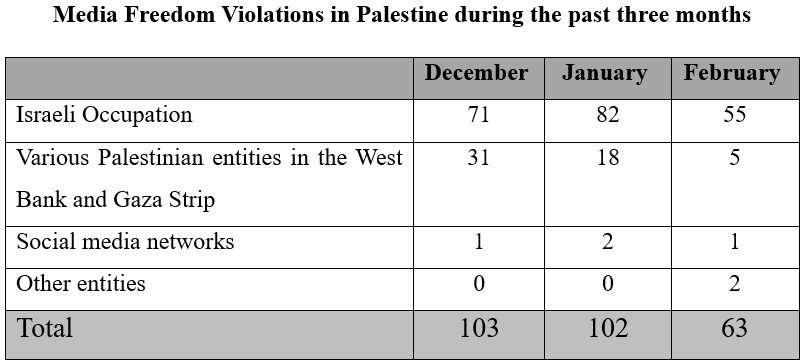
Ramallah – 8th March 2025 The Palestinian Center for Development and Media Freedoms, MADA, has monitored and documented a total of sixty-Three (63) violations against media freedoms in the West Bank, including East Jerusalem, and the Gaza Strip during February. The majority of these violations were perpetrated by Israeli forces, representing a 38% decrease compared to the one-Hundred Two (102) violations documented in January.
The violations recorded in February were distributed as follows: Fifty-Five (55) incidents committed by Israeli authorities, five (5) by various Palestinian entities in the West Bank, one by social media companies, and two (2) incidents involving the prevention of media coverage by an American officer working with a security company responsible for inspecting vehicles at the "Netsarim" checkpoint in Gaza. These two incidents targeted journalists in Gaza.
Israeli Violations:
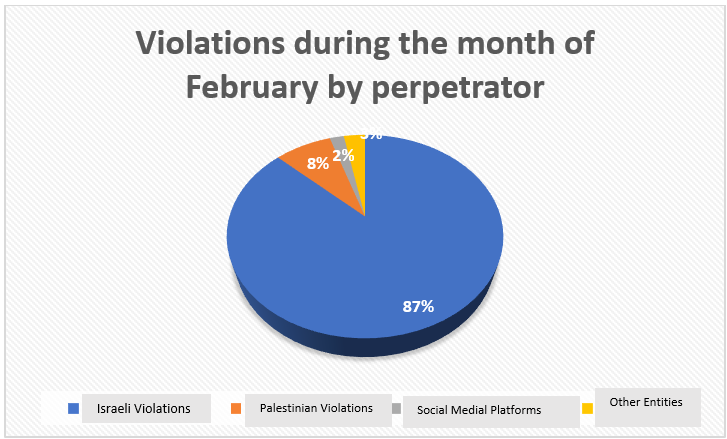
During the month of February, the Israeli occupation authorities committed a total of fifty-five (55) violations against media freedoms. These violations were distributed across forty-nine (49) incidents in the West Bank and six (6) incidents in the Gaza Strip, representing eighty-seven percent (87%) of all documented violations.
Most of these violations are classified as serious breaches of media freedoms in general, with the majority occurring during journalists’ coverage of the military campaign launched by the Israeli authorities against northern cities and their refugee camps, such as Jenin, Nablus, and Tulkarem.
MADA monitored and documented a total of twenty-three (23) violations targeting journalists with live ammunition, sound bombs, and tear gas, preventing them from reporting in both the West Bank and Gaza Strip. Additionally, seventeen (17) journalists were detained in West Bank cities while covering various events in the field. Furthermore, the crew of Palestine TV and two journalists were prevented from covering events in the Al-Fara Refugee Camp in the Tubas Governorate.
Israeli soldiers brutally attacked a journalist in the city of Hebron by beating him with rifle butts and kicking him with their hands and feet while covering the release of prisoners as part of a prisoner swap. This attack resulted in four (4) fractures to his nose and severe bruising to his neck. A female journalist in the city of Jenin also suffered a hairline fracture in her right hand while fleeing from the bullets of an Israeli sniper who fired randomly during coverage of the return of the AL-HANOUN family to their home in the Jenin camp to collect their clothes.
The Israeli forces also arrested freelance journalist HASSAN IMAD ABU AL-HASAN after raiding his home in the town of “Yamoun” west of Jenin and sentenced him to six (6) months of administrative detention during a trial session held at the "Ofer" military court, located on the lands of the town of Beitunia west of Ramallah.
The Israeli intelligence service summoned three (3) journalists for questioning, including freelance journalist BUSHRA AL-TAWIL, who was served with a summons shortly before being released from “Damoun” prison, just hours after the ceasefire deal on January 19th, 2025. She was summoned to appear before the Israeli intelligence.
Military jeeps of the Israeli forces also destroyed the equipment of freelance journalist OBADA TAHAINEH after driving over and breaking it while he was in the city of Jenin covering the military operation on the city and its refugee camps. One of the bullets fired directly hit the broadcast vehicle of the PMP company, which had the press insignia on it, while the crew was in the "Abasan al-Kabira" area, east of the city of Khan Younis in the Gaza Strip, preparing a report about the situation of displaced people.
Israeli forces also confiscated equipment from three (3) journalists after detaining them near the “Karmei Tzur” settlement while they were in the town of “Beit Ummar” in the Hebron Governorate to cover the notification of several homes being ordered for demolition.
Palestinian Violations:
The number of documented Palestinian violations against media freedoms decreased during the month of February, reaching a total of five (5) violations, compared to eighteen (18) violations documented in the previous month of January. This marks a seventy-two percent (72%) decrease.
All of these Palestinian violations occurred in the West Bank, accounting for eight percent (8%) of all documented violations during the past month. The violations included the arrest of freelance journalist GHASSAN NAJAJRAH by the Palestinian intelligence services in Bethlehem for a period of four (4) days. He was interrogated about his journalistic work and media coverage in the town of “Nahalin”, and was forced to sign an agreement pledging not to engage in media work. He was also summoned for interrogation twice after his release.
Additionally, Palestinian security forces detained a reporter for the “Iranian” network in a security vehicle at the Manara Square in Ramallah. They attempted to access his phone while he was at a demonstration supporting the Lebanese people during the funeral ceremonies of the former Secretary-General of “Hezbollah”.
Social Media Violations:
The violations committed by social media platforms against media freedoms during the month of February were limited to a single incident. The “Facebook” application, owned by “Meta” removed a post and images shared by Al-Aqsa TV reporter, journalist BASEL TAWAHINA, which related to the Palestinian situation in the Gaza Strip following the cessation of hostilities there.
Details of Violations:
(01/02) The occupation soldiers assaulted the journalist MUSAB SHAWER by beating him with rifle butts and kicking him with their feet while he was in the center of Hebron on Saturday evening to cover the release of prisoners, which caused him a broken nose and bruises in his neck.
In his testimony to the MADA Center, the reporter of the newspaper “Al-Hadath”, journalist MUSAB SHAWER, stated that he was present at around 2:00PM in the “Al-Haras” area in the center of Hebron, in order to cover the release of one of the prisoners as part of the exchange deal. In the meantime, the occupation forces stormed the area and the soldiers raided the prisoner’s family home and assaulted those inside. Journalist SHAWER was present 200 meters away from the place to cover what was happening.
Meanwhile, one of the soldiers asked him to stop covering and move away from the place. The journalist complied with the orders, and before he could move away from the place, another soldier shouted asking him to come towards him. When the journalist reached the soldier, he asked him “if he wanted to delete the photos” but the soldier said, “No”. He grabbed his hand and led him with another soldier behind a house. One of them brandished his gun and punched the journalist in the face with the butt of the gun until he lost consciousness and fell to the ground. After about two minutes, the journalist woke up and the soldiers kicked his feet and asked him to leave. The journalist moved away from the place, his mouth and nose bleeding, until he reached a store. Citizens offered him water, and he was transferred by a private vehicle to the Hebron Governmental Hospital, where medical examinations and a CT scan of the head were performed, which revealed four fractures in the nose and severe bruises in the neck. He left the hospital at about 7:00PM.
(01/02) Israeli soldiers detained three journalists and interrogated them near the “Karmi Tzur” settlement in Hebron on Saturday morning, preventing them from continuing their work covering the notification of several homes being slated for demolition in the town of “Beit Ummar”. They were released after five (5) hours, and their cameras were confiscated.
According to the testimony of freelance journalist MOHAMMED ISMAIL MASHARQA to MADA, around 10:00AM on Saturday, he was with freelance cameraman NIDAL ASHMAR AL-NATSHEH and freelance journalist IHAB AL-ALAMI in the “Al-Zahr” area, south of Beit Ummar, north of Hebron, to cover the Israeli authorities’ demolition orders for several homes.
After conducting interviews with the residents, a military force consisting of two (2) jeeps arrived at the location, stopping a few meters from where the journalists were. Around ten (10) soldiers disembarked, armed, and demanded the journalists stop their coverage. The journalists complied with the orders. The soldiers then instructed them to approach the military jeeps, where they were asked to place their cameras, phones, and IDs on the front of the jeeps. The soldiers then conducted body searches on each journalist, handcuffed them, blindfolded them, and made them sit on the ground for about fifteen (15) minutes.
They were then transported to military jeeps, which took them to a military camp near the “Karmi Tzur” settlement, south of the town. The soldiers kept them sitting on the ground for four (4) continuous hours before each was taken to an interrogation room.
The soldiers interrogated the journalists about the nature of their journalistic work, the media outlets they were working with, and their personal lives.
Around 5:00PM, the journalists were released near the settlement, and they were informed that the cameras in their possession, which included one (1) Panasonic video camera, two (2) Canon 6D Mark cameras, and one (1) Canon 80D camera, would be examined and returned to them later by the military liaison. Additionally, journalist MOHAMMED MASHARQA was handed a written summons to meet with Israeli intelligence at the "Gush Etzion" settlement, south of Bethlehem, the following day.
(01/02) Israeli intelligence summoned journalist NIDAL AL-NATSHEH and interrogated him for two (2) hours at the intelligence office regarding his journalistic work before he left the premises.
According to the testimony of freelance cameraman NIDAL ASHMAR AL-NATSHEH to MADA, he received a phone call at 8:00PM on Saturday, February 1st, from a person identifying himself as “Captain SALEH” from Israeli intelligence. The caller instructed him to come the next day, Monday, February 2nd, for an interview at the Israeli intelligence office in the “Gush Etzion” settlement, south of Bethlehem.
The next day, journalist AL-NATSHEH arrived at the Israeli military liaison office in the mentioned settlement, where he waited until 2:30PM before being taken into the interrogation facility.
During the interrogation, the investigator asked him about the nature of his journalistic work, the media outlet he works with, and the types of topics he covers. Additionally, the investigator inquired about his personal life and the reason for his previous detention by the Israeli forces around ten (10) years ago.
The interrogation session lasted for about one (1) hour. The journalist attempted to speak with the investigator and requested the return of the cameras that had been confiscated the previous day. The investigator replied that he did not have them and that they would be examined and returned later. The journalist left the premises around 4:30PM.
(02/02) On Sunday evening, Israeli intelligence interrogated freelance journalist MOHAMMED MASHARQA regarding his journalistic work after he was handed a written summons on Saturday, February 1st, during his detention, along with other journalists, at the "Karmi Tzur" settlement.
According to the testimony of freelance journalist MOHAMMED ISMAIL MASHARQA to MADA researcher, he arrived at the Israeli military liaison office in the “Gush Etzion” settlement, south of Bethlehem, at 10:00AM on Sunday, February 2nd, to meet with Israeli intelligence (Shabak) based on the written summons he had received from Israeli soldiers before his release from the “Karmi Tzur” settlement near the town of “Beit Ummar”, north of Hebron, after being detained along with two other journalists the previous Saturday.
At around 3:30PM, the soldiers brought MASHARQA into the interrogation room, where the investigator’s questions focused on the nature of his work, the reason for his presence in the town of "Beit Ummar" the previous day, the media outlet he works for, and the reason for his prior detention by the occupation forces.
The session lasted for approximately two (2) hours, and the journalist left the intelligence office around 5:00PM.
(02/02) On Sunday evening, Israeli forces destroyed the equipment of freelance journalist OBADA AL-TAHAINA by running over it while he was covering the ongoing military operation in the city of Jenin and its refugee camp.
Freelance journalist OBADA MOHAMMED AL-TAHAINA (23 years old) informed MADA’s field researcher that he was standing on the Hospitals Street, which connects the Jenin refugee camp with the city, holding a video camera, a broadcasting device, and a camera tripod at 4:30PM on Sunday, covering the military operation in Jenin. At that moment, three military jeeps approached him at high speed. As they got close, the vehicles suddenly veered towards him as if they were aiming to run him over. He quickly moved away from the area, but this did not prevent the soldiers from violently striking his camera. The three jeeps ran over the equipment, completely destroying the camera and tripod, while part of the broadcasting device was also damaged. After the military vehicles left, the camera remained destroyed on the ground.
On Sunday morning, February 2nd, Israeli forces prevented several journalists from covering events and forced them to leave the “Ain al-Fara” area in the Tubas Governorate, claiming it was a closed military zone, hindering their work.
According to the testimony of Palestine TV reporter AMIR HELMI SHAHEEN (33 years old) to MADA’s field researcher, he was present at 9:00AM along with his colleagues from the Palestine TV crew, LOAI SAMHAN and MARWAN AL-SHAFAI, in the “Ain al-Fara” area, 300 meters from where Israeli soldiers were stationed. They were covering the military invasion of the area, which had been declared a closed military zone after its entrances were blocked with dirt berms and a curfew was imposed.
While preparing for a live broadcast, three soldiers, including an officer, approached them. The officer said, "You are not allowed to be here" and demanded they leave immediately, threatening, "Go from here, and if you stop at another location, I will take action against you, careful!”.
The crew left the site and moved a kilometer away from the soldiers, continuing their coverage for four hours. At approximately 1:45PM, while accompanied by other journalists, including AFP cameraman JAAFAR ISHTAYYA and freelance journalist SEDIQ RAYAN, one of the Israeli jeeps arrived. Two soldiers disembarked, with their faces covered, and one of them, speaking in Arabic, told them, "This is a closed military zone where the Israeli army is operating. You are not allowed to stay or cover media activities here. If you don’t leave, I will arrest you”. He further threatened, "Be careful, you will be banned for a week" and again ordered them to leave immediately.
The journalists withdrew from the area, moving far away from the site of the military operation.
(03/02) On Monday evening, Israeli forces directly targeted the Al-Jazeera Live crew during their coverage in Beit Hanoun, in the northern Gaza Strip, in an attempt to prevent them from reporting on the Israeli tanks crossing into the restricted zone.
According to the testimony of Al-Jazeera Live reporter, HUSSAM BASEL SHABBAT (23 years old), he and his colleague, the cameraman MOHAMMED AL-MASRI, headed at approximately 3:00PM on Monday to the Al-Masriyin neighborhood in Beit Hanoun to cover the incursion of Israeli tanks that crossed into the restricted zone, which was established under the ceasefire agreement that started on January 19th. They were documenting the violations against displaced citizens who had returned to their destroyed homes.
While they were live on air, covering the movement of the military vehicles, the crew came under intense fire from live ammunition. The journalists narrowly escaped a fatal situation as the bullets struck the area where they were located. They managed to withdraw under heavy gunfire and sought refuge behind the walls of a destroyed house.
(03/02) On Monday morning, Israeli intelligence interrogated freelance journalist BUSHRA JAMAL AL-TAWIL at the "Ofer" military camp, located on the lands of the town of Beitunia, west of Ramallah in the occupied West Bank.
According to BUSHRA AL-TAWIL’s testimony, who works for several local and Arab media outlets, she was informed by four Israeli intelligence officers just hours before her release from "Damon" prison, under the ceasefire agreement on January 19th, that she was required to report to Israeli intelligence on February 3rd.
On the specified date, she went to the Ofer military camp around 10:00AM and waited for about three hours before being called into the interrogation room. During the interrogation, the Israeli intelligence officer threatened her, warning her to stay away from "terrorism", to which she responded, "You treat every journalist as a terrorist”.
AL-TAWIL left the Ofer military camp after enduring a series of threats from the Israeli investigator.
It is worth noting that AL-TAWIL had previously spent 11 months in administrative detention without any charges, solely because she is a journalist.
(03/02) Palestinian Intelligence Services detained freelance journalist GHASSAN NAJAJRAH at their headquarters in Bethlehem for three days, where he was interrogated about his journalistic work. He was released after signing a legal pledge worth 5,000 Jordanian dinars should he return to his journalistic activities. He was subsequently summoned for two additional sessions after his release.
According to freelance journalist GHASSAN JAMAL NAJAJRAH, a resident of the town of "Nahalin" west of Bethlehem, he received a phone call summoning him to the Palestinian Intelligence Services for interrogation on January 29th. It was postponed to Monday, February 3rd.
On the specified date, NAJAJRAH attended the intelligence headquarters, where he was taken to the investigation department and underwent four sessions focused on his journalistic work and media activity concerning the events in his hometown of Nahalin. He was not presented to the public prosecutor, and was then held in solitary confinement until his release on Thursday, February 6th, after signing the legal pledge.
Before leaving the facility, his mobile phones—two in total—were confiscated, and he was handed a summons to appear again on Monday, February 10th, 2025.
On the scheduled date, NAJAJRAH arrived at the intelligence headquarters and underwent another round of questioning about his journalistic work. He was released again at 5:00PM, but was told to return the following day, Tuesday. The next day, he was interrogated about his connections in the area for about an hour and a half before being released once more and given back his phones.
(05/02) On Wednesday, during a television production in the town of "Abasan al-Kabira" east of Khan Younis, a group of journalists was directly targeted by Israeli forces who fired live ammunition at them. They were working on a live TV segment about the conditions of displaced persons in the area following the war.
According to IBRAHIM QANNUN, a reporter for Al-Ghad TV, who spoke to "MADA" center, he was present at around 2:40PM on Wednesday along with a team from PMP Media Production, including journalists MOHAMMED AL-ZA'ANIN, AAJAB AL-SHARAFI, and ABDUL MASI'ID. They were preparing a live broadcast about the post-war conditions and daily life of displaced people in the area.
The journalists were over a kilometer away from the Israeli forces’ position, in an area classified as safe and not a restricted zone. Suddenly, the team was surprised by a barrage of live ammunition fired at them by Israeli military vehicles stationed at the borders of the town. One of the bullets directly hit the broadcast van of PMP Media Production, which clearly displayed the press insignia. The equipment for external transmission, including digital cameras and cables, was visible at the site.
The journalists narrowly escaped injury after seeking shelter behind the walls of several destroyed houses in the area.
(07/02) On Friday morning, Israeli forces raided the residence of freelance journalist HASSAN IMAD ABU AL-HASSAN in the town of "Yamoun" west of Jenin and arrested him.
According to an account from his father, DR. IMAD ABU AL-HASSAN, given to the field researcher at MADA center, at around 4:00AM on Friday, Israeli forces stormed the home of his son HASSAN in "Yamoun”. They thoroughly searched the house, ransacked its contents for about an hour, and interrogated the journalist on-site. Afterward, they arrested him and took him to an unknown location.
On February 20th, the military court at "Ofer" issued an administrative detention order against the journalist for six months.
(08/02) On Saturday evening, Israeli police detained cameraman SAIF AL-QAWASMI near the town of Silwan and issued him a summons for an interview the following day. He was handed an order banning him from entering the Al-Aqsa Mosque for one week.
According to SAIF AL-DIN SAID AL-QAWASMI (23 years old), a cameraman with the "Al-Asima" network, in his statement to MADA center, he was on his way home around 5:00PM on Saturday via the "Tel Boyout"[1] road near the Al-Thawri neighborhood in the town of "Silwan". He was stopped by a police car, and the officers claimed he was “wanted”, saying they needed to take him to the "Qishla" investigation center.
After waiting for about 40 minutes, the police told him that he would not be taken to the investigation center immediately but would instead receive a summons to meet with Israeli intelligence at 10:00AM the next day. He was released around 5:40PM.
The following day, he went to the "Qishla" investigation center as scheduled, where he waited for about an hour and a half. He was not interrogated, nor were any questions asked. He was handed an order banning him from entering the Al-Aqsa Mosque for one week. He left the center around 12:20PM, with instructions to return for further investigation the following Sunday for a possible extension of the ban. However, the order was not renewed.
(09/02) On Sunday morning, Israeli occupation forces detained journalistic teams in the Jenin refugee camp for twenty minutes, obstructing their work and firing at them. They prevented the journalists from covering the return of citizens to check on their destroyed homes in the camp.
According to a report by Wafa Agency journalist FATIMA IBRAHIM SHEHADA (38 years old) to the field researcher of the MADA Center, she and a group of journalists arrived at the Jenin refugee camp at around 10:30AM. The team included: ALI SAMUDI, a cameraman for Al-Quds newspaper, freelance journalist MAHMOUD NAJI ZAKARIA (30 years old), freelance journalist SHADA HANAYSHA, the "Al-Arabi" TV team with reporter AMEED SHEHADEH and cameraman RABI' MOUNIR, freelance journalists DINA NAYEF JARADAT (26 years old), AMRO MANASRA, and MISHAAL ABU ALROB, as well as freelance journalist AHMAD SHAWISH. All were fully dressed in press uniforms. They arrived at the camp to observe residents trying to check on their houses and assess the damage after the camp had been raided 20 days earlier.
Journalist MAHMOUD ZAKARNAH was in the street opposite the journalists. While there, the soldiers fired directly at him, even though he was wearing the press uniform. He retreated and withdrew from the camp.
When the rest of the journalists arrived at the "Al-Saha" area in the camp, they were shot at by Israeli forces. Snipers were positioned in front of them, and the journalists found themselves trapped in the camp’s square. Drone aircraft started flying above them, recording their movements for about 25 minutes.
A military force arrived and approached the journalists. SHEHADA asked if they were allowed to move, and the soldiers ordered them to raise their hands and approach them. The soldiers then took their personal phones and questioned them about the reason for their presence and how they had entered the camp.
The soldiers detained the journalists under pressure for 20 minutes, then they opened journalist SHATHA’s phone and questioned her about the reason for filming the soldiers. She explained that she was a journalist and that the filming was specifically focused on the soldiers’ movements. After inspecting the devices, it was found that the pictures of the soldiers were unclear. The soldiers then allowed the female journalists to leave first, with the male journalists to follow later. Coordination was made with ambulances to evacuate them and ensure they would not return to the camp.
At around 1:40PM, freelance journalist DINA JARADAT returned to the camp to document the entrance of the AL-HANOUN family into their house to collect clothes. While there, an Israeli sniper fired indiscriminately, and during her attempt to withdraw, she slipped on the ground, which resulted in a hairline fracture in her right hand. She was taken to the hospital for treatment.
(09/02) A U.S. officer working with the security company responsible for inspecting vehicles at the "Nitzarim" junction in central Gaza Strip prevented journalist ABDEL RAHIM KHADER from continuing his aerial photography work on Sunday afternoon to document the destruction in citizens’ lands. The officer also interrogated him on-site and obstructed his work by confiscating his journalistic equipment, despite KHADER having received permission for coverage from an Egyptian officer.
According to the testimony of freelance journalist ABDEL RAHIM KHADER (23 years old), he headed around 2:30PM on Sunday to the "Nitzarim" junction after the withdrawal of the Israeli occupation forces, intending to document the significant destruction of land, properties, and homes of local residents. He had received permission from an Egyptian officer responsible for the international forces conducting vehicle inspections at the junction to film using a small drone.
While filming and documenting, KHADER was surprised when another drone approached his and interfered with it, attempting to disrupt his work. He assumed it was an Israeli drone, so he landed his drone and left the area.
Less than a kilometer away, while heading toward Gaza City, he was startled to find a civilian car following him and trying to stop him. He realized that the people inside the car were Egyptian soldiers from the security company. They instructed him to stop driving and sit in the back seat, with one of the soldiers taking over the driving.
The Egyptian soldiers returned KHADER to the original filming location, where they were met by a U.S. security officer in military attire carrying a weapon. The officer, accompanied by an Arabic-speaking translator, asked KHADER: "Who gave you permission to film in this area?" KHADER explained that he had received permission from an Egyptian officer. However, the U.S. officer downplayed the Egyptian authorization and demanded KHADER hand over his identity card, phone, and the memory card from his drone.
After a field interrogation that lasted for about half an hour, the U.S. officer returned KHADER’s belongings and instructed him not to return to the location for filming again. He also told KHADER to convey a message to all journalists in Gaza, stating that they would not be allowed to film with aerial drones in that area.
(16/02) Israeli occupation forces targeted press crews and several journalists with sound and gas bombs to prevent them from covering events in the Old City of Nablus after the discovery of special forces in the area on Sunday morning.
According to the testimony of freelance journalist ABDULLAH TAYSIR BAHSH (27 years old) to the field researcher of MADA Center, he, along with the following journalists, was present at approximately 10:30AM on Sunday: the crew of "Roya" TV, reporter HAFEZ ABU SABRA and cameraman MAHMOUD FAWZI; "Haya" Radio cameraman AMEERA HAMOUDA; "Al-Madina" TV reporter SAJDA BANI SHAMSA; the crew of "Palestine" TV, reporter FADI JAYYOUSI and cameraman BADR ABU NAJM; US SIPA cameraman NASSER ISHTAYEH; freelance journalists SEDQI RAYAN, JAMAL RAYAN, and MOHAMMED SAYEH. They were all in the "Bab Al-Saha" area in the middle of the Old City of Nablus to cover the movements of Israeli occupation forces around the city, after the journalists discovered the presence of special forces in the area. One of the soldiers opened the door of the military jeep they were inside and launched a sound bomb towards the journalists from a distance of 100 meters, at a time when only journalists were in the area.
Around 11:54AM, journalist BAHSH, along with cameraman MAHMOUD FAWZI, were attempting to reach the schools street near the eastern complex of Nablus when the soldiers saw them and fired another sound bomb toward them. The soldier began shouting at them, demanding they leave the area.
At approximately 12:15PM, the journalists were directly targeted with a gas bomb. The soldiers dropped it on the ground, forcing the journalists to flee and move away from the area.
(22/02) The management of the "Facebook" application removed a post containing Palestinian content and photos taken in the Gaza Strip shortly after it was published on the personal account of journalist BASEL ABU TAWAHINA.
According to the statement of the journalist and reporter for Al-Aqsa TV, BASEL ABU TAWAHINA (43 years old), he posted a message on his Facebook account, which is owned by "Meta," on Saturday, along with images that reflected the national sentiment in Gaza after the war had ended.
The journalist was surprised the same day when the post was deleted by the App’s management, despite it not containing any hate speech or violating publishing standards. However, the attached image that was deleted showed a child wearing clothes with a picture of his martyred father and holding a banner with a national slogan about the right of future generations to their homeland, which the management deemed a violation.
ABU TAWAHINA also pointed out that Facebook had previously disabled four of his accounts between 2019 and 2021 for similar reasons, as he posted content related to Palestine and the situation in the Gaza Strip.
(23/02) Palestinian security forces detained the reporter for the "Iranian" network, journalist KHALED SABARNA, in a security vehicle and attempted to seize and unlock his phone while he was at a roundabout in Ramallah city on Sunday morning, where he was covering a solidarity rally with the Lebanese people during the funeral of the former Secretary-General of Hezbollah.
In his statement to the MADA Center, KHALED ALI SABARNA, the reporter for the Arabic-language "Iranian" network, mentioned that he was at around 11:00AM on Sunday in the vicinity of the Al-Manara Square area in central Ramallah to prepare a report for the network on the solidarity with the Lebanese people during the funeral of the former Secretary-General of Hezbollah in Lebanon.
When police officers and Palestinian security forces arrived at the location, two of them, one in civilian clothes, attempted to seize SABARNA's phone from his hand. When the journalist refused to hand over his phone, an argument ensued, and the two officers forcefully pulled the journalist into a security vehicle parked nearby.
After about seven minutes, one of the officers arrived and requested the phone. SABARNA responded from inside the security vehicle, saying, "You must arrest me legally and bring a court order to take and unlock the phone" as he was there for legal journalistic coverage.
The journalist was released a few minutes later from the security vehicle and left the location.
(24/02) Israeli forces detained the press crews in the town of "Qabatia" south of Jenin for about a quarter of an hour on Monday afternoon, while they were covering the military operation in the town. The soldiers obstructed their work and prevented them from covering the events by pointing their weapons at them.
According to freelance journalist AHMED MOHAMMED SHAWISH, who spoke to the field researcher from MADA Center, he was present at around 1:00PM on Monday, alongside freelance journalist SHATHA HUNAISHA, "Palestine Post" reporter MASHAEL ABU ALROB, and freelance journalists MOHAMMAD SAYEH at "Police Street" in Qabatia to document the Israeli military operation in the town.
While covering the destruction of infrastructure and land leveling in the street, the journalists saw one of the soldiers harassing them and pointing his weapon at them, firing a shot in their direction, which forced them to withdraw from the area.
As they began to move towards their vehicles, the soldiers attacked them, pointing their weapons and laser sights at them. The journalists raised their hands, showed themselves to the soldiers, and informed them in both Arabic and English that they were journalists.
Despite this, the soldiers continued to point their weapons at them for about a quarter of an hour before eventually allowing them to leave.
(25/02) Israeli forces targeted a group of journalists and media crews with sound and gas bombs while they were present to cover the storming of the "Western Cemetery" in the city of Nablus on Tuesday afternoon.
According to freelance journalist ABDULLAH TAYSIR BIHASH (27 years old), who spoke to the field researcher from MADA Center, he was present around 3:00PM on Tuesday at the Western Cemetery in Nablus, along with freelance journalist MOHAMMAD SAYEH, Radio "Hayat" reporter AMEERA HAMOUDA, "Pal Post" Network reporter MUJAHID TABAJA, "Al-Najah TV" reporter AMER SHTAYYEH, freelance journalist SADIQI RAYAN, and the Palestine TV crew, including cameraman ABDULLAH ABU SABRA and reporter MOHAMMAD KHATIB.
The journalists were there to cover the Israeli forces’ raid around the "Western Cemetery" in Nablus. While standing near the event, one of the soldiers targeted them with a sound bomb, launching it directly at them.
A few minutes later, at 3:15PM, the journalists were targeted for a second time, this time with tear gas bombs, which were fired directly at them from a distance of no more than 100 meters, despite their clear identification as journalists. This resulted in all of them suffering from suffocation and seeking shelter in ambulances.
(26/02) Israeli forces detained journalist ALI SADIQ SAMUDI at the eastern entrance of the "Jenin" refugee camp after chasing him and searching his phone during his coverage of the raid on the camp on Wednesday afternoon.
According to ALI SADIQ SAMUDI (56 years old), a cameraman for "Al-Quds" newspaper in Jenin, who spoke to MADA Center, he was present at the Jenin camp around 11:30AM on Tuesday to cover the return of residents to their homes, as some families were trying to enter and check on their houses. While standing at the eastern entrance of the camp, soldiers chased him and tried to take his phone. He attempted to escape from them, but they continued chasing him until they succeeded in seizing his phone. They opened it, searched its contents, and asked him if he had filmed them. He replied that he had not.
They detained him for an hour, searched him, and then released him around 12:00PM from the camp. The soldiers warned him that if they saw him in the vicinity of the camp, even from a distance of one kilometer, they would shoot at him.
(26/02) Israeli forces targeted photojournalists FADI WAHEED THABET and HAZEM MAZEED with live ammunition while they were preparing a video report for the "Mirsad" institution for political and social studies in Ramallah, about the conditions of farmers east of the "Al-Maghazi" refugee camp in the central Gaza Strip on Wednesday afternoon.
According to freelance journalist FADI THABET, he and his colleague HAZEM MAZEED, accompanied by a farmer, went to conduct an interview as part of their report about the agricultural sector after it was devastated by the occupation during the war. They arrived at a farmland east of the "Al-Maghazi" camp, which is considered a safe area, over 1100 meters away from the border and military vehicle positions.
After they reached the agricultural land, three tanks emerged and began shooting directly at them. The farmer who was with them was shot in the back and was rushed to the "Shuhada Al-Aqsa" hospital in Deir al-Balah. Meanwhile, the two journalists miraculously escaped serious injury. The gunfire appeared to be aimed at stopping the journalists from filming and covering the incident.
Top of Form
Bottom of Form
[1] "Talbiya" neighborhood, which is occupied, is located on the outskirts of the city center to the south of the Old City of Jerusalem. It is now a large commercial center and houses a number of Israeli institutions and archaeological sites, in addition to the residence of the Israeli Prime Minister.
