

Oct. 6th, 2023. Ramallah – September 2023 witnessed a decrease in the numbers of violations against media freedoms in Palestine in comparison to August that recorded a high number of violations.
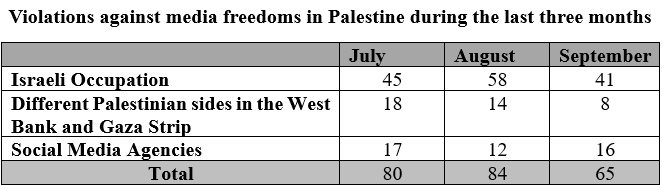
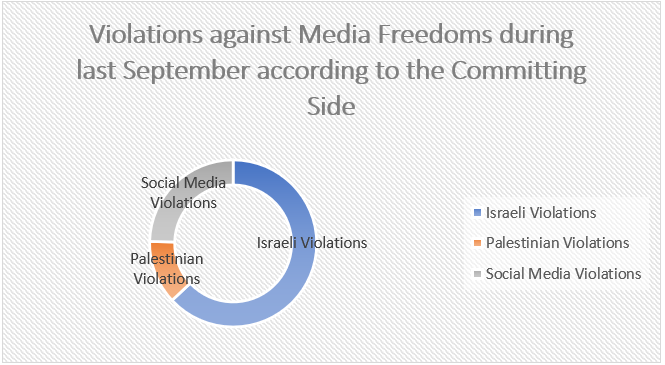
MADA monitored a total of 65 violations during last September against media freedoms in Palestine with a decrease of 23% in comparison to August, where the violations in August reached 84. Also, the Israeli Occupation committed 41 violations last month while the Palestinian side committed 8 violations, as well as 16 violations committed by Social Media Agencies.
Israeli Violations:
The occupation forces and authorities committed a total of 41 attacks against media freedoms, representing 63% of the total documented violations, 34 of which occurred in the West Bank and 6 attacks in the Gaza Strip.
Despite the decrease in the number of documented Israeli violations last September, most of them fall within the serious attacks on media freedoms, most notably the physical attacks that are revealed by the testimonies of the victims and the circumstances in which show deliberate targeting of journalists by occupation soldiers occurred with the aim of removing them from coverage. This was clearly evident in the firing of tear gas canisters at the bodies of journalists in the Gaza Strip while covering peaceful demonstrations in rejection of the storming of Al-Aqsa Mosque courtyards by settlers in conjunction with the Jewish holidays and in support of the prisoners. The extent of 7 physical injuries to journalists was documented, 6 of which occurred in the Gaza Strip.
The injury of Turkish Anadolu Agency photographer ASHRAF ABU AMRA was one of the most severe injuries documented. He was hit by a tear gas canister directly in the fingers of his right hand while covering the Khuza’a area, and he is still receiving treatment in the Republic of Turkey. Journalist MUHAMMAD RIZQ was also injured by a tear gas canister in the left elbow, which ricocheted off to hit Al-Aqsa Radio correspondent ISMAIL ABU OMAR below the shoulder. French agency photographer BILAL AL-SABBAGH was also injured by a tear gas canister in the right thigh, while photographer Fadi Al-Danaf was injured by a tear gas canister in the right knee, and the Quds News Network correspondent was injured by a tear gas canister in the left side of his chest while covering the weekly march in the town of Beit Dajan.
In addition to physical injuries, MADA Center documented 20 violations preventing coverage of journalists, as the occupation forces prevented the “Roya” channel crew from preparing a press report on the repeated closure of the entrances to the town of Qalqilya, and the crew was also prevented once again from covering the town of “Beita” along with the Palestine TV crew. At the Deir Sharaf checkpoint, the occupation forces obstructed the work of photographer JIHAD AL-BADAWI and photographer MAHMOUD FAWZI from covering the storming of the town, while they detained correspondent HAFEZ SABRA for about 15 minutes.
On the other hand, the occupation soldiers prevented a group of journalists (journalist ABDULLAH BAHASH, photographer MUHAMMAD ABU THABET, reporter MUHAMMAD AL-KHATIB, photographer FADI AL-JAYOUSI, and journalist DIANA KHUWAILID) from covering in “Beit Dajan.”
The occupation police obstructed the work of the photographers in Baba Al-Silsilah (Chain Gate), namely: ALI DAWANI, JAMAL AWAD, GHASSAN ABU EID, MARAM BUKHARI, HEBA NAJDI, CHRISTINE RINAWI, MUHAMMAD ASHO, HANAA MAHAMEED, AND SAEED AL-QAQ in addition to breaking the camera lens of photographer SAEED AL-QAQ.
During September, the occupation forces detained 10 journalists. Four journalists were detained at the Beit Furik checkpoint inside their vehicle under the sun, and the soldiers prevented them from opening the vehicle’s windows. This led to a deterioration in the health condition of two of them, and they were transferred to receive treatment in the hospital, while they detained 3 other journalists. In a separate incident, they were inside their car and used them as human shields to repel stones thrown by the demonstrators. They also detained Wafa Agency correspondent MASHHOUR AL-WAHWAH at the southern entrance to the city of Hebron for about an hour, searched his vehicle and obstructed his work, in addition to detaining journalist MONTASER NASSAR at the eastern entrance to the town of Dura for an hour and a half only because he is a journalist.
Palestinian Violations:
Palestinian violations witnessed a clear decline during September, as a total of only 8 violations were monitored, representing 13% of all documented violations, all of which occurred in the West Bank, compared to a total of 14 Palestinian violations monitored during the previous month of August.
Despite the decrease in the number of Palestinian violations, they occurred within serious attacks on journalists and on the state of media freedoms. Among the most prominent of these violations was the arrest of 3 journalists by the Palestinian security services after they were summoned for investigation, and they were subjected to ill-treatment amounting to torture (hanging). Journalist JARRAH KHALAF was released after 11 days of detention, and journalist HATEM HAMDAN was released after spending four days in detention. While freelance journalist TARIQ AL-SARKAJI is still detained by the Preventive Security Organization in the area command building in the city of Nablus, after his detention was extended on 9/27 for 15 days.
In addition to the above, the Preventive Security Organization summoned photographer MUHAMMAD SHUSHA against the background of a post he published on his Facebook page, and Military Intelligence summoned freelance journalist MUJAHID MARDAWAY and subjected him to investigation for hours against the background of his media work. Members of the Intelligence Service prevented journalist MUHAMMAD TURKMAN from preparing a report in the city of Al-Bireh, and the Palestinian Presidential Guard prevented “Media Port” correspondent JIHAD BARAKAT from covering a book launch event at the “Martyr Yasser Arafat” Museum, despite receiving an official invitation from the organizers of the event to cover.
Social Media Violations:
Various social media companies committed 16 violations against Palestinian content during the month of last September, an increase of 67% from what was documented during the previous month of August. During the past month, MADA Center documented 16 violations against Palestinian content, representing 25% of all documented violations.
The violations were divided into 4 violations committed by Facebook, 9 violations committed by WhatsApp, two violations committed by TikTok, and another violation committed by Instagram.
Details of Violations:
September 1st. The “WhatsApp” application administration deleted the account of the journalist at the “Kanaan News” agency, YASSER ABU AWAD, the freelance journalist ASHRAF AHMED RAMADAN, and the journalist AYMAN ABU SHANAB, correspondent for Al-Ghad TV, and also deleted the account of the correspondent of the local Al-Quds newspaper, ALI AL-SAMOUDI, and the correspondent of the “Sanad” agency. Al-Anbaa' YOUSSEF AL-FAQIH permanently, under the pretext of "violating the application's standards without specifying the reason for the ban and cancellation of the accounts."
September 1st. The “Tik Tok” platform permanently deleted the account of the journalist at “Sanad Media” Agency, KHALDOUN ZAKARIA AL-MAZLOUM, and all attempts to recover the account were unsuccessful. It also deleted the account of the freelance journalist MUHAMMAD ALI ATEEQ (31 years old), and the notification sent indicated that the deletion It came under the pretext of incitement to violence.
September 1st. The Instagram application permanently closed the account of Watan Agency photographer Hadi Sabarneh, under the pretext of “violating standards,” noting that he had 9,000 followers on the platform.
September 2nd. Occupation soldiers detained Wafa Agency correspondent, journalist MASHHOUR AL-WAHWAH, at the southern entrance to the city of Hebron for one hour on Saturday morning.
According to the investigations of MADA field researcher, Wafa Agency correspondent MASHHOUR HASSAN AL-WAHWAH was returning towards the city of Dura, southwest of Hebron, at around 10:30 am on Saturday morning. When he arrived at the city’s southern entrance (Hagai), the occupation soldiers were setting up a hasty military checkpoint in the place.
The soldiers stopped journalist AL-WAHWAH's vehicle and asked him for his personal identification card. Then they ordered him to open the trunk of the vehicle where the press equipment was located. The soldiers asked the journalist why there was a bulletproof shield, and the journalist answered that it was related to his journalistic work.
The soldier asked for AL-WAHWAH’s press card, and minutes later the soldier made a call on his mobile phone in Hebrew, which the journalist knew well, saying: “We caught a person carrying a bulletproof vest in a vehicle.” The journalist intervened, trying to convince the soldier that the vest was for his journalistic work, covering confrontations.
The argument continued between them for about 20 minutes, when two people in civilian clothes arrived, accompanied by soldiers, and began interrogating the journalist about his work. Then, his vehicle was searched, and they took out the bulletproof vest from the trunk and inspected it. After an hour of searching, the journalist was released.
September 4th. The management of the "META" company suspended the two communities of the "Khabar Palestinian Press Agency" on the WhatsApp application for a week, which included thousands of followers, without any prior warning.
September 4th. The Military Intelligence Service in the city of Jenin arrested the photojournalist, JARRAH KHALAF, after pursuing him for several days and summoning him several times under numerous promises that he would be released on the same day. He was released after 11 days of detention during which he was subjected to torture and ill-treatment.
Freelance photojournalist JARRAH WALID KHALAF (23 years old) went at 11:00 noon to the headquarters of the Military Intelligence Service in the city of Jenin, accompanied by his father and brother. After waiting two hours without any investigation, he was transferred to the General Investigation Service, and there he was placed in the agency’s custody.
JARRAH was subjected to harsh treatment by the Investigation Service, as the officers deliberately used means and methods that degraded his dignity and humiliated him, such as shouting, psychological pressure, threats, and insults, to the point that the officer attacked him and began to beat and push him, and hit his head against the wall, and then tied his hands behind him “with handcuffs.” And his he hanged by his hands for more than four hours.
After that, another officer came and untied him and took him with him to his office and told him that he was accused of “possessing a weapon,” but JARRAH denied the charge completely, and then took his statement and returned him to the investigation offices. During the way, the officer told him that he was not a journalist and not registered in the union, but JARRAH assured him that he had a membership card, but the officer came back and told him that if the union was interested in him, he would not be here, or they had sent a lawyer and representative to defend you.
The journalist remained in the room for 24 hours. It was not large enough to accommodate 4 people, and there were 10 people in it, all of whom were accused of attempted murder and trafficking in hashish, drugs, and weapons.
The day after his arrest (September 5th), he was presented to the Public Prosecution, where his detention was extended for 48 hours pending investigation. On September 7, a session was held for him in the Jenin Magistrate Court, during which he was acquitted of the charge against him, and it was decided to release him. He returned to the police station and began to prepare his things in preparation for leaving, but he was surprised by the policeman telling him from the window of the police station that he was under arrest by the governor, and that he was denied of visits. When he asked to know the reasons for his detention under the governor’s custody, the policeman told him that he did not know.
On Tuesday, September 10, the security committee investigated the journalist at around ten o’clock at night, and there he was charged with all charges within the framework of his journalistic and political work, the reasons for his filming certain videos, his relationships with personalities present in the field and events all the time, his relationships with some journalists, his monthly salary, and other unrelated questions not related to the weapon charge.
On the afternoon of September 12, the decision to release JARRAH from the Investigation Unit arrived, and he began preparing his things. When they took him out, he arrived at the door of the area command building. In the first moments of his release, he was surprised by a Preventive Security Organization’s patrol, whose members kidnapped him in the vehicle. When he tried to inquire about the reason for his arrest, they told him, “Be quiet and not a word."
JARRAH returned again to the area command building and was placed in a cell the size of a sleeping mattress, which was compressed and had no ventilation, noting that he was suffering from shortness of breath and had told them this previously.
JARRAH was subjected to a new investigation by the Preventive Security Organization Investigator, who asked him the same questions that the Security Committee asked him. The next morning, he was investigated by the Preventive Security Legal Advisor, and he was charged with incitement against the Palestinian Authority, which he completely denied, and then the Investigator told him he said that he would be transferred to the prosecution office, which is what happened, and there the head of the prosecution requested him and asked him what happened to him, and told him that he had to be released and refused to open a new case file.
The journalist returned to the Preventive Security Organization headquarters in the area command, and he had heard from some of the officers that he was under arrest by the Security Committee in Jenin, and he remained in the cells. The officers’ behavior was always full of violence, such as pushing, beating, and screaming, in an attempt to humiliate him as much as possible, and this remained so until Thursday, September 14. He was told at ten o'clock at night to prepare himself to leave, until he was released.
September 6th. The Palestinian General Intelligence Service arrested journalist HATEM MUHAMMAD HAMDAN on Wednesday evening from the city of Al-Bireh, subjected him to interrogation several times and for hours each time, and released him after four days, during which he was tortured more than once, despite his suffering from “migraine.”
According to MADA field investigations, “J-Media” agency correspondent and “Palestine Post” Network photographer HATEM MUHAMMAD HAMDAN (22 years old) was around one o’clock in the afternoon on Wednesday covering a student protest at Birzeit University in support of the prisoners, and after the coverage ended at two o’clock. He set off in his vehicle to film a report in the “Satah Marhaba” area, accompanied by “Al Jazeera Mubasher” cameraman MUHAMMAD TURKMAN (26 years old), and when they arrived in the Al Ain Mosque area in the city of Al Bireh, their car was intercepted by a civilian “Skoda” car belonging to the General Intelligence Service with 3 members in it. From Palestinian intelligence in civilian clothes, as they told him when he asked them to identify themselves, and the officers asked journalist HATEM to stand aside.
The officers checked the identities of journalists HAMDAN and TURKMAN, as well as their press cards, and confiscated their phones. Then they returned the identity and phones of “TURKMAN” and asked him to leave. They asked HATEM to accompany them to the center for just a few minutes, to answer a simple inquiry, and they took him in their vehicle, while one of them took the wheel. HATEM’s vehicle went to the center, and while he was in their vehicle, they confirmed that his presence with them would not exceed two small questions and that the matter might be a mistake or the result of a malicious report.
When HATEM arrived at the General Intelligence service headquarters in the “Al-Balou” neighborhood in the city of Ramallah, one of the security men asked to send HATEM to Medical Services, which meant arresting him and detaining him. When HATEM asked them if he was detained, they affirmed it to him.
HATEM handed over his personal belongings, and then one of the soldiers asked him to open his phones, but HATEM refused, as that required a judge’s decision, which prompted the soldier to beat him and attack him, causing an argument to break out between them, after which a security element intervened and withdrew the soldier, and took HATEM to the Medical Services.
After that, the journalist was transferred to the investigation room, where 6 investigators were waiting for him, where the investigation took place for a full hour about unlocking his phones, which HAMDAN refused, and when he asked them about the reason for his presence here, they told him, “Open the phone first,” and then we would talk about it.
The first hour of the investigation was over, and the journalist was taken, handcuffed, and placed in the corridor leading to the cells in a space not exceeding 1.5 square meters, after being blindfolded.
In the details of the hanging by the hands incident, he was crucified against the wall while he was “shackled” and blindfolded, and prevented from moving. Then they tied his hands behind him and hanged him with an iron chain on the ceiling for several hours. This was only interrupted by the arrival of one of the soldiers to ask him whether he wanted to open the phones or not. This is what HATEM refused, and when he asked them to go to the bathroom or pray, they refused and linked that to turning on the phones, and he remained in this state until eleven o’clock at night, after which he was taken down and brought into the cells while he was “handcuffed.”
On the morning of the second day, an employee of the Public Prosecution came and met with HAMDAN, and began asking questions, which HATEM realized were aimed at extending his detention as he was a former detainee of the Intelligence, including charging him with possession and carrying a weapon, a charge that had previously been brought against him and was found to be false.
HATEM returned to the cell and began to suffer from headaches. When he was arrested, he informed the security officers that he was suffering from headaches due to his suffering from migraines. When he went to the Medical Services, he informed them of this, and they gave him the appropriate medication. However, when the headaches began, the officers at the Military Intelligence did not give him medicine.
When he had a headache in the cell, he asked one of the officers for medicine, but he refused. Another officer came and took him to the place where he hung him from his hands, to do it again for an hour and a half with his hands back. Then the journalist asked for medicine. They told him that he had to open the phones before anything else.
Because of the hanging, the headache, and his need for medicine, HATEM told the officer that he was ready to open the phones, especially since they were empty and there was nothing on them, but this is illegal, and he actually opened them and they confirmed that there was nothing on them, and then he was transferred again to the Medical Services where HATEM explained to the doctor what happened to him and what he was suffering. The doctor injected him with a sedative needle, gave him medicine, and then returned to the cell until the third day.
On the morning of the third day of detention, one of the officers came and asked HATEM in an interrogation session about a weapon, which HATEM negated entirely, and then he returned to the cell until ten o’clock at night, where he was transferred to the investigation room, and there the officer told him that he wanted to close the file, and that he wanted to cooperate with him, as he began to ask him about his work in the “J-Media” network, its details, the nature of work there, his relationship with it, the date of starting work with it, and how the coverage and division of work is carried out.
After that, the officer asked him about the relationship of the Islamic Bloc with the network, something that HATEM denied knowledge of, and denied that there was a relationship, and if there was, he of course did not know about it, and then the officer claimed that he found on HAMDAN’s phone a list of the names of the agency’s employees and their ID numbers, in an attempt to prove that he is responsible for all employees and manages them, something that HAMDAN denied and asked the officer to prove it, but that did not happen. Because of this situation, the officer asked that HAMDAN is to be hanged from his hands, which began at eleven o’clock at night and continued for 12 continuous hours, that is, until eleven o’clock in the morning, and during the period of the torture the officer came to ask about the same topic twice, something that HAMDAN denied because he could not wrong or be unjust to anyone.
After eleven o'clock in the morning, one of the officers came and began to investigate again about the network, the media and the work of the media. The investigation continued for several hours and then he was transferred to the cell and then to the detention rooms, and in the evening they told him to prepare his things in order to leave.
At nine o’clock in the evening on Saturday 09/09, HAMDAN was able to fully prepare his belongings and then sign the entire statement. He received his belongings and left the agency’s headquarters, as the statement he signed was all about the “J-Media” network and working with it.
September 10th. Facebook deleted the personal page of the journalist specializing in investigative reports, TAMER AL-MASHAL, presenter of the “What is Hidden is Greatest” program broadcast by Al-Jazeera satellite channel, following his publication of an investigation into the targeting of Palestinian content on social media sites and Facebook’s intelligence cooperation with the Israeli occupation, and it was restored. The account was opened the next day after Al Jazeera channel management contacted Facebook management.
September 12th. The occupation forces obstructed the work of the "Roya" channel crew and prevented them from preparing a report on the ongoing closures affecting the town of "Azoun" in the city of Qalqilya on Tuesday afternoon.
According to the investigations of MADA’s field researcher, the “Roya” channel crew, consisting of reporter HAFEZ MAHMOUD SABRA (33 years old) and photographer MAHMOUD FAWZI, went around 11:30 noon on Tuesday to the town of “Azoun” in order to prepare a report about the repeated closure of the town’s entrances under the pretext of Continuously throwing Molotov cocktails at the occupation soldiers.
The crew arrived at the village's main entrance, which was not closed this time. However, the occupation soldiers expelled them from the place, obstructed their work, and prevented them from preparing the report.
September 13th. Occupation soldiers targeted photojournalists with a tear gas canister, hitting them in various areas of their bodies while covering the activities marking the 18th anniversary of the withdrawal of occupation forces from the Gaza Strip in the “Malkah” area, east of the Gaza Strip, on Wednesday afternoon.
According to field investigations by MADA researcher, Khabar Agency photographer MOHAMMAD RIZQ SOBH (36 years old) was injured at around 5:30 pm on Wednesday by a tear gas canister in the left elbow that was deliberately fired at him by occupation soldiers while covering the events. Al-Aqsa radio correspondent, ISMAIL FARID ABU OMAR (39 years old), was also injured by the same canister that rebounded after the photographer “SOBH” was injured, hitting him in the area below the shoulder. Both photographers received field treatment in the same place and did not go to the hospital.
September 13th. The occupation forces detained the Roya TV crew at the Huwara checkpoint on Wednesday morning for 40 minutes, interrogated them, thoroughly searched their vehicle, and prevented them from reaching the town and covering the shooting that took place there.
According to the investigations of MADA field researcher, the “Roya” channel crew went to cover the attacks by the occupation forces in the town of “Huwara” south of the city of Nablus after a shooting attack occurred there that resulted in the injury of two settlers.
The crew arrived at approximately 10:10 am on Wednesday morning at the “Huwara” military checkpoint, and there the occupation soldiers stopped them despite the presence of the word Press on the vehicle indicating the identity of the crew. They confiscated their personal cards (identities) and searched the vehicle thoroughly, and when the soldiers saw the uniform of the journalists and their equipment, they interrogated them about their place of work and the reason for their presence there.
The soldiers also inquired about the traces of the bullet in the vehicle's door, and the journalist replied that it was because of them, which angered them so much that they asked him about the type of bullet.
The soldier asked reporter HAFEZ and photographer MAHMOUD to move to the other sidewalk, where the cement cube was, and lift the clothes off their hands and feet to make sure there was nothing underneath.
The crew remained in detention for about 40 minutes before their ID cards were returned to them, and they were prevented from returning to the checkpoint again.
Crew Detention=1
September 13th. The General Investigations Department in the city of Ramallah arrested photojournalist MOHAMMAD SHUSHA on Wednesday based on a complaint filed by the owner of a gas station, following a post that the photographer published on the social networking site after filling fuel from the station.
Photographer MOHAMMAD SHUSHA (40 years old) posted on his page on the social networking site at around 2:30 pm on Tuesday about how he was filling up fuel from one of the filling stations in the Al-Tira neighborhood in Ramallah, but the vehicle’s index did not change and did not indicate that he had filled up without mentioning the name of the filling station, its owner, or to whom it belongs.
On Wednesday morning, “SHUSHA” received a phone call from the Investigation Service asking him to come immediately to the agency’s headquarters, and the photographer went to the headquarters because he had not done anything and did not want his house to be raided while his children were asleep.
The photographer arrived at the General Investigation headquarters in the “Al-Balou’” neighborhood at two-thirty in the afternoon, and they told him that there was a complaint filed against him, and that he was required to provide a statement. SHUSHA provided a statement, which is the post that he wrote without adding or subtracting, and it summarizes exactly what happened to him as the post does not indicate the name of the establishment or its owner.
The journalist went to leave the headquarters as they had told him previously in the phone call, but they told him that he would not be able to leave and would remain in their detention according to instructions.
The journalist handed over his personal belongings, his hands were tied with handcuffs, and he was placed in a small room until four in the afternoon, when SHUSHA was asked for a personal guarantee from another person so that he could leave, without knowing what happened and how it happened, and when he left Between 4:30 and 5 p.m., the detectives asked him to go to the prosecution office on the second day.
SHUSHA learned that half an hour after he left the investigation headquarters, the complainant came to the investigation headquarters and dropped the complaint and case against him. On the second day, SHUSHA went to the Public Prosecution office at the courts’ headquarters in “Al-Balou” as a formality in order to close the case and the file.
September 14th. The occupation soldiers prevented three media crews from covering the closure of the town of Beita and obstructed their work about six times following a shooting attack in the town that led to the closure of the town on Thursday afternoon.
According to the investigations of MADA’s field researcher, the “Roya” channel crew and a group of media crews (the “Al-Ghad” channel crew, correspondent KHALED BADIR, photographer SHADI JARARAA, Palestine TV correspondent, and TV cameraman FADI AL-JAYOUSI) went to the town of “Beita” at about 12:00 noon on Wednesday southeast of the city of Nablus to cover the occupation forces' closure of the town, despite a shooting attack occurring in the place two days earlier.
After the press crews arrived at the place, they were prevented from covering the events for about six times, and in every place they tried to cover the events from. One of the officers also directed his words to the Roya TV correspondent, saying, “You stand against the Israeli law that the Israeli army applies in the territory of the State of Israel.”
September 15th. Freelance photographer ASHRAF NASSAR ABU AMRA was injured by a tear gas canister deliberately fired by occupation soldiers, which hit his right hand while covering the demonstrations in the “Khuza’a” area, east of the city of Khan Yunis, on Friday.
According to investigations by MADA researcher, the photographer of the Turkish Anadolu Agency, ASHRAF NASSAR ABU AMRA, was hit by a tear gas canister directly in the fingers of his right hand (which was holding the camera) while covering the demonstrations in the “Khuza’a” area, east of the city of Khan Yunis, south of the Gaza Strip, which led to a laceration of the fingers of the hand, his right hand, especially the middle finger fracture. He was immediately transferred to Nasser Medical Hospital, and a day later he was transferred to Turkey to complete treatment there, where he underwent three operations and treatment sessions until the date of preparing this report.
September 16th. The occupation forces detained a group of journalists inside their vehicle and used them as a shield to repel the stones of young demonstrators, while covering a raid and search of homes in the town of Beita at dawn on Saturday.
According to the investigations of MADA field researcher, a group of journalists were present: WAHHAJ JAMAL MUFLEH (25 years old) who works for the “Ultra Palestine” website, the freelance journalist AYOUB SAAD (22 years old), and the freelance journalist ABBAS ABD KHABISA (22 years old) at around four o’clock Saturday dawn in one of the side streets in the town of Beita, to cover a random raid and search operation carried out by occupation soldiers in the town.
When the soldiers noticed the presence of the journalists, they forced them to turn off the vehicle's engine, detained them inside in front of the military jeep, and used them as human shields to confront the stones of young men from the village. In addition, some young men fired a gas canister at the occupation forces, where the soldiers left the three journalists inside their vehicle amidst their screams and fled the site quickly, without caring about the fate of the detained journalists.
The detention of the journalists continued for more than forty minutes until the occupation forces withdrew completely from the town.
September 17th. The Palestinian Presidential Guard prevented journalist Jihad Barakat from entering the Martyr Arafat Museum and covering a book launch event at the museum organized by the Prisoners’ Club and the Prisoners’ Authority, claiming that there was no coordination for his entry to cover on Sunday, 09/17.
In his testimony to MADA Center, Media Port correspondent, journalist JIHAD IBRAHIM BARAKAT (34 years old), said that he received an official invitation from the Prisoners’ Authority and the Prisoners’ Club to cover the launch of the book by the prisoner THAER HAMMAD on Sunday, 09/17, at the Martyr Yasser Arafat Museum.
When he arrived at the shrine gate, he was stopped by presidential security personnel to take their usual security procedures, as he is one of the museum’s visitors to cover its various activities and knows those procedures that usually consist of conducting an engineering examination of photographic equipment using police dogs, but he was surprised to be informed after examining his press card, and after the security man communicated. After the security personnel contacted his superiors at the gate via radio, they prevented him from entering due to his lack of coordination to enter the museum.
The journalist then communicated with the Prisoners’ Club and the Prisoners’ Council, which were calling for the event, and with the media department at the museum. Colleagues in the Prisoners’ Authority asked him to wait until they made their contacts, and to wait for their arrival, but after a short while, two security men in civilian clothes came and asked him for his press card again. After the examination, they asked him to leave because there was no coordination, noting that other journalist colleagues had been allowed, without asking them to do any coordination.
On Tuesday, September 26, the journalist received an invitation from the Media Department at the Martyr Yasser Arafat Museum to cover the launch of the Yasser Arafat Museum Guide. Before heading to the museum, he contacted the Media Department and inquired about the possibility of entering the coverage and was informed that he was welcome.
When the journalist arrived at the shrine gate, presidential security conducted the necessary inspection of the equipment through the engineering unit, and he was allowed to enter without asking for his name, as all journalists were allowed to enter without checking their identities.
However, as soon as he completed the coverage and left, the security men stopped him at the gate and asked him to provide them with his name. They asked him to go with one of the security men in civilian clothing next to the gate and informed him that he had instructions from “Operations” not to allow him to be there, and that the security did not prefer to remove him from inside the event, and told him that he was informed previously about this, but he replied that security had informed him the last time that he had not coordinated the coverage, but this time the museum invited him to cover, and communicated with him in advance before coming and welcomed him.
September 17th. The occupation forces directly targeted three photojournalists with tear gas canister, wounding them in various parts of their bodies, while covering a demonstration in the “ABU SAFIYA” area, east of Jabalia camp, denouncing the settlers’ storming of Al-Aqsa and in support of the prisoners on Sunday.
According to the follow-up of MADA field researcher, three journalists were injured by tear gas canister in different areas of their bodies, and they were directly targeted by the occupation soldiers on Sunday afternoon while covering a demonstration called by the national and Islamic forces to denounce the settlers’ storming of Al-Aqsa Mosque and to support the prisoners in the ABU SAFIYA area east of Jabalia camp, north of the Gaza Strip, knowing that they were about 400 meters away from the occupation soldiers and about 200 meters away from the demonstrators.
Al-Manara Agency photographer, FADI MAHMOUD AL-DANAF (37 years old), was injured at 4:00 pm on Sunday, September 17, with bruises in his right knee as a result of the Israeli occupation forces’ direct and deliberate firing of tear gas canisters at him while he was covering the demonstration. He was transported by ambulance to the Indonesian hospital. After medical examinations, it was found that he had bruises in his knee.
The French Agency photographer, BILAL BASSAM AL-SABBAGH (32 years old), was also injured in the same demonstration around 4:15 with a tear gas canister in the right thigh, despite wearing his full press uniform when he was standing next to the agency’s armored car. He was transferred to Al-Shifa Hospital and after examinations were conducted. It was found that he suffered bruises in the thigh area.
Within 15 minutes, the photographer of the Turkish Anadolu Agency, MUSTAFA MUHAMMAD HASSOUNA (43 years old), was injured with bruises on his face as a result of the occupation forces throwing a tear gas canister directly at him, while covering the same demonstration. Immediately after being injured, he headed to the agency’s car, where he treated himself with a solution and cold towels to reduce the severity of the injury, noting that he was wearing a press uniform with a press badge on it.
September 17th. The occupation police suppressed a group of journalists, prevented them from covering, and pushed them out of Al-Aqsa courtyards. They also broke the camera lens of photojournalist SAEED AL-QAQ while covering the events in Baba Al-Silsilah (Chain Gate) on Sunday morning.
According to the investigations of MADA field researcher, SAEED AL-QAQ, a journalist with the German News Agency (36 years old), said that the journalists were present around 9:30 am on Sunday to cover the events normally in Baba Al-Silsilah (Chain Gate), where nothing happened that would require repression or assault.
Suddenly, the occupation police began assaulting and beating those present in the place, including the journalists. They prevented them from filming and asked them to evacuate the area, and they pushed them out of the courtyards of Al-Aqsa Mosque through Baba Al-Silsilah (Chain Gate). Journalist SAEED was pushed and taken out of the area, and during that, one of his camera lenses was broken.
Among the journalists who were present: ALI DAWANI, JAMAL AWAD, GHASSAN ABU EID, MARAM BUKHARI, HEBA NAJDI, CHRISTINE RINAWI, MUHAMMAD ASHO, and HANA MAHAMEED.
September 18th. The occupation forces prevented a group of journalists from covering the events at the Deir Sharaf checkpoint, obstructed their work, and detained the correspondent of the Roya channel for 15 minutes before they withdrew from the place.
In his testimony to a MADA researcher, “Roya” channel correspondent HAFEZ MAHMOUD SABRA (33 years old) said that he went at about 9:40 am on Monday morning with the channel’s cameraman, MAHMOUD FAWZI, and “Quds Feed” network photographer, JIHAD AL-BADAWI, in his private car to cover the events after an operation occurred. Shooting at a settlement outpost on the road to the town of Deir Sharaf, northwest of Nablus.
The journalists arrived at the "Deir Sharaf" checkpoint near the site of the operation, where the traffic jam was stifling. The journalist stopped his vehicle, and all the journalists got out of the car, wearing full press uniforms, to document the events.
During the coverage, Israeli officers came to the place and stormed the shops to obtain camera recordings. When the journalists tried to enter one of the shops to document the attacks on the shops, one of the soldiers grabbed the journalist HAFEZ and detained him for about 15 minutes, while the photographers MAHMOUD FAWZI and JIHAD AL-BADAWI were prevented from covering and kept away from the area.
The journalist's detention continued until the occupation forces withdrew from the place, and the journalists continued covering until 12:00 noon.
September 20th. The Facebook administration closed the personal account of journalist HUSSEIN SHUJAIA, under the pretext of a post related to the campaign to recover the bodies of martyrs. The account was then restored with many restrictions.
September 21st. The “Facebook” administration closed the “Al-Kufiya Satellite” channel page, under the pretext of violation of privacy and publishing standards.
September 22nd. The occupation forces detained a number of journalists at the Beit Furik checkpoint, east of the city of Nablus, for several hours inside their vehicle, and kept the windows closed, which led to a deterioration in the health condition of two of them and they were transferred to the hospital on Sunday afternoon.
According to the investigations of MADA field researcher, a group of journalists went to cover the weekly march in the town of Beit Dajan at around one o’clock in the afternoon on Friday. After the coverage ended, one of the officers approached the journalists and told them that he will wait for them at the “Beit Furik” checkpoint. When they followed him, he ordered them to line up. They were (Quds News Network correspondent ABDULLAH TAYSEER BAHASH (26 years old), photographer NIDAL SHTAYYEH, photographer JIHAD SHTAYYEH, and driver KHALED MANSOUR).
The officer approached the journalists and asked them why they were there. The answers were that they were journalists and doing their work. He accused them of assaulting and attacking the soldiers. He confiscated their ID cards, mobile phones, and car keys, and kept them inside the car under the sun with the windows closed for about an hour.
Photographer JIHAD was able to contact one of his colleagues via a phone that remained hidden and he did not hand it over to the officer. He called an ambulance as he felt tired due to his illness, and the driver also felt tired due to the presence of other illnesses.
The ambulance arrived after two hours had passed since the journalists were detained, and after it insisted on reaching the journalists, it was able to provide first aid to the journalists JIHAD and KHALED, but they asked to be taken to the hospital, but the soldiers refused that and allowed JIHAD to be transferred to treat him and return him again to the checkpoint.
The paramedics were able to transfer journalist JIHAD and driver KHALED to the National Hospital in Nablus under pressure from the Red Cross, and ABDULLAH and NIDAL remained in the car. After another hour, another officer came and asked the soldiers to release them, but he asked for the pictures on the journalist ABDULLAH’s phone, but he refused to open his phone, and after a long discussion he extended his hand to greet him, but the journalist refused that as well. The officer said that if you do not shake my hand, you will be detained for six hours.
Minutes later, the officer let the journalists leave, threatening them with arrest and beating them if they returned for coverage in the place again, and returned the journalists’ personal cards, while keeping the press card of journalist ABDULLAH confiscated.
September 24th. The Palestinian Preventive Security Organization arrested freelance journalist TARIQ AL-SARKJI on Sunday evening after raiding his home in the city of Nablus and confiscating his mobile phone. He is still present in the area command building by the Preventive Security Organization.
According to the investigations of MADA’s field researcher, a force from the Palestinian Preventive Security Organization, numbering four members wearing civilian clothes, went at about 10:30 pm on Sunday to the house of freelance journalist TARIQ YOUSEF AL-SARKJI (36 years old) in the city of Nablus and confiscated his mobile phone and then he was arrested without Presenting a search or arrest warrant against him.
At first, the security personnel tried to make the journalist believe that they wanted to ask him only a few questions, and when he insisted on knowing exactly what they wanted, they told him that he was detained and did not allow him to change his clothes. They asked him to wear a “flipflop” and arrested him, but he was able to get his medications that he takes constantly, as he is sick with diabetes, blood pressure and gout.
The day after the arrest, the journalist was presented to the Public Prosecution office, which decided to extend the detention for 48 hours. On Wednesday, September 27, the detention was extended for another 15 days, and the journalist is still detained in the area command building by the Preventive Security Organization.
During the period of detention, the lawyer submitted several requests to release the journalist, and so far, this has not been done.
September 26th. The Palestinian General Intelligence Service summoned journalist and editor MOHAMMAD BADR from the town of Beit Liqya, Ramallah, for investigation, but he did not arrive at the requested time.
Freelance journalist MOHAMMAD SALEH BADR (34 years old) told MADA that he received a call on Tuesday afternoon from a man who introduced himself as a member of the Palestinian General Intelligence Service and asked him to come to the General Intelligence Service headquarters the following Wednesday, corresponding to 9/27.
BADR (35 years old) works as a journalist and editor for several news sites. He was arrested by the Israeli occupation more than once and was released two months ago after spending four months in administrative detention without charge.
September 28th. On Thursday, the Palestinian Military Intelligence Service summoned freelance journalist MUJAHID MARDAWI for investigation, on the same day he received the summons by phone. He remained at the headquarters for about seven hours as officers interrogated him about several matters, the most important of which was his media work.
Freelance journalist MUJAHID HAMDALLAH MARDAWI (30 years old) reported that he received a phone call from the headquarters of the Palestinian Military Intelligence Service on Thursday morning, and the officer told him that he had to go on the same day, otherwise he would have to send a force to fetch him.
Journalist MARDAWI went to the headquarters in the city of Qalqilya. When he arrived, he was taken into a room where he stayed for about an hour. While waiting, three officers took turns coming and asking him some questions about his life, his studies, his work, and his travel abroad.
After that, two officers came, along with another employee, and they took him to another room for investigation, and the investigation began by asking him about the year 2010, the year in which he finished high school, and his political affiliation during that period, and after that about his media work and his management of some news pages on Facebook, and his previous arrest before. The occupation also asked him whether he received any money from other parties in reference to the Hamas movement.
The journalist signed his statement after the investigation ended, and they made him sit in a chair in a small corridor for three hours, after which the journalist signed a pledge “to abide by the laws of the State of Palestine, and not to participate in any activity related to the Hamas movement.”
The journalist then stayed for about an hour and a half, and the investigator came and returned his ID card and cell phone and allowed him to leave.
September 28th. The occupation forces detained journalist MONTASER NASSAR at the eastern entrance to the city of Dura for about an hour and a half after the soldier learned that he was a journalist on Thursday evening.
According to the investigations of MADA field researcher, J-Media correspondent, journalist MONTASER MOHAMMAD ABDEL KARIM NASSAR (34 years old), arrived at around 10:30 pm on Thursday evening to the eastern entrance of the city of Dura, coming from the bypass road, where the occupation soldiers are setting up a hasty military checkpoint there.
The soldiers were stopping the vehicles, looking at the drivers’ cards, and asking them to leave. Immediately upon the arrival of journalist NASSAR’s car, the soldiers asked him to show his personal ID, and asked him about his work. He replied that he worked as a journalist, and after a few moments, the soldier asked journalist NASSAR to turn off the vehicle’s engine, get out of the vehicle, and stand aside. After about ten minutes, a number of soldiers arrived and began to search the vehicle very carefully. After that, the soldiers asked him to drive his vehicle several meters in front of the checkpoint, turn it off, and return to it. The journalist drove his vehicle a distance of 10 meters and returned to the soldier, who asked him to hand him the vehicle key and his phone. He then forced him to stop behind the cement cubes set up next to the checkpoint.
Journalist NASSAR tried to talk to the soldier about the reason for his detention, and the soldier’s response was that he had no orders to release him. At approximately 12:00 midnight, the soldier handed journalist NASSAR the key to the vehicle, phone, and identity card and asked him to leave.
September 29th. The Israeli occupation forces attacked a group of journalists with tear gas canisters and pushed them and obstructed their work while covering the weekly march in the town of Beit Dajan, east of Nablus, which led to the injury of the correspondent of the Quds News Network, journalist ABDULLAH BAHASH, with a tear gas canister in the left side of his chest, as a result of which he had field treatment.
Quds News Network correspondent ABDULLAH TAYSEER BAHASH (26 years old) reported to MADA Center that he and a group of journalists were present, namely: (photographer MOHAMMAD ABU THABET, reporter MOHAMMAD AL-KHATIB, photographer FADI AL-JAYOUSI, and journalist DIANA KHUWAILID) at around 1:30 pm on Friday in coverage of the weekly anti-settlement march in the town of Beit Dajan, east of Nablus.
During the coverage, the occupation forces attacked all the journalists by pushing and throwing tear gas canisters at them to prevent them from covering. However, journalist ABDULLAH BAHASH was beaten and one of the soldiers pulled a gun on him. He was also targeted with a tear gas canister that hit him on the left side of the chest, which led to him receiving field treatment by one of the paramedics present at the scene.
September 29th. Facebook management restricted the personal account of journalist Palestine Abdel Karim suddenly and without warning.
September 30th. The administration of the "WhatsApp" application disabled the Government Media Office community, which has more than 1,000 followers, and also deleted the account of journalist Ahmed Abu Namous without prior warning.
