

Ramallah - Legal and human rights activists, representatives of civil society organizations, security officers, and international experts all praised the right of access to information draft law, compiled by the Palestinian Center for Development and Media Freedoms (MADA), and confirmed its compatibility with international standards on the right to access to information.
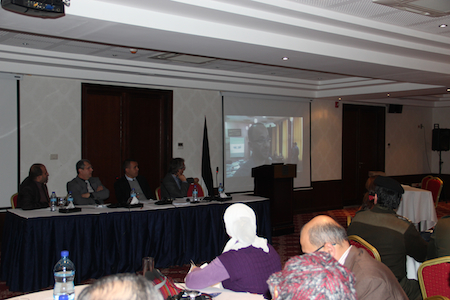
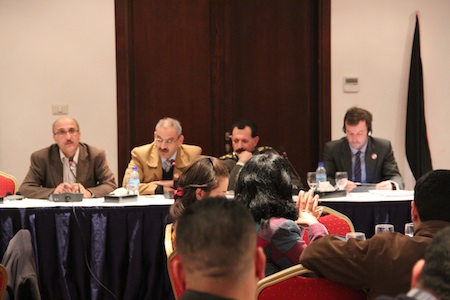
This came during a conference organized by MADA in partnership and cooperation with the Geneva Center for the Democratic Control of Armed Forces, (DCAF), on strengthening the ability of journalists and citizens to obtain information through the legislation, on Sunday (16-12-2012) in Ramallah city.
Attendees and speakers at the conference included: Dr. Mahmoud Khalifa, the Undersecretary of the Ministry of Information, Dr. Ghazi Hanania, Board Chairman of MADA, Fawaz Abu Zer, Secretary-General for Legal Affairs in the Council of Ministers, Nicolas Masson, Deputy Director of DCAF Ramallah, Mousa Rimawi, MADA director, Sa’id Zaid, Secretary of Interior and Security Committee of the Legislative Council, Bilal Barghouti, legal expert from Coalition for Accountability and Integrity (AMAN), Majed Arouri MADA board member, Professor Berttell Koter, University of Lugano, Switzerland, Lt. Col. Bilal Abu Hamed, representative of the National Security, Benjamin Buckland, DCAF, Montasser Hamdan, a member of the General Secretariat of the Journalists' Syndicate and the Alliance of Freedom of Expression, and tens of journalists and security offcers, researchers and interested persons.
The participants stressed the threats posed to access to information. Access to information was described as one of the foundations of democratic control of the armed forces and crucial to the transparency of the security forces and the fight against corruption. Access to information is a right for all citizens to enable them to actively participate in their society.
The conference was structured into three sessions. The first session addressed the amendment bill. The second session came under the title of access to information and the media and national security. The third session focused on the presentation of guidelines for the enactment of access to information in Palestine.
The conference sessions included extensive discussions on many issues related to access to information draft law, and some of the articles in the draft. There was an open discussion between journalists and security officers on the relationship between the two parties and ways to overcome their problems in relation to the work of each party.
Dr. Khalifa said that the ministry supports the passing of the access to information law, which he described as, "Very important."
He referred to the absence of mechanisms for keeping data and information in Palestinian institutions, and the risk of data loss as a result of this. He stressed the importance of the access to information law to strengthen public institutions and the community and to improve performance at all levels.
He said, “We urgently need to pass this law because our media reproduces itself, and investigations are virtually non-existent, and we need the creativity, and all this needs information, and this needs to be regulated by law."
Dr. Ghazi Hanania said, "The convening of this conference complements our ongoing efforts in access to information and follows up on our first conference we held on the ninth of October, in collaboration with DCAF. Its recommendations were important and useful, we have formed a small committee of legal and media professional experts from the West Bank and Gaza Strip, in order to draft a new law of access to information."
He added, "I am pleased to announce at this conference that the committee had completed the work on the new draft law, and in this regard I want to say we did not start from zero. Our work was based on the draft law prepared by the Independent Commission for Citizens' Rights, the amendments made by AMAN, the recommendations of journalists who participated in the workshops and conferences that we organized with DCAF, the study Mohammed Abu Shank prepared through Foundation Internews and the opinion of legal experts and journalists. So, thanks to all institutions, journalists and experts who have contributed in enriching the debate around it and made recommendations and amendments to the draft law."
Dr. Hanania also noted that MADA has launched a campaign to promote the importance of the law, and in order to involve as much as possible journalists, citizens and institutions in this effort, meetings would be held in cooperation with the alliance to defend freedom of expression and in order to rally energies to accomplish this goal.
The chancellor Fawaz Abu Zer, Deputy Secretary General for Legal Affairs in the Council of Ministers said that the draft law on the right of access to information, which was initiated by the Palestinian Center for Development and Media Freedoms (MADA), will be included in the projects included on
Nicolas Mason, Deputy Director of the DCAF office in Ramallah talked about their work to promote good governance in civil society, and the role of access to information in the areas of transparency and anti-corruption and censorship.
He said, "We believe that the information and transparency in the provision and use is a basis for reform," stressing the high levels of response to the work of DCAF in the Palestinian territories, compared to that in other Arab countries.
He noted that there are about 80 states that have passed laws on the right of access to information, including two Arabic states, Jordan and Yemen, expressing hope that Palestine would be the third Arab state to pass access to information law.
Bilal Barghouti from the Committee of Experts talked about the importance of passing the access to information law. He also reviewed the main points that have been modified by the Committee.
He noted that the new draft law will expand the concept of public institutions, so that now it includes all relevant institutions related to public affairs and money, and not only government institutions. This will provide greater protection for whistleblowers, as well as reducing the time required to respond to a request for information from 15 to seven days. Also, as regards the justifiable reasons for a rejection, only seven exceptions are identified in the new draft law.
Majed Aruri said that a request for information need not be justified, but refusal to provide the information must be justified and detailed. There is also provision in the new draft law to appeal a refusal.
Professor Koter from the University of Lugano, Switzerland, praised the amended bill and said he has seen a significant improvement compared to the first draft that was presented in 2005. He added that the project is consistent with international standards and commended the excellent work.
The group reviewed the positive points in the new draft (as amended). They noted that the text was conceptually clear. They also noted the limit of seven days in responding to a request for information, and the importance of this as a basis for obtaining information quickly.
Bilal Abu Hamed said, “to get information is a sacred right guaranteed by law." He added, "No information can be hidden in the era of technological development, which allows the transfer of everything…We need the press and journalists to be neutral.” He stated that the problem lies in a 'crisis of confidence’ and this required work to resolve it in connection with access to information.
Monteser Hamdan stressed that the general rule that must be built upon was that information is a public resource for all Palestinians, that the greatest danger to journalists is the absence of such a law, and that this is one of the reasons for some of the violations against journalists.
He said: "We believe that the law will contribute to the development of the performance of the press as well as the performance and functioning of public institutions, including the security services."
Benjamin Buckland, from DCAF, talked about the international principles of laws on the right of access to information. He stated that a refusal to access based on a national security argument must be truly exceptional and that withholding information must be subjected to severe restrictions in the law.
He said there is general agreement that there is some information that must be kept secret and withheld from the people, but at the same time it is clear that the disclosure of information is important and the question lies in where you should keep the line between these two issues. He stressed the need to balance rights and confidentiality. Also, any restrictions must be defined clearly in the law.
"Some secrecy is necessary for everyone, but barriers to plentiful access to information lead to corruption and ineffectiveness of institutions. So opening access to information is in the interests of these institutions. Making a lot of information secret is a burden on the institutions themselves, to keep what is supposed to be secret, a secret."