

Ramallah – 9th August 2023 - The month of July 2023 has witnessed a huge increase in the number of violations against media freedoms across Palestine compared to the previous month, June, as the number of violations documented by the Palestinian Center for Development and Media Freedoms “MADA” doubled and amounted to 80 violations, compared to a total 36 violations during April.
It was not a single party that was responsible for the increase in the number of violations during the past month. Rather, the increase came as a result of the rise in the number of violations committed by all parties, and this increase comes in light of the activities and events witnessed by some Palestinian cities. As a result, journalists and media outlets were subjected to Israeli and Palestinian attacks while covering peaceful Palestinian activities, the scope of which expanded relatively this month compared to the preceding month.
The frequency of the occupation attacks against journalists increased in most Palestinian cities, during the aggression in Jenin city and camp, in addition to an increase in the number of injuries among journalists in Gaza Strip while covering solidarity demonstrations with the cities of the West Bank.
In addition to the above, the attacks committed against journalists in Gaza Strip during the coverage of peaceful events organized in various parts of the Strip demanding an improvement in the living conditions of citizens.
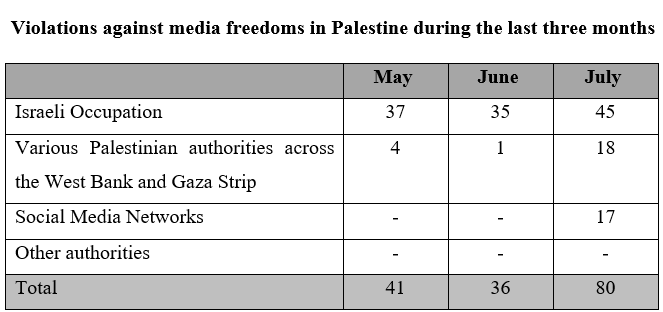
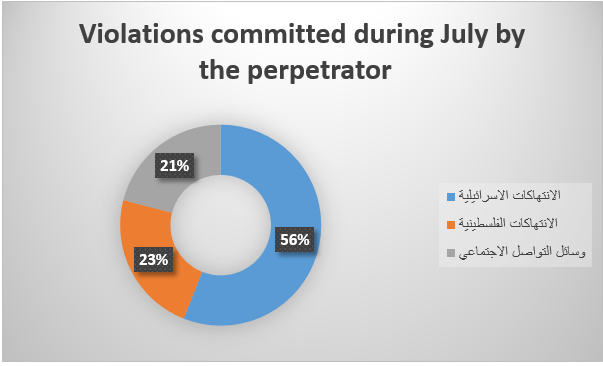
The violations that took place in the West Bank, East Jerusalem, and Gaza Strip during the month of July were distributed among (45) attacks committed by Israeli authorities, (18) attacks committed by Palestinian authorities, and (17) violations committed by social media sites.
Israeli Violations:
The number of Israeli violations against media freedoms increased during the month of February by 29% compared to the previous month and increased from 35 attacks committed during the month of June to reach 45 attacks during the month of July. Most of which were serious attacks on the lives of journalists and media freedoms in Palestine as the physical assaults accounted for the largest percentage of (19), and included the injury of three journalists with rubber-coated metal bullets, and three injuries of suffocation with gas bombs, except for those who were assaulted by pushing and beating, including nine journalists in the city of Jerusalem. The occupation forces targeted a media crew and two journalists with gas bombs to disperse them and ban them from covering the borders of Gaza Strip, and three media crews and four journalists were detained to ban them from covering the events. In addition, five cases of threats against journalists were documented, the equipment of two journalists was destroyed, a journalist was banned from traveling, and a journalist was summoned, questioned, and threatened with arrest if he does not quit practicing journalism. Furthermore, five journalists were banned from covering events in different cities, and the occupation soldiers deleted a journalist’s media material.
Social Media Violations:
The number of social media violations increased during the month of July and accounted for 21% of all violations, as Mada documented a total of 17 violations committed by the Application “WhatsApp”, part of “Meta” Company, compared to zero violations documented during the month of June.
In July, WhatsApp deleted 17 accounts of journalists in Gaza Strip who were members of Islamic Jihad-affiliated groups from the platform.
Palestinian Violations:
The percentage of violations committed by Palestinian authorities accounted for 23% of the total violations documented during the month of July, as they increased to 18 violations compared to one violation documented during the previous month, June.
The violations are broken down as 12 in the West Bank and 6 in Gaza Strip, including the arrest of 3 journalists, one of whom was tortured and ill-treated, the physical assault on one journalist during field coverage in Gaza Strip as he was banned from covering the activity of “We Want to Live” Movement, the detention of Masdar Network crew in Gaza Strip and the seizure of their equipment, and the summons of two journalists in the West Bank, one of whom was summoned three times without being questioned.
It also documented the case of summoning and questioning a journalist in the West Bank, threatening a journalist in Gaza Strip and banning two journalists from covering the activities of “We Want to Live” Movement, incitement by official authorities in the West Bank against the “Quds” News Network, in addition to the Palestinian intelligence in Bethlehem intercepting the car of two journalists and seizing their cell phones.
Details of Violations:
3rd July. The Israeli occupation forces assaulted journalists in Jenin Refugee Camp and fired shots directly at them during the raid into the Camp on Tuesday afternoon, and surrounded them in a house, injuring and damaging the press equipment of “Al-Araby TV”.
At approximately 11:00PM, on Tuesday, after the withdrawal of the occupation forces and military bulldozers from the main square of Jenin Camp, a group of journalists, namely (Al-Araby TV reporter: AMEED SHEHADEH, the TV cameraman RABEE AL-MUNNAYER, the cameramen of the Turkish Anadolu Agency HISHAM ABU SHAKRA and ESSAM RIMAWI, and the cameraman of “Russia Today” TV ABDUL RAHMAN YOUNIS) went to the entrance to the family house of the martyr JAWAD BAWAKNAH at the main entrance to the Camp. Minutes later, the occupation jeeps returned to the site in an area close to their whereabouts, which forced them to enter the house of the martyr BAWAKNAH and take shelter behind the main gate of the house, while the cameraman of “Al-Araby TV” RABEE AL-MUNNAYER left his camera at the entrance of the house from the outside to document the events.
As soon as an Israeli military jeep arrived facing the camera, one of the soldiers opened the back door of the jeep and began firing directly at the camera, with more than ten bullets, which resulted in its damage and falling off the metal stand on the ground and breaking into parts that are not working properly, while some bullets hit a bag and a live broadcast device, which led to its explosion and complete destruction.
This coincided with the shooting of Israeli soldiers in every attempt the six journalists made to go out to rescue the camera, and they continued under siege for more than an hour and a half amid heavy live fire towards the entrance to the house, behind which they took refuge.
Journalists continued to send appeals to the Red Cross until a Red Crescent ambulance was able to reach the site of their siege and assisted them at around 1:10PM.
3rd July. The Palestinian Intelligence Service questioned the freelance journalist AHMAD AL-BIQAWI, who was summoned on 22nd June on his way back from Turkey through Al-Karama crossing on 22nd June, due to --- order against him, but it was rescheduled until the end of Al-Adha Eid Holiday.
In his statement to MADA, the freelance journalist AHMED BAHIJ AL-BIQAWI, 35 years old, who produces a program named “Taqarob” on YouTube and podcast platforms, said that the Palestinian Intelligence Service told him that there was ---- order against him while he was returning from Turkey through Al-Karama crossing on 22nd June, but he postponed the interview until the end of Al-Adha Eid Holiday and told him that the matter would end within three hours at most.
On 3rd July, the journalist went to the Intelligence Headquarters in the city of Tulkarm at about 10:00AM on Monday morning, where he was questioned about several topics, including political matters, and others related to incitement and defamation against the Palestinian Authority and security services.
The Intelligence Service made an offer to the journalist AL-BIQAWI and an opportunity to close the file by acknowledging that all the previous “incitement, defamation and sedition” towards the Authority had passed, and that he had changed. He was also asked to sign an undertaking not to do any of that again.
The journalist refused to sign the statement and undertaking, but the video the journalist had posted before he went to the interview had gone viral and served as a means of pressuring the Intelligence Service to release him.
The journalist was released at around 10:00PM on the same day after 12 hours of detention.
4th July. The occupation police suppressed a group of journalists by pushing and beating them, on Tuesday evening and banned them from covering a stand on “Salah Al-Din” Street in Jerusalem in solidarity with Jenin Camp and the aggression against it, which led to the injury of journalist AHMED ABU SBEIH with bruises to his hand and back as a result of falling to the ground while fleeing from the police officers.
According to investigations by MADA researcher, a group of journalists arrived at Salah Al-Din Street at about 06:00PM on Tuesday to cover the solidarity sit-in with the residents of Jenin camp while the occupation forces were gathering in preparation for suppressing the sit-in.
After about an hour, the Israeli police began to push the journalists who were in the area, despite the fact that they carry cameras and gather in front of the persons standing in solidarity and not between them, and the police officers continued to pursue them.
With the end of “Salah Al-Din” Street, demonstrators and journalists entered the beginning of “Al-Zahra” Street, and suddenly the occupation police began to disperse the demonstrators, and everyone started running towards one of the young demonstrators in an attempt to prevent the occupation forces from arresting him. At this moment, with the contact of journalists with soldiers in an attempt to stop the stampede, journalist AHMED MOHAMMED ABU SBEIH (23 years old) fell and was injured with his hand and back due to crashing into an iron barrier installed between the edge of the sidewalk and the street. His injury was minor and did not necessitate treatment.
The journalists who were there, namely (the freelance cameraman FIRAS HINDAWI, ALI DAWANI, cameraman of “Al-Araby Al-Jadid”, the freelance photographer Amir Abd Rabbo, freelance photographer Saeed al-Qaq, the cameraman AMMAR AWAD, Al-Araby TV cameraman, JAMAL AWAD, Reuters cameraman, SINAN ABU MAZER, and the cameraman of Al-Quds Newspaper MAHMOUD ELEYAN) were all pushed to obstruct their work and ban them from reporting.
4th July. The Israeli occupation forces targeted a group of journalists with tear gas canisters to disperse and ban them from covering youth demonstrations organized on Tuesday near the separation fence on Gaza Strip border in support of the city of Jenin and its camp, which was subjected to Israeli aggression one day before the demonstration, which led to suffocation and injury to a number of them.
According to investigations by MADA researcher, a group of cameramen (Turkish Anadolu Agency cameraman MOHAMMED AL-ALOUL, MUSTAFA HASSOUNA, freelance journalist HANI AL-SHAER, and Reuters cameraman FADI SHANA’A (38 years old)) arrived at approximately 3:35PM, on Tuesday, east of Khan Younis, the southern Gaza Strip, to cover the youth demonstration, which included the burning of rubber tires and the raising of Palestinian flags.
The journalist SHANA’A was 500 meters away from the occupation soldiers and 200 meters away from the demonstrators, where the occupation soldiers initially fired dozens of tear gas canisters at all the journalists present in the coverage to disperse them, and after they dispersed, the journalist SHANA’A returned alone to complete the coverage. At that time, he was targeted by one of the occupation soldiers directly and deliberately with tear gas canisters, one of which hit his left foot and caused him burns, in addition to suffocating from gas inhalation.
The cameraman treated himself with cold water compresses and alcohol, then got on the armored jeep he came in and continued to work despite the firing of tear gas canisters at the demonstrators.
On the evening of the same day, at about 5:40PM, the Israeli occupation forces targeted Al-Araby Tv cameraman, OSAMA YASSER SALEH, (35 years old), with a tear gas canister that hit him in the right foot, causing “foot hairline fracture” while covering a demonstration in “Malaka” Area on the eastern border of Gaza City, called by the factions and national forces in Gaza in support of the city of Jenin and its camp.
The journalist was 700 meters away from the Israeli occupation soldiers and about 10 meters from the demonstrators. The Israeli occupation soldiers fired dozens of tear gas canisters at the journalists to disperse them, causing the journalist to be injured by a tear gas canister in the right foot. He received field treatment at first and was then transferred in an ambulance of the Palestinian Red Crescent to Al-Shifa Hospital in Gaza City, where an X-ray was done for him in which it was found that he had “minor hairline fracture”. He was discharged from the hospital after about an hour.
At the same time, ten minutes later, the crew of “Palestine Today” TV was targeted with tear gas canisters fired at them by the Israeli occupation soldiers, which led to their suffocation while covering the same event east of Khan Younis, southern Gaza Strip.
According to investigations by MADA field researcher, the reporter of Palestine Today TV, ASHRAF AL-SARRAJ, (25 years old), was directly targeted with a tear gas canister as soon as he arrived at the eastern border of Khan Younis at around 5:30PM on Tuesday to cover the same event. The journalist was about 500 meters away from the occupation soldiers and 200 meters away from the demonstrators. He fell to the ground and fainted for ten minutes due to gas inhalation.
The journalist’s colleagues treated him with alcohol and perfume, and then he returned to practice his work, but he was unable to continue that due to the gas bombs that were fired heavily on him and a group of journalists who were there. So he went to the broadcast car to leave, and the occupation soldiers targeted him and his colleagues in the broadcast car directly and deliberately with gas canisters, which led to the injury of his colleagues, including the broadcast engineer BILAL AL-HATTAB and his coworker AHMED MURTAJA from the TV’s external operations unit, with suffocation. It should be noted that he was wearing a helmet and shield and holding the TV “microphone” with its logo on it, and the logo was clearly on the broadcast car as well.
5th July. The Israeli occupation forces obstructed the work of journalists at the entrance to Khalil Suleiman Governmental Hospital in Jenin on Tuesday evening, banned them from covering the events, and fired tear gas canisters at them to disperse them.
According to the reporter of ROYA TV, HAFEZ SABRA (33 years old), in his statement to MADA, a group of journalists, namely (AMEED SHEHADEH, Al-Araby TV reporter, RABIE AL-MUNIR, Al-Araby TV cameraman, HAFEZ ABU SABRA, ROYA TV reporter, ASEEL SULEIMAN and BARAA ABU RAMOUZ, the cameraman ASHRAF AL-NABALI, the freelance cameraman AMR MANASRAH, and Middle East Eye cameraman LATIFA ABDEL LATIF) were in front of Khalil Suleiman Governmental Hospital to cover the events there after the occupation forces stormed Jenin Camp.
As the many injuries continued to arrive at the Hospital, the occupation soldiers’ jeeps in front of the entrance fired dozens of tear gas canisters into the emergency department yard, suffocating many citizens and suffocating journalist HAFEZ SABRA.
One of the nurses there provided field treatment to the journalist SABRA for half an hour.
5th July. The Palestinian Intelligence Service arrested the reporter and journalist of SANAD News Agency, AHMAD HAMID KHUDAIR ALBITAWI, 41 years old, from his home in Nablus on Wednesday evening, and was released after a week of detention during which he was tortured and ill-treated.
The journalist ALBITAWI stated to MADA that on Wednesday evening, he returned from work to his house located in Al-Dahia Area in the City of Nablus at about 10:30 PM, and as soon as he entered the house, a force from the Palestinian Intelligence Service came and told him that he was under arrest, and they did not have an arrest warrant, and without searching the house, he took his mobile phone at their request, and some of his clothes and left the place.
Immediately after his arrest, the journalist was transferred to “Al-Junaid” Prison, handed over his trusts, and then entered a small cell (2x2) in which there was no blanket or pillow and lacks the basics of life, and stayed there for three consecutive days. While in the cell, the journalist was exposed to shackling/chaining twice, the first inside the cell for 4 hours, with his hands tied and his eyes blindfolded, and the second time he was ghosted for nearly two hours inside the corridor with a bag placed on his head and his hands tied.
On the second day of arrest, the court extended the journalist’s detention for 15 days, and after eight days, the lawyer filed an appeal, and the judge accepted it and decided to release the journalist, but the Intelligence Service did not release the journalist. On Thursday, corresponding to 12th July, the judge rejected for the second time the Prosecution’s request and decided to release the journalist.
During the period of detention, the journalist ALBITAWI underwent four interrogation sessions, with an average of one hour per session, and was directly questioned about a post on his Facebook Account that he had published one day before the arrest, as the security services believed that it’s them that were intended in the post, while the journalist meant the occupation authorities.
Some of the journalist’s old posts on social media, some of which date back to 2017, were brought before him and he was asked about them, which are critical posts of the Authority and its political performance, which was considered by the Intelligence as an attack and incitement to the Authority, which the journalist completely denied.
The journalist was asked questions about his media work at SANAD News Agency, whether the Agency is licensed, the source of salaries, the mechanism for communicating with Gaza office, the Agency’s reporters, in addition to being asked about his relationship with some other journalists.
The journalist was released on Thursday corresponding to 12th July and it was decided that he should come back on Saturday corresponding to 15th July, where he was held in a room until 03:00 PM, without investigation, and this was repeated three more times in a row.
6th July. The Israeli occupation forces detained the cameraman MUTASIM SAQF AL-HAIT at Deir Sharaf Checkpoint, northwest of Nablus, for one hour, and soldiers beat him with hands near Deir Sharaf checkpoint on Thursday evening.
Quds News Network cameraman, MUTASIM SAMIR SAQF AL-HAIT, (34 years old), a researcher of MADA, reported that he was covering a march organized by settlers towards Deir Sharaf Checkpoint after an attack that took place at the site, during which settlers attacked Palestinian vehicles.
During the coverage, the journalist was detained for an hour, while three Israeli soldiers who were inside a nearby restaurant attacked him and beat him with hands when he refused to delete the videos, he had taken of settlers attacking Palestinian citizens under the protection of the occupation soldiers.
After an hour of detention, the cameraman deleted the videos and was released.
9th July. The Israeli occupation court renewed the decision to ban journalist MAJDOLINE HASSOUNA from traveling for the fourth time in a row during its session held in Jerusalem on Sunday, corresponding to 9th July 2023.
MAJDOLIN REDA HASSOUNA, (34 years old), a journalist for the Turkish TRT TV, reported that the Central Occupation Court in Jerusalem decided to deny removing the travel ban for the fourth time in a row, four years after the decision was issued, and renewed it, during its session held in Jerusalem on Sunday corresponding to 9th July.
This denial, issued for the first time since August 2019, was based on a secret file and a secret accusation on the pretext that the journalist poses a threat to Israel’s security. The journalist was also unable to attend the court session because she was denied a permit to enter Jerusalem and the Palestinian territories occupied since 1948.
10th July. Israeli occupation soldiers detained two journalists for about four hours after beating one of them and damaging the tires of his car at Deir Sharaf Checkpoint after midnight on Monday.
According to Al-Jazeera Live cameraman MOHAMMED AHMED TURKMAN (26 years old), a researcher of MADA, he was accompanied by his colleague, the reporter of SANAD News Agency and the reporter of Al-Israel network, KARIM SOBHI KHAMAISA (25 years old), returning from the city of Jenin to the city of Ramallah at about 12:00 PM on Monday, and while they were passing through Deir Sharaf Checkpoint, they were stopped by members of the occupation soldiers, and one of them asked the journalist TURKMAN to give him his phone, and after he took it, he asked him to open it, and when the journalist refused to do so, he attacked him with his hands and the weapon and had taken them out of the vehicle.
The soldier asked another masked soldier to detain the journalists near the concrete blocks close to the Checkpoint, then climbed into the journalist’s vehicle and drove it over the nails at the Checkpoint, damaging the car’s four wheels.
The journalists remained detained for nearly four hours until the staff at the Checkpoint was switched, and the journalists were released after other soldiers took the next shift.
The journalists contacted a truck to transport the car to a repair garage in Nablus.
11th July. Some Palestinian official authorities incited against Quds News Network through a video posted on its groups and widely circulated after it was shared by other pages and groups on social media.
YOUSEF SAMI ABU WATFA, (30 years old), a journalist and editor at Quds News Network, stated to MADA that a video clip was shared between five private groups belonging to the Palestinian security services and Fatah, noting that the video was produced by Quds Network (the video included an interview with a political prisoner who accused Quds Network of inciting against the security services and exploiting his case for private purposes), while the Network never met this person and was not responsible for the video in the first place.
Quds Network contacted a number of Fatah officials about this, but received no responses.
11th July. The Israeli Intelligence Service summoned journalist ABDULLAH BAHSH and interrogated him for two hours at Huwara Center and threatened him with arrest if he continued his media work.
ABDULLAH TAYSEER BAHSH, (24 years old), the reporter of “Quds” News Network, reported to MADA that a phone call was received at noon on Monday 10th July from the captain of Nablus Area, and after introducing himself, he asked the journalist to go the next morning to “Huwara” Interrogation Center and threatened him that if he did not attend, he would be brought by force.
The journalist went the next day at about 10:30 AM, and he was questioned on charges of incitement, terrorism, extremism, and communicating with people who should not be contacted, and all the charges were within the framework of his journalistic work and it affects citizens negatively.
The officer threatened the journalist that if he continued his journalistic work he would arrest him, and called the journalist’s father and threatened to destroy his son ABDULLAH and arrest him if he continued his work.
Two hours later, the journalist left, but the journalist’s father asked him to leave journalism for good.
12th July. A Palestinian Intelligence Service vehicle intercepted and stopped the car of journalist JIBRIL SABRI, and armed officers withdrew the IDs and phones of the journalist and his colleague, ABD AL-RAHMAN HASSAN, and asked them to report to the headquarters.
Journalist SABRI MUSA JIBRIL, a reporter for J-Media Agency, (32 years old), said that he and his colleague, Quds Feed reporter, journalist ABD AL-RAHMAN HASSAN, were on Wednesday at 11:20 PM covering a protest against the political arrest of a citizen, which was organized in front of the court in the city of Bethlehem.
The coverage lasted no more than 10 minutes, and the journalists left. On the way back, a Palestinian intelligence car intercepted the journalist’s car, which was marked “Press”, and a number of masked gunmen got out of it and took the phones and ID cards from the journalists, and asked them to go to the headquarters of the Intelligence Service to recover what had been taken from them.
Both journalists contacted the Journalists Syndicate, and the problem was resolved, and after they went to the headquarters of the Intelligence Service, the official invoked that there was a mistake by the officers, and they returned the identity cards and phones of the journalists and left the headquarters.
13th July. The journalist AQEEL AWAWDEH was detained by the Preventive Security Service for four days for his posts criticizing the security services on social media and he was released four days later on a 3,000 Jordanian dinar bail.
According to the investigations of the researcher of MADA, members of the Preventive Security in civilian clothes arrested the journalist of Al-Raqeeb Radio Station, AQEEL AWAWDEH (32 years old) at about 4:00 PM, on Thursday, at the end of his working hours and went to his other work in the city of Al-Bireh, where he was stopped by three members and after identifying themselves they asked for his identity card, and asked for his personal phone and took him to the Service headquarters located in Al-Baloua in Al-Bireh, where the Head of the headquarter therein asked to send him to the Service headquarters in Beitunia.
The journalist had heard indirect threats during his transport, using the same vocabulary he uses in his posts about describing the general situation, such as “we will get you in through the back door” and “we will do much ado about nothing”.
Upon the journalist’s arrival, he handed over the personal belongings and was transferred to the neighboring military services headquarters, where he underwent medical examinations that showed that the journalist suffered fractures in the ribs of his rib cage as a result of the attack by Preventive Security officers on him two years ago, and then he was returned to Beitunia headquarters and entered a 2x1 cell and stayed there until 08:00 PM.
At exactly 08:00 PM, the investigation began with the journalist by five officers of the Preventive Security Service and lasted for five hours, where it ended around 1:30 AM, and the investigation was conducted violently and with an intensity of tone. They had a file consisting of twenty-nine pages, all of which include posts by AQEEL on social networking sites. The investigation revolved around those posts, and questions about who stands behind him and who supports him and urges him to write, which are accusations denied entirely by AQEEL.
On Sunday, corresponding to the 16th of July, the journalist was brought before the Prosecution again for half an hour, and during his interrogation, he was accused of two charges, namely “publishing information that incites racial strife and the charge of defamation against the Authority” and was transferred to court.
The Public Prosecution submitted an application to the court to extend AQEEL’s detention, but the lawyers rejected this and asked the court to review his investigative file, and on the basis of that, the court took its decision. When this happened and the court reviewed the investigative file, it issued a decision to release him.
15th July. The Israeli occupation forces detained WAFA News Agency crew for three hours in the south of Hebron Governorate and did not allow the crew to pass to the village of AT-TUWANEH to cover the events taking place there, searched the crew’s vehicle, filmed it, and confiscated their identity and press cards on Sunday morning.
According to the investigations by MADA researcher, WAFA News Agency reporter MASHHOUR HUSSEIN AL-WAHWAH (40 years old) and the Agency cameraman MUNIF AHMED QAZZAZ (28 years old) arrived at approximately 9:30 AM, on Sunday at the entrance to the village of AT-TUWANEH east of Yatta, south of Hebron Governorate, to document the attacks of settlers and occupation soldiers against shepherds in Sarura Area near the village.
When the crew arrived at the hasty checkpoint near the Village’s entrance, the soldiers stopped the vehicle at the checkpoint and the soldier asked the journalist AL-WAHWAH to turn it off and get out of it, and then the soldiers searched the vehicle, and searched the journalists physically, raised their hands up, and also seized their personal and press cards, and asked them to stop next to the road under the scorching sun.
The soldiers filmed the journalists holding their ID cards, and when the journalists tried to convince the soldiers to let them pass, they replied “There are events and they will not be allowed to pass to prevent them from covering such”.
At around 12:30 PM, after three hours of detention, journalist AL-WAHWAH asked the soldier to hand him the identity card, but the soldier refused, and AL-WAHWAH replied that he did not need it and would leave the place accompanied by his colleague without IDs. When they moved therefrom, the soldier gave them their IDs and press cards and allowed them to enter the Village. But the event ended, and the soldiers withdrew with the settlers.
16th July. The Israeli occupation forces prevented two journalists from covering twice, obstructed their work, and threatened to open fire in the town of Janata, east of Bethlehem while covering the incursion of the Israeli occupation forces into the town on Monday morning.
According to the investigations of a researcher at MADA, both Russia Today reporter ABDUL RAHMAN MOHAMMED MOUSA YOUNIS (36 years old) and the Turkish Anadolu Agency cameraman HISHAM KAMEL ABU SHAKRA (35 years old) went at about 10:30 AM, on Monday, to the town of Janata, east of Bethlehem to cover the incursion of the occupation forces into the town and search homes therein.
As soon as the two journalists arrived, the Israeli occupation soldiers had completely blocked the road with their military vehicles, and the journalists tried to drive their car to a dirt road leading to an area overlooking the incident where the Israeli occupation forces were.
The two journalists began to document the events, and during that, a mounted force of three female soldiers arrived and asked them to leave the place quickly, so the two journalists left the place immediately, and returned to the main road leading to the town of Janata where the army forces were on high alert. The journalists moved slowly behind the army and at an estimated distance of 50 meters so that they would not be intercepted again by the soldiers. However, one of the soldiers stopped on the road and started shouting at the journalists in Hebrew that they understood and told them to stop and not follow the force, while another soldier approached the journalists and pointed his weapon at them while shouting and asking them to stop filming and immediately leave the site.
The journalists moved 100 meters away from the soldiers’ location, but the soldiers continued to shout at them to prevent them from covering, and one of them continued to point their weapons at them and indicate their location with a light attached to his weapon.
At about 2:00 PM, the two journalists went to the Muqata'a Area in the center of Bethlehem, where the soldiers closed the area and began documenting the events at a distance of 100 meters away from the soldiers’ location, during which two soldiers arrived, one of whom spoke Arabic and began cursing journalists with profanity and obscenity, and shouted at them to leave the place immediately, and when the journalists tried to talk to him that they were press crews and did not constitute an obstacle to their work at all, the soldier replied: “If you don't leave, I'll shoot you in the legs”, pointing his weapon at them.
The two journalists retreated back several meters, while the soldier followed him while pointing his weapon at them. This incident was repeated several times during a period of five minutes, the two journalists were moving away from the place as he followed them, cursing and shouting at them, forcing them to move away from the event for more than 200 meters.
19th July. Palestine TV cameraman was suffocated live by firing tear gas canisters at the TV crew while covering the incursion of the Israeli occupation forces into the eastern area of Nablus at approximately 11:00PM on Wednesday evening.
ABDULLAH MAHMOUD ABU SABRA, (23 years old), stated to MADA researcher that the television crew, consisting of the cameraman ABDULLAH ABU SABRA and the reporter BAKR MOHAMMED ABDUL HAQ, (34 years old), was in a live broadcast on Amman Street to broadcast the incursion of the occupation forces into the eastern area of Nablus, where the occupation forces were securing the site in preparation for the settlers’ incursion into Joseph’s Tomb.
During the coverage, a military jeep surprised them with the heavy firing of tear gas canisters, which led to the injury of the cameraman ABU SABRA with severe suffocation, as he was transported to one of the ambulances of the Palestinian Red Crescent and received the necessary treatment, and then returned to complete the coverage an hour later.
23rd July. On Sunday morning, an Israeli occupation soldier assaulted WAFA Agency reporter and beat him in the leg, which led to his transfer to the hospital while the Israeli occupation forces were covering the bulldozing of Palestinian lands in Khallet Taha area, west of Dura.
According to the investigations by MADA researcher, WAFA Agency reporter MASHHOUR HUSSEIN AL-WAHWAH, (40 years old), went at 7:30 AM, on Sunday to Khallet Taha Area, southwest of Dura, south of Hebron, to cover the bulldozing of citizens’ land near the settlement of Nijohot.
As soon as the journalist arrived at the place, the occupation mechanisms were working to bulldoze the land while a group of settlers was present in the place, and the journalist began to document the bulldozing of the land, and during that, one of the soldiers approached the journalist and asked him to stay away under the pretext that it is a closed military zone, and showed him a military order to close the area, but the journalist AL-WAHWAH spoke with the officer and told him that he does not hinder the work of the soldiers, noting the settlers were also there, which is a violation of the military order. After an argument between them, the officer attacked the journalist, pushing him hard and knocking him to the ground, and kicked him several times on his right leg.
The journalist was taken by WAFA Agency vehicle to Dura Governmental Hospital, where an x-ray image was done for him and it showed bruises on his leg and back, and he was given appropriate treatment and left the hospital.
26th July. YOUSEF SHEHADEH, the reporter of Awda TV, was wounded by Israeli gunfire while covering the clashes that erupted in Al-Tirah neighborhood in Ramallah on Wednesday evening.
In his testimony to MADA, Awda TV cameraman YOUSEF SAMIR SHEHADEH (23 years old) said that between 09:00 PM and 10:00 PM, on Wednesday evening, he was in Al-Tirah neighborhood in Ramallah wearing the press uniform and covering the incursion of the occupation forces and settlers into the neighborhood.
The journalists were in an area that was difficult for the cameraman to reach due to the closure of the roads by the occupation soldiers, so he was forced to position himself at the top of the mountain opposite the occupation soldiers, and suddenly the cameraman was hit by a rubber-coated metal bullet in the right knee.
The occupation soldiers continued to run after the journalist after he was injured until a private car took him to Ramallah Governmental Hospital, where he received the necessary treatment, and it was found that there was a problem in the knee tissue, where it is clear that there was a hole in the place of injury.
30th July. Members of the Internal Security Service in Gaza Strip verbally assaulted two journalists in two different areas and prevented them from covering the activities of the “We Want to Live” Movement, which was organized in several areas of Gaza Strip governorates on Sunday evening to protest the difficult living conditions and demand the provision of basic services such as electricity.
According to the investigations of MADA field researcher, the reporter of Palestine TV and Abu Dhabi TV in Gaza Strip, WALID TALAL ABDUL RAHMAN (45 years old), was in Al-Trans Area in Jabalia camp, north of Gaza City, at about 6:00 PM on Sunday to cover the activity of the “We Want to Live” Movement, and while he was filming the event with his mobile phone, four individuals in civilian clothes approached him for the first time, and identified themselves as members of the Internal Security, and then took him to an alley of a street near the event, grabbed him by the collar of his blouse and pulled out his mobile phone, searched it and prevented him from continuing to cover.
The journalist WALID returned to continue his work filming with his mobile phone, to be approached again by seven individuals in civilian clothes who identified themselves as members of the Internal Security Service, and who tried to physically assault him and insulted him with inappropriate words, so citizens gathered around them and were able to keep the security personnel away from the journalist, who fled away for fear of arrest.
On the same day, at around 4:50 PM., while the freelance journalist IHAB AL-FASFOS, (50 years old), was in Khan Younis, southern Gaza Strip covering the same event, he was threatened with arrest and damaged equipment if he continued to cover. A person in civilian clothes approached him and asked him to identify himself and asked him to show permission to film, and the journalist IHAB replied that he was a member of the Journalists Syndicate and a member of the International Federation of Journalists, so the journalist asked the person to show his card, so he withdrew from his side and joined a group of individuals.
Journalist IHAB continued to cover until he arrived Jalal Street in the city, where a number of security personnel approached the journalist and prevented him from filming, so he refused to obey their orders, so one of them threatened to break the camera on his head and arrest him, so the journalist AL-FASFOS returned to his home to protect the camera from breaking or stop them from detaining him, and then returned to cover the demonstrations with his personal phone.
30th July. WhatsApp platform, a company of META, has removed the numbers of dozens of journalists affiliated with Islamic Jihad groups from its platform.
According to the investigations of the field researcher of MADA, the platform WhatsApp deleted the numbers of dozens of journalists subscribed to groups affiliated with the Islamic Jihad Movement on the platform, including ABDEL NASSER ABU OUN, a presenter in local Jerusalem Radio, and the reporter of the same radio, MUTHANA AL-NAJJAR, Al-Maseerah Tv reporter, DOAA ROQA, MATAR AL-ZAQ who works as a journalist for Palestine Today TV, AHMED GHANEM, Al-Mayadeen TV reporter, RAED OBAID who works as an administrative employee for Al-Quds Radio, IMAD EID, ALMANAR TV reporter and Director MAAN Agency’s Office in Gaza, MOHAMMED AL-KAHLOUT, a journalist for Dunia Al-Watan Website, SALEH AL-MASRI, Director of Palestine Today Website, SAED HASSOUNA, who works for Palestine Today Website, and both journalists MOHAMMED AL-MUQAYYAD, AYMAN ABU SHANAB, DAWOUD SHEHAB, the media spokesman for the Islamic Jihad, the journalist RABAH MARZOUQ who works for Al-Quds Radio, the writer HASSAN ABDO, the writer ASAAD JUDEH, and the journalist AHMED SAMHOUD who works as a reporter for Al-Quds TV.
31st July. A Palestinian intelligence force in Tulkarm abducted the freelance journalist SAMI AL-SAEI from his workplace and took him to the Service headquarters in the city as he was interrogated for several hours before being released late in the evening of the same day.
In his statement to MADA, SAMI SAEED AL-SAEI, (43 years old), he said that a force from the Palestinian intelligence service (about six masked people in black clothes), riding in two cars, one of them with a yellow plate, arrived at his workplace in Tulkarm at around 12:00 PM, on Monday and abducted him within seconds at gunpoint after ascertaining his identity.
The journalist was taken to the intelligence service headquarters in Tulkarm, and since his arrival one of the officers asked him to hand over his mobile phone, and then he was transferred to the interrogation room.
The phone was brought for the journalist to open, but he was unable due to a large number of previous and wrong attempts to open it, and it was clear that they tried to open it and could not, and the attempts continued until 04:00 PM in the afternoon.
During that, the journalist was interrogated for nearly four hours about a group of posts mocking and criticizing the security services, and posts supporting the teachers’ movement, and they asked about the journalist’s relationship with the movement and the extent of his knowledge of those in charge of it, and what groups he subscribed to on WhatsApp Platform, the journalist’s responses to all questions were recorded and included in the statement.
The journalist asked to be offered medical services because he suffers from eye allergies and migraine and was immediately transferred. He returned to the headquarters once again and went down to the detention room at his request to sleep.
After several hours, the journalist was returned to the interrogation room, and they had opened the phone and extracted what they wanted from him, but what they were looking for was a WhatsApp group called “Ahrar Tulkarm” because they believed that the journalist was its supervisor, even though the journalist had nothing to do with it.
The investigating officer asked the journalist to leave all the groups he joined, and when he refused, he was released at about 11:30 PM after he signed a pledge not to share anything on Facebook and to return for the interview next Monday, corresponding to the 7th August.
31st July. The Municipal Police in Shujaiya neighborhood of Gaza City detained Masdar News Network Staff and press equipment for an hour, obstructed their work for fear of media coverage of the “We Want to Live” protest, and released them with the intervention of the Interior Ministry spokesperson.
According to MADA field researcher’s investigations, three uniformed municipal police officers arrested Masdar News Network’s crew, consisting of the reporter SAFA MANSOUR GHALAYINI (36 years old) and the Network’s cameraman, AHMED YASSER AL-MASARI, (34 years old), who went to the Bastat area in Shujaiya neighborhood of Gaza City at around 10:15 AM, on Monday to interview citizens about the meeting of the secretaries-general of the Palestinian Factions in Cairo.
During the process, three municipal police officers intercepted their work, asked for their ID cards and work cards, and took them to an area of the municipal police in Shujaiya neighborhood and demanded that they show a filming permit, but they had not obtained a permit because the place is public and does not need prior filming permit.
After about half an hour, two people in civilian clothes came and asked the journalists to board with them by bus and go to the headquarters of the General Investigation Service in the city, but they refused to do so, after which the camera was detained and searched and made sure that they filmed meetings with citizens about the meeting of the factions and not covering the demonstrations of the “We want to live” Movement.
Again, they tried to take them to the Investigations Headquarters, and when they refused, one of them threatened GHALAYINI to bring a female police officer to force her to board the bus.
The cameraman made a phone call to his supervisor at work and explained what had happened, which in turn encouraged him not to go to the Investigations headquarters and made a call to the Interior Ministry spokesman IYAD AL-BOZM.
The journalists were released, and the private camera was seized and detained. Two and a half hours later, the crew received a phone call from the Investigations headquarters to retrieve the camera, and Major General MAHMOUD SALAH, Gaza Police Director, apologized to them for what has happened on behalf of the police officers.
