

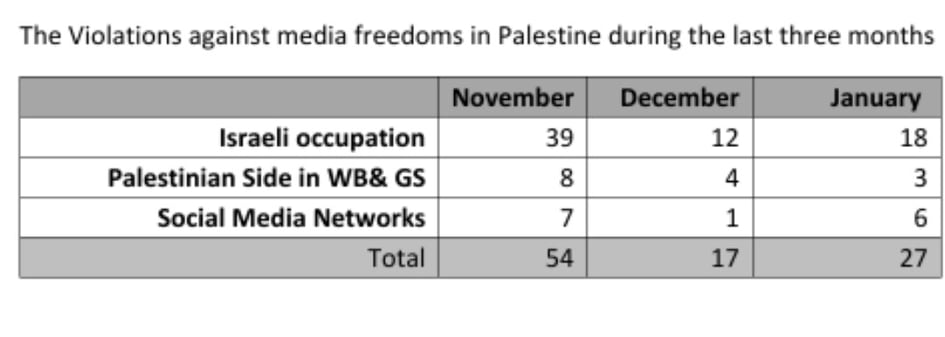
Ramallah- Feb,13rd,2022- The month of January witnessed an increase in the number of violations against media freedoms in Palestine, as Mada Center monitored and documented a total of (27) violations compared to (17) violations that were monitored during the month of last December, bringing the increase in the number of violations to 63% compared to the month Previous.
The violations were distributed during the month of January to (18) attacks perpetrated by Israeli parties, (3) attacks committed by Palestinian parties in the West Bank and Gaza Strip, and (6) violations committed by social media networks sites.
The Israeli violations came at the first stage, not only in terms of its number, but also in terms of its type and the extent of their danger to media freedoms. The physical injuries committed by the occupation alone constituted 72% of the total Israeli attacks.
The Violations against media freedoms in Palestine during the last three months
Israeli Violations:
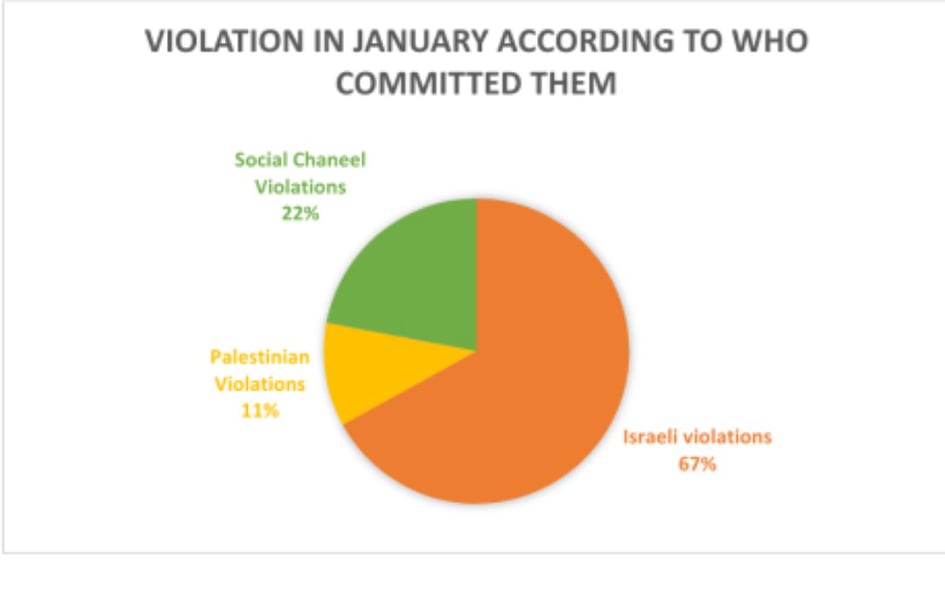
During the first month of 2022, the Israeli occupation committed 67% of the total violations of the month. The number of these violations reached (18) of the total (27) violations that were monitored against media freedoms in the West Bank, including occupied Jerusalem and the Gaza Strip. These attacks affected a total of 12 journalists and three media crews.
The Israeli attacks included the physical assault on (11) journalists while performing their work in the field: Fayez Abu Rumaila, Rima Al-Amla, Khalil Abu Arab, Muhammad Al-Khatib and Iyad Al-Hashlamoun working for Palestine TV/freelance photographer Ibrahim Al-Singlawi, photographer Muhammad Al-Sharif/ and photographer Dephné Lemelin working for AFP, J-Media photographer Abdel Mohsen Shalaldeh, reporter Nasir Thabet was also injured and targeted to prevent coverage, photojournalist Moatasem Saqf Al-Hait working for Quds News Network, and photographer Ahmed Gharabla
As for the media crews, Al-Ghad TV crew was obstructed by settlers while covering a demonstration by settlers in the city of Jerusalem, while the settlers verbally assaulted the Al-Jazeera TV crew and obstructed their work in front of the Israeli government headquarters in Jerusalem, while the J-media staff was detained for 3 hours at (Dotan) military checkpoint.
Social Media Networks Violations:
The number of violations of social media networks sites increased during the month of January to reach (6) violations, representing 22% of all violations committed, affecting two journalists, at a time when it decreased significantly during the previous month, as Mada Center documented only one attack during last December by social networking sites.
All violations of social media networks sites were committed during the past month by “Meta” company, but they were distributed among (4) violations committed by "Facebook" and two violations committed by the Instagram. Facebook restricted two accounts and closed another of the journalist Ali Obeidat, and the Instagram application restricted one account for the same journalist, and the pages of the social media employee at the British Consulate, Manal Abdullah, were deleted from the Facebook and Instagram platforms.
Palestinian Violations:
MADA Center documented 3 violations committed by Palestinian sides in West Bank and Gaza Strip, compared to four violations documented during the past month. Palestinian violations constituted 11% of the total violations during the past month.
The violations were divided into two violations committed by the security in the West Bank. The Preventive Security summoned the journalist and writer Abdel Salam Awad, while the same free journalist arrested Muhammad Thabet and interrogated him. The third attack came in the form of a summons and investigation, which was subjected to a Syrian satellite correspondent in the Gaza Strip from the Government Information Center.
Violation in January according to who committed them:
Violations Details:
Jan,3rd :
The Preventive Security in the city of Nablus summoned the teacher and journalist Abd al-Salam Awad, for an interview on Monday jan,3rd. Journalist and writer for the "Ikhbariat" news agaency, Abd al-Salam Muhammad Awad (50 years old), stated that he had been summoned for this interview on the same day of his release last January/2021 after a 13-day detention. The journalist was unable to go to the interview due to ill conditions that he experienced at the time, and after communicating with the Preventive Security, the interview was postponed until Wednesday, jan,5th.
According to the following appointment, journalist Awad went at 10:30 a.m. on Wednesday to the headquarters of the Preventive Security in the city of Nablus, and after handing over his ID card, he entered the waiting room and stayed there for two hours, until one of the officers came and returned his identity to him back and released him without subjugation for any investigation.
Jan,5th:
A settler attacked photojournalist Hamza Abu Rumaila in front of "Asaf Harofeh" hospital in the city of Lod, while covering a demonstration organized by settlers in front of the hospital against the decision to end the administrative detention of prisoner Hisham Abu Hawash.
The photographer of the Turkish Anadolu Agency, Fayez Hamza Abu Rumaila, 28 years old, told Mada Center that he went at 5:00 pm on Wednesday, accompanied by Anas Kamel, the director of the Anatolia Agency’s office in Jerusalem, to the “Asaf Harofeh” hospital in the city of Lod, where the prisoner Hisham Abu Hawash is located. Inside the hospital, to cover the settlers' demonstration against the Israeli authorities' decision to end the administrative detention of prisoner Abu Hawash.
Photographer Abu Rmeileh began covering the demonstration and taking pictures in the presence of Al-Ghad TV crew. About 15 settlers were present at the demonstration. During that, two settlers approached the media crews (wearing strange masks and completely concealing their facial features), and began harassing Al-Ghad TV crew (reporter Iman Jabour and the cameraman). Sohaib Salhab) to prevent them from covering the events, while the second settler went to the photographer Hamza and started asking him questions: With whom do you work? Why visualize? Then he moved to accuse him of "you are terrorists." Abu Rumaila, replied that he was a photojournalist who was doing his job, with evidence that he was covering a demonstration for settlers.
After that, the settler insulted him and his family in Hebrew language and asked him to stay away from the demonstration location, but the photographer Abu Rumaila refused, so the settler approached him more and tried to push him, but the photographer Hamza came back so he pushed the settler photographer Abu Rumaila and punched him on the jaw with his hand, what knocked him down, causing him to hit the ground hard.
The photographer, Abu Ramila, was rescued inside the ambulance to be transferred back to the hospital, for four hours, during which he was x-rayed to ensure that there were no fractures in his body.
At 11:30 pm, the photographer, Abu Rumaila, filed a complaint against the settler at a police station in the city of Lod. The police station told him that a file had been opened in the complaint and he had to submit his statement, which happened later.
Jan, 5th:
The Government Media Center in Gaza Strip summoned the Syrian Al-Ekhbariya correspondent, the 28 years old journalist Ramzi Abdullah Al-Maghari, asking him to sign a pledge to stop his work with the Syrian Al-Ekhbariya channel.
Al-Maghari journalist reported to Mada Center that he had received a summons based on a complaint that had been submitted by Al-Manara Company in the Gaza Strip to a government media center regarding the company’s financial dues to the Beirut-based “Octopas” company, which acts as an intermediary between Al-Manara Company and the “Syrian News” channel.
The journalist Al-Maghari received the summons on Wednesday jan,5th from the Government Information Center to inquire about this issue, and inform him of the complaint filed against the channel for which he works (the Syrian News). The Syrian News channel.
Al-Maghari journalist was asked to sign a pledge to stop working with Al-Ekhbariya, but he refused, and the State Media Center did not insist on signing the pledge.
Note that the press frameworks intervened to solve this problem, as they will try to reach the intermediary company in Beirut to pay the dues to Al-Manara Company in Gaza, but there were no developments regarding the matter until the date of writing this report.
Jan, 4th:
“Meta” company has restricted the content of journalist Ali Obeidat's accounts on Facebook and Instagram, where his account was restricted on Facebook, while his account on Instagram was restricted for one time.
Ali Nasr Obeidat, 38 years old, a journalist working for the “Lamat Sahafa” social channel, stated that on jan,4th the Facebook restricted his account due to a post he had published on his personal page during the year 2013, and as a result, the journalist was prevented from posting, and sending messages, Live broadcast for an entire month.
Journalist Obeidat resorted to using his backup account on the same day to close his main account, but it was suspended too without giving any reasons other than that he "could not publish".
The account of journalist Obeidat on Instagram was also subjected to content restrictions on Jan, 10th, after he posted a video showing the beating of a young man in the “NAKAB DESERT” by the occupation soldiers, where he was prevented from broadcasting live and from posting videos for two days.
Jan,7th:
“Meta” company has restricted the accounts of the social media employee at the British Consulate in Jerusalem, Manal Abdullah, on both Facebook and Instagram, due to posting in solidarity with the prisoner Hisham Abu Hawash, who has been on hunger strike for 141 days.
Manal Nizam Abdullah, 33 years old, who works in the social media department at the British Consulate in Jerusalem, told MADA Center that the management of the Meta Company had restricted her accounts on Instagram and Facebook, respectively, on the pretext of violating the policies and standards of these sites.
This closure came after Manal published a series of stories on her Instagram account (which is followed by 100,000 followers) about the hunger striker, Hisham Abu Hawash.
At the same time, the Facebook restricted Manal's account because it was directly linked to the Instagram page.
Manal contacted the help center on Instagram, where she lodged an objection to the closing of the page, but she did not receive any response about the objection.
Jan,7th:
Occupation soldiers targeted Quds News Network cameraman, Mutassim Samir Saqf Al-Hait, with a rubber bullet in the chest, while covering clashes between citizens and Israeli soldiers in Al-Bireh on Friday afternoon.
Journalist Mutassim Samir Saqf Al-Hait, 31 years old, from MADA Center, reported that he was present at 1:00 p.m. on Friday near the northern entrance to Al-Bireh city, covering the clashes between the citizens and Israeli soldiers, when the soldiers started firing tear gas and rubber bullets at the demonstrators.
The photographer, Saqf Al-Hait, stayed with a number of journalists, including (Abboud Younis, Saja Al-Alami) covering the clashes, and they were standing about 100m away from the demonstrators and the Israeli soldiers.
At approximately 1:30 PM, Mutassim was targeted with a rubber bullet that hit him directly in the chest. It was a minor injury that did not require treatment because he was wearing a protective shield.
On the same day, Quds Network correspondent, Nasir Radwan Thabet (27 years old), was wounded by a rubber bullet in the head while covering clashes with Israeli soldiers in the village of Beit Dajan, east of Nablus.
Naseer stated that he was present at 1:00 PM in the town of Beit Dajan, covering the march organized weekly against settlements. The march included the firing of sound and gas bombs and rubber bullets against the citizens. This resulted in the injury of journalist Thabet with a rubber-coated metal bullet in the head around 2:00 pm.
The journalist went in his private car to “AL-Sadakah” Medical Center near the town of “bait Dajan”, and he received the necessary treatment, as the wound was sutured to his head with three stitches.
Jan,9th:
The Israeli occupation forces targeted the Palestine TV crew with a gas bomb thrown at them, which caused the fall of the TV reporter in the city of Nablus, Rima Muhammad Al-Amla (44 years old), to the ground, causing her severe pain and severe suffocation.
Palestine TV correspondent stated to Mada Center that she went on Sunday, Jan,9th at 11:50 pm to cover a tree planting event that was held on the occasion of Martyr’s Day in the village of Burqa in the city of Nablus. The settlers attack the citizens in an close place to thvillagege of “Burqa” called “ Jabal AL-Qusoor”.
When the TV crew arrived at the scene, the Israeli soldiers fired tear gas canisters at them, and it was the first bomb the army fired at the TV crew. Journalist Rima suffers from health problems in her chest.
The young men in the place pulled the bomb from its side and threw it away, and the journalist was rescued from suffocation by the young men present in the place, but she still suffers from some pain in her back as a result of her falling to the ground.
Jan,10th:
The Preventive Security in the city of Nablus arrested freelance journalist Muhammad Radwan Thabet on Monday Jan,10th, and subjected him to interrogation about his media work, coverage and reports before releasing him the next day.
Free journalist Muhammad Radwan Muhammad Thabet (42 years old), a reporter and cameraman for several radio stations and some local TV channels, stated that he received a written summons from the Preventive Security on the same day that he was released from the police station on Jan,10th, after a 22 day arrest - This arrest was not due to his journalistic work-. When the police handed him over to the Preventive Security in the district of Nablus, and there he was summoned in writing to attend an interview the next day at the same headquarters, provided that he had to brought his mobile phone with him.
Journalist Muhammad went as schschedule the headquarters of the Preventive Security, he underwent an investigation about his media work, specifically his coverage of the weekly Beit Dajan march. With whomever he deems appropriate, regardless of political affiliation, because he is a journalist and performs his work professionally. He was also asked about his coverage of local elections.
After the investigation was completed, the journalist remained detained at the headquarters until the next day and was released around 5:00 PM.
Jan,11th:
The Palestine TV correspondent in Nablus, journalist Khalil Muhammad Abu Arab, was hit by a stone thrown at him by settlers while returning from the town of Al-Sawiya at the Za'tara junction,.
In his testimony to MADA Center, the Palestine TV correspondent Khalil Abu Arab, 50 years old, said that after he finished his work in the town of Al-Sawiya at 4:40 pm on Tuesday, he was on his way to the town of Beita, passing through the Za’tara checkpoint, he saw a group of settlers, performing provocative dances, and after he passed the checkpoint, he felt stones hit his car on which he wrote the word “press” in Arabic and Hebrew. One of the stones hit him in the right shoulder and bounced back to hit his jaw.
The Journalist Abu Arab went to “Rafidia Hospital”, where he was x-rayed, and due to the lack of resources, he went to a special center to complete the rest of the treatment, x-rayed again to show that his jaw is broken.
The journalist was unable to move his shoulder and his neck fully for several days, and he was not able to eat normally for several days due to a wound inside the mouth.
Jan,12th:
The Media student Yousef Shehadeh was wounded by a rubber bullet in the left knee, which was fired at him by an Israeli soldier, while he was covering the soldiers invasion into the town of Beituniya in Ramallah on Wednesday.
Yusef Madi Shehadeh (22 years old), a student at the Faculty of Mass Communication at Al-Quds Open University, stated that he went on wWednesday Jan,12th, to cover the storming of the occupation forces into the town of Beituniya in the city of Ramallah, along with Palestine TV reporter Ali Dar Ali, where a building was stormed and arrested Three citizens by Israelisoldierss.
The invasion and arresting process ended at around 6:00 AM, and during the withdrawal of the military jeeps from the place, the journalist was only ten meters away from one of them, when the soldiers started firing bullets towards those present at the place, which led to the injury of Youssef with a rubber- bullet in the left knee.
Youssef was rescued with the help of his colleague Dar Ali and the rest of the young men, and then he was transferred to the Ramallah Hospital, where he was x-rayed and it was found that the bar of the leg had moved from its place. The doctor advised him to keep his leg out for 4 days, after which he would see if he needed surgery or not.
Youssef stayed in the hospital for an hour and a half, and then left the place.
Jan,14th:
The Palestine TV correspondent in Salfit city, journalist Muhammad Al-Khatib, sustained a hand injury after falling to the ground after Israeli soldiers threw a sound bomb at him while covering the weekly march against settlements in the village of Beit Dajan in Nablus city on Friday.
According to his testimony to MADA Center, Palestine TV reporter Muhammad Abdul-Karim Al-Khatib, 32 years old, accompanied by his colleague, TV cameraman Samer Habash, to cover the weekly popular event in the village of Beit Dajan against the establishment settlements on Citizens' lands east of the village.
Since the start of the event, the demonstrators were present in the place in addition to the occupation Israeli soldiers, and about 15 minutes after the start of the event, the Israeli soldiers started firing tear gas and sound bombs towards the demonstrators. Meanwhile, they fired ten bombs at once towards the journalist Al-Khatib and his photographer colleague, which led to the fall of one of the bombs next to him. While trying to get away from her, he slipped to the ground because of the wet ground from the rain, which led to the twisting of his right hand under his body.
Muhammad received field treatment with the help of medical staff, and then was transferred to Rafidia Hospital in the city of Nablus. It was found that there was damage on the hand, which was subjected to strong trauma, which also caused him swell in his hand, which was wrapped in gypsum.
Jan,19th:
The occupatisoldierers prevented journalists from covering the incidents of demolishing the house of the “Salhia family” in the Sheikh Jarrah neighborhood of Jerusalem, and blocked their work on Wednesday, jan,19th.
The Photographer Ibrahim Kamal Hamad "Al-Sanglawi" (27 years old), stated to MADA Center that he was in Sheikh Jarrah neighborhood at 4:00 am on Wednesday to cover the demolition of the Salhiya family's house, after he recognized of the intention of the occupation forces to carry out the operation.
The photographer “sinjilawi” tried to reach an area close to the house to cover the demolition, as he was 100 meters away from the site, but the Israeli soldiers prevented him from entering the area despite showing his press card, and when he tried to turn around from another road, he was also prevented from entering. On the third time, he tried to enter on foot, but he was also prevented and the soldiers threatened to beat him and arrest him if he approached the place.
After the demolition ended at 6:30 am, Al-Singlawi's colleague, videographer Mohamed Sharif, and AFP reporter "Dephné Lemelin" came to try to take pictures of the demolished house, but they were all prevented from approaching and covering it.
Jan,25th:
The Israeli soldiers targeted photographer Ahmed Gharabla with a rubber bullet in his shoulder while covering the evacuation of the “Karama family’s” home in preparation for its demolition in “Al-Tur neighborhood” in Jerusalem.
The AFP photographer Ahmed Kamal Gharabla (40 years old), stated to MADA Center that he went to Al-Tur neighborhood in Jerusalem at 11:00 AM on Tuesday Jan,25th after informed about the evacuation of the Karama family's house in preparation for its demolition by the occupation forces.
Gharabla and his fellow photographers (who was known as the photographer Mahmoud Elyan) took an elevated area 100m away from the army forces to cover the demolition process. At that time, they were targeted with a sound bomb, but none of them were hurt.
At 1:30 pm, the photographer was targeted with a rubber in his left shoulder suddenly, causing him to fall to the ground, but he was able to reach his car nearby to head to “Kobat Holim Center”, from which he was transferred to Hadassah Hospital, where he underwent an electrocardiogram, as it was found that there was a scratch in the lung.
The necessary tests were done to ensure the safety of breathing and heart rate, and he stayed in the hospital for 6 hours.
Jan, 28th:
The Photojournalist Nasser Shtayyeh was wounded by a rubber bullet in the right shoulder while covering the weekly march in the village of Kafr Qaddoum on Friday.
The “SIDA” USA photographer Nasser Suleiman Shtayyeh (51 years old) stated to Mada Center that he was in the village of Kafr Qaddoum, east of Qalqilya, on Friday Jan,28th to cover the weekly demonstration against settlements, which began immediately after Friday prayers around 1:30 PM.
Since the clashes began, the Israeli soldiers began firing sound bombs, gas and rubber bullets at the demonstrators. At first, journalist Shtayyeh was standing ten meters away from the army soldiers, but then withdrew to complete the coverage next to his colleagues (Jaafar Shtayyeh and Alaa Badarneh), who were standing at a distance of 200 meters On the side of the Israeli soldiers, a group of young protesters gathered behind them.
As soon as journalist Shtayyeh prepared himself in the new corner next to his fellow journalists, he was hit by a rubber bullet in his right shoulder, but it was slight. As a result, he received field treatment through the ambulance located in the place.
Jan,29th:
The occupation solders detained the J-Media Agency staff at The Military “Dotan Checkpoint” on Saturday evening, Jan,29th , and subjected them to interrogation. They seized the agency's photographer's ID card and obstructed the crew's work, before releasing them after 3 hours of detention.
J-Media correspondent Fayhaa Ali Khanfar (28 years old) told MADA Center that she and her cameraman, Laith Basem Jaar (25 years old), were in Jenin refugee camp to prepare press reports, when they were returning to Tulkarm at 3:40 pm and when they approached a checkpoint “Dotan” they noticed that the soldiers were checking the citizens cars on the road.
But when the agency's crew arrived, the soldiers stopped them and asked for the reporter IDs Fayhaa and the photographer Laith, and after they took the identity of photographer Laith, they didn't care about the reporter Fayhaa's ID, which she didn't even have. They checked the ID and kept it with them and asked them to stand on the side of the street, and the soldiers started making their calls.
The soldiers searched the car twice after they confiscated the key and inquired about the photographic equipment in it. The crew explained to them that it was media work equipment. They also confiscated the mobile phone of the photographer Laith and asked him to open it, they searched him and inquired about the pictures that they have filmed on the events.
The soldiers moved away from the journalists for a while and returned and forced the journalists to stay in the car, where they were held in the car for at least two hours. After that, one of the soldiers approached and asked the photographer Laith to speak to an army officer on the phone, who in turn asked Laith about his studies, and also asked him if he had He did "anything wrong", Laith replied that he was a journalist, "if he considers this to be a mistake," and the call ended.
The soldier returned after a short time and returned the car key, Laith's phone and his ID card, and he and the reporter Faiha were released at 6:30 pm after about three hours of detention.
Jan, 29th:
The occupation forces assaulted J-Media cameraman Abdel Mohsen Shalaldeh and Palestine TV cameraman Iyad Hashlamoun by pushing them while they were covering the Israeli soldiers losing shops in the Old City of Hebron.
J-Media's photographer for media services, Abdel Mohsen Tayseer Abdel Mohsen Shalaldeh (29 years old), told MADA Center that a group of journalists - about 10 journalists - were in the Old City of Hebron on Saturday, Jan, 29th, at 11:00 AM to cover an event held against The closure of some shops in the town by the occupation soldiers on the pretext of throwing stones by the citizens at the solders at a solders camp near those shops.
During the coverage, the occupation soldiers ordered the journalists to stay a few meters away from the shops if they wanted to cover, unless they were not prevented from covering directly. Half an hour later, one of the soldiers pushed the photographer, Shalaldeh, while taking some pictures, a distance of one meter from one of the shops. He pushed him with some force. As a result, he fell to the ground and landed his left foot under one of the cargo lifts in the place, sustaining minor injuries.
The Palestine TV cameraman Iyad Hashlamoun was also pushed hard when he approached the army, and the journalists continued their coverage until 12:30 PM
Among the journalists present at the scene: Sari Jaradat, Quds News Network cameraman, Anadolu Agency photographer and Reuters photographer Mamoun Wuzuz, Ayman Qawasmi, AFP correspondent, Montaser Nassar, J-Media correspondent, Al-Ghad TV crew, reporter Raed Sharif, and cameraman Jamil Salhab.
Jan,30th:
Al-Jazeera TV crew was verbally assaulted by settlers while transmitting a news message in front of the Israeli government headquarters in Jerusalem to support the people of the “Negev Desert” on Sunday, which hindered their work and prevented them from completing the live broadcast.
Al-Jazeera correspondent Najwan Shehadeh Samri (40 years old) stated to MADA Center, that she and the channel's cameraman, Wael Salaymeh, were live on AL-Jazeera on Sunday at 1:00 pm, that after a demonstration of Palestinian citizens in support of the people of the “Negev desert” ended, and by chance, a demonstration of settlers arrived at the same place, and as soon as the reporter Najwan started speaking In Arabic, they even attacked the crew with insults, cursing, pushing and threatening, even spitting on them, which led to the crew's withdrawal with great difficulty.
