


With the participation of the parties concerned,
MADA Organizes a Panel Discussion on Digital Rights in Palestine
Ramallah (18/12/2019) – The Palestinian Center for Development and Media Freedoms (MADA) has organized, within the project A Step Forward towards Promoting Freedom of Expression in Palestine funded by the European Union, a panel discussion on the protection and promotion of digital rights in Palestine, in which many representatives from different parties participated in, such as representatives of CSOs, the Ministries of Justice and Communications, the Public Prosecution, UNESCO, International Media Support Foundation, and the Palestinian Telecommunications Company (Paltel).
Moussa Rimawi, Director General of MADA Center, said that digital rights are human rights that everyone should have, and it should be available at reasonable prices if not free. To achieve this goal, the government, private sector, and civil society organizations should workside by side.Moreover, Rimawi pointed outthe major challenges facing these rights, the most prominent of which are the violations and policies of the Israeli occupation, which obscures modern technologies from the Palestinian people, in addition to its direct violations of the rights of journalists and digital citizens. These violations also extend to social media companies, especially Facebook Company, which implements a large-scale blocking of the Palestinian content. The Director General of MADA confirmed that the biggest problem in this context is the adoption by social media companies, such as Facebook, of Israeli concepts 'terrorism and incitement’.
Rimawi explained that the challenge facing digital rights at the Palestinian internal level is represented by the prosecutions that target freedom of expression in connection with what citizens and journalists publish through social media, and blocking websites. He also pointed out the promises from the government to respect freedom of expression, which is supposed to be associated with the practice, through amending the Cybercrime Law, and adopting the Right to Access Information Law.
Rimawi confirmed that MADA Center will follow up on the recommendations in cooperation with civil society institutions, government parties and private sector companies concerned.
Huda Al-Wahidi, Director of the Information Technology Department at the Ministry of Justice, pointed to the interdependence of the rights system (especially the right to information, the right to access the Internet and the right to privacy). She explained that countries all over the world follow several patterns to preserve digital rights in their dealings with Internet service providers, and Palestine adopts the most open pattern, which makes the service providers only responsible when a judicial decision is issued.
Al-Wahidi also wondered about the limits of protection provided by Internet services companies with regard to the rights of citizens, and whether they filter or block some of the content or use whatever passes through its servers, and finally she wondered about the guarantees that these companies provide in order to protect the privacy of the subscribers’ data and their digital rights. Al-Wahidi also pointed out that it is being worked on a bill to protect personal data, stressing the importance of passing such a law in protecting digital rights in Palestine.

Somoud Al-Barghouti from AMAN Coalition reviewed the most prominent recommendations that came out of a conference that was organized by the coalition recently on the governance of the telecommunications sector in Palestine. These recommendations included the need to establish an independent body (the government does not manages and controls it) in order to manage the telecommunications sector in Palestine. Additionally, the telecommunications law includes the possibility of imposing fines and penalties on telecommunications companies because the current law speaks only of penalties against citizens in the event of attacks on communication networks. Finally, all the agreements signed between the Palestinian Authority and Israel should be disclosed publically, in addition to the license signed between the authority and the Palestinian Telecommunications Company (Paltel). Al-Barghouthi also emphasized the need to allow the licensed companies to use the fiber optics of the electricity company.
Ammar Jamous, a Human Rights Researcher at the Independent Commission for Human Rights, said that the biggest threat and the main problem that human rights are now facing (including digital rights and the right to privacy) is the “institutionalizing of violations” through the approved the Cybercrime Law. Jamous also explained the importance of protecting personal data and the right to privacy which the international agreements dealt with some kind of sacredness as one of the most important human rights.
Jamous pointed out that the controversy and debate that the Palestinian society witnessed in connection with the Cybercrime Law has centered on the right to freedom of expression, but it did not address the required level of the right to privacy despite the high importance and sacredness of this right that must be protected. He confirmed that Cybercrime Law gave broad powers to the Public Prosecution and law enforcement parties including the access to traffic data and interception of communications with fewer guarantees than it was. Consequently, the law did not require a crime to be referred to the court in order to intercept communications or violate privacy.Jamouscalled on the Palestinian Telecommunications Company (Paltel) and Internet providers to disclose the number of examination requests submitted by the Palestinian Authority to them.
The expert in media and digital rights, Mamoun Matar, called for paying attention to the fact that artificial intelligence technologies are capable of violating all current and other rights, explaining that everything will be violated, which requires wide awareness and work to develop a Palestinian national strategy for digital security to address violations and encroachments on information and data which may occur from outside Palestine, not from within.Matar explained: “"Everything can be good internally in Palestine, but we can be -at any minute- violated from outside. So, this can only be addressed through a national strategy for security and digital rights to protect our rights from home and abroad.”
Dr. Issam Abdeen from the Al-Haq Organization stressed the need to achieving transparency in various levels as one of the main pillars for the protection of digital and human rights. Dr. Abdeen said that the government did not show the agreement concluded with the Palestinian Telecommunications Company (Paltel), which deprives citizens even of the possibility of discussing it. Later, this was repeated when the government approved the Cybercrime Law in its first version.No one saw the law except when it was published in the officialnewspaper ,where it later became clear that it is “one of the most dangerous laws on freedom of expression, approved during the Palestinian National Authority era.” Additionally, Abdeenreferred to 8 articles in the Cybercrime Law that were called to be amended, but the amendments that were made did not affect the substance and did not address the actual problem. He also said the Palestinian Executive Authority lacks serious will regarding what it has declared to support freedoms in Palestine.
Dr. Abdeen also pointed to a major rift in the Palestinian system, and he confirmed that civil society institutions represent the last bulwark of defense, and that the main solution lies in organized collective action to confront the violations that occur.
On the other hand, Prosecutor Louay Shraiteh stressed the importance of having Cybercrime Law, and he explained the need for such law to regulate these cases, in order to provide protection and compulsion that cannot be achieved without the presence of a legal body.
The Legal Adviser of the Palestinian Telecommunications Company (Paltel), Shahenaz Abu Farha, explained what the company offers for its customers, and all the pressures that the company face by the Israeli Occupation, especially in working in different areas of the Palestinian territories (area C for example), and she also explained what Israel is doing to prevent the entry of equipment and devices to Palestine. Hence, this affects the digital rights of citizens and delays the provision of required optimal services.
The Coordinator of the Palestinian Human Rights Council, Mahmoud Al-Afranji, indicated that everyone involved in commercial activities is obligated to implement human rights and is prevented from violating these rights. Al-Afranjipointed to the need to review laws related to human rights, digital rights and intellectual property, as he confirmed: “If we do not have a set of laws that protect human rights, violations will continue for the coming years”, pointing to the centrality of the right to privacy and intellectual property.
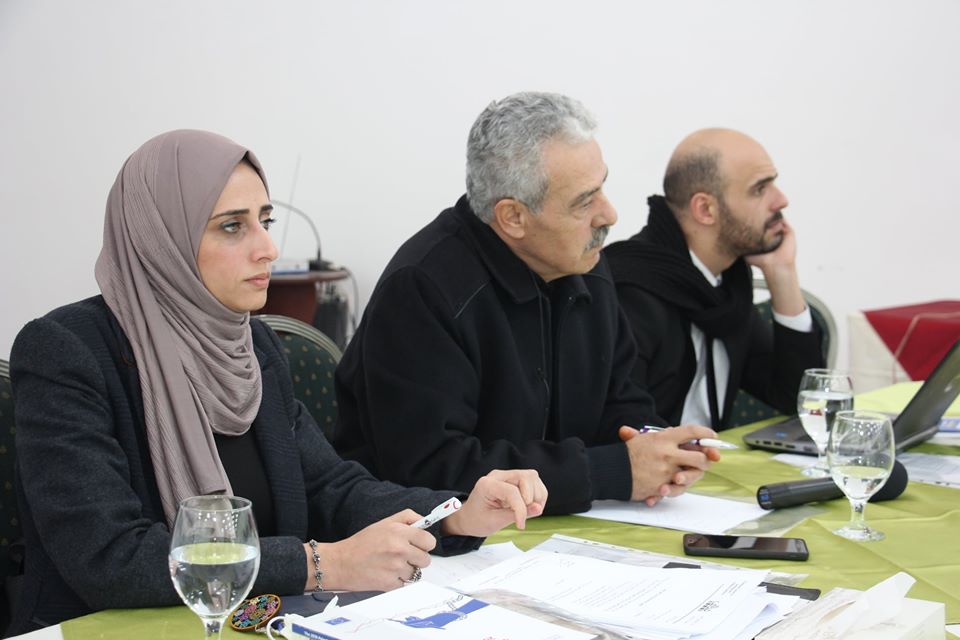
At the end of the discussion, the participants recommended the need to raise awareness of digital rights, ensure access to the Internet as a human right and at the lowest prices, develop a national action plan for digital security and a legal system that protects and guarantees digital rights, ensure full access to the Internet as a basic human right, and amend the Cybercrime Law to ensure its compatibility with the Palestinian Basic Law and International standards. The participants also recommended monitoring and documenting violations of digital rights, follow-up at the local and the United Nations mechanisms, and ensuring transparency in the telecommunication sector, raising awareness of buying Israeli SIM cards security danger, and uniting efforts by civil society organizations to achieve these goals.
