

Ramallah – (10 September 2018) – August of 2018 has witnessed a decline in the total number of attacks (including the Israeli and the Palestinian) committed against media freedoms in Palestine, compared to July of 2018, note that the attacks remained at high and serious rates.
During August, a total of 47 attacks against media freedoms were documented.
Most of which were committed by the Israeli occupation forces and authorities (36 attacks), while a total of 11 attacks were committed by different Palestinian authorities. It should be noted that July has witnessed a record number of attacks totaled to 68 attacks, 60 of which were committed by the occupation.
It seems that the relative decline in the number of attacks recorded in August is mainly due to the decrease in the field activities, which are usually accompanied by the suppression of demonstrators and media staffs, especially in Gaza Strip.
The Israeli Attacks
During August, the occupation forces have committed a total of 35 attacks against media freedoms, most of which fall under the serious attacks against freedom of the press and freedom of journalists. Notable among these attacks are the injury of the journalist of Al-Quds Media Network, Alaa Abdelfattah Al-Namlah, by a gunshot in his right leg while he was covering the events of the return march taking place east of Rafah, in Gaza Strip, the injury of the freelance photojournalist, Mahmoud Bassam Al-Jamal, on the same day, by a fragment in his ear and head which caused him a wound that had to be stitched in the hospital with four stitches, the injury of BBC photographer by a gas bomb in his left hand while he was covering the events of the return march taking place in Malka, east of Gaza, the injury of the photojournalist of “Rowad Al-Haqiqa” Network, Mohammad Samih Hassan Abu Sultan, by a gunshot in his knee while he was covering the events of the weekly return march taking place east of Gaza, and the injury of photojournalist of Al Aqsa TV Channel Yousif Ziad Labad with shrapnel following the bombing of Al-Mishal Cultural Center in Gaza Strip.
The shooting by the occupation soldiers at the vehicle of ROYA TV reporter, Hafeth Abu Sabra, while he was on his way home in Nablus, the West Bank, the injury of the media student, the reporter of Al-Quds News Network, Mutasem Sameer Hamdi Saqf Al-Heet, by three rubber bullets in the hand and chest while he was covering a storming process guarded by the Israeli Army in Balata Camp, in Nablus, the detention of Palestine TV staff by the occupation forces, including: the journalists, Ahmad Abdelmalek Ibrahim Shawer, Mohammad Mahmoud Hassan Enaya, Omar Ahmad Abu Awad, the journalist, Watan Bassam Balas, the drivers, Samer Asad Abu Salman and Ayman Mohammad Tahseen, while they were handcuffed and blindfolded, and while they were reporting the settlements in Jericho, their detention lasted for eight hours, including “punishing” the journalist, Omar Abu Awad, by the soldiers through detaining him under the burning sun as the area is known with its burning heat, which caused him a heatstroke that necessitated hospitalization for two days as he was in a coma-like state after they were released, the continuation of the Israeli occupation forces in the arrests of journalists this month, which affected four journalist, namely: the director of “Hawa Nablus” Radio, Muhammad Anwar Muna, who was arrested by the Israeli occupation army after his house was raided in Zawata, west of Nablus, Ibrahim Ahed Khalaf/Al-Rantisi, the reporter of TRT in Ramallah, who was arrested by the army after raiding his home in Rantis, Ramallah, and the official Palestinian TV reporter, Ali Dar Ali, who was also arrested by the occupation army after raiding his house in Barham, Ramallah, at night, and the photographer of the official Palestinian news agency WAFA, Bahaa Nasr, who was arrested after being beaten by Israeli soldiers while covering Palestinian protests against settlements in Ras Karkar in Ramallah.
The Palestinian Attacks:
In August, a total of 11 Palestinian attacks against media freedoms were registered in Gaza Strip, represented mainly in targeting Palestine TV staff working in Gaza Strip for reporting on an attack against a child by persons belonging to Hamas in Gaza Strip. As a result, the security services in Khan Younis has summoned the Director of Palestine TV in Gaza Strip, Raafat Hammad Al-Qudra, the photographer, Mo’men Muhammad Hashim Al-Shubaki (a resident of Gaza City) and the producer, Yousef Muhammad Ahmad Abu Maghsib (from Deir Al-Balah) three times and subjected them to interrogation on the charge of “falsification and fabrication” pressed by Hamas. Furthermore, their colleague, Mohammad Samir Salim Al-Agha, a resident of Al-Satar Al-Gharbi in Khan Younis, was also summoned. However, when he arrived at the investigation headquarters, he was told that he was not wanted and therefore he was interrogated. This is in addition to the Investigation Office of the Ministry of Tourism, at the Ministry of Interior in Gaza Strip which prevented the conclusion of a seminar about “the role of media in activating the Palestinian prisoners’ case” which was decided to be held in Abdullah Al-Hawarni Center, in Gaza City, under the pretext of not obtaining a prior authorization, knowing that the seminar was to be held inside the center, which is something the Center used to do for many years without obtaining any prior authorizations.
Details of Attacks:
(1st August) At around 12:00 on Wednesday, 1 August, a number of settlers broke into Balata village in the east of Nablus, an overcrowded residential area, under the pretext of praying at the Yusuf Mosque (a religious historical site) under the protection of Israeli occupation forces. , In one of a series of incursions usually carried out by the settlers to this site, leading to outbreaks of confrontations in the area.
(1st August) at around 12:00 midnight, on Tuesday/Wednesday, corresponding 1st August 2018, a number of settlers have broken into Balata camp, east of Nablus, which is a densely populated residential area, under the pretext of praying at Joseph’s Tomb (a religious historic site), under the protection of the Israeli occupation forces, in one of a series of incursions usually carried out by settlers to this site, leading to clashes in the area.
According to MADA researcher’s investigations, a group of journalists, including the journalist, Mutasem Sameer Hamdi Saqf Al-Heet, a 29-year-old media student at the Modern College and a reporter for Quds News Network, have went to the site to cover the storming and clashes which have triggered. He was wearing the press shield and helmet, and while he and his colleagues were at a distance of about 100 meters away from the location where the soldiers were, at the junction leading to Joseph’s Tomb, a number of soldiers approached the journalists and asked them to move away. The journalists told them that they were doing their job, but few minutes later, the soldiers fired gas bombs, causing the journalists to retreat a few meters. A soldier came and asked the journalist, Mutasem, to leave the site so that he would not be harmed, so he replied in Hebrew that he was doing his job. About three minutes later, the journalist Mutasem was injured by a rubber bullet in the right thigh, another in the bottom of his left leg, and a third in the chest area, but he was wearing the shield. For about three hours she stayed in the hospital. At around 1:00AM, the journalist was taken to Rafidia Hospital and there he was treated for about three hours.
(1st August) a force of the occupation army, on Wednesday dawn, corresponding 1st August 2018, has raided the house of the journalist, Mohammad Anwar Muna, (36 years old), located in Zawata/5 kilometers away from east Nablus, and he was arrested.
According to the investigations conducted by MADA researcher, about 15 soldiers have raided the house of the journalist Mohammad Anwar Muna, who works as the director of Hawa Nablus Radio and a reporter of Quds Press Network at around 2:30 AM on Wednesday, corresponding 1st August 2018. They asked him to put on some clothes and take his objects he might need. He was not questioned, but rather was informed that he was in detention. Within 15 minutes, he was taken to Hawara military camp, south of Nablus. The following day, Thursday, corresponding 2nd August 2018, the Israeli military court “Salem” extended the detention of journalist Mohammad Muna for a week without disclosing any details to his family. On Sunday, 12 August 2018, the journalist Mohammad Anwar Muna was transferred to administrative detention for six months in Megiddo prison. It is noteworthy that the journalist Mohammad Muna was arrested several separated times (5 arrests), the most recent of which was in 2013.
(1st August) The Investigations of the Ministry of Tourism of the Ministry of Interior in Gaza Strip, on Wednesday, corresponding 1st August 2018, has prevented the seminar on “The role of the media in activating the issue of Palestinian prisoners”, which was scheduled at Abdullah Al-Hawarni Center in Gaza City.
According to the director of Abdullah Al-Hawarni Center, Nahed Zaqout, as he stated to MADA researcher, the seminar was organized in cooperation with the Palestinian Journalists Syndicate and the Commission of Martyrs, the Wounded and Prisoners in Fatah movement, in the center, on Wednesday, corresponding 1st August 2018, and following the distribution of invitations to participants and attendees, the Center received a call from the Investigation Department at the Ministry of Tourism in Gaza, one day before the seminar, (Tuesday, corresponding 31st July 2018), warning to hold the seminar, on the grounds that no prior authorization was obtained from the competent authorities. This has prompted Al-Hawarni, at around 9:00 AM, on the following day, (Thursday, corresponding 1st August 2018) to contact the headquarters of the Investigation Department at the Ministry of Tourism in Al-Maqusi Tower in Gaza City to find out the reason for this prevention. He was informed that the Investigation Department at the Ministry of Tourism is the party in charge of any event taking place in the hotels and that he had to obtain a prior authorization. When he told them that the seminar would be held inside the center hall and did not require prior authorization as it was not a public act according to the law, they told him to transfer it to the tent of prisoners located opposite the Council of Ministers in Gaza City, but he refused.
Abdullah Al-Hawarni Center used to hold various seminars in the center hall for twenty years without obtaining authorizations or prior authorizations from any party. The center hall is also given to various NGOs to hold workshops without any financial fees in return.
The intervention of the Investigation Department at Ministry of Tourism of the Ministry of Interior in preventing seminars inside the centers is contrary to the Palestinian law, since it is not the competent party on the one hand, and given the absence of legal provisions obligating the organizing party to obtain authorization to hold activities in closed places inside centers and institutions.
(3rd August) The journalist, Hiba Sami Mohammad Awad, (21 years old) has suffered suffocation while she was covering the events of the return march, taking place east of Khan Younis, on Friday, corresponding 3rd August 2018.
According to the investigations conducted by MADA researcher, Hiba Sami Mohammad Awad, a resident of Khan Younis refugee camp, working for the Misk News Network, went to the Khuza’a area, east of Khan Younis, on Friday, corresponding 3rd August 2018, to cover the peaceful return march organized to take place at the separating border since 30 March 2018. She was wearing the PRESS shield and helmet, and at around 6:00 PM, while she was filming the events that were taking place, which included firing tear gas bombs and bullets at the demonstrators, without event recording any bullet injuries. At the time, two Israeli military jeeps, with small rocket launchers to shoot tear gas bombs installed on their tops, stopped in front of them. She went to photograph a 14-year-old boy holding high the Palestinian flag over the separating fence at the opposite side of the soldiers. She approached the fence at a distance of 50-70 meters, 20 meters away from the demonstrators, and the military jeep fired a number of gas bombs which landed around her, until she became completely surrounded with gas bombs, in every direction, which caused her to suffer severe suffocation until she could not move. A team of volunteered paramedics came and took her to Jakar Street, located at a distance 300 meters away from the fence, where she received the necessary first aid.
(6th August) The Israeli occupation forces continued to target journalists in the West Bank. A week after arresting five journalists, the Israeli occupation forces arrested Ibrahim Ahed Khalaf/Al-Rantisi, a reporter for TRT in Ramallah, after raiding his house in Rantis village, northwest of Ramallah.
According to the investigations conducted by MADA field researcher, and based on the statement of Eman Shalash, the wife of the journalist, Ibrahim Al-Rantisi, an Israeli force has raided the house at 2:00AM, at the dawn of 6th August 2018, after breaking the main door. They requested the personal identity card of Ibrahim, seized his cell phone, and dragged him outside the house. They then took him on foot to the main street next to the village where the military vehicles were waiting for them, as the family later found out. Three days later (August 9, 2018), the military court in Ofer decided to release four journalists on the condition that a bail of 5,000 shekels has to be paid, namely: Mohammad Sami Alwan, Qutaiba Hamdan, Husni Injas, and the journalist, Ibrahim Al-Rantisi, who stated to MADA researcher after he was released “"I was taken from the house, handcuffed, and on foot and was harassed by the soldiers until we reached Rantis Barrier, which is about 5 km from the village. It was about 8:00 AM”. From there he was transferred to Ofer Prison in Betunia, blindfolded and handcuffed. And when he arrived Ofer, he was subjected to a thorough search. After about two hours of waiting, he was taken to a room inside of which there were two interrogators. He was questioned for about three hours for the charge of “incitement” through his work with media outlets in the past. But he “proved to the interrogators” - as he said, that his previous arrest was triggered by “retaliation” motives from the Palestinian journalists and the attempt of Israeli authorities to charge him with “incitement”. At the end of his interrogation, he was transferred to the Etzion detention center near Bethlehem and arrived at 8:00 PM. On the following day, (corresponding 7th August 2018), he was transferred again to Ofer Center in Beitunia, Ramallah. He was subjected again to another investigation session which has lasted for two hours. They displayed to him videos they captured for the journalists while covering the events taking place at Beit El barrier. He was released on bail of NIS 5,000 and was threatened by the investigator that he will summon his at any time after his release.
Al-Rantisi, the sixth Palestinian journalist arrested by the Israeli occupation forces since July 30, as they have arrested on July 30, Alaa Al-Rimawi, the Director of Al-Quds TV channel in Beit Rima, northwest of Ramallah, and the journalists: Mohammad Alwan (Ramallah), Husni Abdeljalil Injas (Kharbatha Bani Hareth, west of Ramallah), Qutaiba Hamdan (Betunia, west of Ramallah) and the journalist, Mohammad Anwar Muna, the reporter of “Quds Press” International Agency in Nablus, after his house was raided in Zawata, west of the city, on 1st August, bringing the total number of journalists held in Israeli jails to 28; including two patients, seven sentenced to actual imprisonment, 5 administrative detainees and 16 still in interrogation cells.
(9th August) a journalist with Al-Aqsa TV, Yousif Ziad Mohammed Labad (29years) was injured by Israeli planes following the bombing of Said al-Mishal Cultural Centre as he was there to cover the initial threats to bomb the center. Based on the center’s field worker in Gaza Strip investigations; photojournalist of Al Aqsa TV channel, Yousif Ziad Mohammad Labad (29 years), based in Gaza Strip, headed to Al-Mishal Cultural Center western of Gaza at around 17:30 On Thursday (09/08/2018), after the channel learned that civilians of the neighborhood were informed that the IOF are willing to bomb the center and all civilians are to evacuate their homes, hence, Yousif headed to the scene to cover the bombing, afterwards, IOF launched warning missiles in the crowded area, similar to civilians in the area Yousif moved away from the building, IOF bombed the center, Yousif was injured with shrapnel in his left hand, internal bleeding in his ear and bruises in his shoulder he was immediately transferred to the hospital.
(10th August) Three journalists were suffocated and wounded by Israeli occupation bullets during their coverage of a march that took place east of Rafah in Gaza Strip on Friday, corresponding 10th August 2018, as part of the return marches which were launched in Gaza Strip on 30 March.
According to the investigations conducted by MADA field researcher, the journalist, Alaa Abdel-Fattah Al-Namla (35 years old), working for Al-Quds Media Network, went to the east of Rafah at about 4:00AM, on Friday, corresponding 10th August 2018 to cover the return march organized there. He was wearing the PRESS shield, and carrying in his hand a photographic camera. At approximately 5:30, the journalist, Alaa, approached the fence and stopped, along with two other journalists, at a distance of 200 meters away from the separating fence while the demonstrators where setting in fire the tires and throwing stones at the soldiers who were firing live bullets, gas bombs, and smoke bombs at the demonstrators from place where they were stationed to the other side of the fence. The shooting increased by the soldiers as a number of demonstrators tried to approach the fence and become closer, which resulted in injuring a number of demonstrators. One of them (the volunteer paramedic, Abdullah Al-Qatati) was martyred. The journalist, Alaa Al-Namla then retreated to a distance of about 400 meters away from the fence, and at around 7:00, the journalist, Al-Namla, was injured by a bullet in the left knee which caused him a minor wound before injuring his right leg (causing an entry and exit). He immediately fell to the ground and a number of volunteer paramedics provided him with some first aid at the medical point established about 700 meters away after he was taken by an ambulance of the Palestinian Red Crescent, where he received more treatment. At around 7:30, he was transferred to Abu Yousef Al-Najjar hospital, located to the east of Rafah, where an x-ray was taken for him, and it showed that his injury was not that serious. He received the treatment and returned at around 8:00 to his house.
On the same day and the same place, the freelance photographer, Mahmoud Bassam Al-Jamal, (24 years old), at around 6:30 PM, was injured by a fragment of a live bullet, in the ear, which caused him a head wound, while he was covering the events of the march at approximately 200 meters away from the border fence where the soldiers were deployed. Immediately, the paramedics in the area took him by ambulance to the field medical point where he received some aid and was taken to Abu Yousef Al-Najjar Hospital, to which he arrived at around 7:00PM. At the hospital, an x-ray was taken for him, and the wound in his ear caused by the fragment was stitched with four stitches in addition to three stitches for the wound in his head. After about an hour and a half, he was discharged from the hospital.
At approximately 06:30 on the same day, and the same place, the freelance photographer, Mahmoud Mohammad Shata, (25 years old), was severely suffocated while he was covering the events of the march. He fell to the ground and was carried by an ambulance of the Palestinian Red Crescent to the field medical point where he received the necessary first aid for a quarter of an hour.
(15th August) The Israeli occupation forces has continued targeting the Palestinian journalists in the West Bank, and arrested, on Wednesday, at dawn, corresponding 15 August 2018, the official reported of Palestine TV, Ali Dar Ali, from his house, located in Burham village, in Ramallah. It is noteworthy that during July, seven other journalists from the West Bank were arrested: Lama Khater, Alaa Al-Rimawi, Qutaiba Hamdan, Husni Injas, Mohammad Muna, Ibrahim Al-Rantissi and Mohammad Sami Alwan.
According to the investigations conducted by MADA researcher, an Israeli occupation force, at dawn, on Wednesday, corresponding 15 August 2018, has raided the house of Palestine TV official reporter, Ali Dar, (34 years old), at Burham village, 13 km to the north of Ramallah. His wife heard a loud knock on the door of the house which woke her husband Ali and he went towards the door from the back of the house and opened it after they introduced themselves, loudly, that they are the Israeli army. When he opened the door, around fifteen one entered the house. One of them asked him to bring his personal identity card, the laptop and the cell phone. They began to search everything in the house. After twenty minutes of searching the house, seizing his cell phone and lab top, the soldiers handcuffed Ali, arrested him and took him to one of the three patrols and a military soldiers’ carrier that his wife saw parking in the area. At the evening on the day he was arrested, the Prisoners’ Affairs Committee informed Ali’s family that he had been transferred to Ofer detention center in Betunia in Ramallah. On the following day, Thursday, corresponding 16 August, 2018, his detention was extended to question him. The court was later postponed until 4 September 2018. The Israeli Army has announced the arrest a Palestinian citizen (the night before) for the charge of incitement against Israel, in reference to the journalist, Ali Dar Ali. The spokesperson of the Israeli army for the Arab media, Avichay Adraee, claimed in a tweet he published on his Twitter account that “under the framework of a large operation last night to arrest terrorist activists engaged in incitement, the Israeli border forces detained a Palestinian who systematically published incitement materials through the social media against Israel and the Israeli army”. He also claimed that “the detained Palestinian has filmed and edited videos for the Israeli Army soldiers during their duty in the field, not to mention that he encouraged violence against them, as well as attacking the Israeli army forces and Israel”. He also stated that “the Israeli Army sees the seriousness of such acts, and will work by all means to eliminate the incitement acts in the West Bank”. It is noted from the army’s statement that the intended was the reporter of Palestine TV, although it was not disclosed or mentioned that the detainee was a journalist or a reporter working for Palestine TV, but the official account of the so-called “The Coordination Unit of the (Israeli) Government’s Action” in the occupied Palestinian territories, has published explicitly a comment with the photo of journalist, Dar Ali, which reads “During the night, a number of Palestinians who regularly incite through the social media were arrested in recent months. Among the detainees was the journalist Ali Dar Ali from Burham. Words have power, incitement through the social media may kill and negatively affect stability! Do not be part of this! He incited, therefore he was arrested”. This is not the first time that the Israeli army has arrested journalists or activists on charges of “incitement”. It is evident from the statements of journalists who have been arrested and released recently that the investigation was conducted about their work and about what they publish on social media websites, including any materials or comments that may be used against them as “inciting” material in many cases.
(24th August) Three journalists suffered suffocation while they were covering the peaceful return march on the 22nd Friday … when, in Malka East Gaza.
According to the investigations conducted by MADA field researcher, the reporter of Thaqalayn TV, the journalist, Fatima Jabr Al-Atawna, (38 years old), and her colleague, the photographer working for the same TV, Midhat Adnan Hajjaj, (30 years old), while they were interviewing one of the field paramedics during their coverage of the weekly return march, at around 6:00M, on Friday, corresponding 24 August 2018, have suffered suffocation due to firing gas bombs by an Israeli drone at the demonstrators in the march, although (Al-Atawna and Hajjaj) where wearing the PRESS shield, and they were 150-200 meters away from the separating fence where the Israeli soldiers were deployed. They were given the field first aid by the medical staff. On the same day and place, according to field ambulance staff in the location, the journalist, Mahmoud Al-Ajrami, a BBC photographer, was also injured by a gas bomb causing a shake in his left hand, although he was treated on the ground, it lasted for three days.
(25 August) The Palestinian Security Services in Gaza Strip have summoned four journalists working for Palestine TV, a few hours later after reporting on TV about some of Hamas members who attacked and severely beaten the kid, Mohammad Abu Anza, in one of Khan Younis mosques.
According to the investigations conducted by MADA field researcher, the General Directorate of Investigation has summoned to its headquarters in Bani Suhaila east of Khan Yunis, on Saturday, corresponding 25 August 2018, four journalists working for Palestine TV, upon complaint filed by Hamas, concerning the report broadcasted on Palestine TV which covers the attack and severe beating by Hamas members against the kid, Mohammad Abu Anza, from Absan, east of Khan Younis. The Director of Palestine TV in Gaza Strip, Rafat Hammad Abdel Majeed Al-Qudra, (50 years old), from Al-Qarara, Khan Younis, received at about 10:30AM on Saturday, corresponding 25 August 2018, a phone call from a person who has introduced himself as one of the investigation police officers at the Eastern Area center in Khan Younis, and asked him to come to the headquarters. Indeed, he responded, and at around 12:30 PM, he arrived at the headquarter, where he was questioned without any threat or intimidation, about the report televised on Palestine TV about the kid, Mohammad Abu Anza, and the attack against him at one of the mosques on 20 August 2018, without being charged with anything. They heard his statement about what has happened, and he informed them that he was assigned by the TV office to interview the kid and his family and talk about the attack. Accordingly, they sent a photographer and producer to film the interviews, and he sent the filmed material to the TV office in Ramallah, where the entire report was finalized. Subsequently, they asked him to contact the photographer, Mu’min Mohammad Hashim Al-Shobaki, (42 years old), from Gaza City, and the producer, Yousef Mohammad Ahmed Abu Maghsib, (38 years old), from Deir Al-Balah, and inform them to come to the investigation department at the police headquarters in the eastern area. Indeed, they arrived at the headquarter at around 3:30PM on the same day. Mu’min Al-Shubaki was interrogated in the same room where Al-Qudra was present, without intimidation, threatening or charging. Furthermore, Yousef Abu Maghsib was interrogated in another room. After the investigation was completed, they were informed that a complaint filed by Hamas against the TV office for the charge of “falsification and fabrication”, based on the report, and that there is an order to detain them but they will be released provided they return at 8:00 AM the next day, Sunday, corresponding 26 August 2018. Separately, their colleague, the photographer, Mohammad Samir Salim Al-Agha, (29 years old), from Al-Satr Al-Gharbi, Khan Younis, who works for Palestine TV, has received a phone call at around 9:00AM on Saturday, corresponding 25 August, from a person who identified himself as an officer from the investigation department, and asked him to come to the headquarters of the investigation services in the town of Bani Suhaila east of Khan Yunis. Al-Agha informed him that he was “busy now and will come at noon”. Indeed, he actually went there and arrived at the headquarters at around 1:00 PM, where he saw the television director, Rafat Al-Qudra, and one of the police officers told him that he was not wanted. Accordingly, he left the headquarters about 10 minutes after his arrival without being subjected to any interrogation. On Sunday, corresponding 26 August 2018, upon the request of the investigation department the previous day, the staff consisting of Rafat Al-Qudra, Yousuf Abu Maghsib and Mu’min Al-Shubaki, have returned to the police station east of Khan Yunis at approximately 8:00 AM, where their statements were registered again by the police investigators not the investigation department. After about three hours, they released them after they were told that their file will be transferred to the Public Prosecution, and that they have to go there for follow up purposes at 10:00AM on Tuesday, corresponding 28 August 2018 and that they will be released on bail. On Tuesday, the three journalists arrived at Khan Yunis Prosecution Office at around 9:30AM, accompanied by the legal advisor of the TV office, Hazim Abu Sha’ban. The statements of the entire staff were taken individually by the prosecutor. However, the TV Director, Rafat Al-Qudra, and the prosecutor in Khan Younis, Ibrahim Al-Dabbari got into a verbal altercation, in the presence of the lawyer of MADA Center in Gaza Strip, Ihsan Abu Shrakh, due to the prosecutor’s loud voice when he asked the journalist Al-Qudra, why they did not get a prior authorization for filming, and that the filmed material about the kid Abu Anza must be presented to the regulatory authorities before televised. The prosecutor decided to question Al-Qudra after the altercation, after he asked all the staff to leave, including the lawyer of MADA Center and the legal advisor of the TV Office who were following up with this case. He remained alone in the office of the prosecutor, and 20 minutes later, the TV legal advisor was allowed to enter the room. At approximately 11:00AM, the TV director signed his testimony at the end of the interrogation, as did his colleagues, Yousef Abu Maghsib and Mu’min Al-Shubaki. At around 12:00PM they all left, after the prosecutor told them to come back on Sunday, corresponding 2nd September 2018 to meet the chief prosecutor, who wanted to “know them and drink a cup of coffee with them”. Al-Qudra replied this has taken a very long time and it may cause media escalation.
The lawyer of MADA Center, Ihsan Abu Sharakh, has attended the interrogation sessions twice, one at Khan Yunis Eastern Police Station on Sunday, corresponding 26 August 2018, and the second in the Khan Younis Public Prosecution Office on Tuesday, corresponding 28 August 2018. He considered what happened to Palestine TV Staff for reporting on the child who was attacked in Absan, Khan Younis, on 22 August 2018, has no legal basis, and that it falls under the scope of political rivalries due to internal division, intimidation of journalists, and restricting their journalistic work. He said that it was a legal violation when the lawyers of MADA Center were prevented from attending the interrogation session in Khan Younis Prosecution Office on Tuesday, corresponding 28 August 2018, not to mention allowing him and the legal advisor, to enter the prosecutor’s office only few minutes later, given that in the room, there was the Director of Palestine TV in Gaza Strip, Rafat Al-Qudra, without again allowing MADA’s lawyer to enter, despite his right to do so, even if there is more than one lawyer with him (the accused).
(27th August) Joseph’s Tomb, located near Balata Refugee Camp, east of Nablus, is considered a very hot area, as the Israeli frequently enter this densely populated residential area, claiming to perform religious rituals in the place they consider sacred. The area is usually crowded with clashes and attacks by soldiers against the Palestinian civilians. On 27 August 1988, the journalist, Hafeth Abu Sabra (29 years old) was targeted.
According to the investigations conducted by MADA researcher, the journalist, Hafeth Abu Sabra, (29 years old), who works as a reporter for ROYA TV in the West Bank, on his way to his house in Nablus, at 11:18 PM, on Monday, corresponding 27 August 2018, in the main street, next to Nablus Municipality building, in the direction of Al-Quds Street junction, Balata refugee camp, where Joseph’s Tomb is located, was surprised by a force of about ten soldiers from the Israeli army, where they started firing live bullets towards his car without causing any material or physical harm, forcing him to quickly turn around and return to search for an alternative way. His car was carrying a badge that says PRESS, in both English and Arabic. While searching for an alternative way, he was stopped by an Israeli military vehicle, and one of the soldiers informed him that the area was a closed military zone and that he had to take another road, endangering his life due to the firing of live bullets at his vehicle. On the following morning, corresponding 28 August 2018, the spokesperson of the Israeli army for the Arab media, Avichay Adraee, has stated “the entry of 750 settlers to Joseph’s Tomb near Balata refugee camp, in Nablus, to the northern West Bank was secured, and that troops from the army entered the city of Nablus in order to secure the entry of the Jewish worshipers to what they call Joseph’s Tomb, the clashes erupted and the live bullets were used not to mention a Palestinian vehicle was suspected” and this appeared to be a sign to shoot the vehicle of the journalist, Abu Sabra.
(27th August) Mefuot Arkhu Settlement is located to the northwest of Jericho, where the Israeli occupation forces have established a military outpost in which the soldiers are constantly present to protect the neighboring settlements. One settler, called Aumar, has seized more than 500 dunums of Palestinian land and planted them with palms, pomegranates and olives. This settler spread a state of terror in the area, and he was shooting the shepherds to intimidate them, he even killed a number of the sheep owned by Bedouin families living in the area.
According to the investigations conducted by MADA field researcher, Palestine TV staff, consisting of: the journalist, Ahmad Abdelmalek Ibrahim Sjawer, the journalist Mohammad Mahmoud Hassan Enaya, the journalist Omar Ahmad Abu Awad, the journalist Watan Bassam Balas, and the drivers, Samer Asad Abu Salman and Ayman Mohammad Harash, went on Monday, corresponding 27 August 2018, to the Bedouin gathering of the Zayed family northwest of Jericho, to film a new episode of “Not a neighbor” show. After they completed filming the episode, an Israeli military patrol consisting of three soldiers and an officer called Sophie, have detained the staff and seized their cell phones, deleted all the filmed materials from their cameras and took the keys of their vehicles belonging to the Palestinian Broadcasting Corporation. This detention lasted for more than two hours and took place in Al Mu’Rajat Street, before the Israeli officer called another military force including four female soldiers. They handcuffed and blindfolded all of the TV staff and took them in a military jeep to the military outpost located near the Bedouin gathering. It should be noted that this is the closest military outpost to the region, and their transfer to the mentioned outpost did not take time but few minutes according to the staff members. At around 02:30PM, the TV staff members were handed over to the Israeli camp blindfolded. One of the soldiers told them that “it is now 02:30 and you will be released within an hour”. Then journalist Omar Abu Awad asked the rest of his colleagues whether they were all there with him in the place, and everyone answered yes. At that exact moment, a female soldier asked him to be quiet, and Abu Awad answered that he will not be quiet until he makes sure that his colleagues in the staff are all fine. She grabbed him by his hand and asked him to get up, and he did. She took him away from his colleagues and put him under the sun, and said “you can sit here and talk all you want”. Abu Awad did not know how long he remained under the burning sunlight, but he said, “When I felt a pain in the head, I spoke and said that my head hurts me. One of the soldiers replied that he was a paramedic and said to me: “Drink some water”, and when he drank some water he felt a severe headache and lay down on the ground. When the soldiers saw him lying on the ground, a female soldier came and said to him: “Hey! Good Morning, the punishment is over, come on! Get up”. She took him to his colleagues and sat with him, he asked again “Who’s here?”, his colleague Ayman Harsh answered “I’m here Omar, and we are all here fine”, Abu Awad replied that he was tired and wanted some water. One of the soldiers brought water and chocolate sandwiches to all the staff except for Abu Awad because he was unable to eat anything due to the severe pain he felt in his head. At around 7:12 PM (the staff members heard the Maghreb prayers” and they were still in detention. Abu Awad then lost his ability to move or talk due to the fatigue and exhaustion he felt. At that moment, Ayman Harsh said to the occupation soldier “What did you do to him? take off my blindfold, I want to see Omar”. An argument was heated between Harsh and the soldiers. The soldiers released the entire staff except for Abu Awad, who was mentally conscious but unable to move and talk. A brown-skinned female soldier removed the blindfold from his eyes as well as the handcuffs. He was unable to move, talk, or even see well even though he was fully aware of what was happening around him. The Israeli soldiers put a needle in his left hand to enter the fluids to his body and provide him with the first aid. One of the soldiers addressed him saying “Do you want us to take you to your home to see your children? Come on! Wake up! Because we cannot take like this”. He continued talking to him, but Abu Awad could not stand up or talk. The soldiers took him by ambulance from the camp to the main street, which is about 700 meters away. His colleagues were waiting for him. A Palestinian Red Crescent ambulance was in the area, but the soldiers refused to hand over Abu Awad to the Palestinian medical staff, and asked them to wait until the Israeli medical staff comes and check his condition. However, the Palestinian official paramedic refused to wait since Abu Awad’s condition was serious and the oxygen content in his body did not exceed 60% which is why he had to be transferred to the hospital as soon as possible, according to the paramedic, Ahmed Al-Alami, of the Palestinian Red Crescent Society. Abu Awad was taken to Jericho Governmental Hospital and he remained in a complete coma for two days according to medical reports. He received the initial treatment at Jericho Governmental Hospital on the first day without any signs of improvement. On the following day, he was transferred to Istishari Awab Hospital in Ramallah, and according to the medical reports, Abu Awad was suffering from lack of vision, severe mineral deficiency, a severe sunstroke and severe dryness as a result of being detained under the direct sunlight.
(28th August) Within the targeting of Palestinian journalists, especially photographers who work in the field and cover the attacks against the Palestinians, their property and lands, the occupation forces have arrested the photographer of the Palestinian news agency “Wafa”, Bahaa Nasr, not to mention attacking other journalists during their coverage of the resistance of Ras Karkar population to the levelling operations conducted for establishing settlements which the settlers began to implemented above the territories of the village.
According to the investigations conducted by MADA field researcher, at around 13:33 PM, on 28 August 2018, and while the population of Ras Karkar, located to the west of Ramallah, were trying to resist the Israelli bulldozers which were building a street for the settlements, in the area of “Al-Risan” Mountain located to the west of the village. The Israeli occupation forces attacked a number of journalists and photographers: Hisham Abu Shaqra, Anatolia Agency photographer, the freelance photographer, Abdel Rahman Younis, and Palestine TV staff, which included the reporter Khalid Mutawe, and the photographer Mohammad Al-Arouri, not to mention attacking the photographer of Al-Hayat Al-Jadida newspaper, Issam Al-Rimawi, the photojournalist, Mohammad Turkman, with beating, pushing and forcing them to leave the site as well as obstructing their work. A soldier from the Israeli Border Police has pushed the photographer of the Palestinian news agency WAFA, Bahaa Mohammad Mahmoud Nasr, (34 years old), and asked the other soldiers to help in arresting him. A number of soldiers have beaten the photographer Mohammad Nasr and dragged him on the ground, took his cameras and beaten him all over his body. They then tied his hands behind his back and threw him on the ground under the sun for more than two hours, in the area where he was arrested by a military vehicle and taken to an unknown location. After six hours of detention, the photographer, Bahaa Nasr, was released. Later, he stated to MADA researcher that he was subject to torture and humiliation by the occupation soldiers while he was detained under the sunlight for more than two hours. He stated “I remained under the sun for more than two hours before they took me in the jeep, I remained for fifteen minutes lying on the ground on my stomach, then they searched me and took me in the jeep. They hit my head inside the vehicle and took me with two other detainees (from the demonstrators). This is in addition to the profanity and threatening with imprisonment”. At about 1:00PM, some officers arrived and had a discussion with the soldiers and decided to arrest him. He was taken with his cameras and his stuff. They forced him to enter the jeep and sit in a very difficult position with his head down. He was forced to close his eyes so he did not know where he was. Halfway, while he was being transferred as a detainee, he began screaming from the severe pain he felt in his foot due to sitting in a difficult position. One of the soldiers slapped him on the face and asked him to be quiet. He was taken to Benjamin Investigation Center and when he was removed from the military jeep, hey pulled his feet, but he did not feel them as a result of the severe pain, while the soldiers were laughing and cursing. Then his handcuffs were changed and he was taken to the hall of the investigation center accompanied by two soldiers, where he stayed for about an hour and a half, until a police officer asked him, “Why did you hit the soldiers”. He then asked him what had happened to him. Nasr told him that while he was filming he informed the officer that he was a journalist and would leave the place but the officer in the army got angry and attacked him with a number of soldiers. About an hour later, the same officer (investigator) returned and asked him the same question. Nasr told him that he was filming a video, and that he could see if anything of what the soldiers have claimed was true. They informed him that he will be handed over to the DCO. Then another officer came, took some information from his personal card, and registered the same on a laptop that he had. After about six hours of detention, the soldiers transferred the journalist Nasr from “Benjamin” investigation center to the settlement of “Beit El” located in Al-Bireh - specifically to the liaison department where he was handed over to the Palestinian liaison department.
(31st August) On Friday, corresponding 31st August 2018, six journalists suffered severe suffocation after they were targeted by the occupation soldiers with gas bombs while they were covering a peaceful protest organized by the population of several villages in Ramallah against a settlement project that is targeting their lands, even though they were all dressed as journalists.
According to the investigations conducted by MADA field researcher, on 27 August 2018, the occupation army has submitted to the population of Ras Karkar, to the west of Ramallah, a military decision stating that “Al-Risan” Mountain owned by the population of Ras Karkar, Kharbatha Bani Hareth, and Kufr Neima, is a military closed zone, to which the Palestinians are prohibited to have access, as a result of the protests against the settlement project implemented by the occupation authorities in that area to build a settlement road. On Friday, corresponding 31 August 2018, hundreds of villagers from Ras Karkar, Kharbatha Bani Hareth, and Kufr Neima, have gathered and prayed above the lands targeted by the settlers and the occupations forces. Moreover, several journalists went to the site to cover what was taking place (especially since other protests were organized in the previous days there). Following the end of the Midday Prayers at around 1:00PM, clashes broke out between dozens of Palestinians and the Israeli soldiers. While the journalists were covering these clashes, one of the soldiers has threatened, Ethar Ibrahim Abu Ghraibah, the photographer of Al-Araby TV, (35 years old) and asked him to stay away from the area, otherwise “he will be treated in another manner”. It should be noted that the soldier who told him that was wearing the dark green uniform that is known as the uniform of the “Israeli Border Police” forces, and the word “Makaf” was written in Arabic on his military shirt. Few minutes later, at around 1:10, the reporter of Al-Arabiya TV, Abdul Hafiz Zuhair Jawan, (38 years old), and the photographer, Salem Nasr Hamdan (39 years old) were both targeted while they were reporting to the TV with more than ten gas bombs, even though they were far away from the soldiers deployed at Al-Risan Mountain between Kharbatha and Ras Karkar. During the clashes which were taking place 70 meters away, the reporter, Abdul Hafiz, suffered severe suffocation and fell to the ground because he could not put on the muzzle. He was given the field first aid through the Palestinian Red Crescent Medical staff at the site. Moreover, Al-Ghad TV photographer, Munther Mohammad Shihada Al-Khateeb, has suffered suffocation after he was targeted with tear gas bombs while he was filming the events at a distance of 70 meters away from the clashes. This is in addition to the reporter of Baladna Radio, of MAAN News Agency, the journalist, Safiya Omar Qowar, (32 years old), who suffered suffocation more than once while she was covering the clashes taking place on Al-Risan Mountain. She stated “I was wearing a phosphoric vest, marked with PRESS in Arabic and English, and while I was approaching the clashes, the occupation soldiers heavily fired gas bombs. After that, I could not breath, one of the young men helped me out and pulled me to another area, where the Red Crescent medical staff provided me with the first aid. I stayed for about 15 minutes sitting on the ground and could not complete my work”.
(31st August) The photojournalist of “Rowad Al-Haqiqa” Network, Mohammad Samih Hassan Abu Sultan, (24 years old) was injured by a gunshot in his knee while he was covering the events of the weekly return march.
According to the investigations conducted by MADA field researcher, the photojournalist of Rowad Al-Haqiqa Network, Mohammad Samih Hassan Abu Sultan, (24 years old), at around 4:00PM, on Friday, corresponding 31 August 2018, was with his colleagues from the Network inside the tent of the journalists located 500 meters away from the separating fence, waiting for the march to begin. At around 5:00PM, he approached the separating fence area and stopped at a distance of 50 meters away, near the gathering of the demonstrators who started setting in fire rubber tires, while the soldiers on the other side of the fence where firing bullets and gas bombs at the demonstrators. While he was taking photos for the demonstrators, he was injured at around 5:15PM, with a gunshot in his left knee causing “an entry and exit”, and immediately fell to the ground. A number of volunteered paramedics approached him and provided him with the first aid by dressing the injury to stop the bleeding. He was then transferred with an ambulance for the Palestinian Ministry of Health to the medical point established 700 meters to the west of the separating fence. He arrived at 5:30PM, and received more necessary aid. Five minutes later, he was taken by an ambulance to Abu Yousef Al-Najjar Hospital, in Rafah. He arrived the at hospital at around 6:00PM, where it was found that there was a fracture in his left knee, and that he needs a surgery. But he had to wait for an hour due to the preoccupation of the only operations room in the hospital. This caused the bleeding to start again and he was given four blood units. He went to the operating room and underwent an operation that has lasted for about one hour. The fracture was set in and the wound was dressed. On the following day, the bleeding started again and he needed two blood units. Abu Sultan remained in the hospital until the present report was prepared on 2 September 2018.
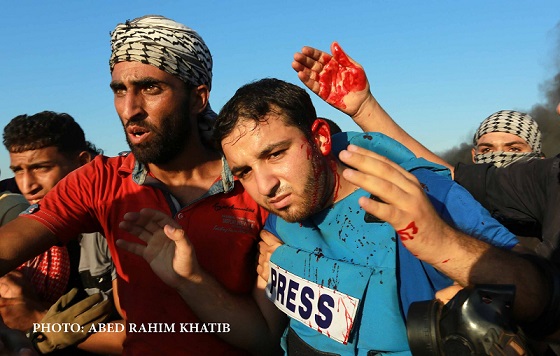
Freelance photojournalist Mahmoud Al-Jamal after he was injured by a fragment of a live bullet
Photo By: Abdulrahim Al-Khatib
