

Ramallah - The attacks against media freedoms in Palestine during July maintained the same high and serious rates which were registered in the past few months. During July, a total of 68 were registered, most of which (60 attacks) were committed by the Israeli occupation, while a total of eight attacks were committed by various Palestinian parties in the West Bank and Gaza Strip.
The total number of attacks against media freedoms registered during July was almost identical to that of the preceding months. Last June has witnessed a total of 60 attacks whereas May has registered 57 attacks, and April has witnessed 54 attacks while March has registered a total of 46 attacks.
Israeli Attacks
The Israeli attacks have increased significantly and almost doubled during July, compared with the preceding month, June, where it reached 60 attacks which constitutes an increase of 114% over the attacks committed during June (totaled to 28 attacks).
It should be noted that 37 of the total Israeli attacks registered during July have taken place in the West Bank compared with 23 in Gaza Strip.
In parallel to the growing number of the Israeli attacks, most of them, as usual, are serious and physical attacks totaled to 24 physical attack (some of which caused by live bullets, explosive bullets, metal bullets, and gas bombs directly fired). This is in addition to six arrest and detention cases of journalists not to mention prohibiting Al-Quds TV from working in the Israeli territories, the West Bank, and the occupied city of Jerusalem.
Among the most prominent Israeli attacks registered during this month was the injury of the journalist, Muein Tayseer Al-Dabba, by a gunshot through his left hand (causing an entry and exit) which caused fractures, laceration, and snapped tendons, while he was covering the events of the return march east of Gaza Strip, the injury of the freelance photographer, Nihad Khalil Mohammad Abdelnabi, by an explosive gunshot in the left thigh while he was covering the events of the return march east of Gaza Strip, the injury of his colleague, Abdelkareem Hamdounah, who was next to him, by fragments from the same bullet, in his right thigh, the injury of the journalist, Hiba Sami Mohammad Awad, by a gas bomb in the left shoulder, shot directly against her while she was covering the events of the return march in Khuza’a, east of Khan Younes, the injury of Sobhey Mousa Abu Al-Hossain, by a gunshot in the right thigh while he was covering the events of the return march, east of Rafah, the injury of the photographer, Anas Jamal Mahmoud Al-Sharif, with burns and dislocation in the left shoulder by a gas bomb shot directly against him by the occupation soldiers while he was covering the events of the return march in Abu Safiya, east of Gaza Strip, the injury of the freelance photographer, Adel Al-Hawajri, by a fragment of a bullet in the calf muscle while he was covering the events of the return march, east of Bureij Camp, the injury of the photographer, Nidal Ishtayya, who works for Xinhua News Agency and Anatolia News Agency, by a rubber bullet in his foot shot at him by one of the soldiers while he was standing right in front of him while he was covering the events of the weekly anti-settlement demonstration in Kafr Qaddum, Qalqiliya governorate, and the injury of Palestine TV photographer, Loay Abdelhafeeth Aref Samhan, by a metal bullet in his left leg while he was covering the weekly anti-settlement demonstration in Kafr Qaddum as well. This is in addition to firing Palestine TV Staff with two bullets by the soldiers while they were inside their vehicle marked with “TV” in Oreif village, Nablus governorate, where they went to cover the attacks of settlers. The front of the vehicle was damaged with no injuries caused to the staff inside the vehicle.
Palestinian Attacks:
July has witnessed a significant decline in the number of Palestinian attacks, which were limited to eight (seven of which have taken place in the West Bank and only one attack in Gaza Strip) compared with June, which has witnessed a total of 32 Palestinian attacks.
These attacks included mostly arrest, detention, and arbitrary detention, such as the attacks against the three journalists: Mohammad Jahaysha, a presenter at Al-Marah local radio in Hebron, the media student, Huthaifa Ali Jamous, and Iyad Al-Rifae who was summoned and detained for four hours in a closed room post interrogation by the Palestinian intelligence services in Ramallah, and threatened with beating and shabeh as well as dismissal from work (he works for Wataniya Mobile, a company that owns a substantial shareholding of its shares) during interrogation. Furthermore, sentencing Amer Ba’lousha by a court in Gaza with a financial fine of 200 shekels and suspended imprisonment for six months because of a post he had published on Facebook a year ago, knowing that he was arrested at that time because of the post and detained for 12 days. Since that time, several hearings for the trial were held, and his trail ended on 4 July 2018 with the issuance of this ruling against him.
Details of Attacks:
(3rd July) the freelance photographer, Zaki Yahia Awadallah, (27 years old), from Yabna Camp, Rafah, south Gaza Strip, was injured by a gas bomb in his head and suffered severe suffocation. It was shot at him by the occupation soldiers while he was covering the women march organized under the slogan “Palestinian women towards the peaceful Return and breaking the siege” in Malka, east of Gaza City, as part of the peaceful return marches taking place since the 30th of March close to the separating fence east of Gaza.
According to the investigations of MADA field researcher, the journalist Zaki Awadallah, was injured in Al-Awda Camp, east of Gaza, at around 4:30 PM, on the 3rd of July and he was not wearing the recognized press vest. He was holding a Canon Camera (D360, Mark 3), and he started filming the influx of participants on the road to the Camp while he was at a distance of 700 meters away from the border fence. Then he went with some freelance photographers, namely: Mohammad Qandeel, and Bader Al-Najadi, to cover the burning of rubber tires by some of the female and male demonstrators, near the border fence, at around 5:30, while he was at a distance of 150 meters away from the border fence. Awadallah stopped with his colleagues at a distance of 30 meters away from the demonstrators (totaled to few dozen) who were setting fire to the rubber tires. He started filming, and while he was filming an Israeli military jeep (located on the other side of the fence) fired more than ten gas bombs from a platform installed on the front of the jeep towards ?, the jeep fired a similar amount of tear gas at him and the group of journalists with him. He tried to escape but fell to the ground after he felt that one of bombs injured the back of his head (near the neck). He noticed heavy smoke around him caused by five bombs which fell near him. This has led to his loss of consciousness due gas suffocation, and he did not wake up until about (15 minutes) post his injury. He was transferred by the civil defense staff to the field hospital in Malka, and stayed about 45 minutes receiving treatment in the field hospital. He was discharged at about 7:00 PM. On the following day, 4th July (on which he was interviewed), he was still suffering pain in the place of injury, redness, and a superficial wound not to mention his pain in the back. It should be noted that the shutter of his camera was damaged after it fell to the ground due to his injury.
(3rd July) at around 5:00 PM, on 3rd July, thousands of women and men began to arrive to Malka, east of Gaza Strip, to take part in the event “Palestinian women towards the Return and breaking the siege”, as part of the ongoing peaceful return marches taking place since 30th of March. With the arrival of the participants, the occupation forces began firing gas and tear gas bombs at the demonstrators. Around 134 of the demonstrators were injured, 43 of which were women, including the journalist, Safinaz Allouh and four other journalists, according to the Ministry of Health, in addition to the injuries of: Thaer Abu Rayash, injured by a gas bomb in the head, the photojournalist, Zaki Awadallah, injured by a gas bomb in the neck, the journalist Mohammad Al-Zaghnoun, injured by fragments in the shoulder, and the reporter of “Amad Media Agency”, Safinaz Allouh, injured by a gas bomb in the face.
According to the investigations conducted by MADA field researcher, the journalist Safinaz Baker Magmoud Allouh, arrived at around 5:00 PM on the 3rd of July, to Malka, east of Gaza to cover the events of the women march organized that time. She was wearing the PRESS vest and at around 5:30 PM, while Safinaz Allouh was conducting interviews with the demonstrators at a distance of 150-200 meters away from the separating fence, the occupation forces fired a barrage of gas bombs, and one of the bombs has injured a young man standing near Safinaz and then it bounced back to the face of the journalist and she suffered suffocation.
Due to the intensified firing of gas bombs, she fainted and did not realize what was happening near her. She found herself at around 7:30 in Jerusalem Hospital in Tel Al-Hawa. According to the doctors, the bomb injured Safinaz’s nose, which caused bulge in the nose. Oxygen was used for her suffocation. She stayed in the hospital until about 11:00 PM (on the same day). She was discharged even though she was still suffering from bulge and itching in the nose.
Concerning the freelance photographer, Thaer Khaled Fahmi Abu Rayash, he was injured by two gas bombs in his head and foot while he was covering the events of the peaceful return march on the same day and in the same area (Malka in the east of Gaza). Even though he and a group of journalists were approximately 200 meters away from the separating fence, they, along with the demonstrators, were exposed to a barrage of gas bombs automatically fired by an Israeli military jeep on the other side of the fence, which forced them to escape. After the jeep stopped firing gas bombs, a soldier approached the fence and did the same manually and directly at the photographer, Abu Rayash, where the first bomb injured his foot and another one injured his head. This injury caused hemorrhage and he was transferred in an ambulance to the field hospital in that area. In the hospital, his wound was stitched and he received the necessary treatment.
(3rd July) the freelance photojournalist, Mohammad Imad Al-Zaghnoun, (32 years old) was injured by fragments of an explosive bullet in his hand and feet while he was covering the women demonstration organized near the separating fence in the border area east of Gaza.
According to the field investigations conducted by MADA field researcher, at around 4:30 PM, on Tuesday, corresponding 3 July 2018, Al-Zaghnoun went to Malka, east of Gaza, wearing the PRESS vest and helmet, to cover the women demonstration accompanied by a number of journalists. The area was crowded with women demonstrating at a distance of 700 meters away from the border fence. While some young men were a few meters away from the border fence, the Israeli soldiers were fired tear gas bombs at the demonstrators by drones that have reached Al-Awda Camps. As he approached 200 meters from the separating fence, where ambulances and civil defense were present, Israeli soldiers fired a number of gas bombs at him, and he became surrounded by gas from all directions and could not move. One of the demonstrators rushed to rescue him but the Israeli soldiers fired an explosive bullet at that demonstrator and wounded him on the right side of the abdomen. Fragments of the bullet projected into the right hand, and both knees of the journalist, Al-Zaghnoun. This happened at around 6:00 PM, immediately after this, the civil defense rushed towards the demonstrator and Al-Zaghnoun, and transferred them through the ambulance to the medical point where they received first aid. Then Al-Zaghnoun was transferred to Al-Shifa Hospital, west of Gaza where he stayed until 10:00 PM and was discharged after making some images and receiving the necessary treatment.
(4th July) The Bedouin community of Khan Al-Ahmar is located to the east of Jerusalem, on the highway, near Ma'ale Adumim and Kfar Adumim settlements. It is one of several Bedouin communities in the same area. Its population is approximately 41 Palestinian families. It is located within the territories targeted by the Israeli occupation authorities for the implementation of the settlement project titled E1. The population living in this area are exposed to the risk of displacement after the Israeli occupation authorities have notified them with deportation and demolishing their homes based on the decision issued by the Israeli Supreme Court of Justice which requires the evacuation of the area before 25 September 2018. The demolition includes all the houses, a mosque and a school built of rubber tires and clay, serving about 180 students.
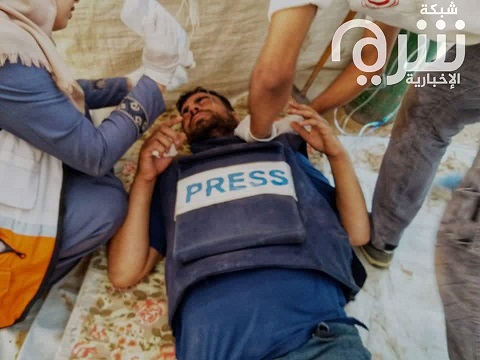
Since 4 July 2018 and over the following three weeks, Khan Al-Ahmar has witnessed a lot of sit-ins and various peaceful protest activities to prevent the demolition and displacement of population. As a result, a relatively large number of journalists were present on a daily basis in the area to cover these activities. The Israeli occupation forces, in various ways and means, have prevented journalists from covering these activities by not allowing them to reach the area sometimes and by attacking some of them or detaining them or taking other actions against them.
On 04 July 2018, at 7:00 AM, a large number of Palestinian journalists went to Khan Al-Ahmar after the Israeli authorities decided to implement the deportation and demolition decision of all the houses there. The population who were trying to prevent the implementation of this decision resisted this which is why the Israeli soldiers attacked the citizens. The soldiers also attacked some journalists by beating and preventing them from covering the levelling of streets conducted by the Army as a prelude to demolish all houses of citizens in Khan Al-Ahmar. Below are some of the journalists affected by these attacks:
- The journalist, Mohammad Ali Abed Turkman, (50 years old), a photographer of Reuters, went to Khan Al-Ahmar at 7:00 AM, to cover the events and when he arrived the area, he was denied access by the soldiers. After several attempts, he was able to enter the area, he immediately began his work as a journalist and started filming the levelling of the streets surrounding Khan Al-Ahmar carried out by the occupation authorities. They also prevented the citizens to reach their houses. At the time, a large group of the Israeli patrol unit, called “Yassam”, with their dark blue uniforms and light arms, pushed all the demonstrators in the area, including Turkman, who was close to the demonstrators to document what was happening. Soon after that, two Israeli soldiers pushed him back and he fell on his back. He was unhurt, but his 1DX camera with 16/35 lens, Mark III crashed.
- Al-Awda TV reporter, Mohammed Jarir Tawfiq Hamdan, (29 years old), injured with bruises and scratches in his right foot and lower back, after an attack by a group of the Israeli army. One of them hit him with an electric baton on his chest, and he became unable to move. The Palestinian Red Crescent crew provided him with initial treatment and he was transferred to the Palestinian Medical Complex in Ramallah. After the necessary medical examinations were conducted, it was found that Hamdan was suffering from shortness of breath and a simple fracture (hairline fracture) in one of the thoracic cage ribs. He stayed in Palestine Medical Complex for 7 hours under observation. Hamdan was also attacked while he was near a group of his fellow journalists, carrying a camera and a microphone and doing his job. It should be noted that he was not wearing the PRESS vest.
- The Journalist, Hafez Mahmoud Hafez Abu Sabra, 28 years old, a reporter for the Jordanian TV, ROYA, was deliberately pushed more than once by the soldiers while he was reporting live. An Israeli soldier pushed him and prevented him from coverage. His colleague, ROYA photographer, Ashraf Mohammed Dar Zeid Al-Nabali, was also pushed.
- The journalist of Associated Press (AP), Imad Mohammad Hashim Saed, (50 years old), was pushed by the Israeli soldiers and fell to the ground which caused him bruises in his right shoulder and right foot. He received the field treatment by Palestine Red Crescent staff.
After that, Saed went to his vehicle (after receiving the necessary treatment) to send the photographed material to the agency he works for. When he finished sending the material, and prepared himself to leave Khan Al-Ahmar, one of the Israeli police officers stopped him and asked for the official papers of the vehicle. He wrote him a ticket of an amount of 250 NIS under the pretext that he has parked his vehicle in a spot where parking was not permitted, while Saed has emphasized that he has parked his vehicle in a spot dedicated for parking.
- The journalist, Hisham Kamel Khalid Abu Shara, (30 years old), works for Anatolia Agency, was deliberately pushed by the Israeli occupation army soldiers who also threatened him with arrest if he did not leave the site.
- The photojournalist, Khalid Ali Sabarnah, (48 years old), was threatened by soldiers with arrest if he did not leave Khan Al-Ahmar (which is where Sabarnah works).
- Palestine Radio reporter, Fathi Khalil Issa Barahma, 55 years old, was prevented by soldiers from entering Khan Al-Ahmar area to cover the events.
- Palestine TV reporter, Kristin Khaled Waleed Renawi, 29 years old, was deliberately pushed by the soldiers during her live coverage. After completing her work, she went to her vehicle and found a 250 shekel ticket placed by the Israeli police on the windshield of the vehicle.
- On the following day, the sit-in of dozens of citizens continued in Khan Al-Ahmar to stop the demolition. Furthermore, the journalists continued to cover these events, which means that the attacks continued. The reporter of Ma'an TV, Mohammed Abdul Nabi Atallah Al-Lahham, 51 years old, was beaten by Israeli soldiers while he was getting ready at 8:05 AM, on 5 July 2018 to send a voice message to the TV by phone, but soon after that he was surprised by a soldier kicking his knees three times, and hitting him with the fist on his chest. Which is why he fell to the ground, where a number of people rushed to the tent near Khan Al-Ahmar to receive field treatment. The Israeli police has also issued him a ticket of 500 shekels for parking his vehicle. This became a procedure by the Israeli police which has affected another number of journalists who were ticketed while they were crossing the street or for parking their vehicles near Khan Al-Ahmar under the pretext that they have committed traffic violations. Furthermore, the vehicle of WAFA agency, holding plate No. (1576) was seized given that the driver, Alaa Ali Allaham, (47 years old), at around 11:50 AM, on Thursday, corresponding 5 July 2018, was inside the vehicle waiting for the staff assigned to cover the events in Khan Al-Ahmar after parking the vehicle in a place containing at least, 12 vehicles. At around 12:30 PM, Allaham stepped out of the vehicle and went to a nearby place to drink some water, when he returned after fifteen minutes approximately, he did not find the vehicle. The journalist, Sulaiman Abu Sorour has told him that he had seen the Israeli police seizing it. After informing the official authorities, the vehicle was returned to the driver, Allaham, at 4.30PM without issuing any tickets to him by the Israeli police.
The traffic tickets issued by the Israeli police have also affected the journalist, Hiba Mohammad Kareem Aslan, (30 years old), works for “Al-Jazeera Net” Website, as she was ticketed with an amount of 250 NIS, while she was walking on foot and denied access to Khan Al-Ahmar. Furthermore, a ticket was issued to a reporter of Palestine TV, Dana Ghazi Mohammad Abu Shamsiya, (27 years old), with an amount of 250 NIS (for her vehicle).
At 6:15PM, on Wednesday, corresponding 18 July 2018, the photographer of Reuters, Mohammad Zaki Abu Ghaniya, (45 years old) went to Khan Al-Ahmar to cover a solidarity-based sit-in with the population of the area. When he arrived the place, and before stepping out of the vehicle, an Israeli police officer has issued him a traffic ticket with an amount of 250 NIS, under the pretext of parking the vehicle on the yellow line in street adjacent to Khan Al-Ahmar.
(4th July) a court in Gaza, on 4 July 2018, has issued a sentence of six-month suspended imprisonment and a fine of 200 NIS against the journalist, Amer Awni Mohammad Ba’lousha, due to a post he published on his Facebook page a year ago even though he was arrested then and detained for a period of 12 days. Ever since that time, several hearings have been held for his trial which ended on 4 July 2018 with the issuance of this sentence.
According to the investigations of MADA field researcher, the internal security in Gaza has arrested on 4 July 2017, Amer Awni Mohammed Ba’lousha, (26 years), a resident of Beit Lahia in northern Gaza, works for the newspapers “Al-Badeel” and “Al-Hadath” on the charge of “abuse of electronic devices” after he was summoned due to the post he published on his Facebook page on 3 July 2017 (that is, one day before arrest), which reads “Do their children sleep on the ground as our children sleep? Do they use the rice trays as our mothers use them? The post highlighted the extreme heat experienced by the population of Gaza Strip in the absence of electricity. The post has received great reaction on the Facebook. He was also threatened by an officer of the Internal Security through commenting on the post asking him to delete it, and then sending him a message on the Facebook asking him to withdraw the post. On the following day, corresponding (4 July 2017), Balousha went to the Internal Security Center in Jabalya refugee camp in the northern of Gaza Strip and handed himself over at around 10:00 AM. He was immediately placed in a cell and later questioned about his posts, to whom he addresses his writings, and who pushed him to publish the post. He remained in detention for a period of thirteen days in Beit Lahia prison under the charge of abusing the electronic devices. He was released on 16 July 2017 after concluding an agreement (deal) between him as a citizen and the internal security officer under which he will be released provided he shall not “speak about the circumstances of arrest in the case, in addition to not returning to incitement against the government”. However, his case remained pending before the court which deferred hearing the case eight times until 4 July 2018 on which this sentence was issued against him.
(6 July) the Israeli soldiers have attacked the Palestinian TV staff and fired two bullets at them while the staff members were inside their car marked with “TV”, while they were in Urif village in Nablus governorate to cover the settlers’ attacks there.
According to the investigations of MADA field researcher, Palestine TV staff working in Nablus, consisting of the reporter, Baker “Mohammad Sabah” Mamdouh Abdelhaq (28 years old), the photographer, Samer Mustafa Habash (32 years old), and the driver, Abdullah Rida Abdullah Sawalma (46 years old), at around 4:50 PM, on Friday, corresponding 6 July 2018, went to cover the attacks carried out by the Israeli settlers in Urif, located 12 kilometers to the Southwest of Nablus. When they arrived the eastern area of Urif through the vehicle marked with TV, a Hyundai, h1, silver, and despite the soldiers were at a distance of 100 meters, they fired rubber bullets at the staff and hit the front section of the vehicle. The TV reporter, Baker, shouted from the window “Press, Press ..”. However, the soldiers fired another metal bullet, which is why they quickly drove the vehicle away from the soldiers’ sight. This attack caused only material damage to the front of the car. The staff continued to cover the events for about an hour and a half.
(7th July) A number of settlers, protected by the Israeli Occupation Army, have confiscated 20 Donums of the lands of Al-Hamra, located in Bani Naim, east of Hebron, where they placed mobile homes and brought their livestock. On 7 July 2018, the owners of the confiscated lands at Al-Hamra went along with foreign activists to plough their lands, and a number of journalists went to cover this activity including the photographer of Palestine TV, Iyad Abdelhafeeth Al-Hashlamoun (28 years old), and his colleagues from the staff, namely Samia Abu Sharkh, Fadi Khlaf, and the photographer, Wisam Al-Hashlamoun. Due to the rugged terrain of the area, the journalists parked their cars about half a kilometer away from the lands they intend to plough, to which they arrived at 11:20 PM, where seven tents were set up for the settlers. Al-Hashlamoun began filming the arrival of citizens to their land. At the same time, approximately four jeeps of the Army arrived, in addition to soldiers’ carrier and an Israeli police car. The soldiers began demanding the citizens to leave the place immediately, and they were speaking in Hebrew, out loud. The soldiers started pushing the citizens and indeed the citizens began to retreat. In the meantime, an Israeli soldier went to Iyad and shouted at him in Hebrew. Iyad did not understand what he had told him. He ended his filming and left the site towards Palestine TV Vehicle which was parked half kilometer away from the site. When he arrived to the vehicle, three soldiers approached Iyad, grabbed him tightly from his hands and neck. He told them he was a journalist and asked them why they were doing this. One of them asked him in Arabic to keep quiet and took him to the military jeep even though he was carrying his camera, Tripod and microphone. It was found that the Israeli army arrested seven of the foreign and Jewish activists, a Palestinian activist and the journalist, Iyad Al-Hashlamoun, and took them in the army’s jeep to the investigation center, located inside Kiryat Arba settlement in the center of Hebron. When they arrived, the soldier asked them to turn off their phones and not to speak at all. Iyad stayed with the group in the waiting room for about 4 hours. During this time, Iyad spoke with the lawyer Haya Abu Asfour. He was then brought to the investigation room where the interrogator told him that he was in a closed military zone and did not obey the orders of the soldier who asked him to leave the site, even though the soldier showed him a paper explaining so, Iyad replied that the soldier spoke in Hebrew and he did not understand what he said to him as he did not see any papers, and he does not understand Hebrew. The interrogator asked him who had called for the activity, and Iyad explained to him that he is the official reporter of Palestine TV and that he went to the site under the instructions of the television and showed him a TV card. The interrogator asked him about the days or times when he goes to Alhamra and Iyad replied that he may go to any Palestinian area where events are taking place, since his job is a photojournalist. The interrogation lasted for about half an hour with Iyad. Then his fingerprints were taken as well as his signature on the investigation papers and statements, which were written in Hebrew, the language Iyad does not understand. The interrogator then told him that he was banned to enter Bani Al-Naim or the bypass road for a period of 15 days as of its date. He was released at the entrance of Kiryat Arba at around 7:00 PM after he was detained for six hours and a half (between 12:30 PM, and 7:00 PM).
(9 July) the occupation forces prevented Palestine TV staff from covering the levelling operations conducted by the Israeli occupation forces to establish a Caravan (mobile homes) near Abu Dis to deport the residents of Khan Al-Ahmar after being displaced from their village which was besieged a month ago, and which the Israeli authorities decided to demolish and deport its residents.
According to the investigations of MADa field researcher, Palestine TV staff, which consists of the reporter, Christine Khaled Walid Al-Rinawi, 29 years old, and the photographer, Firas Fayez Abdullah Al-Hindawi, 27 years old, went to the site where the bulldozers were setting up for the caravans to evacuate the residents of Khan Al-Ahmar near Abu Dis. While the journalist, Christine Al-Rinawi, at around 12:06PM, was reporting live to the program “Reporters in the Field”, broadcasted on Palestine TV at 12 o'clock, the occupation forces approached the TV staff and forced the photographer to place the camera on the ground and pull out the sound cables to prevent live coverage. They also threatened the reporter, Christine Al-Rinawi, who continued reporting to the program for several minutes with arrest if she continued the coverage, and they forced them to leave the site.
(9th July) the Israeli authorities have prohibited “Al-Quds” TV from working within the occupied city of Jerusalem and Israel. They also prohibited a media production company from working with “Al-Quds” TV through providing media services after it summoned the company’s director and two of its staff members and informed them to stop working with the TV Channel under any circumstances. The channel reporter was arrested and informed to stop working with the company as well.
On Monday morning, corresponding 9 July 2018, the Israeli police handed over the director of Al-Bashir ProMedia for Television Production and two of his colleagues in the company in addition to the reporter of “Al-Quds” TV inside the Green Line territories and in Jerusalem official summonses for investigation purposes, and notified them with the prohibition of “Al-Quds” TV within Jerusalem and the Green Line territories and to stop working with Channel as Al-Bashir ProMedia provides it with media services just as it does with other media organizations.
The director of Al-Bashir ProMedia, Iyad Al-Nael Jabareen, 42 years old, from Um Al-Fahm, stated that he and his colleagues from the company, the broadcast engineer, Mohammad Abu Yousef Jabareen, 23 years old, and the video photographer, Ali Nael Jabareen, 24 years old, have received official summonses in their homes demanding them to go directly to the investigation centers “I and Mohammad went to Wadi Ara Investigation Center, while Ali went to Kishon Prison Center. The Reporter of Al-Quds TV, Anas Mousa Ighbariya, 33 years old, was arrested from his house and was present in the investigation, where he was not allowed to go alone. After they told him that they need to interrogate him for 10 minutes, they took him to Um Al-Fahm Center, and from there to Haifa Center, and he was returned to Kishon Prison”.
“I arrived at the interrogation center at about 9:30AM and stayed in the investigation for about three hours during which I was asked questions about the nature of our work and the work of the production company (a television production company that provides media services to several TV channels). I explained to them that it is a private and non-partisan company and that it works with all TV channels and provides services. The interrogator asked in details about our work with Al-Quds TV, and I told him that it is basically providing media services. The officer told me that the TV channel belongs to Hamas and incites terrorism, and that its work is prohibited in Jerusalem and the Green Line territories. Therefore, we should not work with it under any circumstances. He asked me to stop all forms of work and services with the TV channel because we are a licensed Israeli company and that this prohibition does not fall within a specified period - that is, it is open or permanent”, he added.
Jabareen stated that “all the employees of the company were asked the same questions and were released at the same time, except for the reporter, Anas Ighbariya, who was released provided he shall not exit the house for a period of five days, communicate with the company for a period of 30 days, and travel for three days”.
(13th July) the freelance journalist, Adel Ibrahim Salman Al-Hawajri, (24 years old) was injured by a fragment of a bullet in his calf muscle while he was covering the events of the return march, east of Bureij Camp, Gaza Strip.
According to the investigations of MADA field researcher, the freelance photographer, Adel Ibrahim Al-Hawajri, at around 3:30 PM, on Friday, corresponding 13 July 2018, went to the east of Bureij Camp to cover the events of the peaceful return march. At around 5:00PM, and while Al-Hawajri was at a distance of 300 meters away from the separating fence, wearing his PRESS helmet and vest and filming some of the demonstrators, he felt an injury in the leg (calf muscle from the back). A number of young men took him to the medical point established in the place where the paramedics found that he was injured by a fragment of a bullet that caused an entry and exit. He received the necessary treatment. He felt no need to transfer him to Al-Aqsa hospital and then he was discharged and went back home”.
(13th July) By the afternoon on Friday, corresponding 13 July 2018, the journalist, Muein Tayseer Al-Dabba, 30 years old, was injured with a bullet in his right hand while he was covering the events of the peaceful return march east of Gaza, in front of Karni crossing, by the soldiers stationed on the other side of the separating fence. He was transferred to Al-Quds Hospital of the Red Crescent in Gaza for treatment and there, it was found that the bullet went through his hand (causing an entry and exit) not to mention serious laceration in the hand, as well as snapped tendons in his fingers and some fractures in the hand. He underwent more than one operation to heal the wounds and fractures. He stayed in hospital for four days, but still needs another operation.
(13th July) The Israeli Occupation Forces continued its targeting of journalists while covering the peaceful return march on the sixteenth Friday since the launching of these events.
According to the investigations of MADA field researcher, the freelance photographer “Mohammad Omar Qandeel”, 29 years old, went to the eastern borders of Rafah, to the south of Gaza Strip, on 13 July 2018, to cover the events of the return march. At around 5:30PM, he, alongside his colleagues, Mahmoud Al-Jamal, and Abdelraheem Al-Khateeb approached the border fence. He was wearing the PRESS vest and holding a photographic camera, Nikon 7100, standing 30 meters away from the demonstrators’ gathering, taking photos of the events, that is when the Israeli occupation forces started firing gas bombs heavily at the demonstrators. About half an hour later, the journalist Qandeel was severely suffocated and fell to the ground. An ambulance crew provided him with the necessary treatment, and he returned home at 7:30 PM. He felt some pain and went to Abu Yousef Al-Najjar Hospital, in Rafah, and received the necessary treatment. In the same place, about half an hour after Qandeel’s injury, the journalist, Alaa Abdelfattah El-Namla, 35 years old, works for Al-Quds Media Network, also suffered severe suffocation even though he was wearing the PRESS vest and a muzzle to avoid the gas. He was carrying a photographic camera, Nikon D90, taking photos and shooting live through his mobile phone the events to upload it on his Facebook page. He fell to the ground as a result of inhaling a lot of gas. A number of paramedics in the area approached him and provided him with the necessary field treatment. When he returned around 7:00PM to the house, he suffered headache and exhaustion and therefore, went to Abu Yousef Al-Najjar Hospital in Rafah, received the necessary treatment and then got back home.
(13th July) the freelance photographer, Nihad Khalil Mohammad Abdelnabi, 24 years old, was injured with an explosive bullet in the left thigh while he was covering the events of the return march taking place in Abu Safiya, on Friday, corresponding 13 July 2018.
According to the investigations of MADA field researcher, the freelance photographer, Nihad Khalil Abdelnabi, before the Maghreb prayers (between 7:30 PM and 8:00 PM), was near the medical staffs and ambulances, at a distance of 200 meters away from the separating fence, in Abu Safiya, to the north of Gaza, where he arrived in the afternoon, to cover the events of the return march in the area. In the meantime, the soldiers fired bursts of bullets at the demonstrators and everyone present in the area which caused his injury by an explosive bullet in the left thigh. Furthermore, his colleague, Abdelkareem Hamdouna, who was standing near him, was also injured in his right thigh. His camera screen crushed and the camera’s lens of his colleagues, Hamdouna, were also crushed due to falling to the ground after their injury. They were immediately transferred by the ambulances to the field hospital established in that area. After they received the first aid there, they were transferred to Al-Awda Hospital close to the event to complete his treatment and take out the fragments.
Abdelnabi stayed in the hospital for two days, while Hamdouna stayed for one day. After they were discharged from the hospital, they continued to follow up their conditions on a daily basis to clean the wound and change its dressing.
(13th July) the photographer of “North Online” Network and Al-Aqsa TV Facebook Page, Anas Jamal Mahmoud Al-Alsharif, 22 years old, was injured with burns and dislocation in the left shoulder by a gas bomb fired by the occupation soldiers while he was covering the events of the return march in Abu Safiya, east of Gaza, on 13 July 2018.
According to the investigations conducted by MADA field researcher, the photographer, Anas Jamal Mahmoud Al-Sharif, went on the afternoon of Friday, corresponding 13 July 2018, to Abu Safiya, east of Gaza, to cover the events of the return march. He was wearing the PRESS vest and helmet, and after about three hours of walking around and doing his work there, and while he was, at around 6:30 PM, 200 meters away from the fence, the Israeli soldiers fired gas bombs manually and automatically (from one of the launchers). He tried to escape from the site, but one of the bombs injured him in the left shoulder which caused him dislocation and burns. He was then transferred immediately to the field hospital in the area. After he received the first aid, he was taken to the Indonesian hospital for additional examinations and treatment and stayed there for one day as he was discharged from hospital the next day.
The photographer, Anas Alsharif was injured on 6 July 2018 while he was covering a similar demonstration with severe suffocation due to a gas bomb which caused him seizures and shortness in breath which is why he was transferred to the Indonesian Hospital.
(13 July) the photojournalist working for Xinhua News Agency and Anatolia News Agency, Nidal Shafiq Taher Ishtaya, 49 years old, was injured by a rubber bullet in his foot fired directly at him by the soldiers while he was standing in front of him covering the events of the weekly demonstration organized in Kafr Qaddum against the settlement.
According to the investigations conducted by MADA field researcher, the journalist, Nidal Shafiq Ishtaya, at around 1:15 PM, on Friday, corresponding 13 July 2018, was in Kafr Qaddum to cover the events of the weekly march (in seven years, each week, a march is launched against settlement and to call for opening the village closed road for over than fourteen years for the interest of Kedumim settlement established above Kafr Qaddum sixteen kilometers to the west of Nablus City. He is a photojournalist who works for the Chinese news agency and Anatolia news agency, and while he was at a distance of 40 meters, in a very close area to the Israeli soldiers to cover the events taking place there, about half an hour later, a group of three soldiers approached the journalist Ishtaya on the main street, where the clashes were taking place, at about 15 meters away from him, and Ishtaya was waiting for an opportunity to film a shot for the soldiers who were firing bullets at the demonstrators. While he was looking at them through his camera, he noticed that one of the soldiers was pointing the gun towards him, indeed, the bullet was fired but did not injure him. Therefore, he changed his spot to make it visible for the soldier that he is a journalist wearing the blue PRESS vest and helmet. The demonstrators were to the left side of the journalist Ishataya while the soldiers were in front of him. He moved a distance of two meters, but the soldier fired bullets again at Ishtaya and injured him by a rubber bullet in the left foot. Which is why he shouted out loud at the soldier / I am a journalist and I am in my PRESS vest and helmet with the cameras in my hand, you can clearly see me, and still you are firing bullets at me/; however, the soldier ignored him, and Ishtaya retreated from the site and moved away from the demonstrators’ gathering. He kept waiting until the soldiers retreated from the site and went towards the ambulance where he received treatment by the paramedics who have sterilized the wound and put some ice on his foot. It should be noted that this is the 35th injury, approximately, of Ishtaya caused by rubber bullets fired by the soldiers since the beginning of covering the events …. Before …..”.
(14th July) The Preventive Security Services has arrested Mohammed Saeed Jahaysheh, 34 years old, a programs presenter at Al-Marah local radio in Hebron, on the road, after he left the radio station to buy some stuff. His arrest came three days after he received a summoning which he ripped and did not respond to.
At around 12:00PM, on Wednesday, corresponding 11 July 2018, and while Mohammed Saeed Jahaysheh, 34 years old, was in his house in Idna, Hebron, he heard knocking on the inner door of his house (the house has two doors, one of them is an inner door which a person can reach only if he/she entered the main door, through the house yard, up to the stairs). He was in his bedroom and the window looks out into the inner door, he saw a man in civil clothing knocking the door, which surprised and provoked him as the man in the civil clothing was basically trespassing.
Mohammad opened the door and the man told him that he was from the Palestinian Preventive Security Services. He handed him over a notification stating that he must go to the Services headquarters. Mohammad took the notification, ripped and threw it in front of the man. He said to him that he had no right to enter the house in this way (he said he ripped the notification because of the way the man entered the house, and because he was exhausted, with no concentration since he did not sleep for long hours at that time and because he has not published any political posts on the Facebook two years ago). Three days later, on Saturday, corresponding 14 July, 2018, after Mohammad finished presenting his program via Al-Marah Radio in Hebron at 9:30 AM, he went out to buy cigarettes, and he was surprised by a man he did not know approaching him and had a firm handshake with him. Soon after that, another two men joined him, grabbed Mohammad from his hands, and told him that they were from the Preventive Security Services. They took him to a white car of the Preventive Security Services, and asked him to turn off his phone and take off his sunglasses. When he arrived to the Preventive Security Services headquarters in Hebron, he was manually searched. He put everything in his possession in the safe and was transferred to a cell that smells so bad inside of which there was a blanket that smells stinky, not to mention that the ventilation inside the cell was almost absent. They closed the air vents of the door and he stayed in the cell around ten hours. Then he was taken to the investigation at the same time of the Maghreb prayers (at 7:50 PM). One of the officers who were with him in the room asked him why he ripped the notification and why he published a post about the security services on his Facebook page. He was also asked about an old post he has published previously about the Water Authority “which caused anxiety in Idna, and a post he has published two years ago because of which he was accused of attacking the Attorney General concerning the closure of Safa Agency”. After this investigation, they took him back to another cell upon his request. On the following morning, corresponding 12 July, he refused their request to sign his statement, and at around 10:00AM he was transferred to Dura Prosecution Offtice handcuffed with another accused person. There, he met his lawyer (Shaker Al-Tmaizi) who was appointed by MADA center. He spent two to three hours with the civilian detainees in the court waiting room before appearing before the chief prosecutor, in the presence of the representative of the Journalists’ Syndicate in Hebron, Jihad Al-Qawasmeh, who requested to speak with him and told him that he was detained for the charge of “blackmailing a girl”, and that this subject was closed and he has to open his Facebook page to release him immediately. Mohammad refused to open his Facebook page “as long as there is no order from the Public Prosecution to do so”. After that, the journalist Mohammad was brought to the chief prosecutor, and he requested the presence of the investigation lawyer. Indeed, the advocate Shaker Al-Tmaizi was summoned and initiated the investigation in the presence of the Journalists’ Syndicate representative, Jihad Al-Qawasmeh. He was questioned about ripping the notification and about his Facebook posts only. His detention was extended for 48 hours, and he was taken to a cell in the Prosecution office in Hebron. During the 48 hours, Mohammad was questioned seven times about ripping the notification and his Facebook posts. At one time, the interrogator repeated the same questions and suddenly asked him “Whose the girl you’re talking to? Mohammad replied that he is a journalist and he speaks with so many people. The interrogator asked “the girl you disrespectfully talk to?” Mohammad replied that even if there was someone he speaks with, what does the Public Prosecution has to do with this? The interrogator cursed him “you are rude and disrespectful”. On the third day of his detention (On Monday afternoon), about 12 hours before the expiry of the detention extension ordered by the Public Prosecution, Jihad Al- Qawasmeh met him again and told him that the Syndicate wants to help him, but his case is not a journalist’s case, rather it is a “blackmailing case of a girl through the Facebook”, which is a very sensitive type of cases. He asked Mohammad to open his Facebook page during the investigation for five minutes on the same day. Mohammad refused again and he was presented to the interrogator again who asked him the same questions. Al- Qawasmeh asked the interrogator to properly detain Mohammad, accordingly, he was taken to another room in which there were other accused persons (one of them was charged with armaments while the other was a drug addict who continuously was smoking, then attacks Mohammad and tells him that he will kill him, in other sense, he was hallucinating). Mohammad stayed in the room about 12 hours, on Tuesday morning, corresponding 17 July 2018, he was transferred to Dura Court after he was charged by the Public Prosecution with contempt of a public servant and a security service. The judge heard the lawyer’s response and decided to release the journalist, Mohammad, under a bail of an amount of 500 JD, but it was late (2:00PM and the funds were closed), so Mohammad was taken again to the same cell. On the following day, Wednesday, corresponding 18 July 2018, he was released after the bail requested from him was changed to a personal guarantee. The interrogator has informed Mohammad to return to the Services headquarter on Sunday. Mohammad was not informed with the reason of the notification he received in the first place, he did not know why the representative of the Journalists’ Syndicate addressed the case of blackmailing a girl while he was arrested. But he was asked so many times and more than once throughout the investigation about the posts he published on his Facebook page. He was charged with contempt of a public servant. A hearing session was scheduled for his trail on 26 November on which the witnesses will be brought (the employee from the Preventive Security Services who delivered the notification to identify the reason why he ripped it).
(17 July) the Israeli Occupation Forces prevented the reporter of “Quds Net”, the journalist, Abdulmohsen Tayser Shalaldeh from travelling and sent him back from Al-Karama crossing. On the following day, he was summoned for investigation where he stated to MADA “on the morning of 17 July, I went to Amman and when I arrived the Israeli side at Al-Karama crossing, around 8:30, I presented my passport, and they kept me waiting until 12:30 PM. The Israeli soldier gave me back my passport marked with a label that says I am banned from travelling “banned for security reasons”. On the following day, corresponding 18 July, I went to the Israeli Military Liaison Office to find out the reason of my travel ban for security reasons. However, they did not help me other than explaining that it was a “police ban” without any reasons or justifications. They handed me over an official summoning paper for interview in Etzion Center on Thursday, corresponding 26 July 2018”.
In a later statement he added “at 10:30AM, on Thursday, corresponding 26 July, I went to Etzion Prison, as scheduled, and kept waiting after my personal card was seized until 1:30PM. Then I entered the room of an officer called Captin “Kedim” (who is in charge of Sa'ir, Ash-Shuyukh, and Al-Arroub) for investigation purposes. He first asked about what I filmed on the day my uncle was released free from detention four years ago, and then moved to question me about the reasons why I want to travel and I answered for study purposes but the specialization I wanted to study was not available, he replied that I was banned for security reasons because I am a /terrorist / and that this ban was decided personally by him. He threatened me with arrest right from my house in the future. He also turned on my phone, opened my personal page of Facebook, checked the posts and noticed one post I have published about Khan Alahmar in which I described the occupation as Nazi for assaulting a child. He asked me about the post and I replied that he had to watch the video and after watching the video, he threw the phone hard on the ground. Finally, he told me that the ban is existing and I will not travel. They released me at about 3:30 PM”.
(20th July) two journalists were injured, one with a bullet through both of his legs, and the other with severe suffocation while they were covering the events of the peaceful march east of Rafah, in Gaza Strip, on 20 July 2018.
According to the investigations conducted by MADA field researcher, the freelance journalist, Zaki Yahya Awadallah, 27 years old, went to east Rafah, south of Gaza Strip, in the afternoon, on Friday, corresponding 20 July 2018 to cover the events of the peaceful return march there. At around 6:30 PM on that day, he alongside the journalists, Tuqa Al-Zamli and Riwa Khalid, approached the separating fence, carrying a photographic camera, Canon 5D Mark, he was not wearing the PRESS vest, and stopped at a distance of 50 meters away from the separating fence. He started taking photos of the demonstrators when the Israeli occupation forces at that time began firing gas bombs heavily at the demonstrators. About half an hour later (at around 7:00PM) Awadallah was injured with a bullet through both of his legs (causing an entry and exit – the same bullet went through one leg and then exited from the other). He fell to the ground, and was taken then by the ambulance staff of the Palestinian Ministry of Health immediately to the field hospital at a distance of 700 meters away from the demonstrators’ gathering. He was given the first aid and then he was transferred in an ambulance to Gaza European Hospital in Khan Younes. The moment he arrived the hospital at around 7:30 PM, he was taken to the operations room and underwent an operation that has lasted for two hours in which the Calf was removed due to serious laceration. Furthermore, one of the veins which got cut off due to the bullet was connected, and both of his legs were placed in cast. He remained under anesthesia until around 11:00AM the following day. He suffered several new complications and a severe hemorrhage which required fifteen blood units and hospitalization for two weeks.
On the same day, the photojournalist, Mohammad Samih Abu Sultan, 24 years old, works for “Rowad Al-Haqiqa” Network, was injured with severe suffocation due to firing a barrage of gas bombs by the soldiers while he and some of his colleagues, at around 5:00PM, approached the demonstrators’ gathering who were at a distance of 40 meters away from the separating fence. It should be noted that he was wearing the PRESS vest and helmet, and carrying a photographic camera Nikon D300. Due to his injury, he fainted as a result of inhaling large amount of gas and fell immediately to the ground. Volunteers and paramedics rushed to take him to an ambulance that was nearby and transfer him to the field hospital, about 700 meters away from the border fence. In the hospital, he received the necessary treatment, but later on, he continued to suffer from complications such as, redness in the face and shortness in breath. At around 7:30 PM, when he returned to the house, he had to go back to Abu Yousef Al-Najjar Hospital in Rafah where he received more treatment as a result of suffering from some complications such as throwing up and pain.
(20th July) the Israeli occupation forces continued targeting the journalists while covering the peaceful return marches which have erupted four months ago. This targeting has affected the journalist, Hiba Awad, on Friday, corresponding 20 July 2018, east of Khan Younes.
According to the investigations conducted by MADA field researcher, the journalist Hiba Sami Mohammad Awad, 21 years old, works for PalHadath Agency, from Khan Younes, went to Khuza’a, east of Khan Younes, to cover the events of the return march on Friday, corresponding 20 July 2018, and at around 3:30 PM, she went with her colleague, Madeleine Aqra, who works for the same Agency, towards the border fence to cover the protests of dozens of demonstrators and stopped at a distance of 100 meters away from the separating fence. She was carrying a D-9 Nikon Camera, and wearing the PRESS vest and helmet. She started taking some photos of the demonstrators in the area where three Israeli military jeeps were stationed in addition to the soldiers on the other side of the fence. The jeeps and the soldiers began firing gas bombs at the demonstrators and after about half an hour (at 4:00PM) she was injured by a gas bomb in the left shoulder, the bomb stuck to her shoulder due to its overheat, which confused and frightened her. A young man grabbed the bomb, removed it and threw it away from her. The gas bomb caused her superficial burn. The civil defense transferred her to an ambulance which was at a distance of 300 meters approximately and she received the first aid.
(22nd July) The Palestinian Intelligence Services has arrested the graduate student, in the Media Faculty / Al-Quds Abu Deis, Huthaifa Ali Jamous, 26 years old, was arrested after he was summoned for investigation. Huthaifa’s mother, Najah Abu Zeina, reported to MADA that Huthaifa “went on Sunday, corresponding 8 July 2018, to the Preventive Security headquarters in Ramallah and stayed there from 8:00 AM until 2:30 PM. He was questioned about his posts on the Facebook, most of which were about the same topic which is lifting penalties imposed on Gaza. They tried to make him sign on a pledge to commit to the Cybercrimes Law, and on a declaration not to incite. But he refused to sign both documents and signed only his statements. On 19 July, and while he was in the University, he received a phone call from a strange number. Later on he found out that the number belongs to the Palestinian Intelligence Services. In the phone call, he was told that he is requested to go to the Intelligence Services headquarters on the following day, corresponding 20 July, but he told them he was preoccupied with his studies at the University and will not go. On Sunday morning, corresponding 22 July, at around 7:00 AM, he went to the Intelligence services headquarters, but did not return until Tuesday corresponding 24 July. As we learned – from the phone calls – he was brought before the Public Prosecution on Monday, corresponding 23 July and his detention was extended to 24 hours without knowing the justifications of the arrest”.
Huthaifa was brought before the court and his arrest was extended for 15 days to complete the investigation under the charge of “possessing a weapon” based on a photo saved on his phone he has published once on his Instagram three years ago, in which Huthaifa appears carrying a weapon that belongs to one of the employees at the Palestinian Authority.
(24 July) the Israeli occupation forces have arrested the journalist author, Lama Abdulmutaleb Deeb Khater, 24 years old, after raiding and searching her house located in Hebron, at dawn, on 24 July 2018.
According to the investigations conducted by MADA field researcher, an Israeli military force, at around 1:30 AM, on Tuesday, corresponding 24 July 2018, has raided the house of the Eng. Hazem Khader Nimer Al-Fakhouri, 45 years old, located in Luza, Hebron, and informed him that they will search the house. They asked him about his wife, Lama Khater, who was in her room, and asked him to call her immediately. The moment she left her room and came, the Israeli officer informed her that she was under arrest, and asked her to bring her phone, and computer. They seized the hard disc of her computer as well as her personal phone. A female Israeli soldier has searched her and asked her to say goodbye to her family. Indeed, she said goodbye to her family and started crying especially when she saw her little kid, aged 18 months. They took her to the jeeps parked in front of the house. According to her husband, Hazem, Lama’s lawyer has informed him on 26 July 2018 that Lama’s detention was extended until the investigation is completed with her.
The occupation forces have raided Lama’s house two years ago to arrest her, but her husband informed them that at that time she had a baby, two months old, and that he cannot stay away from his mother, she insisted to take her baby with her to the prison, which forced the occupation forces to suspend her arrest at that time according to her husband’s statement. However, the Israeli intelligence services summoned her husband, Hazem, to Gush Etzion and asked him to tell his wife to stop publishing inciting posts, not to mention that he literally asked him to disconnect the internet to prevent Lama from publishing inciting posts as the Israeli officer described them to her husband.
(27th July) the photographer of Al-Aqsa TV, Alaa Fayez Mohammad Al-Hindi, 40 years old, from Ar Rimal block in Khan Younes, was injured with severe suffocation while he was covering the events of the peaceful return march in Khuza’a, east of Khan Younes.
According to the investigations conducted by MADA field researcher, at around 3:30 PM, on 27 July 2018, the journalist, Alaa Fayez Mohammad Al-Hindi, arrived on the motorcycle (Dayon 40), accompanied by the reporter of Al-Aqsa Radio, Ismail Abu Omar to Khuza’a, carrying a video camera (Sony 175) belonging to Al-Aqsa TV, which he works for. He went to the vehicle reporting live which arrived before him to the site and stopped at a distance of 400 meters away from the separating fence, and 500 meters away from the border fence. He was wearing the PRESS vest and helmet, and carrying his camera. Due to a problem in the vehicle reporting live, he had to report live through his Facebook page to the TV channel. At around 5:30 PM, he alongside the reporter, Wisam Al-Ghalban, began working on the events report using a Galaxy J7 Camera for the TV Channel. At around 6:10, and while he was near his colleague, the reporter, Mohammad Qaoud, suffered severe suffocation by gas bombs thrown by a drone at the demonstrators and journalists. One of the bombs fell two meters away from him, in conjunction with the firing of gas bombs by the Israeli military jeeps stationed on the other side of the fence. The injury caused him shortness in breath, which is why the Red Crescent Ambulance staff has to put him under the oxygen concentrator. They transferred him to the field hospital at a distance of 300 meters away from their location, and gave her the necessary first aid.
(27th July) the occupation forces attacked two journalists while they were covering demolitions taking place in Kubar, Ramallah Governorate, noting that the Army was using a shield for protection from the demonstrators’ stones.
According to the investigations conducted by MADA field researcher, 25 Israeli military patrols raided Kubar (10 kilometers to the north of Ramallah), at around 4:00AM, on 27 July 2018, at dawn. They closed the village and prevented its population from leaving or entering. However, they retreated temporarily from the village at around 9:00AM, and came after about an hour and a half to raid the family house of the martyr, Tareq Yousef, who has allegedly killed an Israeli settler in “Adam” settlement, north Jerusalem. After that, at around 2:00PM, while Al-Ghad TV reporter, Diaa Houshia, was reporting on the army’s raiding of the house, five soldiers, including officers known to the journalists such as “Raja”, approached him and searched the TV Channel vehicle. They requested the personal and journalism cards. During the search, Houshia, continued to cover the event live, and one of the soldiers grabbed the microphone from him and turned it off.
However, it seemed they knew he was reporting live, so the known officer “Raja” intervened and returned his cards and microphone back to him. He ordered him to leave the site immediately under the pretext that it is a closed military zone. At around 2:00PM on the same day, the soldiers detained the photographer of Associated Press Agency, Majdi Mohammad Ishtaya, 35 years old, while he was attempting to enter Kubar from the northern entrance of the village. One of the border patrol officers grabber the car keys and ordered him to turn off the engine of the car. When the officer saw he was about to use his phone, he shouted at him asking him to turn off his phone and tried to take the phone by force. He threatened him with spraying the pepper gas at him. Furthermore, the soldiers tried to use his vehicle as a shield for protection from the stones thrown by the demonstrators at them which subjected him to serious danger as he “was between the stones of the demonstrators and the bullets of the soldiers” as he stated.
(27th July) the journalist, Sobhey Mousa Abu Al-Hossain, 45 years old, works at the Media Office of the Ministry of Interior in Gaza, was injured with a bullet in the right thigh while he was covering the events of the peaceful return march, east of Rafah, on Friday, corresponding 27 July 2018.
According to the investigations conducted by MADA field researcher, while Sobhey Mousa Abu Al-Hossain was with a number of journalists at a distance of 150 meters away from the border fence, he was injured with a bullet in the right thigh causing and entry and exit. Immediately after his injury, the paramedics transferred him to the ambulance to take him to the field hospital in the same area, at a distance of 700 meters, where he received first aid for about five minutes. The doctors transferred him to Gaza European Hospital in Khan Younes, and the moment he arrived the hospital at around 5:30 PM, he was admitted to the E.R. for treatment and dressing the wound after stitching as a result of rupture in the muscles caused by the bullet exit wound. About an hour after he entered the ward, the doctors decided to discharge him. He left the hospital heading to the house. At about 7:00 on his way to his home, he felt severe pain and hemorrhage, which is why he returned to the hospital.
On the same day, the photographer of Safad Press Website, Mahmoud Mohammad Shata, 25 years old, has suffered severe suffocation while he was at a distance of 100 meters away from the separating fence filming the events of the demonstration noting that he was wearing the PRESS vest and helmet, carrying a photographic camera, due to firing gas bombs heavily at the demonstrators, at around 6:00PM, he was transferred by an ambulance of the Palestinian Red Crescent to the field hospital where he received the necessary treatment for about 15 minutes.
(27th July) seven journalists suffered severe suffocation due to firing gas bombs by the Israeli occupation forces heavily at the demonstrators while they were covering the events of the return marches in the border area, east of Gaza.
The journalist, Attiya Mohammad Ali Darwish, 30 years old, from Nuseirat Refugee Camp, works as a photographer for Al-Ray Agency, was wearing the PRESS shield and helmet, putting a piece of clothing on his mouth and nose to avoid being severely suffocated by gas as he did not have any muzzle. He was standing at a distance of 300 meters away from the separating fence, and while he was taking some photos for the clashes, he suffered suffocation due to inhaling gas and received field treatment. Furthermore, the journalist, Hind Osama Hassan Al-Khudari, 23 years old, from Gaza, a reporter of Kuwait TV English and Russian Today, has also suffered severe suffocation while she was at a distance of 150 meters away from the separating fence covering the events of the return march. It should be noted that she was wearing the PRESS shield and helmet without a muzzle. The field first aid was given to her by the medical staff in the site.
Moreover, the journalist, Ghalya Ali Mahmoud Hamad, 27 years old, from Gaza, a reporter of Al-Jazeera Mubasher, has suffered severe suffocation at around 7:30PM, while she was preparing herself to leave the border area accompanied with the staff after she finished working. At that time, she was inside the live reporting vehicle at a distance of 500 meters away from the borders. She was not wearing the (helmet, shield, and muzzle) because she was about to leave the place. Israeli drones started firing gas bombs heavily which made her suffer severe suffocation. She was transferred in an ambulance to the medical point in the site where she received field treatment.
The journalist, Mustafa Amer Mohammad Salah, 27 years old, from Al-Shati Refugee Camp, works as a photographer for Al-Manara Media Agency, was injured with his colleagues from the staff members, including the reporter, Hajer Harb, and the photographer assistant, Ali Al-Attar, who were at a distance of 150 meters away from the separating fence, when an Israeli jeep heavily fired gas bombs. It should be noted that Salah was wearing the PRESS shield, and was transferred with his colleague, Al-Attar to the medical point in the area and received the necessary treatment.
The journalist, Hajar Mohammad Harb, 33 years old, has stated to the field researcher of MADA, that she went on 27 July 2018, accompanied by Al-Maseera TV staff , composed of the photographer, Mustafa Salah, and the assistant Ali Al-Attar, to her officer in Malka, east of Gaza, wearing the PRESS shield to cover the events of the peaceful return march. She approached a street called “Jakar”, 300 meters away from the separating fence, and while she was there, an Israeli drone fired a barrage of tear gas bombs in a circle, which is why she could not move because she passed out for inhaling large amount of gas. Immediately, the Red Crescent staff came and transferred her to the field hospital in the area where she received first aid and treatment until she regained consciousness. It should be noted that the journalist, Harb, was suffering from Cancer and recovered a short while ago. Until Tuesday, corresponding 31 July 2018, she was still suffering from gas suffocation.
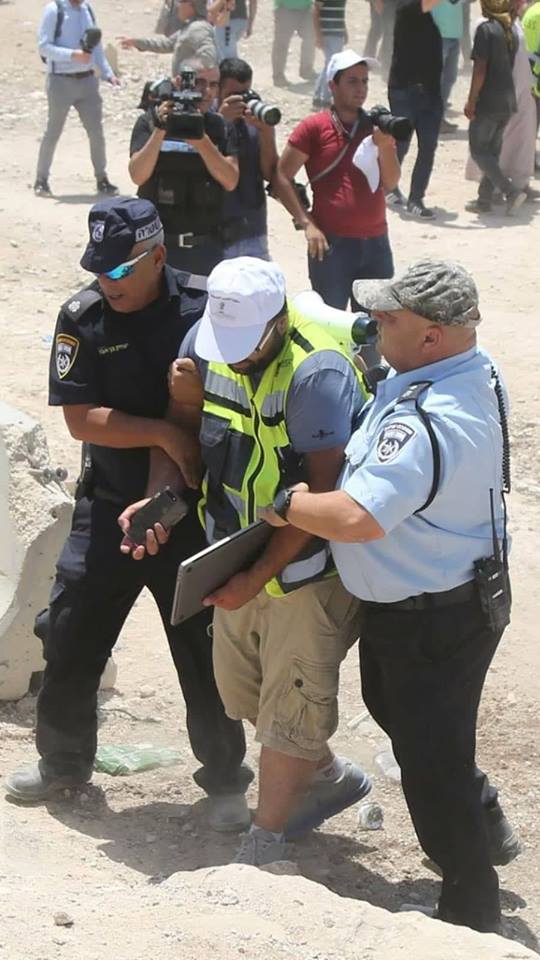
(28th July) the photographer of Palestine TV, Loay Abdelhafeeth Aref Samhan, 39 years old, was injured with a metal bullet in his left leg, fired at him by one of the occupation soldiers while he was covering the weekly march to protest settlement and closure in Kafr Qaddum on 28 July 2018.
According to the investigations conducted by MADA field researcher, three soldiers approached an abandoned house where the journalists, Mahmoud Fawzi, the photographer of Ramsat Agency, and Ahmad Shawer, the reporter of Palestine TV, were standing near him (at a distance of 10 meters approximately), and asked them to leave the site immediately and threatened them with shooting. This has caused the journalists, Shawer and Fawzi to retreat towards the village and walk away 100 meters away from the abandoned house. The journalists continued to cover the events, and at around 5:20PM, the journalist, Loay Samhan was suddenly injured with a metal bullet in his left leg (an eye-witness has likely stated that the soldiers stationed in the abandoned house have fired the metal bullet). He fell to the ground and was immediately transferred by the ambulance to Darwish Nazzal Governmental Hospital in Qalqilya, where an x-ray was taken for him and where he received treatment for his injury.
(28th July) after the announcement of the Palestinian President in March, 2018, penalties were imposed on Gaza Strip as a result of the dead end the reconciliation has reached between Hamas and Fateh. Several demonstrations and marches have erupted in the West Bank and Gaza Strip demanding to lift the penalties. The journalist, Iyad Abdelrahman Ahmad Al-Rifae, 26 years old, from Anata, east of Jerusalem, works at the Public Relations Department at Al-Wataniya Mobile, in Al-Bireh, has participated more than once as a journalist and young activist in some of the marches organized in Ramallah. Recently, he was subject to a series of threats and incitement by some people Iyad believes belonging to the Palestinian Authority services and using nicknames.
On 24 July 2018, the journalist, Iyad Al-Rifae, received a phone call from a person who has identified himself as an intelligence officer, without saying his name. the officer informed him to go to the intelligence services headquarters in Ramallah, Jerusalem Intelligence services department, at 10:30AM, on Saturday, corresponding 28 July 2018, when Al-Rifae arrived the headquarters on the scheduled time, he was searched and his personal phone was seized, he was taken to one of the investigation offices by three persons (who did not identify their names) for five continuous hours. Al-Rifae was exposed to threatening with dismissal from Al-Wataniya Mobile Co. as well as with beating and shabeh during the investigation as he stated. The investigation focused on his activities in Al-Quds University, Abu Deis, five years ago, and his work as a journalist in addition to his involvement in the action towards lifting the penalties over Gaza Strip. after the completion of the investigation, one of the interrogators said to him before leaving that “the director was not available as he went to Farah”, and therefore, they kept Al-Rifae in detention in the same room and closed the door. He remained in detention for four hours and was not released until at about 8:30PM on the same day without taking any procedure against him or informing him with anything except for leaving. Iyad confirmed that on the day he was summoned, on 24 July 2018, he received messages on the Facebook threatening him, his wife and his little son with murder, from anonymous persons known by nicknames, one of the messages was sent under the name “Shireen Mousa” in English. The text of the threatening message contained a photo of his wife and little son that says: “imagine when you look at this photo and start crying instead of laughing”. The journalist, Iyad, stated that he has filed a complaint to the Investigations Police Services, without any reply so far. Furthermore, he was subject to incitement campaign via the social media about a month ago under which he was accused that he “works for Al-Qassam intelligence”, belonging to Hamas and that he “runs” web pages against the Palestinian National Authority.
(30th July) the occupation forces, at dawn, on 30 July 2018, have arrested the director of Al-Quds TV, Alaa Al-Rimawi, 40 years old, and the photographers, Qutaiba Mohammad Hamdan, 25 years old, who was arrested from a house in Betunia, west of Ramallah, and Husni Hassan Injas, 32 years old, who was arrested from his house in Kharbatha Bani Hareth, in Ramallah, in addition to the journalist, Mohammad Sami Aref Alwan, 34 years old, who was arrested at 3:00AM, at dawn, in Sateh Marhaba, al-Bireh.
According to the follow up of MADA field researcher, all of the above mentioned journalists were arrested from their houses, handcuffed and blindfolded, after their journalism equipment were seized from them. The seized equipment included Hyundai Santa Fe, a computer, the shields and helmets of the journalists, in addition to the filming and imaging equipment which were seized from the house of Al-Quds TV director, when he was arrested from his house as his wife stated. Moreover, three computers, four various cameras, imaging equipment in addition to four cell phones, the PRESS vest and helmet were seized from the house of the journalist, Qutaiba Hamdan, before he was arrested and taken to the Israeli Camp, Ofer. He was handcuffed and blindfolded as his mother stated. Additionally, the vehicle of the photographer, Husni Hassan Injas, Fiat 2008, was also seized when he was arrested from his house in Kharbatha Bani Hareth, in addition to two computers, imaging equipment, press cards, hard discs, and his archive before he was taken to Kiryat Sefer settlement, close to the village as stated his sister. Furthermore, the computer of the journalist, Mohammad Sami Aref Alwan, in addition to his camera, storage devices (hard disc), and cell phone before he was arrested from his house in Al-Bireh. He was taken to Psagot Settlement close to Al-Bireh, as his sister, Faten Alwan, stated to MADA field researcher.
The arrest of the four journalists came after the Israeli occupation authorities banned Al-Quds TV from working in Israel several days ago, and pursuing a journalist staff working with it inside Israel, although the occupation authorities did not officially announce the ban of Al-Quds TV even though they have already arrested a number of journalists under the pretext that they were working with the TV channel and brought some of them to trial on the grounds that they were working with “an organization belonging to Hamas”.
(30th July) the Preventive Security Services in Salfit has summoned the freelance journalist, Khalid Amin Maali, 52 years old, on Monday, corresponding 30 July 2018, to question him about his posts on the Facebook. His personal card and cell phone were taken and he was threatened with closing his Facebook page. Maali (from Salfit) stated to MADA “on Monday, corresponding 30 July 2018, I received a summoning through the phone by the Preventive Security Services in Salfit, on the following day (Tuesday, corresponding 31 July 2018), I went to the headquarters, and the investigation was initiated by questioning me about my posts on the Facebook, and that I have to be careful with my posts. The questions in the investigation were general, they did not disclose anything specific in this regard. They took my personal identity card and my phone, and threatened me with closing my Facebook Page”.
“on the following day, Wednesday, corresponding 1 August 2018, I went again to the headquarters in Salfit and stayed from 10:00AM until the afternoon waiting to take my personal identity card and phone” Maali added.
.jpg)
