

Ramallah (19/5/2018) Last April has witnessed a very serious escalation in the Israeli occupation forces (IOF) attacks targeting journalists and media freedoms in Palestine. The most extreme attacked were represented by the killing of two Palestinian journalists by IOF snipers during their coverage of the peaceful return marches that are ongoing at the Gaza Strip borders since March 30; in addition to injuring other journalists targeted deliberately with live ammunition, as indicated by field investigations conducted by "MADA" Center researchers.
The month of April witnessed a total of 54 attacks against media freedoms in Palestine, of which 45 were committed by the Israeli occupation, most of which fall under serious and serious attacks.
The Israeli violations:
In April 2018, the Israeli Occupation Forces (IOF) have committed a total of 45 attacks against media freedoms in the West Bank and Gaza Strip, with 19 attacks more compared to 27 attacks in March.
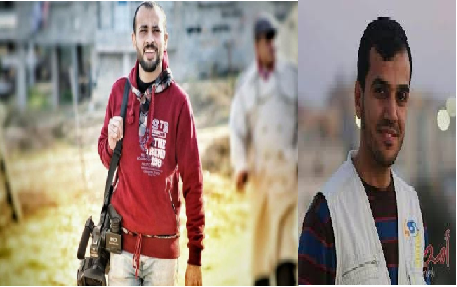
The killing of Yaser Mortaja, a (31-year-old) photographer with the Ein Media Agency, and Ahmad Abu Hussein, a (26 year-old) journalist for the Sawt Ash-Shaab “Voice of People” Radio station and freelance photographer, by the IOF snipers were the most serious and grave attacks, especially that all information indicate the two crimes were deliberate and direct in order to kill. The two journalists Mortaja and Abu Hussein were targeted and killed by explosive bullets (in two separate incidents), while they were at a distance of 350 meters and 300 meters from the border fence where IOF soldiers and snipers have been deployed against the participants in the peaceful marches covered by the martyrs Abu Mourtaja and Abu Hussein. They were killed despite the fact that they were in uniform with clear badges that show their press identities with no doubts (for full details, see the details of violations in this report).
In addition to the killing of the two journalists Mortaja and Abu Hussein last April, the IOF has targeted three other journalists with live and explosive ammunition, a fourth one was shot with rubber bullets and six others were injured in the head, chest and other places by gas bombs fired by soldiers. These attacks provide an additional evidence on direct targeting by the IOF. The Israelis also closed one of the media institutions in Jerusalem. In addition, dozens of other journalists have suffered from various suffocation due to the heavy firing of gas bombs at journalists and demonstrators.
The Israeli crimes against journalists and media freedoms in Palestine (as stated by many statements of Israeli officials and army leaders) became more serious as they are committed based on a systematic official policy and instructions by the Israeli government. The Israeli Defense Minister Avigdor Lieberman defended the Israeli army killing of Mortaja and he was careless about the crime justifying it by the pretext that Mortaja has used a drone to film the demonstrations. The Israeli Haaretz Newspaer reported that Lieberman commented on the killing of Mortaja at a dinner ceremony of “Maimouna” in Ashdod saying "I do not know who he is, whether he is a photographer or not, whoever uses a small drone over army soldiers must know that he is risking his life.”
The Palestinian violations:
The number of Palestinian violations in April was decreased to nine (it was 19 in March). The most prominent of these violations were arresting four journalists, summoning and interrogating several others as well as preventing the “Al-Ghad” satellite channel reporter Diyaa’ Hushiyyeh from access to the headquarters of the PA Presidential headquarters to cover the Palestinian National Council meeting that was held there.
Details of Violations:
(1/4) The Israeli occupation forces prevented the photographer of "Media Freedom Network" Ali Ismael Abd Al- Majid Al-Abed (30 year-old), photographer of "Al-Hadath" Newspaper Musab Abd As-Samad Hamed Shawar Tamimi (28 year-old) and the photographer of "Zain" Agency Mohammad Ezzat Mohammad Halaiqa from covering events in the area of the "Haram Ar-Rama Well" in Hebron and detained two of them. Al-Abed and Halaiqa told MADA that they arrived at about 8:00 pm on the first of April 2018 to cover the deployment of the army and settlers in the "Haram Well”, when they arrived at the Ramah junction, they saw Israeli soldiers deployed on the rooftops of several houses and between the houses; about 10 minutes from their arrival, a border police officer approached them, seized their ID and press cards. Afterwards, the officer returned and told them that he would not give them their cards back unless the army leaves the area and he allowed them to film. However, the soldiers asked photographers Musab Shawar and Ali Al-Abed (and a third journalist who arrived to cover the event) to move to the opposite side of the mosque. The journalists and their other colleagues were repeatedly kept remote from the event center up to approximately100 meters to film. At about 09:30 pm, the photographer of, "Zain" Agency, Mohammad Ezzat Mohammad Halaiqa arrived and began filming, then four soldiers turned towards him and began pushing him. He responded and went back, but they pushed him back to an area from which it was difficult to film. At approximately 11:30 pm, the army began withdrawing after the settlers. The officer returned the two photographers IDs he seized and by leaving the area the soldiers fired two tear gas canisters at the journalists.
(1/4) The Preventive Security Force in Qalqilya has arrested Al-Quds Newspaper correspondent, Mustafa Ali Sabri (51year-old), for two days under interrogation and seized his ID card. Sabri was summoned for other consecutive times after his release. He told MADA that "on 31/3/2018 at about 11:30 pm,, I received a phone call from the Preventive Security force in Qalqiliya telling me that I have to go to meet them next day morning (Sunday - April 1) at 10 am at the Preventive Security Headquarters. I was waiting there until 12 noon and I was asked to hand over my belongings. Afterwards, I have been transferred to the Military Medical Services for medical examination, but I refused to make it and I announced food, water and medicine strike".
He added “they brought me back to the preventive security headquarters where I was taken to a cell. After about an hour, I was interrogated on my children receipt of their university fees in 2014from a prohibited party. I told the interrogator that this is not my business as I personally did not receive any money. On this day (Sunday) and the next day, Monday, I was under interrogation sessions every three hours on the same subject. I was also asked other questions about place and nature of my work and my membership in the Journalists' Syndicate. At about 10pm, the officer told me that he would release me, but I should come back on Wednesday 4/4 at 10 am to the preventive security headquarters. When the officer handed over my ID card, I continued waiting until 3:30 pm and then left the place upon their request without meeting anyone or interrogation provided that I should return on Sunday 8/4 to pick up my ID card. I went there on time and stayed from 10:00 am to 03:30 pm without any questions or interrogation other than the officer’s question:/ the same topic .. Is there anything new? Which means that I have to pay the sums my sons received, but my answer was no. He asked me to return again on Tuesday 10/4, I returned to the preventive security headquarters at 10:30 am and waited until 12:30 pm. I was taken out through the back door of the headquarters without understanding the reason behind it and without getting my ID card. They told me to come back again on Monday, 16/4. "
On 14/4/2018, the MADA lawyer has intervened in this case. On 16/4/2018, he sent a letter to the Preventive Security asking them to stop summoning the journalist Mustafa Sabri illegally and to return his seized ID card otherwise he (the MADA lawyer) will file a case to the Palestinian Higher Court of Justice. In the evening of the same day, the preventive security force returned back Sabri’s ID card at his home and stopped summoning him.
(2/4), The Israeli occupation police prevented the media and public relations officer of the Islamic Endowments Department in Jerusalem, Feras Yousef Ahmed Debs (33 year-old), from entering Al-Aqsa Mosque Debs told MADA that “On Monday at about 8 am (April 2, 2018), I went with a group of colleagues to Al-Aqsa Mosque, specifically through Al-Asbat Gate, but the Israeli police stationed at the door have seized my ID card, my mobile phone and prevented me access. They told me that the officer in charge of the Haram, named "Dani", has circulated a decision preventing me access to Al-Aqsa Mosque until further notice."
He added “for more than an hour, I tried to enter from the Hatta, al-Ghawanmeh, al- Majles, an-Nather Gates, but the response was the same, without telling me the reason although it is clear that they want to prevent me from documenting their various and serious violations inside the courtyards of Al-Aqsa, especially in their feast in which their raids increase."
(3/4) The Palestinian Public Prosecution arrested the journalist at (Wafa) News Agency, Rami Nabil Ahmad Samara (38-year-old) who is in charge of the Agency's "Multimedia", for several days and interrogated him for more than one time on the basis of an alleged complaint of “slander and defamation” filed by the Director of the Media Development Center at An-Najah University, Ghazi Mortaja, against the journalist Samara. The General Prosecution has also interrogated the Director and Correspondent of Al-Arabi Al-Jadid Newspaper, Naela Khalil (40 year-old), because of the comments she wrote on Facebook in solidarity with the journalist Rami after his arrest.
Mortaja has filed this case against Samara and Khalil due to comments they wrote after the Media Development Center fired a number of Journalists working at the center on 26/3/2018.
Samara was arrested after a summon WAFA received on Tuesday morning 3/4/2018 from the Public Prosecutor's Office, asking him to go to the prosecutor's office in the city of Al-Bireh. Samara went there immediately, and when he handed over his ID card and introduced himself, a policeman told him that he is under detention, and he was held at the detention center at the prosecutor’s office. After about an hour (about 11:30), he was returned to the prosecutor’s office where he was interrogated by a prosecutor who told Samara that he was "detained based on a complaint filed by Ghazi Mortaja in which he claims that you defamed and slandered him and his family". The journalist Samara was held in the detention center until 4:00 pm and was then transferred to the central police prison in Beitunia.
At approximately 8:30 pm on the same day (Tuesday 3/4/2018), President Mahmoud Abbas ordered the release of journalist Rami Samara immediately after the intervention of the Journalists Syndicate as well as the demands by MADA Center, journalists and many relevant institutions to release him. However, he was released next morning (Wednesday 4/4/2018) claiming that "the release requires some measures to be taken by the prison and prosecution".
On Sunday 8/4/2018, the prosecution held another hearing at its headquarters in the city of Al-Bireh for the journalist Samara to complete the investigation. Several journalists headed to sit-in in front of the prosecutor’s office in solidarity with Samara, including the journalist Naela Husni Khalil (40 years) who was surprised by notifying her through the Journalists Syndicate lawyer (Alaa’ Faraijat) that the prosecution is summoning her at that moment for interrogation. She went with the lawyer Fraijat to the hearing that was held jointly with Rami Samara because they both have "one case and one file, as the lawyer said." Naela Khalil was interrogated about two comments she wrote on Facebook. After about an hour of questioning and investigation, the prosecutor decided to keep Naela free as well as Rami Samara and transferred the case file to the court, but he seized Rami Samara and Naela Khalil’s ID cards to ensure their presence before the court hearing that was scheduled for the same day. After two hours and a half of waiting, a hearing was held for journalist Naela, while the plaintiff Ghazi Mortaja did not attend the hearing, although lawyer Alaa Faraijat and the prosecution confirmed that they had sent him a summoning letter. After nearly half an hour of deliberations, Judge Ramez Jomhur decided to postpone the hearing and accusations against journalists (Naela Khalil and Rami Samara) until 16/5/2018.
(AFP) - The Chief Editor of "Sky Press" news agency, Izz Abd Al-Aziz Abu Shanab (33 year-old), was wounded by an explosive bullet in the left foot fired by the Israeli occupation forces while covering the return marches in the eastern Gaza Strip. Abu Shanab told MADA “I was standing about 400 meters from the border fence (where the soldiers are stationed). My colleague journalists and I were about 200 meters behind the demonstrators and I was wearing my full journalist uniform (the jacket and the helmet). At about 5:15 pm, I was injured by an explosive bullet in my right foot which entered through my left foot and exploded inside. The Journalist, Adham Al-Hajjar, was also injured by an explosive bullet in his foot before I got injured.”
Abu Shanab added "I was taken to the field medical center where I received first aid, and then I was transferred by an ambulance to Ash-Shifa’ Hospital around 6:00 pm to find out that I have fractions in the foot bones. I underwent a surgery continued for 5 hours. On Monday (8/4), I underwent another surgery which also continued for 5 hours and until today (Tuesday 9/4), I still lying in the hospital for follow-up.
(9/4) Israeli soldiers assaulted three journalists by beating and prevented them from covering the arrest of a student from the Palestine Technical College “Khadouri” at the Aroub branch in Hebron Governorate. The journalists were on their way to the university that day to cover the second student creative "Gravos" exhibition at the university.
The assaults targeted the correspondent and photographer of Watan Agency Sari Sharif Abdel Ghaffar Jaradat (32 year-old), photographer and correspondent of "Al-Hadath" Newspaper, Musab Abd As-Samad Hamed Shawar Tamimi (28 year-old), and photographer of "Zain" Agency Mohammad Izzat Mohammad Halaiqa.
Jaradat said that when he began filming the arrest of one of the students (it was turned out later that the student is Qusay Ad-Darabeea’) by his mobile camera, a soldier asked him not to film. Sari told the soldier that he is a journalist, then the soldier returned to the military jeep, put a black mask on his face and attacked him with another soldier. They prevented him from moving, put their feet on him and one of them took his mobile and deleted the photos Sari took. The soldiers stopped the journalist Musab Shawar and Sari tried to hide from the soldiers in the university guard room to photograph the assault on his colleague. However, one of the soldiers has run after him and punched him on the back during Sari’s attempt to go away.
Masab Shawar said that while he was standing 15 or 20 meters from the first soldier and about 50 meters from the military jeep to film (the arrest of a student) in front of the university, a soldier went to him and told him that "filming is forbidden." He told the soldier that he is a journalist, showed him his card and wore the press uniform immediately and began filming. Two soldiers returned to the journalist Shawar, seized his camera and went back to the army jeep, then Shawar began filming by his mobile phone. The two soldiers quickly returned towards him and punched him on the face, abdomen and back.
Halaiqa said he arrived in the university about 10:30 am and began filming the arrest of one of the students and some clashed took place simultaneously. Two soldiers approached him and asked him to stop filming. He showed them his card and told them that he is a journalist and he held his camera to film. The two soldiers began punching him on the head, face and back before a third masked soldier came and hit him on the head, caught his neck and dragged him to the military jeep. The soldiers tried to push him inside the jeep but he resisted in order not to be arrested and beaten. He started screaming "I am a journalist. I am a journalist." At this moment, one of the soldiers took Mohammad's camera and took the memory out. The soldiers started firing sound grenades and gas canisters at the students who then started throwing stones at the soldiers. Mohammad used these events and ran away from the soldiers. Shortly, a military jeep arrived with one of the army officers who released the journalists and gave them their cameras (canon 5D, canon 7D) after deleting the material.
(9/4), the Preventive Security Force in Salfit summoned the freelance journalist Khaled Amin Maa’li (52 year-old) and interrogated him. “Ma’’li told MADA: “on 9/4 at 12 noon, I received a phone call from the Preventive Security Force and they asked me to go to their headquarters in Salfit on Wednesday 11/4 at 10:00 am. At the beginning I rejected to go and considered it as an illegal summoning, but the security officer told me that it is a simple issue and does not require legal summoning. “
“I went to the preventive security headquarters in Salfit on time where my mobile and ID card were seized. I was waiting for about 20 minutes and then called for interrogation. They asked me ordinary questions that have been previously asked many times by security forces, such as where do you work? how is the situation of media and the press in the country? And other questions on the Electronic Crimes Law. The officer asked me how many times I had been arrested by the Israeli authorities and he asked about my degree and whether I am a journalist or just a social media activist. By the end, he asked me to be more balanced in my articles. I told him that I am a journalist and I do not insult or underestimate anyone through my writings and that my critique is also within the rational limits. After about two hours, I was released and got my ID card and mobile phone."
(12/4) An Israeli Border Guards soldier has fired rubber bullets at the journalist Samer Mohammad Thabet (33 year-old) who is the Director of Public Relations and Information at Shuqba village council. Thabet was wounded in his thigh while he was documenting a morning house demolition in the village of Shaqba in Ramallah governorate." He told MADA that “in the morning of April 12, four army patrols accompanied by a bulldozer raided the western part of the village of Shuqba and began to demolish a house and agricultural facilities under the pretext of building without a permit. At approximately 8:00 am, a crowd of citizens were gathered about 150 meters from the army patrols and bulldozer. There were some confrontations between the citizens and the soldiers when they tried to prevent the demolition. The confrontations were escalated and some citizens started throwing stones at the soldiers who responded by rubber bullet and gas canister firing.”
Thabet added: "I was filming by a mobile phone without any indication that I am a journalist, but I told the officer who approached me that I am the media officer in the village council and I was documenting what was going on. At approximately 8:30, a soldier fired a rubber bullet at me from a 30-meter distance only hitting me in the right thigh and I was transferred to Palestine Medical Complex for treatment."
(13/4) the occupation army snipers killed the journalist photographer of “Ein Media” Company, Yaser Abd Ar-Rahman Mortaja (30 year- old), while he was covering the events of the peaceful return march at the Gaza Strip borders. His colleague Hosam Hesham Salem (29 year-old), who works at the same company, told MADA: "on Friday 13/4/2018, we went to Khuza'a area in the southern Gaza Strip, namely to the return camp, to cover the activities of the second Friday of the peaceful return march and we filmed the Friday prayers and the citizens gathered there. After the prayers, demonstrators set fire to car tires and Yasser was filming the scene from behind, wearing protective shield and helmet and he was about 350 meters from the border fence (where the Israeli soldiers and snipers are deployed). The soldiers started firing metal bullets at the demonstrators injuring one of them at the beginning. Then Yasser was shot by an Israeli sniper in the left side of his lower abdomen and the bullet went out from the right flank leaving its remains inside his abdomen. "Yasser was transferred to Nasser hospital in Khan Younes, where he was taken to intensive care unit and then underwent a 4-hour surgery in which part of his lever was cut. It was found out that the bullet had caused damage to the spleen and ruptured some of the arteries, which resulted in loosing much blood. The doctors had to provide him with 16 blood units, but his body did not accept this blood."
He added: (after the surgery) he was taken to the intensive care room, where he was supposed to remain under control for 24 hours, but at around 12 midnight (about 10 hours after his injury), his health situation was worsened and the doctors referred him back to the operations room to be announced dead after one hour.”
(13/4), freelance photographer, Mohammad Ali al-Hajjar (31 year-old), was wounded by bullet shrapnel in his hand and knee by Israeli soldiers while he was covering the peaceful return march in Gaza. Al-Hajjar told MAD: "on 13/4 at 10:30 am I went to cover the third Friday return march to the east of Malaka Square in Gaza and I was wearing the full press uniform. At about 2:30 pm, I and a group of journalists stood about 200 meters from the border fence to cover the demonstrations in that place, the Israeli soldiers began firing heavily, so I ran away to the north, but at that moment I was injured by a bullet shrapnel in my right arm and in my knee. It seems that the bullet hit a body next to me and exploded. At the beginning, I did not feel the injury except when the young men noticed that I was bleeding. I went to a nearby ambulance where its staff offered me the first aid. They cleaned and bandaged the wound and I left the place after about an hour."
(13/4) the reporter of Al-Amwal As-Saghira satellite channel, Raghda Zeyad Yasin (23 year- old), was severely suffocated as she was covering the return march to the east of Jabalia. Yasin told MADA: "the freelance cameraman Mahmoud Ismael and I were in the Malaka area East of Jabalia to cover the return march on 13/4. I was standing near a gathering of journalists, ambulance and civil defense staff at about 600 meters from the border fence and I was wearing the press uniform. We (my colleague and I) were preparing a report on the violations against journalists in the field. At about 4:30 pm, during my interview with Al-Jazeera staff (a reporter and cameraman, I do not know their names) for this end. We were targeted by three gas canisters, one of which fell between us, one to the right and the other to the left. This caused us severe suffocation. I felt suffocated and my face was burning for 30 to 45 minutes and I received first aid treatment in the field."
(13/4) The reporter of Iranian “Al-A’alam” channel, Esraa Al-Buhaisi (32 year-old) suffered from severe suffocation and convulsions as Israeli soldiers fired several gas canisters at a group of journalists while reporting on the peaceful return marches in Gaza. Buhaisi told MADA that: “on 13/4, I was in the Malaka area to the East of Ash-Shajaeya in Gaza to prepare a report on the peaceful return march. After I finished a (stand) and while I was waiting for the burning of the Israeli flag at 2:30 pm. The Israeli occupation soldiers began heavy firing of bullets and gas in the area, which caused my severe suffocation. At that moment, I was not putting the muzzle on (because the muzzle disturbs talking during the preparation of the report), but I was wearing a flak jacket, and I could not run like the others. I fell and had convulsions, but I was treated in the field. I was transferred to a field medical center in Malaka area and stayed there for about an hour, received further medical aid and left, but I had convulsions the same night for an hour during which my husband helped me."
Ahmad Abu Elbeh directly injured in the chest east of Jabalia/ Palestine TV staff (Fuad Jarada 0592600719) gas suffocation east of Gaza/ Odeh Marwan al-Ghoul, Al-Mayadeen Agency cameraman 0599755010 simple gas inhalation east of Gaza (this is attached to Buhaisi report).
(13/4) Israeli soldiers prevented a number of journalists from covering the incident and arrest of a young man in Hebron. The two journalists Maamoun Wazzouz and Abd Al-Hafiz Diab Hashlamoun (54 year-old the European News Agency cameraman told Mada: “on Friday 13/4/2018 at about 1:30 pm, clashes broke out between Palestinian youth and Israeli soldiers in Bab al-Zawyeh area in the center of Hebron, which is about 100 meters from an army checkpoint located at the entrance to Al-Shuhada Street in Hebron. This is the boundary between the Palestinian Authority-controlled area and the Israeli-occupation-controlled part of what is known as the (H1 and H2) areas. The soldiers arrested a 15 year old young man, and during our covering to the arrest (we were about 20 journalists there), the soldiers pushed me, I Mamoun Wazzouz, with their hands and threatened to throw sound grenades. Al-Hashlamoun was also pushed by the soldiers some of whom put their hands on the cameras of journalists to prevent them from filming the arrest.”
(17/4) On Tuesday evening 17/4/2018, the Palestinian Preventive Security Force arrested the Journalist Hazem Imad Hosni Naser (28 year old) from his house located between Ektaba and Shweika neighborhoods to the north of Tulkarm. His cousin, Amin Khuwailid, who was in the house at the time of arrest told MADA that 13 persons, ten were in uniform and three were in civil clothes, arrived in Hazem’s house and asked him to go out. When he asked them about the reason, they told him/ we want you/ and they took him to one of their military jeeps.
"MADA's lawyer has followed up Naser’s case, whose arrest was extended more than once, and succeeded on Sunday 6/4/2018 to have a decision from the court to release him and the decision was enforced at 09:00 pm the same day.
(18/4) Israeli occupation intelligence locked "Elia Youth Media” Foundation headquarters after raiding it at noon. The director of the foundation Ahmad Hussein Safadi (44 year old) told MADA “on Wednesday April 18, 2018 at 12 noon, affiliates of the Israeli occupation intelligence and members of the police and army raided the headquarters of the foundation in Salah al-Din Street in East Jerusalem. None of the staff were present as they avoided to attend the headquarters that day because of a blog by the Israeli Defense Minister Avigdor Lieberman two days earlier (Monday, April 16, 2018) on Twitter describing the Ilia Youth Media Foundation as a /terrorist organization/ and the intelligence and police members hanged an order at the entrance stipulating the closure of the foundation until further notice.”
"I filed a complaint to the court through the Jerusalem Legal Aid Center against the closure decision.
(20/4) The video cameraman of Gaza Media Center, Hamad Hassan Mohammad al-Sawalhi (40 year old) was wounded in the palm of his hand by an explosive bullet fired by Israeli soldiers while he was preparing a report on the return march east of Gaza. Sawalhi told MADA: on Friday at 10:00 amGaza, to cover the peaceful return march of the fourth Friday and I was filming normally until the end of Friday prayers as the number of demonstrators increased. At approximately 4:00 pm, while I was standing about 700 meters from the border fence far from the demonstrators filming and interviewing elderly women who were watching the demonstration distantly, I was shot by a metal bullet in the palm of my right hand. The bullet has hit my palm and exploded in the camera and damaged it."
He added: “I was taken to the field medical center erected in that area and I received first aid there. At about 4:30 pm, I was transferred to al-Quds Hospital and stayed there for about an hour during which I received the necessary treatment."
According to the Ministry of Information in Gaza, six journalist were also injured in the eastern part of Khan Younes, namely the British “Image Live” cameraman Ahmad Hasaballah, who was hit by a gas bomb in his right foot, cameraman of “Noor News Network” Du'aa Zoa'rob who was seriously unconscious, the camerawoman of “Balada” channel Salsabil Abed who was also unconscious as a result of tear gas, , the photographer of “Klakit Radio” Ala’ Ali Abu Ruqaa’who was suffocated and became unconscious by gas and the Cameraman of Klakit Radio and “Kinan” Agency Muatasem Ahmad Al-Khatib who was suffocated by gas as well as the freelance journalist Abdullah Ata Issa who was suffocated and became unconscious by gas in the Central Region.
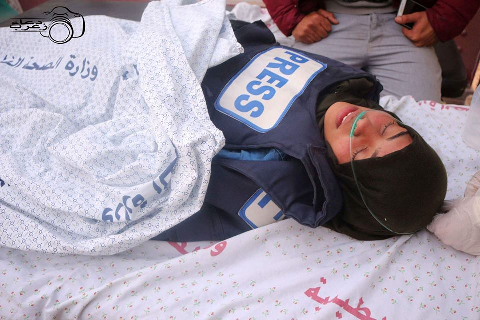
(22/4) The occupation soldiers detained the journalist at "B'Tselem" organization Manal Al-Jabari in Hebron after assaulting her for several times. Al-Jabari told MADA: "I went to the Ibrahimi Mosque area around 2:00 pm where there were (two policemen and one policewoman) of border guards at the checkpoint holding a woman and two young men. After I arrived at the checkpoint and because they know me in person and they know the place of my work, they left the people they hold and they held me.
The policewoman began inspecting me thoroughly so that she emptied my bag and threw everything on the ground, and she searched by her hands. She asked me to stand on the wall and raise my hands, but I did not respond to her orders. So she called an officer, who came with other five border guards, and shouted at me to obey police orders. When I refused, he assaulted me and forced my hand behind my back and pushed me hard against the wall. He asked the policewoman to inspect me in the upstairs room. When I went up to the inspection room, which was of glass, I refused to take off my clothes and she began pushing me with her hands because of my refusal to be inspected. From time to time, she used to turn my hands to my back strongly with another policeman and they insulted me.
Around 2:30 pm, the policeman asked the policewoman to take me to the mosque police station and I was actually pulled there after half an hour of inspection and humiliation. With another police woman who was there, she took me to a room and asked me to fully take off my clothes. When I refused, she went out to tell the officer in charge. At this time I made a phone call with Betselem organization. They became crazy when they knew that I called the organization and the officer asked the policewoman to search me normally and release me. She took me out and then the officer decided to release me. I told him that I want to file a complaint, but he re-assaulted me and turned my hands to my back painfully, pulled me to inside the station and pushed me to the floor, handcuffed my hands and told me that I am detained. One hour later, I was transferred to Jaa’bara police station to arrive there at about 3:00 pm. Over the interrogation, there was no charge, but after telling all the incident details, the officer decided to prevent me access to the mosque area for 15 days and scheduled a court hearing for me to be on 6/9/2018. I was released at 9:00 pm.
Two days after my release and due to the strong pains I felt in my neck and shoulders, I went to the Shifa’ Medical Complex in Hebron and received the necessary treatment as they found bruises on different parts of my body.”
(27/4) Israeli occupation forces continued to target journalists for the fifth consecutive Friday, while covering the peaceful return marches along the Gaza Strip border, despite they were in press uniform. These attacks have resulted in wounding 14 journalists, one of whom was shot by live ammunition and the others were directly injured by gas canisters, suffocations and fainting by inhaling the tear gas fired by the occupation army targeted them and the participants in the peaceful demonstration.
According to investigations conducted by "MADA" field researcher, 14 injuries among journalists were documented in the five events of peaceful return marches to the east of Jabalia, Gaza, Al-Bureij, Khan Younes and Rafah.
- Freelance journalist Abdul Rahman Hani Abd Al-Qader al-Kahlout (22 year old), was wounded by an explosive bullet in the right foot while covering events in the area of Malka, east of Gaza City although he was in uniform.
Al-Kahlout has undergone three surgeries. The first was at Dar Ash-Shefa’ Hospital where the wound was cleaned and decontaminated, the second was at Al-Quds Hospital where the wound was also cleaned and decontaminated, while the third surgery was at the Indonesian Hospital in the northern Gaza Strip to remove the shrapnel and treat nerve damage. He still at the Indonesian hospital because of the cuts the injury caused to the nerves.
- Director of Al-Mayadeen office in the Gaza Strip Na'im Ragheb Shahin /Dghaish (44 year old) was severely suffocated while covering the peaceful march in the Khuza'a area east of Khan Younes.
- A photographer from Hamas media office, Munib Samir Ahmad Abu Hatab (24 year old), was injured by a gas canister in the neck while covering events in Khuza'a area east of Khan Younes. He was transferred to the Algerian Military Hospital in Bisan area for treatment.
- Journalist for the local “Hala Palestine” agency, Hashem Eyad "Mohammad Hashem" Hamada (25 year old), was hit by a gas canister in his head while he was covering the events of the return march in the Malaka area east of Gaza City.
- Freelance journalist, Abd Ar- Rahim Mohammad Dib Al-Khatib (39 year old), who was a former employee of several foreign and local agencies was hit by a gas canister in his left foot, east of Rafah in the southern Gaza Strip.
- Photographer of the “Al-Qala’a Media Network and correspondent of "Al-Hayat" Radio Station Nour Talal Salman An-Najjar (22 year old), was hit by a gas canister in her right foot that also caused her severe suffocation while covering the march in Khuza'a area east of Khan Younes. She was transferred to the Algerian Military Hospital in Bisan area and then to the European Hospital.
- Photographer of the “Palestine Today” Channel, Mohammad Abd Allah Mohammad Jouda (28) was hit by a gas canister while covering the events east of Rafah city in the southern Gaza Strip. He was transferred to the hospital. This is his third injury after being hit two times earlier by two gas canisters in the chest.
- Al-Hurra Newspaper correspondent, Wesam Mohammad Hasan Yasin (42 year old), was severely suffocated by the Israeli occupation forces tear gas canisters fired while she was covering the peaceful march in the Malaka area east of Gaza city. This is the second time Yassin was suffocated as the first was in the fourth Friday of return marches in the same place.
- Palestinian TV cameraman Mohammad Samir Salim al-Agha (29 year old), was seriously suffocated while covering the events of the return march in the Malaka area east of Gaza City. He was transferred to Ash-Shifa’ Medical Complex for treatment.
- Palestine TV correspondent, Islam Imad Mohammad Az-Zaa’noun (28 year old), was severely suffocated while covering the events of the return march in the Malaka area east of Gaza City and was treated in the field.
- Photographer of "Shams News" local agency, journalist Hasan Hussein Hosni al-Jedi (25 year old), was seriously suffocated east of Gaza City and was transferred to Ash-Shifa’ Hospital for treatment.
- Photographer and correspondent of "Fursan Al-Irada" radio station, journalist Nihad Fuad Ibrahim Abu Ghalioun (33 year old), was hit by direct tear gas canister in his back fired by Israeli soldiers during his coverage of the peaceful march in Tallat Abu Safiya area east of Jabalia refugee campand he was transferred to the Awda Hospital for treatment.
- Photographer of the Chinese agency "Shenkhuwa", journalist Wesam Samir Nassar (34 year old) was suffocated by gas while he was covering the events east of Gaza City. He was treated in an ambulance.
- EPA photographer, Saber Nour Ad-Din (38 year old), who was fainted due to tear gas inhalation while covering the events of the return march in the Malaka area east of Gaza City.
- Other journalists had less severe suffocation and did not receive any treated at medical points or hospitals.
(25/4) A journalist in Sawt Ash-Shaab radio station and freelance photographer Ahmad "Mohammad Ashraf" Hasan Abu Husein (24 year old) was killed by an explosive bullet fired by an Israeli sniper on Friday 13/4/2018 while covering the events of the peaceful return march Abu Safiya area east of Jabalia refugee camp.
According to the field investigations conducted by MADA Center with eyewitnesses, they stated that at approximately 02:15 pm on Friday, April 13, Ahmad Mohammad Ashraf Hasan Abu Husein (24 year old) was wounded by an explosive bullet in his left part of abdomen fired by the Israeli occupation forces while he was working in Al-Awda camp east of Abu Safiyya to the east of Jabalia refugee camp in the northern Gaza Strip. He was in press uniform (helmet with a TV sign and blue flak with “Press” sing on it) in what is known as the Jaker Street, which is about 300 meters from the border fence (where Israeli soldiers and snipers are deployed).
According to eyewitnesses (Thaer Fadl Ahmad Az-Za'anin, Nour Ad-Din Abd As-Sattar and Ramadan Al-Kurdi), journalist Ahmad Abu Hussein was present on Friday, 13/4/2018, by 8:00 am in the area, filming the peaceful demonstrators and he was waiting in the journalists' tent until 2:00 pm. When the demonstrators flooded the area simultaneously with the Israeli occupation army firing of gas canisters and live ammunition at them, he left the tent that is about 700 meters from the border fence and headed to the Jaker Street (approximately 300 meters from the border fence) and stationed near the ambulances and medical staff for filming. About ten minutes later, around 2:10 pm, he was busy in filming the demonstrators who were directly next to the border fence, he was wounded by a live bullet in the left abdomen and immediately fell on the ground. He was transferred by an ambulance to the Indonesian hospital in the northern Gaza Strip. He was admitted to the operation room immediately and underwent a life-saving surgery. He was suffering from internal bleeding as announced by the physicians who have been there and described his situation as serious.
Rami Ash-Shurafi, a member of the General Secretariat of the Journalists Syndicate, who has been following his condition since he was admitted at the hospital, stated that the following day, Saturday 14/4/2018, necessary arrangements were made by the hospital and the Ministry of Health to transfer him to treatment after his condition stabilized, but the Israeli occupation was slow to issue an urgent approval for his. After pressure by many jurist organizations and a follow up by the Journalist Syndicate, the Israeli occupation agreed, at 7:00 pm on Sunday 15/4/2018, to issue a permit to allow him access to the West Bank for treatment. He was transferred the same day by an ambulance to Beit Hanoun (Erez) crossing in the northern Gaza Strip at approximately 10:00 pm towards the Palestinian Medical Complex in Ramallah, where he arrived at around midnight.
According to Ash-Shurafi, Ahmad Abu Hussein underwent a surgery on Monday 16/ 4/2018 in the Palestinian Medical Complex in Ramallah as the Israeli hospitals refused to receive him. His position has stabilized until Thursday (19/4/2018), then his health has deteriorated. The Ministry of Health has again contacted the Israeli hospitals and only Tel Hashomer Hospital agreed to receive him. He arrived at the Israeli hospital at 12:00 midnight, but the doctors were on leave on Friday and Saturday. On Sunday 22/4/2018, the Israeli doctors met to assess his condition and the declared that he had no treatment as he suffers from brain damage and decided to send him back to the Gaza Strip, but his mother refused. He stayed at the hospital until he was announced dead on Wednesday night, April 25, 2018 at around 3: 35 am. The body was returned the same day to the Indonesian hospital in the Gaza Strip at around 6:30 pm, and his funeral was Thursday 26/4/2018 in Falluja cemetery of Jabalia refugee camp.
(30/4) The Palestinian Presidential Office in Ramallah banned Al-Ghad TV correspondent Diyaa’ Ahmad Saleh Hoshiyyeh (36 year old) from covering the proceedings of the Palestinian National Council (parliament) held on 30/4/2018. Hoshiyyeh told MADA that like other journalists and after the announcement of the opening of the registration of journalists who are willing to cover the conference as announced through a website circulated by the Palestinian Presidency Media on 20/4/2018, the correspondent of Al-Ghad TV, Diyaa’ Hoshiyyeh has registered the same day and received an email from the Presidency Office after about 15 minutes stating that the process has succeeded and a reference number was attached to that email.
I continued waiting the approval and instructions usually sent by the Palestinian presidency regarding the access of journalists. 9 days late (on 29/4/2018) I found that all journalists received e-mails from the Presidency Office approving their entry to cover the sessions of the National Council, accompanied by instructions and details of entry, but I did not receive a similar message like my colleagues. After inquiries and phone calls made through friends who contacted some officials, I was assured that there was a decision to prevent Al-Ghad TV from entering the presidential headquarters for coverage without giving further details.