

Ramallah (11-1-2018) the latest month of 2017 witnessed a sharp rise in attacks against media freedoms in Palestine as a result of a wave of Israeli attacks that accompanied the unrest in the Palestinian territories in protest against the US administration's decision to recognize Jerusalem as the capital of Israel.
The total number of violations monitored by the Palestinian Center for Development and Media Freedoms (MADA) in December 2017 amounted to a total of 89 violations committed by the Israeli occupation, 84 of them, noting that the Palestinian official authorities did not commit any violations during this month. 5 of the incidents consisted of the injuries of five journalists from stones thrown by demonstrators during clashes with the Israeli occupation army.
The attacks included 9 women journalists who were subjected to serious attacks just as similar as there male’s journalists colleagues.
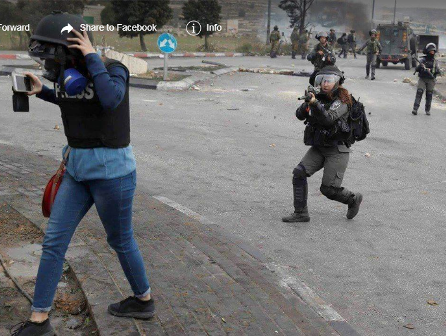
In addition, most if not all journalists who participated in covering these incidents on the ground suffocated from the gas bombs or they were at risk of obstructing their work or indirectly preventing them from carrying out their work and covering these protests.
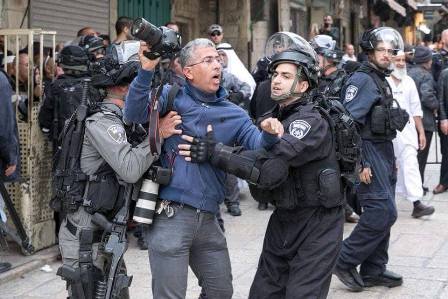
It was noted during this month that the Israeli army used a new method to block the picture and prevent journalist to cover the image of what is happening on the ground, through mass detention of journalists (the detention ends when the event ends), and also using mass expulsion to prevent journalists from the opportunity to transfer the reality of what is happening on the ground.
This procedure was repeated at least twice, the first was in Hebron on 20-12-2017 and the second was implemented in Jerusalem on 29-12-2017.
On 20-12-2017, the Israeli occupation forces prevented all journalists from covering demonstrations in three locations in the city of Hebron (Bab al-Zawiya, Hawawra, and the police bridge area south of Halhul). They were expelled from the three sites and threatened with arrest if they did not comply.
In the city of Jerusalem, the Israeli occupation forces, forced dozens of journalists who were present on 29-29-2017 at Bab al-Amoud to cover the events of the fourth Friday of the Palestinian protests, to be located only behind metal barriers set by the police, and prevented them from moving freely to cover the protest that attracted the attention of dozens of foreign and Palestinian media on that day.
Furthermore, Israeli social networking pages were flooded this month with incitement to violence against journalists and the media, which led to direct calls for the killing of journalists and the removal of the media from the sites of events to prevent the transmission of what is happening on the ground from Israeli attacks. It is interesting to note that some Israeli journalists took part in this wave of incitement, as well as the silence of the Israeli authorities, who have been arresting and persecuting any Palestinian who may write or publish a statement interpreted by the Israeli authorities as inciting against the occupation or the Israelis.
Israeli violations:
The Israeli occupation has committed at least 84 attacks against journalists and media liberties, most of which fall within the grave attacks on the lives and work of journalists and the media outlets.
52 physical attacks where recorded on journalists (62% from the overall Israeli attacks) noting that 20 journalists were victims of smoke, sound bombs and rubber bullets that were fired by the Israeli occupation forces directly on them causing them injuries and varying burns.
The rest of the injuries ranged from beatings to severe suffocation (all requiring medical treatment), with varying the lives of journalists, such as a horse that is ridden by an Israeli police officer stepping on a foot of a female journalist to keep her away from doing her job or another police officer punching a journalist using a metal object on the grip of his hand or spray a third journalist with pepper spray directly on her face and her eyes from zero distance.
Targeting journalists directly with smoke bombs and rubber bullets shows the intentions of the Israeli occupation forces to prevent these journalists to do their jobs. For example, the incident that happened with the video cameraman in the Reuters news agency Fadi Shanaa on 22-12-2017 while standing on a cement block height of a meter and a half documenting a demonstration at the border of Gaza, an Israeli soldiers fired a gas bomb towards him hitting him in the chest causing him to collapse. The dangerous thing is that he fell over the bomb, doubling the seriousness of what he was subjected to gas inhalation, which caused him to suffer severe suffocation, although some of the young people who came to help him soon moved away protecting themselves from the gas.
Palestinian violations:
No Palestinian violations of media freedoms were recorded during the month by official Palestinian authorities in the West Bank and Gaza Strip. Violations attributed to Palestinian (unofficial) authorities were limited to five incidents in which Palestinian journalists were injured from the stones that Palestinian demonstrators threw, during their coverage of the protests that took place throughout the Palestinian territories this month. Some of them cause severe injuries or fractures.
Details of violations:
(7-12), a Palestinian photographer and director of the Palestine Television in Jericho, Omar Ahmed Abu Awad (30 years), was wounded by a rubber bullet in the leg while covering a demonstration in Jericho, Abu Awad said to MADA: "At 2:30 pm on Thursday (7-12) while covering the clashes between the Palestinian youth and the occupation army at the southern checkpoint of Jericho, me and my colleagues the TV correspondent Wattan Balas and the driver Samer Asaad Abu Salman were targeted by a rubber bullet that hit my left leg below the knee. I was treated in the Red Crescent car and then went to the Jericho Governmental Hospital; doctors x-rayed my leg to confirm that there are no fractures and left the hospital after half an hour."
(7-12), the producer of the Russia today channel Amjad Hussam Shahin (27 years) and his colleague Yafa Esteti, correspondent of Russia today and two correspondents of Al-Mayadeen channel were severely suffocated by the direct targeting of gas bombs in Al-Bireh. Shahin said to MADA: "Day 7-12 during our coverage of the clashes at the Beit El checkpoint north of Al-Bireh, me and my colleague, the correspondent of the Russia today channel Yafa Sitti, were in the middle of the gas, I tried reaching my colleague to help her but I couldn’t (though she managed to hide in a nearby car to avoid the gas), I was suffocated with severe exhaustion and woke up and found myself in the ambulance. After that, I was transferred to Ramallah Governmental Hospital where I stayed for two hours during which I received the necessary treatment.”
AL Myadeen reporter Nisreen Mohammad Selmi (40 years) said to MADA while she was with her colleague the correspondent for Al Myadeen channel Khalid, "we severely suffocated by a gas bomb that was fired at us by the Israeli occupation forces. We received field treatment in the ambulance at the location."
(8-12) Reuters TV cameraman Adil Ibrahim Abu Nimah (48 years), was hit by a gas bomb in his chest and suffered from severe suffocation while covering the clashes in Jericho. Abu Nimah said, " at 3:30 Pm on 8-12 I went to cover the protest at the southern entrance of Jericho when I arrived I started wearing my helmet and the bullet proof vest, then I started to get my camera ready so I could start filming I was located right next to Palestine TV crew. After I started filming, a gas bomb was fired directly at me, hitting me in my chest, but it did not hurt me because I was having my bullet proof vest on, but I suffered from a severe suffocation due to the huge amount of gas that I inhaled which leaded me to fall on the ground. Then I received a field treatment in the Red Crescent ambulance. I did not go directly to the hospital, but the next day I became ill, so I went to Jericho Governmental Hospital where I was diagnosed with bronchitis, due to inhaling a large amount of gas and lack of oxygen.”
Abu Nimeh added: “when I was hurt and on the ground Al-Rihan Radio crew from Jericho and Mohammad Jawad an independent photographer where in the scene and also the Israeli occupation army tried more than once to use us as human shields while targeting Palestinian youths.”
(8-12), the correspondent of Al-Ghad Al-Arabi TV channel, Dia Ahmad Hoshiya(33years), was injured twice while he was covering the clashes in Al-Bireh. "On 8-12, I was covering a demonstration which lead to clashes between Palestinian youths and Israeli soldiers at the entrance to Al-Bireh city I was severely suffocated due soldiers firing gas bombs at us journalists. My colleague Eyad Asi, a photographer for Wide Media, was also suffocated as we received treatment at the location.”
Dia added that on 13-12-2017 "I was covering the clashes at the same place and my leg was hit with a stone by a Palestinian youth by accident while he was throwing stones at the Israeli soldiers’ during the clashes which broke my leg and got me a torn ligament and I’ll be with cast covering my leg for a month as the Doctor said to me.”
(8-12) Palestinian TV correspondent Ali Dar Ali(34years), was shot rubber bullets in the head and hand by Israeli soldiers while he was covering a demonstration at Beit El checkpoint north of AL-Bireh City, he said: "At around 3:30 pm on Friday, 8-12. While I was covering the clashes between Palestinian youths and Israeli soldiers at Beit El checkpoint north of Al-Bireh, two rubber bullets were fired at me by the soldiers. The first shot hit me in the back of my head, while the second bullet hit my right hand."
Ali also added: "I was immediately transferred to the Ramallah Governmental Hospital, where I got three stitches in my head, and the second bullet broke my right middle finger so I went under surgery where Platinum was implanted in my finger and remained in the hospital until the following day."
(9-12), the correspondent of the 24 news agency Ali Nasser Nasr ebidat (34 years) was injured in the hand and his camera was destroyed by a gas bomb fired by soldiers directly at him while covering a demonstration at the northern entrance of Al-Bireh. Ali said, " that the Israeli occupation soldiers fired a gas bomb directly towards me where it destroyed my camera and burned my shield vest and injured the palm of my right hand from the outside, I was immediately treated on the ground, but until today (13/12), I receive Physical therapy for my hand."
(9-12) the reporter and the photographer of Al-Hayat Al-Jadida newspaper, Diala Juihan, was injured twice by Israeli cavalry police, Mo’men a young man was also injured while covering a demonstration in Jerusalem. Dalia said to MADA : "At about 1:20 in the afternoon of 9-12 I was on Salah al-Din Street to cover the protests, and then the Israeli police started to push us and preventing us from filming, and suddenly 3 Israeli police officers pushed me very strongly, which led me to the fall on the ground, I got bruises on my both hands and got scratches in different places on my body, I immediately got felid treatment from the medical crew that was at the location."
She also added: "After about 10 minutes, I stood next to a shop and was pushed back by Israeli police. One of the horses used by the Israeli police stepped on my legs while they were dispersing the demonstrators, causing me injuries and bleeding in my toes, at the next day I went to the hospital and received the needed treatment."
Whoever was at the location was pushed away such as Mu’men shbanah who fell on his forehead due to all the pushing which caused him to have a swollen forehead, Liali Ziad the correspondent for AL – Quds educational channel, Yasmin Assad from Al-Ghad channewhere also the victims of the pushing caused by the Israeli cavalry police, Mahmoud Alyan, Nidal Knaana, Jameel AL-Qadamni from Sky news and Ahmad AL-Ghrabli all these jerunalsists where pushed away as well.
(8-12), a photographer in Ramsat media company in the northern West Bank Mahmoud Fawzi Abdul Ghani (32 years) was wounded by a rubber-coated metal bullet fired by the Israeli- soldiers while covering a demonstration in Kufr Qaddum. "During my coverage at Kafr Qaddum, on 8-12 while I was interviewing one of the marchers, a soldier hit me with a rubber-coated metal bullet that hit me under the ear, causing minor injuries, and I was also hit by a young demonstrator with a stone in my right leg."
(11-12) Nasser Hussein al-Shuyukhi (49 years) photographer for Associated Press was wounded by a rubber-coated metal bullet fired by Israeli soldiers while he was covering a demonstration at the entrance of Al-Bireh. He said: "At approximately 12:00 noon on 11-12, the northern entrance of Al-Bireh city at 2:00pm, I was targeted by a rubber bullet by the Israeli soldiers, which hit me in the right shoulder, causing me bruises and redness in my shoulder; I received medical treatment in one of the ambulances on the location."
(11-12), Reuters TV cameraman, Isma'il Fuad Khader (39 years), was wounded by a rubber-coated metal bullet in the leg while he was covering a demonstration at Al-Bireh entrance. Ismail said: "When I was covering the clashes at the northern entrance of Al-Bireh on 11-12 rubber bullets was fired at me by the Israeli soldiers, hitting my right leg leaving me with a minor injury."
(12-12) Al-Hayat al-Jadida photographer Issam al-Rimawi (34 years) was injured by a stone thrown by a demonstrator, and he also was punched in the chest from one of the Israeli undercover soldiers that were arresting the Palestinian youth at the north entrance of Al Bireh city. Issam said to MADA: "that during the clashes near the settlement of Beit El (the northern entrance of Al-Bireh city), a stone thrown by a Palestinian youth hit me in the right hand and I received field treatment at the site. The next day (13-12) at 2:00 pm, during the coverage of the clashes in the same place, I was punched hard by an Israeli under cover soldier (Israeli special force) in the chest during the arrest of a number of demonstrators, but did not cause me any harm as I was wearing a bullet proof sheild."
(12-12) The reporter of Roya TV channel Hafez Mahmoud Sabra (28 years), was twice injured while covering the clashes in Al-Bireh and Nablus. Hafez reported to MADA: "During the clashes in Al-Bireh and Nablus I was hit twice. The first was on Tuesday (12-12) at the northern entrance of AL-Bireh city, where a stone hit me in the waist. The second injury was on Friday 15-12 at Howara checkpoint in Nablus, where I was hit hard in the palm of my right hand, I think a rubber bullet was the cause of my injury my hand is still under recovery."
(12-12) Israeli soldiers detained the Associated press photographer Iyad Nimer Hamad (58 years), while he was filming the clashes at the entrance of Bethlehem city. Iyad reported to MADA "On 12-12, while I was covering the clashes at the entrance of Bethlehem city, army vehicles were on the opposite side of us, a soldier was telling me to go back so that I could not film. I refused, I told him that five days ago I had been covering and filming and had not bothered the soldiers, When I insisted on that, the Israeli soldier pulled me out and held me inside a military tower, which is few meters away. I was held in the tower for almost 15 minutes and then an officer came in and ordered us not to go beyond the existing line. "
An Israeli occupation force raided Manahil printing house and searched it for allegedly provocative materials. Mu'az Ghassan Tukan (31 years) technical manager at Manahil printing house said to MADA: "At approximately 2:30 am 14-12 I received a telephone call from a person who identified himself as Captain Zakaria, who told me that he was standing in front of the printing House and wanted to search it. I immediately went to the printing House knowing that I live on the other side of the city. When I arrived and opened the door, the Israeli soldiers began to search the printing House for about an hour. The printing House was searched very carefully. The computers were opened and connected to the Internet, but I did not know exactly what did they do with the computers."
Mua’az added: "In the meantime, the officer told me that this inspection campaign included several printing houses around the city fearing for the presence of incitement materials from any kind, and apologized before he left."
(14-12) An Israeli police officer assaulted Palestinian TV correspondent in Jerusalem Dana Ghazi Abu Shamsiah( 25 years), by beating her and preventing her from covering a demonstration in Jerusalem. Abu Shamsiah reported to MADA: "at about 5:15 pm, And when I was in the meantime in a live broadcast, an Israeli officer approached me and tried to prevented me from covering the demonstration I start telling in English and in Hebrew that I’m a journalists, his respond was punishing me with his fist on my stomach and kicking me several times. And then another female soldier came and a started hitting me on my stomach and on my hands, and they both prevented me from completing the live broadcast. "
Abu shamsiah added: "I received medical treatment on the location where my hand did not stop hurting and I was in constant pain, the next day my hand got swollen so I went to the health center and X-rayed my hand and found out that I was suffering from Bruises."
(15-12) Palestinian TV cameraman Nael Mohammad Buaytel (31years), was wounded by a rubber-coated metal bullet in the leg while he was covering a demonstration at Al-Bireh entrance to. Nael reported to MADA "while I was covering the Friday demonstration at Al-Bireh northern entrance, an Israeli soldier fired a rubber-coated metal bullet towards my left leg and I was severely injured, I was transferred to Ramallah Governmental Hospital and got the needed medical treatment for 2 hours."
(15-12) The Israeli soldiers fired rubber bullets towards the vehicle of Palestine TV correspondent Jihad Ibrahim Barakat (27 years), while he was covering the clashes at AL- Berih entrance causing damage to his car. Jihad said to MADA: "while I was covering a demonstration at AL- Berih northern entrance near Bai El settlement, my car was hit with rubber bullets fired by the Israeli soldiers, that hit different parts of the car, causing the windshield to break and the side glass to fall, and several holes in the car doors."
(15-12) Ajyyal Network reporter Ranin Swatfah (29 years), was injured while she was covering a demonstration in Aatouf, and also few other journalists were detained and injured as well, Swatfah reported to MADA: "I went on Friday (15-12) to Aatouf near Tubass to cover a demonstration, and before even the Friday prayers was done the Israeli soldiers start firing Gas bombs which caused suffocation to many people that where at the location."
And she also added: all the demonstrators where located around the mountain and us the journalists where going closer towards the Israeli soldiers to cover the clashes, even though the soldiers saw us only 2 meters away from the demonstrators, they fired two gas bombs towards us, which caused us to suffocate ( Al – Haris Al Husni Wafa agency reopter in Tubass, Palestine TV crew Amir Shahin – reporter and Loai the photographer, public relation employee in Tubass Governorate Adham Bani Odah, and the independent journalists Malik Bsharat , Zaid Abu Arra ), and when the Israeli soldiers asked for PRESS ID cards Adham and Malik where held because they didnt have their Press ID cards on them so they were held for almost 2 hours and they were beaten up as there SD cards were taken from them.
And after the clashes where calmed down, and was getting ready to leave the location, I was far away from the clashes but even though the Israeli soldiers’ fired gas bombs at me which caused me to suffocate and fall down, I fainted and woke up in the ambulance going to Aatuf medical center where I got the medical care needed, knowing that I called me colleague in Palestine TV and Waffa Agency, they told me that they were held for almost 15 minutes by Israeli soldiers’ before leaving the location.
(15-12) Ro’ya TV photographer Mohammad Dar Salim\Al-Nabali (34 years) was injured in his hand, by a stone while covering the clashes at Al-Berih entrance, AL-Nabali reported to MADA: while I was covering the clashes near Bait El settlement on 15-12 I was holding the camera, a stone thrown by one of the demonstrators which hit me in my right hand bouncing and hitting my head near my right eye, leaving me with minor injuries didn’t even need medical treatment.
(15-12) One of the israeli soldiers, At Al- Berih City entrance, Pushed the freelance photographer Ahmad Talaat Hassan(24 years), while covering the clashes at the entrance of Al-Bireh city, which led him to fall and crash his camera. Hassan reported to MADA: "On Friday (15-12), I was covering the clashes at the northern entrance of Al-Bireh city, and when the youth rushed to transport a martyr who was shot and killed by soldiers, one of the soldiers pushed me hard and start beating me up and pushed me to the ground, which led to the crash of my camera”.
Palestine TV cameraman Sakher Abd Alrahim Zwatya (29 years), was suffocated while covering the clashes in Jenin, Zwatya reported to MADA: that while I was covering the clashes on AL Jlama checkpoint on (15-12) Friday afternoon I suffered from suffocation due to the Gas bombs that were fired towards the people, where I got medical treatment at the location.
(15-12) The reporter of the Iraqi channel Naim Fatima Jabr Al-Atawneh (37 years old) was suffocated more than once during her coverage of the demonstrations that accrued at the Gaza border. Al-Atawneh reported to MADA : that on Friday afternoon (15-12) I was present to cover the clashes in eastern Jabalia, the Israeli soldiers fired heavy gas bombs at the demonstrators, due to all the gas bombs I was suffocated that lasted about half an hour and I received medical treatment in the same location”.
She added: "On 22-12, around 2:15 pm, I was covering a demonstration in the Shaja'iya area (Nahil Ouz), The Israeli soldiers fired sound and gas bombs, and I again suffered a minor suffocation and received treatment at the location."
(15-12) The supervisor and photographer at Gaza Port, Samer Saadallah Al-Za'anin (27 years), and two of his colleagues were subjected to more than one attack during their coverage of the clashes at Gaza border, where Za'anin reported to MADA: "on 15-12 while I was covering the clashes at east of Jabalya "My friend and colleague Mohammed al-Madhoun were targeted with gas bombs, which caused us to suffocate. The effect was more on me, so I was taken in an ambulance to al-Awda Hospital where I was treated there."
He also Added: on 22-12 me and my collogue the correspondent for Al-Quds station Talal Hwehi (25 years) near Eriz check point north of Gaza, to cover the clashes that acquired that afternoon, we were wearing protective helmets and vests, and we were 500 meter away from the clashes but even though we were targeted and the Israeli soldiers fired 10 gas bombs which caused us to suffocate and faint and I was transferred in an ambulance to Bait Hanoon Hospital and Talal to Al- Awda hospital and we stayed in the hospital until 10:00 pm.
AFP photographer Jaafar Zahid Ishtia (45 years), was wounded by a rubber bullet, Ishtia was beaten in two separate incidents while covering clashes in Nablus. Ishtaia reported to MADA "I was covering the demonstration and clashes near Huwwara checkpoint at the entrance of Nablus, and I was shot with a rubber bullet in the leg by the Israeli soldiers."
(16-12) Saeed Abd Al-Nasser a freelance photographer, working for several media outlets including the Jerusalem network and Jerusalem Media Center, was injured by a sound grenade while covering a demonstration in Jerusalem. Abd AL-Nasser reported to MADA "During a demonstration in Salah al-Din Street in Jerusalem on (16-12)"The Israeli police fired at us sound bombs, and one of them hit my left foot, causing me minor bruises I received medical treatment in an ambulance for 20 minutes at the location."
(16-12) MAAN TV channel correspondent, Mohammed Issa al-Sayyad (30 years) , and his colleague Maisa Abu Ghazaleh, were injured by a sound bomb fired by Israeli police officers while they were covering the clashes in Jerusalem. Sayyad reported to MADA: "While Me and my colleague, Maisaa Abu Ghazala where in Jerusalem covering the clashes that took place on 16-12 at Salah al-Din Street, while I was filming a sound bomb was thrown at me, causing severe burns and wounds to my right foot and left thigh, while Maisa was burned in the foot but was lighter burns than mine " .
(18-12) The correspondent of the channel "Al-Alam" Samah Mahmoud Al-Kahla (28 years) and her colleague Khalid Al-Deek were targeted by Israeli soldiers, Kahla reported to MADA: between 12:00 pm and 12:30 pm me and my colleague the photographer, We were in the northern part of Al- Berih (Beit El checkpoint), and there were no clashes yet, and while we were preparing for the live broadcast, we were hit by gas bombs and rubber bullets fired by the Israeli soldiers towards the broadcasting car, which led to my injury and my friend Khalid suffocation, It also caused us headaches the next days . "
Kahla also added: "The next day (19/12) we went to Atara military checkpoint to cover clashes there, and while we were on a high hill to take some photos, my colleague from the media holding company Nabil Qandil were targeted by a gas grenade fired at us by the Israeli soldiers, the bomb almost hit me but my colleague Nabil moved me from its way".
(20-12), the Israeli police arrested the director of Eliaa’ media organization Ahmad Hussein al-Safadi (44 years), while covering a demonstration in Salah al-Din Street in Jerusalem. an order was issued against him to prevent him to be present in Salah Al – Din street for 10 days. AL- Safadi reported to MADA: While I was on 20-12 in Salah Al – Din Street taking photos of the clashes gas and sound bombs were fired at the demonstrators and piper spray was sprayed at the people, I was trying to give some help to the people the Israeli police officers arrested me even when I told them that I’m PRESS and I have nothing to do with the demonstration.
"I was taken to the police interrogation center on Salah al-Din Street and I was held there from 5:00pm until 11:00pm. I was released in a condition of being banned from Salah al-Din Street for ten days," he said.
He also added: “On Monday 18/12, while I was sitting with my colleagues in a cafeteria on Saladin Street, police officers attacked us for no reason and my camera was shattered,"
An Israeli officer attacked the journalist and photographer of Al-Hayat Al-Jadida newspaper Dalia Jwihan while she was covering a demonstration in Jerusalem and sprayed her with pepper spray causing her severe burns and suffocation, Jwihan reported to MADA: AT 4:30 from the afternoon of 20-12 me and other colleagues were covering a demonstration on Salah al-Din Street in Jerusalem, and when the demonstrators began chanting slogans Israeli police officer began to attack all the people to separate the crowd, and when the officers approached the journalists and near me I was sprayed with pepper spray in my face from zero distance, Where the gas entered my eyes and my mouth and nose, and my skin was burned and reach a state of suffocation , which made me faint”.
Jwihan added: "The ambulance crews took me to the Makassed Hospital and there I was given oxygen for 4 hours. My face was treated from the burns, and I left the hospital at about 9:00 pm at the same day."
“Who were present in the press place Maisa Abu Ghazala, photographer Firas Hindawi, correspondent Layali Eid and all of them suffered from suffocation from the piper spray”.
(20-12), a photographer of the newspaper Al-Hayat Al-Jadida Essam Al-Rimawi (34 years) was injured in his hand and his camera was destroyed by a gas bomb fired by the Israeli occupation forces towards him, While covering a demonstration at Qalandia checkpoint, Al- Rimawi reported to MADA: At around 2:00 PM on 20-12, while I was covering a demonstration at Qalandiya checkpoint, a gas bomb fired by an Israeli soldier hit me in the right hand (between the elbow and the wrist), which crashed my camera”.
Al-Riamawi added: “that injury caused a readiness and bruises in my hand nothing major.”
(20-12) the photographer of Ro’ya Jordanian TV channel Wissam Abed Rabbo Hajjouj (26 years) , was injured in his leg by a stone while covering a demonstration at the Qalandia checkpoint south of Jerusalem. Hajjouj reported to MADA: "At about 2:00 pm on 20-12, At Qalandia checkpoint, a stone hit me in the left knee during the clashes that took place, I received medical treatment and later went to the hospital X-rayed it to make sure that I didn’t have any fractures.”
(20-12) Israeli occupation forces prevented all journalists from covering demonstrations in Hebron and threatened them with arrest, and expelled them from three places where the Palestinian protests took place. "All journalists were exposed in Hebron on 20-12," said Amer Abu Arafa( 33 years), To prevent the coverage, where they were expelled and separated by gas and sound bombs from three areas witnessed demonstrations and clashes between the citizens and the occupation army in Hebron on this day, and the soldiers’ threatened us that they will arrest us if we continued to cover.
"We were expelled from the Bab al-Zawiya area, Hawawra area, the police bridge area south of Halhul and we were prevented from covering," Abu Arafa said.
The independent journalist Mohammad Izzat Halayka(35 years), who was at the location said: "I was hit by shrapnel from a sound bomb in my right elbow while I was trying to protect my head, but it was a minor injury didn’t need any medical treatment”.
(22-12), the photographer of Al-Mayadeen channel in Gaza, Abdel Aziz Mahmoud Al-Afifi (35 years), was suffocated while covering a demonstration in eastern Shajaiya.AL Afifi said: "While I was covering a demonstration in eastern Shajaiya (Nahal Ouz), soldiers started firing a large number of gas bombs With the direction of the wind, and it seems to be new types of high-impact gas bombs, where not only caused suffocation and tears and burning eyes, but it caused me stomach ache and throwing up, I received medical treatment at the location. But the stomach ache and the throwing up stayed for several days after the day of my injury.”
(22-12)-The videographer at the Reuters news agency in Gaza, Fadi Tawfiq Shana'a, 33years, was injured with a tear gas canister that directly targeted him by IOF and was severely suffocated, as he reported to MADA "After Friday prayers ON (22-12), while I was covering a demonstration in eastern Shajaiya (Nahal Oz- area) The soldiers targeted demonstrators, journalists and ambulance crews alike by firing heavy gas bombs at different times, as it appeared in terms of its color (brown) and its smell and effect. Although I wore the press vest and the protective helmet and stood on a concrete block about 1.5 meters high to cover the events, I was targeted by an Israeli soldier standing on the other side, I was hit with a gas bomb that hit me in the chest. I fell to the ground on top of the canister, which caused me severe suffocation”.
"Afterwards some demonstrators tried to carry me but they failed and left me as they were also suffocated, and I stayed until an ambulance came and treated me with oxygen".
“I remained in this condition for about three hours (between 2:00 and 5:00 pm). I felt tired, suffocated and unable to breathe, with my eyes burned. The burning in my eyes and headaches lasted until the second day”.
(22-12)-Israeli police beat at least eight journalists while covering a march in East Jerusalem as Mahmoud Ibrahim Ellyan (44years) reported to MADA"As we were in the old city of Jerusalem to cover the march of Friday anger on December 22-12, A few minutes later, the Israeli police attacked everyone, especially journalists. They beat journalists brutally with their hands and feet until we fled".
He also added "Among the journalists who have also been beaten is Fayez Abu Armila, freelance journalist, Ammar Awad, Reuter’s photographer, and Ahmad al-Gharabli, photographer of AFP."
On the other hand Lewa’ Abu Rmeileh (26years) photojournalist and reporter of Palestine Today TV reported to MADA "We were on the 22nd of December to cover a march in the Old City of Jerusalem. When the march arrived in the area of the valley, all journalists were standing in one place (including foreign and Israeli press) and when we saw the police started to push us and hit us to get away from the place until we arrived to (The Via Dolorosa -path of pain)”.
She added "One of the soldiers pushed me hard and hit me with the brass knuckles (a metal object used as a weapon), which caused me a severe injury on my left hand as I received treatment in the field".
"Those who were present in the field were also beaten and pushed photographer Mahfouz Abu Turk, the cameraman of Ro’ya TV Ali Dawani and the journalist Maysa Abu Ghazala".
(22-12)- Israeli occupation forces targeted a number of journalists while covering a demonstration at the entrance to Al-Bireh where the video cameraman at al-Ghad al-Arabi, Ayad Fawzi Asi, 43 years, reported to MADA "On 22-12, me and my colleague reporter of Al-Ghad Raed Al-Sharif at the entrance of the northern city of Al-Bireh toc over the third Friday anger demonstration we were in a place far from everyone, but we were targeted with a tear gas canister fired directly at us by IOF but we were not harmed because we were wearing masks."
He added "After the clashes intensified and a young man was arrested from the scene, a female soldier pointed arms in our faces and ordered us to stay away”.
"at the scene there were Reuters photographers Ismail Khader and Saed Hawari, and the cameraman of Al Arabiya, who was severely suffocated and was taken by ambulance”.
(22-12)-Israeli officer confiscated the press card of a freelance journalist, Osayed Abdel-Majid Amarna, 32years, while journalist Hisham Abu Shakra was injured in his hand. His camera was destroyed by a gas bomb and several other journalists were injured while covering the peaceful demonstration of Santa Claus in Bethlehem”
Amarneh reported to MADA "As I was standing at the entrance of the city of Bethlehem to cover a demonstration that took place after Friday’s prayer on (12-22), IOF began to suppress the demonstrators while I was covering the Israeli soldiers' arrest of one of the youths, an Israeli officer called me and requested me to hand him my press card, he informed me that it is confiscated under the pretext that I was standing in a place prohibited to cover from, noting that, Israeli soldiers examined most of the journalists press cards more than once”.
He added” On the next day (Saturday, December 23), while covering the peaceful march of Santa Claus in the city of Bethlehem, we were surprised that the soldiers began to attack everyone with stun grenades and gas canisters that were fired directly and heavily on everyone,, which caused most of journalists to suffocate differently”.
Hisham Abu Shaqra (29 years) the photographer of Anadolu Agency reported to MADA “As I was preparing to cover I was hit with a gas bomb that hit me in the fingers of my left hand and broke the camera and the mobile”.
"I was taken through the ambulance to al-Hussein hospital. There were bruises in my hands without any fractures. I left the hospital about half an hour later, but the next day I noticed some blisters spread”.
(22-12) Palestinian TV correspondent in Hebron, Azmi Walid Banat (27years), was wounded by a rubber-coated metal bullet in his face while covering a demonstration in Al-Aroub. Banat reported to MADA "During a demonstration in Al-Arub on the afternoon of 22-12, I was hit by a rubber bullet in the face under my left eye fired by Israeli soldiers. I got medical treatment at the location then I was transferred to the Ahli hospital in Hebron, where there were bruises that caused my face to swell."
(22-12) A photo and video photographer in Al-Hadath newspaper Rashid Wadi (24 years), was wounded by a rubber-coated metal bullet in his back while he was covering a demonstration at the entrance of Al-Bireh city. Wadi reported to MADA: "I covered a demonstration at the northern entrance of AL- Berih city on 22- 12. The soldiers directly assaulted journalists in the area with sound and gas bombs, and held me and three colleagues about 10 minutes near a house to prevent us from covering. "
"Then I went up on a hill to take some photos for the clashes, and while my back was towards the soldiers, I was shot with a rubber bullet that hit me in the back and I received medical treatment at the location."
(24-12) WAFA Agency photographer in Hebron, Mashhour Hassan Wahwah(33 years), was wounded by a rubber-coated metal bullet in the forehead while covering a demonstration in Al-Aroub. WAhwah reported to mada: " while I was covering clashes at Al-Aroub College in Hebron, I was injured with a rubber built fired at me by Israeli soldiers which hit me in my forehead and led me to fall directly on the ground, then I was taken to the Ahli hospital in Hebron where I received the needed medical treatment all that night and left the hospital the next morning.”
(28-12) Israeli occupation soldiers oppressed journalists with gas and sound bombs as they covered a peaceful demonstration near Offar prison and prevented them from covering. Correspondent of Al-Ghad Al-Arabi TV channel Diaa Ahamd hushyieh said to MADA "We were a large group of journalists near the Offar prison in Ramallah, A demonstration was held in solidarity with the detained child, Ahad al-Tamimi, and minutes after the demonstrators gathered (around 12 :00 pm), Israeli soldiers began firing sound and gas bombs at demonstrators and journalists alike. They pushed the journalists with their hands to prevent them from covering. Reuters journalist Saed Al-Huwari who was the first one that have been pushed and guns pointed at him I was live broadcasting and I was stopped from broadcasting ,and then all journalists have been targeted with sound and gas bombs to prevent them from doing their jobs. "
Al-Arabiya cameraman Zaher Abu Hassan, Ramadan Afana of Al-Jazeera camera man, and the camera man of "Ro’ya" Ashraf Al-Nabali. Among the photographers was Essam Al-Rimawi from Al-Hayat newspaper, Mohammad Turkman from Reuters and Abbas Momani from the French Agency, Emad Said of AP.
(9 journalists were prevented from covering are: Saed Al- Huwari Reuters camera man, Diaa Husheyeh AL-Ghad correspondent, Zaher Abu Hassan AL-Arabiyah photographer, Ramadan Afaneh from Al-Jazeera channel, Ashraf Al-Nbali Ro’ya TV photographer, Issam Rimawi Al Hayat newspaper photographer, Mohammad Turkman Reuters photographer, Abbas Mu’mni Frech photo photographer and Imad Assad Associated photographer.)
(29-12) Israeli police have prevented dozens of journalists from covering events in the city of Jerusalem, where the correspondent and photographer of Al-Hayat Al-Jadida newspaper Diala Juihan reported to MADA: On 29-12, Israeli police prevented scores of journalists from covering renewed protests in Jerusalem for the fourth day. "There were dozens of journalists at Bab al-Amud. Journalists were forced to stand behind metal barricades set up by the Israeli police and prevented them from moving to cover and photograph the incidents. The police tried to keep them out of the area all the time."
There were dozens of journalists in the area, including the crew of Al-Jazeera, the staff of Al-Mayadeen channel, Al-Quds channel, Palestine TV, Al-Quds educational channel and many other media crews. "
(29-12) Israeli soldiers detained a group of journalists and prevented them from covering a demonstration in Hebron, where the correspondent of Palestine TV in Hebron Mahmoud Shehdeh (30 years) said to MADA: “After Fridays prayer on 29-12 me and any my collogues photographers for Palestine TV Alaa Al Hadad and Eyad Hashlamon, we were covering the demonstration that started from Ebn rushd towords al Shuhadaa Street in Hebron, as soon as we the demonstration reached Al Shuhada Street the Israeli soldiers started firing sound bombs randomly, and all the jeurnalsits gathered all together and we were wearing helmets and vest shields.
"There were some soldiers on the rooftops and they targeted the journalists with about 20 sound bombs fired at us. At least two bombs exploded under my legs, but they did not cause me any injuries," he said. "On Friday, 22/12, while I was in the Bab al-Zawiyya area in Hebron, one of the soldiers approached my colleague Iyad Al-Hashlamoun and pushed him hard after he stepping on his foot and threw him into the ground after punching him in the chest. "