

Ramallah, 10/12/2014 - The violations on media freedoms in Palestine have continued unabated during the month of November 2014, with 24 cases monitored by the Palestinian Center for Development and Media Freedoms (MADA).Physical assaults formed the largest part of these violations.
In addition, a new Israeli policy meant to repress freedom of expression seems to be confirmed this month, which consists in the harassment of journalists, civilians and activists on the background of their writings on social media platforms.
Indeed, following a first case on 28/8/2014, when Suhaib Zahde from Hebron was accused by the Israelis of incitement for his writings on Facebook and arrested for one week, another incident occurred in November. On 18/11 Mahmoud Abdul Raziq Osaili (aged 31), from Jerusalem, was arrested for his writings on Facebook after being summoned by the Israeli police for incitement against the IOF. He is still under arrest.
Furthermore, it appeared that the IOF (Israeli Occupation Forces) have used several times journalists as human shields, putting their lives at risk. This is a flagrant violation of international law which criminalizes such practices.
Those new phenomenon add to the already numerous violations suffered nearly every day by media freedoms in Palestine at the hands of the Israeli occupation authorities.
From the other side the harassment of journalists and the violations of freedom of expression by the Palestinian security forces have escalated in November.
10 media freedoms violations by Palestinian sides were monitored in November by MADA, 9 in the West Bank and 1 in Gaza. They included 4 cases of arrest and 4 cases of summons for investigation. Some of these actions were accompanied by the raiding of houses and the seizing of equipment.
Israeli Violations
13 media freedoms violations were committed by the IOF in November. The most frequent (9) were serious physical assaults. According to the victims’ testimonies, most of these attacks were deliberate and targeted them directly.
Four journalists were injured after being directly shot at with rubber and steal bullets as well as tear gas canisters while they were covering events in Jerusalem and the West Bank. Bait Al-Maqdes and Himma news agencies correspondent Liwa’ Abu Rmeleh (aged 23) was shot at with rubber bullets two consecutive times (on 3/11 and on 5/11) while she was covering events in Jerusalem.
The freelance journalist Haitham Al-Khatib (aged 38) was injured by 4 tear gas canisters thrown at him while he was covering a peaceful demonstration in Bil’in on 14/11. The IOF shot the Chinese news agency photographer Ma’moun Wazwaz (aged 38) with a steal bullet while he was covering events in Hebron on 21/11. EPA news agency photographer Abdul Hafiz Al-Hashlamoon (aged 47) was shot at with a rubber bullet while he was doing his work in Hebron on 23/11.
The Israeli forces have at least twice used journalists as human shields while they were covering clashes in Ourif and Kafr Qadoum villages (on 18/11 and 28/11), as reported by journalists Abdul Rahman Qousini and Ala’ Badarne.
The Israeli government arrested Mahmoud Osaili for his writings on Facebook on 18/11. Two Israeli soldiers assaulted Huna Al-Quds news agency volunteer journalist Hazem Sandouka (aged 22) on 2/11 while he was covering the Israeli closure of Al-Aqsa Mosque. On 3/11 an Israeli soldier assaulted Reuters’ cameraman Adel Abu Ne’meh while he was covering bulldozing operations in Jericho, and subsequently the Israeli intelligence summoned him for investigation. On 11/11 the car of Pal Media video director Fadi Madi (aged 33) was hit by a stone thrown by Israeli settlers while he was going home in Salfit.
On 3/11 the IOF detained Palestine Public TV staff (cameraman Mohammad Inaya, correspondent Ahmad Shawer, and driver Ayman Nazzal) while they were heading to cover the destruction of facilities near Qalqilya and prevented them from covering. On 13/11 the IOF detained Huna Al-Quds chief editor Mazen Awwad (aged 35) for two hours while he was passing the Huwwara checkpoint, south of Nablus; his car was thoroughly inspected and damaged in the process. On 17/11 Israeli police officers threatened Panet and Good Morning Jerusalem program cameraman Ameer Abd Rabbo, banned him from covering a sit-in in Jerusalem, and kicked him out of the place.
On 18/11 Quds.net correspondent Diala Jwehan received an anonymous threat on Facebook telling her to close her personal account. The identity and nationality of the author of the threat are still unknown.
Palestinian Violations
The Palestinian Intelligence services arrested Al-Aqsa TV correspondent in Hebron Ala’ Al-Titi for six days after summoning him for investigation on 4/11. On 20/11 Palestinian Investigative officers arrested Al-Quds University Media student Ayman Al-Mahareeq, accusing him of stirring up strife with his writings on Facebook. On 24/11 the Palestinian Preventive Security forces arrested Al-Quds University Media student Abdul Qader Abu Rahma for his writings on Facebook. The Internal Security forces in Gaza arrested the blogger Hazem Salama and interrogated him for his writings on Facebook on 8/11.
Palestinian Security forces prevented Al-Quds TV correspondent Linda Shalash from covering the commemorations of the death of Yasser Arafat from the roof of a building situated opposite the presidential headquarters (Al-Muqata’a). The Preventive Security forces raided the house of Mus’ab Sa’eed, an Al-Quds University Media student who also works as a freelance journalist. He was summoned to their headquarters on 29/11. On 19/11 the Palestinian Intelligence services raided the house of Filasteen newspaper journalist Lama Khater in Hebron after arresting her husband, they seized her laptop and some family official documents. On 22/11 the intelligence service also summoned Al-Fajr Al-Jadeed TV editor in Tulkarem Sami Al-Sai and interrogated him for his writings on social media, telling him to stop publishing comments on Facebook. On 25/11 the Preventive security forces summoned for investigation Al-Quds University Media student Mu’tasem Qarmash.
Reuters’ photographer was injured by a stonethrown by Palestinian protester, when he a was covering clashes between IOF and Palestinian protesters in Ourif village on 18/11.
Recommendations
MADA condemns all violations against media freedoms in Palestine. It demands that they cease and that those responsible be held accountable.
MADA expresses its concerns for the expansion of IOF abuses, especially the reported use of journalists as human shields. It is also worried about the new cases of harassment of journalists and activists for their writings on social media sites, and recalls that arresting citizens for expressing their opinion has no justification whatsoever since the law gives anyone the right to litigate in case of defamation. On the other hand, MADA asks journalists and activists not to use insults, treason and blasphemy.
Moreover, MADA expresses its concern for the interruption of the program “An Eye on Palestine,” an investigative journalism program exposing corruption issues which has been broadcast by the Palestine Public TV. The Palestinian society is in real need of such programs.
Details of violations
2/11- Two Israeli soldiers assaulted Huna Al-Quds network volunteer journalist Hazem Sandouka (aged 22) while he was covering the closure of Al-Aqsa Mosque. Sandouka reported to MADA: “I was standing near Bab Hutta in Jerusalem to take photos of the closure of Al-Aqsa Mosque (the Israelis forbade access to men under the age of 40). One of the soldiers pushed me and when I walked away he followed me and attacked me with another soldier. They both beat me with their hands and legs before an officer came and ordered them to leave me.”
3/11 The Israeli police assaulted Bait Al-Maqdes news agency and Himma News correspondent Liwa’ Abu Rmeleh (aged 23) while she was covering events in Jerusalem. Abu Rmeleh reported to MADA: “I was taking photos of the Israeli police assaulting one of the Al-Aqsa Women Guards while she was saying “Allahu Akbar” (after the Israeli Knesset vice-president Shuli Mualem Rafaeli had entered the Al-Aqsa compound). The police beat the Palestinian woman very hard. As I was trying to document this with photos, an Israeli female police officer pushed me twice and kicked me with her foot. She also hit me with something on my head and my right arm, shouting at me not to take photos.”
3/11- The Israeli occupation forces detained Palestine Public TV staff while they were going to cover the destruction of facilities near Qalqilya city north of West Bank. The TV cameraman Mohammad Inaya (aged 23) reported to MADA: “Correspondent Ahmad Shawer, driver Ayman Nazzal and I wen to cover the destruction of facilities near Qalqilya, right behind the Apartheid wall. We had not coordinated with the security to go there. Some Israeli soldiers came and wanted to seize our IDs, journalism cards and cellphones but we refused and told them that we are journalists and that they should not treat us this way. As a result they took us to Tsofem Camp. They detained us and inspected our car twice. They also tried to know if I had filmed them while arresting us. After that, the Israeli liaison officer in Qalqilya came and talk to us in a provoking way. He said that we were not allowed to be there, even for filming. We were detained in the car for three hours. The Palestinian military liaison intervened and we were eventually released. Our identity and press cards were returned to us.”
3/11- The IOF assaulted Reuter’s cameraman Adel Abu Ne’meh (aged 45) while he was covering bulldozing operations in Jericho city. Abu Ne’meh reported to MADA: “We headed to cover the bulldozing of agricultural land in Yashe’ area, near the Security Forces headquarters in Jericho. An Israeli soldier came to me and told me that I was not allowed to film although I was standing far away and wearing the Press vest. When I asked for an official document confirming the filming interdiction, the soldier raised his hand to hit me. I held his hand and did not let him strike me. Some soldiers then came to stop the row.”
He added: “The following day, I got a phone call from the Israeli intelligence service ordering me to go to their headquarters because the soldier who had assaulted me had filed a complaint against me. I refused to go and I told them to call the Palestinian liaison office.”
4/11- The Palestinian Intelligence service summoned for investigation Al-Aqsa TV correspondent in Hebron Ala’ Al-Titi (aged 32) and detained him for six days. His brother Abdul Qader told MADA: “Intelligence service officers were deployed around our house, watching Ala’. They did not enter the house and called some of Ala’s friends to tell him to go to their headquarters in Hebron for a cup of coffee. Ala’ went there at 6:30-7:00 pm and did not return home. The Intelligence service told us not to publish anything about the summons of Ala’ but we did after 12:00 am. The lawyer tried to visit him but they did not allow him until he brought an official document from the prosecution. In the afternoon he appeared in front of the prosecutor and they extended his detention for 24 hours.”
Al-Titi reported to MADA: “When I arrived at their headquarters, they took my ID and cellphone and led me to the investigation section. Then they took me to the medical services and to the prison. On Thursday morning (6/11) I appeared in front of the prosecution and I was detained for 24 hours. Later they extended again my detention for 48 hours until Sunday. But on Sunday they extended my detention for another 24 hours. I was released on Monday but they asked me to bring my computer to inspect it.”
He added: “The investigation was about my work at Al-Aqsa TV and about financial matters. They wanted to know about 3,600 $ I had received. The money corresponded to three months of salary unpaid during the Israeli attack on Gaza but they accused me of money laundering. They also talked about my journalistic covering of political arrests and of the Palestinian Security forces’ abuses of protestors during the attack on Gaza. In addition, they asked me about my connections with Gaza, especially my phone conversations with Salah Al-Bardaweel (member of the Palestinian Legislative Council, member of Hamas Political Bureau, and chairman of Al-Aqsa network). They kept me in solitary confinement in bad conditions, and then moved me to a collective room until the night of my release. I was not subjected to violence or torture.
I was not given a date for my trial. I did not appear in front of any court or judge during my detention, except for the prosecutor. They kept my computer and mobile phone until 23/11.”
5/11- The correspondent of Bait Al-Maqdes and Himma news agencies Liwa’ Abu Rmeleh (aged 23) was shot with two rubber bullets while she was covering events in Jerusalem on 5/11. Abu Rmeleh reported to MADA: “While I was covering the clashes in the Old City of Jerusalem after the death of Ibrahim Al-Akkari, I was shot with a rubber bullet in my right leg. My leg started turning blue and I got field treatment. The following day I went to Al-Hikma medical center in Jerusalem and the doctor told me to rest for a week. He also found out that I had been shot with a rubber bullet in my back as well, but the injury was minor.”
8/11- The Internal Security forces in Gaza arrested the blogger and writer Hazem Salame (aged 40) and interrogated him for his writings on Facebook. Salame reported to MADA: “At around 10:30, the investigators went to my house and left a summons to go to their headquarters. They also called me on my phone and told me that I should go there immediately. I went at 11:00 and was taken to the Passports investigation section. They interrogated me about my articles, especially one untitled “What is happening in Gaza” dealing with the latest explosions targeting Fatah leaders. They also asked me who I 'serve.’ They beat me and cursed throughout the investigation. They also accused me of spying, of being in contact with Mohammad Dahlan, and of taking part in Fatah’s preparation of the commemorations of the death of Yasser Arafat.”
He added: “I was detained in a confinement cell in bad conditions, without even a mattress to sleep on. The following day they interrogated me again. I was released on Sunday at around 1:30 but asked to go to the Internal Security headquarter at Ansar.”
I went there on Monday and they interrogated me three times. The questions regarded my article on the latest explosions in Gaza. When I told them that many journalists wrote about this subject, they said that my situation was different since I am related to Fatah. The last thing the officer told me is to break my pen otherwise they would teach me a lesson. The interrogation lasted from 10:00 am until 4:00 pm. They did not assault me.”
11/11- The Palestinian Security forces prevented Al-Quds TV correspondent Linda Shalash (aged 27) from covering the commemorations of the death of Yasser Arafat from the roof of Pal Media, located in front of the presidential headquarters (Al-Muqata’a). Shalash reported to MADA: “I was on the roof of Pal Media to cover the commemorating event when undercover officers came and asked me to stop filming and to put the microphone on the ground. One of them told me to stop talking and he closed the camera lens with his hand. When I asked them if they were doing this because I work for Al-Quds TV he did not answer and told me to leave and forget about it.”
She added: “Russia Today TV was covering the event from the same location but only my colleague and I were prevented from covering. When we later asked about the reason they replied that it was because we did not have the necessary authorization from the security service to be inside the security perimeter. My colleague and I had not even tried to enter Al-Muqata’a because we knew that they would not let us, as they always refuse. In any case we did not even need to cover the event since we can get reports from Pal Media which supplies many media outlets.”
11/11- The car of Pal Media Film section manager Fadi Madi (aged 33) was hit by a stone thrown by Israeli settlers while he was going home in Salfit. Madi reported to MADA: “On my way home, near Ofra settlement, settlers in a Land Rover car threw stones at a car in front of me. After hitting the ground, one of these stones rebounded on my car, breaking the dash board and the radiator. A few minutes later, the car’s oil and water started leaking on street.”
13/11- The IOF detained Huna Al-Quds chief editor Mazen Awwad (aged 35) for two hours at the Huwwara checkpoint. They inspected his car and damaged it in the process. Awwad reported to MADA: “While I was passing by the Huwwara checkpoint at 7:00 with my colleague, the Israeli stopped us. They told us to get out of the car, which has the Press sign on it, and they seized our IDs. The officer asked me where I work and I told him that I am a journalist. Few minutes later, the situation started becoming tense. They took me behind the watch tower where they detained me and asked me to take off my clothes. They also inspected my car carefully, threw all its content on the floor and cut cables inside. The officer told me that the dog they were using for the inspection was very nervous and asked me what I had inside the car. I replied that I had nothing. After two hours of thorough inspection, the officer told me to collect all my belongings and leave. I felt that the whole thing was a military training for a group of female soldiers who were there attending the inspection.”
14/11- The freelance journalist Haitham Al-Khatib (aged 38) was hit by 4 tear gas canisters thrown by the IOF while he was covering a peaceful demonstration in Bil’in, west of Ramallah. Al-Khatib reported to MADA: “The IOF was banning the protestors from entering the village. While I was standing between demonstrators and the IOF, the soldiers started throwing many tear gas bombs at the protestors. I was directly targeted with four of these bombs, even though I was somewhat away from the soldiers and wearing my journalism vest.”
He added: “The first bomb hit my left thigh, and the other three ones hit my protective vest. I got treatment on the site and there was no need to go to the hospital.”
17/11- An Israeli police officer threatened Panet and “Good Morning Jerusalem” programin the Palestinian Public TV cameraman Ameer Abd Rabbo (aged 23) and banned him from covering a sit-in in Jerusalem. Abed Rabbo reported to MADA: “I went to Bab Al-Silsila in the Old City of Jerusalem to cover a sit-in of the Al-Aqsa Women Guards protesting against a ban impeding them from entering the mosque. At the gate, an Israeli soldier asked me whether I had a permit to enter and I replied that another officer had allowed me in. He called the officer, who assured him that he had indeed authorized me to go in, but he still refused to let me enter. Instead, he threatened of arresting me and bringing me to Bet Yahu investigation center if I did not obey his orders. There were no other journalists in the place and the soldier looked really serious so I left the place.”
18/11- The IOF arrested Mahmoud Osaili (aged 31) for his writings on Facebook. His wife Yassmine reported to MADA: “On 18/11, while Mahmoud was at work, the Israeli Police brought an order saying that he had to go to their headquarters. They also called him to assure that. We both went to Al-Maskoubiyya investigation center in Jerusalem city. After waiting for 3 hours, an officer said that my husband was under arrest and told me to call a lawyer. The next day, they held a court session for his case and the Intelligence prosecution demanded a postponement until Sunday 23/11. They accused him of writing inciting and racist messages against Jews and Druze on Facebook. They also interrogated him about Ibrahim Al-Akkari’s attack (he ran into pedestrians with his car in Jerusalem). Al-Akkari is our neighbor and they said that Mahmoud encouraged him to execute his attack. They also said that his writings on Facebook incited Oday and Ghassan Abu Jamal (who attacked a Jewish synagogue in Jerusalem) since he had published a video on his page defending Palestinians killed by Israelis after a Druze had posted Al-Akkari’s picture with the caption “Go to hell.” The Israelis linked Mahmoud posts on Facebook with the recent violent attacks in Jerusalem and said that he might work for a terrorist group, possibly Hamas. It appeared later that they arrested Mahmoud after a complaint filed by Druze people.”
She added: “On Sunday they delayed the court session for another two days and they interrogated me for 7 hours, asking whether I agreed with what Mahmoud writes on Facebook and about my political affiliation. During the court session on Tuesday, they said that after investigating both Mahmoud and I they had found “confidential material” filed by the Shin Bet (Israeli Security Agency). Even our lawyer Namir Idliby was not allowed to know what that material was.
A court session was held on 1/12. Mahmoud was accused of incitement against Jews and Druze. A new court session is planned for Friday 5/12. The lawyer thinks that he will either be released or sentenced.
Yassmine added that her husband was subjected to severe torture while he was detained. Mahmoud appeared in very bad shape during the court session.
18/11- Reuters’ photographer Abdul Rahman Qousini (aged 46) was severely injured while he was covering clashes between the IOF and Palestinians in Ourif village, near Nablus. Al-Qousini reported to MADA: “On 18/11 I went to cover the attack of a secondary school by settlers. The settlers were throwing stones at the school. When the villagers came out with cudgels and stones, the IOF came to pull the settlers away. There were clashes between the IOF and the Palestinians, the soldiers were firing many rubber bullets and tear gas bombs. While I was fleeing from the place, a stone hit me in the testicle causing bleeding and swelling. I was taken to Rafidia hospital for treatment.
Qousini said: “Two Israeli officers used journalists as human shields by hiding behind them during the clashes so that the Palestinians’ stones would not hit them. At the same time the Borders’ guards were trying to put us away from the place.”
19/11- The Palestinian Intelligence Service raided the house of Filasteen newspaper colmunist Lama Khater (aged 38) in Hebron and seized her laptop and some family official documents. Abu Khater reported to MADA: “The day following the arrest of my husband (who works as a computer engineer), the Intelligence service raided our house in Hebron at 9:30 pm. They inspected the house and seized 2 laptops, an external hard disk, several CDs, 2 broken cameras and private documents.”
She added: “On the next day (Thursday 20/11) at the same time, 30 members of the Palestinian Intelligence service tried again to raid our house. They attempted to enter but I locked the door and did not allow them in. They tried to break the door and my brothers-in-law prevented them. The Intelligence men beat them and tried to arrest one of them. They eventually left without managing to enter as numerous relatives and neighbors had come to help.”
Khater said that their seized possession had not been returned to them, and that every time they ask for them they are told that they are still under inspection.
She said further: “I think they arrested my husband to pressure me, and not only because he is considered to have relations with Hamas. This is not the first time, each time they ask him to put pressure on me so that I reduce my journalism activities. I have been summoned for investigation in the past but I went just once, in 2010, and was interrogated about my journalism activity.”
20/11- The Palestinian Investigation service arrested Al-Quds University Media student Ayman Al-Mahareeq (aged 23). His brother Ahmad and his lawyer Muhannad Karaja reported to MADA that he was arrested on Thursday 20/11 in Ramallah and that his detention was extended for another 48 hours. On Sunday he was sentenced to another 15 days of imprisonment by the court after a request made by the prosecution on the basis of an investigation file accusing him of sedition and insult of the security forces on Facebook (where he criticized the Palestinian government’s comments about the latest events in Jerusalem).
Ahmad and Karaja said they visited him several times in Beitunia prison and that it was obvious that he had been severely beaten. The lawyer requested a release on bail but has not been given a reply yet.
21/11- Chinese news agency photographer Ma’moun Wazwaz’ camera was damaged by a steal bullet while he was covering clashes in Hebron. Wazwaz reported to MADA: “There were heavy clashes in Hebron between the IOF and Palestinian youth during a demonstration in solidarity with Al-Aqsa Mosque. The IOF fired loads of stun and tear gas grenades. While I was covering the clashes, and Israeli sniper shot at my camera with a steal rubber coated bullet. The bullet broke the lens. Without the presence of the camera, the bullet would have hit my eye directly.”
22/11- The Palestinian Intelligence services summoned Al-Fajr Al-Jadeed local TV news editor in Tulkarem Sami Al-Sai. They interrogated him about his writings on Facebook and asked him to stop publishing comments. Sai reported to MADA: “On 22/11 late at night, I received a phone call from the Palestinian Intelligence telling me that I should go to their headquarters on the next day. I went there at 9:00 am and waited for 45 minutes before being interrogated. The questions lasted for an hour and a half. The atmosphere was cordial. They asked me about my writings on Facebook which deal with the hard times the Palestinian people are going through, especially in Jerusalem. They told me that I should not incite people to protest in Jerusalem. According to the interrogator, I gave others the opportunity to criticize the Palestinian security forces. They told me that the way I write affects people in Tulkarem. I was not abused during the investigation.”
23/11 The European Press photo Agency (EPA) photographer Abdul Hafiz Al-Hashlamoon (aged 47) was shot with a rubber bullet by the IOF while he was covering clashes in Hebron. Al-Hashlamoon reported to MADA: “On 23/11 at 10:00 I was covering a sit-in of teachers and students in protest for the closure of the school entrance by the IOF after the burning of the Container checkpoint in that same street the past Friday (21/11). Israeli soldiers came to disperse the demonstrators and threw stun and teargas canisters. While I was taking photos from a distant location, I was shot at by the IOF with a rubber bullet that injured my right leg. It was the only rubber bullet that was shot at that moment. I got treatment on site.”
24/11- The Palestinian Preventive Security forces arrested Al-Quds University Media student Abdul Qader Abu Rahma (aged 20) for his writings on Facebook. His father Mohammad told MADA: “On Monday Abdul Qader went to the Preventive Security headquarters in Ramallah because our neighbor, who works for them, had told us that Abdul Qader’s name is included in a list of persons they want to arrest for their writings on Facebook. He has not returned home until this moment.”
His lawyer Mustafa Wahdan said that Abdul Qader is accused of lese-majesty (criticizing the president) in his writings on Facebook. His detention was extended for 48 hours by the general prosecution, and for another 15 days on 27/11.”
Wahdan added: “We requested a release on bail but it was rejected. I was promised that Abdul Qader would be released on Thursday 5/12.” According to Wahdan, Abdul Qader does not seem to have been tortured or badly treated.
25/11- The Palestinian Preventive Security Forces summoned Al-Quds University Media student Mu’tasem Qarmash (aged 26). Qarmash reported to MADA: “On Tuesday the Preventive Security forces summoned me to their headquarters. So far I have refused to go. I know why they summoned me. I have gone to a similar investigation in the past; it was about my political affiliation and activities in the university. Until now I have not received other summons.”
28/11- The IOF used a journalist as human shield while he was covering clashes in Nablus. Xinhua news agency photographer Nidal Eshtayye (aged 45) reported to MADA: “The IOF do not always manage to assault the protestors directly so they assault the journalists instead out of anger. While my colleague Ala’ Badarne and I were standing between the IOF and the protestors during a weekly demonstration in Kafr Qadoum, near Qalqilya, an Israeli officer used Ala’ as a human shield. He stayed behind Ala’ to protect himself from the stones and prevented him from leaving. I ran away and went back to the middle of the street to take photos. Then a soldier came and pushed me. Ala’ stayed there with the officer behind him until he managed to flee the place.”
28/11 Quds.net correspondent Diala Jwehan received a threat from an anonymous on her Gmail chat who told her to close her Facebook account. Jwehan reported to MADA: “An anonymous sent me a message on my Gmail chat threatening me to close my Facebook account as he closed many other accounts, telling me that Facebook is wasting people’s time and turning a blind eye on freeing Al-Aqsa mosque.”
Jwehan says it might be someone from a group who call themselves “Nabeel Al-Quds”. They are anonymous and they recently appeared on Facebook, she says this is not the first time she gets threatened, since someone has previously threatened her if she does not cut her relation with a colleague who works in media.
29/11 The Palestinian Preventive Security forces raided the house of Al-Quds University Media student and freelance journalist Mus’ab Sa’eed. They inspected his house and told his family that he had to go to their headquarters. Sa’eed reported to MADA: “Numerous Preventive Security officers raided my house in Birzeit at around 9:00 pm. They did not have a search warrant. There were armed and plain-clothed officers. They inspected my room and seized my ID and several summonses I had received in the past. They also seized press reports I wrote at university and which deal with the activities of the Islamic(student) block. They also threatened my family and told them that I had to go to their headquarters, saying: 'He has until tomorrow 10:00 am maximum. If he does not come, we will stay in your house until he does.’”
Sa’eed added: “I did not obey and contacted instead the Journalists’ syndicate which told me they would follow up with the Preventive Security forces.”
He said: “On 1/12 after taking the advice of a lawyer of the Journalists syndicate and consulting a relative who works at the Preventive Security, I decided to go to there. They interrogated me about my activity as a journalist and my work for Anin Al-Qayd news agency. They also asked me to give my sources of information on the subject of prisoners but I refused since no one has the right to know them. They asked as well about the activities of the Islamic (student) block, and my personal involvement in them. The investigation was interrupted as the investigator had to work on something else but he asked me to come back on Wednesday 3/12. I was treated well during the investigation.”
Mus’ab added that the Preventive Security forces told his brother (who was also interrogated) that he is no longer wanted by them.”
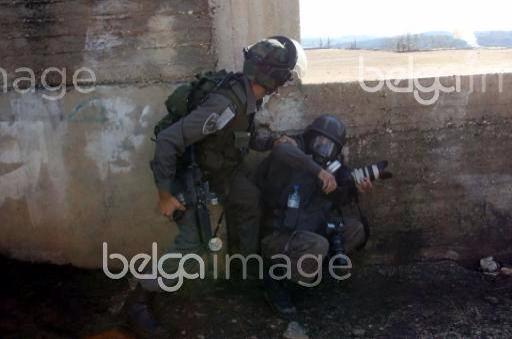
(Photo By: Nidal Eshteyeh) Israeli officer used Ala’ Badarne as a human shield in Kafr Qadoum
