

MADA: Numerous attacks on media freedom in October, especially in Jerusalem
Ramallah: October 2014 witnessed an increase in the violations against journalists in Palestine compared with the previous month.
MADA monitored 38 violations against media freedoms in October; all of them took place in the West Bank and East Jerusalem. The majority (27) were committed by the Israeli occupation forces, and the rest (11) by Palestinian security forces.
This preoccupying situation shows once again that real pressure must be placed by human rights organizations and the international community to hold the aggressors accountable, as reminded by the UN International Day to End Impunity celebrated on 2 November to demand accountability for those targeted for exercising their right to freedom of expression. On that occasion, MADA emphasized that the lack of accountability of those responsible for media freedoms violations is a direct encouragement for the continuation and intensification of such crimes, as dramatically illustrated in July and August 2014 by the death of 17 journalists and media workers killed by the Israeli forces during their latest assault on the Gaza Strip.
Israeli Violations
The Israeli occupation forces (IOF) increased their attacks against journalists and media freedoms in October 2014. Physical assaults represented the main form of violations. The IOF clearly tried to prevent journalists from covering events on the ground, as further exemplified by their seizure of journalistic material such as photographs and videos.
Israeli soldiers pepper-sprayed the freelance journalist and volunteer at the Israeli human rights center B’Tselem Bilal Abdul Salam Al-Tamimi while he was covering a peaceful demonstration in Al-Nabi Saleh on 10/10.
The Israeli police repeatedly assaulted Al-Jazeera TV photographer Mohammad Al-Salayme and other journalists while they were covering clashes at Al-Aqsa Mosque in Jerusalem on 13/10. Salayme was subjected to another assault on the following day, when he was hit in the back by a stun grenade shot by the Israeli police while he was covering clashes in Jerusalem.
Al-Hayat Al-jadidah newspaper photographer Issam Rimawi was injured in the right leg by a rubber bullet thrown by an Israeli soldier while he was covering a demonstration in Beitunia, near Ramallah, on 17/10. On the same day, the photojournalist Marwa Idrees was injured in the back with a rubber bullet while covering events in Jerusalem. The bullet caused bleeding in her spleen.
Sabah Al-Khair Ya Quds program producer and Public Palestinian TV emergency cameraman Nader Bebars was hit by two rubber bullets shot by the Israeli police while he was covering clashes in Jerusalem on 24/10.
AP photographer Majdi Eshtayye was hit by four rubber bullets while he was covering a demonstration with other journalists in Silwan village. One of the bullets damaged the camera of his colleague (a freelance photographer from Switzerland named Lazar Simonov).
The Israeli police twice assaulted Al-Quds Net correspondent and photographer Diala Jweihan while she was covering a demonstration in Jerusalem on 24/10.
The IOF arrested Al-Aqsa TV correspondent Mustafa Al-Khawaja at his house in Ni’lin village west of Ramallah on 20/10 (he is still under detention).
The Israeli military court renewed the detention of Al-Aqsa TV manager in the West Bank Aziz Kayed for another four months.
The IOF seized the cameras of AP photographer and Al-Ayyam newspaper correspondent in Jenin Mohammad Ballas and Palmedia cameraman Ahmad Kilani while they were covering an IOF arrest in Jenin refugee camp on 2/10. They also took their filming tapes, batteries and memory cards.
The Israeli occupation forces detained the Iranian Khabar TV correspondent Jihad Addin Al-Badawi in Al-Arroub refugee camp in Hebron city as he was covering clashes there on 1/10.
On 8/10 several journalists were prevented from covering clashes in Jerusalem. They were: Trans Media cameraman Suhaib Salhab, Filisteen Al-Yaum producer Ruba Bardaweel, Al-Arz cameraman Ayman Abu Ramouz, freelancer Mustafa Al-Kharouf, and Al-Mayadeen correspondent Hana’ Mahameed. Abu Ramouz holds the Israeli journalist card which he showed to the police officer but to no avail.
The IOF detained Trans Media photographer Muath Amarne and Orient News correspondent Samer Rweished while they were preparing a report on the olive harvest in Sureef village, near Hebron, on 11/10.
The Israeli police assaulted Beit Al-Maqdes news agency correspondent and “Himma News” founder Liwa’ Abu Rmeleh while she was covering clashes in Jerusalem on 15/10.
The IOF assaulted Wattan news agency cameraman Mohammad Awad after raiding his house on 21/10.
On 25/10, the Israeli police prevented Shihab news agency correspondent Amer Abu Arafa from traveling through Allenby Bridge to participate in a social media forum in Jordan.
The Israeli police assaulted and severely beat Huna Al-Quds network freelance correspondent Hazem Sandouqa while he was covering clashes in Jerusalem. They detained him, forced him to delete the photos he had taken, and threatened to assault him again if he took photos in the future.
On 31/10, the IOF detained Palestine Public TV correspondent Ali Dar Ali while he was filming clashes in Silwad village, and took him to a detention center located in an Israeli settlement.
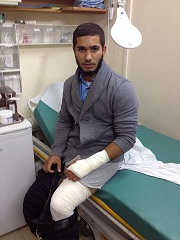
freelance correspondent Hazem Sandouqa recieving medical treatment in hospital
Palestinian violations
The Palestinian preventive security forces summoned Al-Fajer TV staff in Tulkarem city (i.e. website director Shadi Abdullah, administrative and financial director Yusri Al-Sarghali, and cameraman Ala’ Al-Jallad) for investigation about broadcasted news. In protest, Al-Fajer TV halted the broadcast for 4 hours.
The Palestinian security forces assaulted Wattan TV staff, including Hebron chief correspondent Murad Al-Ja’bari, while they were covering a demonstration in Hebron on 17/10. They detained Wattan cameraman Kamal Al-Sharif, seized the team’s cameras, and prevented them from covering.
The intelligence services arrested Al-Aqsa TV correspondent Tareq Abu Zaid and Ramsat photographer Mahmoud Abdul Ghani while they were covering a demonstration in Nablus. They detained them for hours, interrogated them and deleted all the films and photographs contained in their cellphones and cameras.
The Palestinian intelligence services arrested the freelance photographer Ghassan Najajra, accusing him of ” raising strife” and incitement against the Palestinian security forces on 21/10.
The Palestinian preventive security forces arrested Anin Al-Qayd network freelance journalist Abdullah Shatat.
The Palestinian police arrested Al-Asreyye College media student Khalid Thyab while he was taking photos in a vegetable market in Ramallah. They detained him in the police station for hours, beat him, and threatened to sue him if he revealed what happened.
The Palestinian intelligence services took the unprecedented step of preventing the blogger Ali Qaraqe’ from travelling through Allenby Bridge crossing, and interrogated him about his writings on Facebook.
The Palestinian preventive security forces summoned Shihab news agency correspondent Abdul Halim Abu Arafa, and Orient News TV correspondent Samer Rweished at a checkpoint at the entrance of Hebron. They were accused of mocking the Palestinian security forces.
Recommendations:
MADA condemns all the attacks against journalists. It demands the end of the violations of freedom of expression in Palestine and the respect of the journalists’ right to carry out their professional duty freely and safely. MADA reminds that media freedoms and freedom of expression are guaranteed by the Universal Declaration of Human Rights, as well as in the Palestinian Basic Law.
In today’s world, the truth cannot be hidden from national and international public opinion.
MADA reaffirms the need to hold accountable those guilty of aggressions against journalists, in particular those responsible for killings and severe assaults. Protecting the aggressors and not holding them accountable encourages them to commit more crimes.
Details of Violations:
1/10- The Israeli occupation forces detained the Iranian “Khabar TV” correspondent Jihad Addin Al-Badawi (aged 27) as he was covering clashes in Al-Arroub refugee camp, Hebron.
Al-Badawi reported to MADA: “For the past three weeks there have been repeated assaults by the IOF on Al-Arroub refugee camp as well as clashes with its residents. The confrontations escalated after the IOF accused a 12 year old cancer patient of stone-throwing. On 1/10, as I was filming heavy clashes, the IOF tried to attack me but I showed them my journalist card and my ID. When the clashes were over, we headed to the camp where the IOF stopped me with another three men and seized our IDs and my journalist card. They released the others half an hour later but kept me detained for three hours in bad conditions in the military tower that stands on the borders of the camp. After making phone calls they released me with threats that they might arrest me again in the future.”
2/10- The IOF seized the cameras of AP photographer and Al-Ayyam newspaper correspondent in Jenin Mohammad Ballas (aged 44) and Palmedia cameraman Ahmad Al-Kilani (aged 33) while they were covering an arrest in Jenin refugee camp
Ballas told MADA: “We went to cover an IOF raid of Jenin refugee camp on 2/10 at around 6:30 AM. While we were filming and photographing the arrest of two men (who were released later), two masked members of the Israeli Special Forces Unit came to us and seized our cameras (my two photo cameras and the video camera of my colleague Ahmad Al-Kilani). They gave them back to us fifteen minutes later but without the batteries, memory cards and filming tape. We are still waiting to get them back.”
8/10- Israeli police officers assaulted Trans Media cameraman Suhaib Salhab (aged 22) and other journalists, obstructing their work and preventing them from filming clashes in Al-Aqsa Mosque, Jerusalem.
Salhab reported to MADA: “A large number of Israeli police and Border police officers raided Al-Aqsa Mosque from Bab Al-Magharba (Dung Gate) and assaulted the worshippers with tear gas bombs and stun grenades to make them evacuate the mosque’s square before Israeli Jews raided the compound to perform the religious rituals of Sukkot. Journalists were covering the actions near Bab Al-Asbat (Lion’s Gate) but the Israeli police obstructed us. They pushed me many times to prevent me from covering, and also assaulted Filisteen Al-Yom producer Ruba Al-Bardaweel, pushing her out of the place many times.
8/10- The Israeli police assaulted Al-Arz company photographer Ayman Abu Ramouz (aged 24) while he was covering clashes at Al-Aqsa Mosque in Jerusalem and prevented him from photographing.
Abu Ramouz reported to MADA: “While we were covering clashes at Al-Aqsa Mosque, particularly near Bab Al-Majles, an Israeli police officer pushed me many times. I showed him my journalist card but he did not care. He punched me on my shoulder when I told him that I was not disturbing him so he should not disturb me. My freelance colleague Mustafa Al-Kharouf was also strongly pushed.”
8/10 The Israeli police assaulted Al-Mayadeen TV correspondent Hana’ Mahameed (aged 29) while covering clashes at Al-Aqsa Mosque, preventing her from doing her work and threatening to sue her.
Mahameed reported to MADA: “I was covering the raid of Al-Aqsa Mosque and the assault of worshipers inside the Old City of Jerusalem when the Israeli police prevented me and other journalists from doing our job. While I was heading to interview some women, a police officer attacked me and accused me of incitement against Israel. I told him that I was only doing my work. He asked for my ID and journalist card and threatened to submit a complaint against me. A short while later, I got my papers back and was able to leave.”
8/10- The Palestinian Preventive Security Forces summoned some Al-Fajer TV staff for investigation about broadcasted news in Tulkarem city.
The following staff members were summoned: website director Shadi Abdullah (aged 24), administrative and financial director Yusri Al-Sarghali (aged 25), and cameraman Ala’ Al-Jallad (aged 20). In protest, Al-Fajer TV halted the broadcast for 4 hours.
Abdullah reported to MADA: “Al-Fajer TV broadcasted the news that a man had died following a fight in the Mega Land amusement park in Tulkarem city on 8/10. In fact the man was just injured, so we corrected the news on both our TV and website, and also apologized to the injured man’s family, who accepted the apology and everything was fine. However, less than 15 minutes later, the Preventive Security Forces called us for interrogation, asking questions about the news we had broadcasted and our sources of information. An hour later they released us but when we reached the entrance they asked cameraman Ala’ Al-Jallad to stay so as to take his testimony again. We all waited for him until 9:15 PM, when they finally released him.”
He added: “Al-Fajer TV administration halted the broadcast in protest for our detention and investigation until our release. The broadcast was halted from 5:00 PM until 9:00 PM.”
10/10- The IOF used pepper spray on Bilal Al-Tamimi (aged 48), volunteer journalist at the Israeli human rights center B’Tselem
Al-Tamimi reported to MADA: “At around 2:30 PM I was covering clashes between Palestinian youth and the IOF during the weekly demonstration of Al-Nabi Saleh. One of the Israeli soldiers used pepper spray towards my eyes, preventing me from working. This is not the first time; I have been assaulted in such a manner three times in the past.”
“It is known that peppers spray causes burns in the eyes, preventing the affected person from opening its eyes for almost an hour,” said Al-Tamimi, who added that he did not get any treatment except for cold water compresses.
11/10- The IOF detained Trans Media cameraman Muath Amarne (aged 27) while he was preparing a report on the olive harvest in Sureef village, near Hebron.
Amarne reported to MADA: “I headed off with my colleague Samir Rweshed (aged 26), who works as a correspondent at Orient News, to prepare a report on the olive harvest in Sureef. It was 11:00 AM when an Israeli military vehicle stopped us and asked us what we were doing? (We were behind the Apartheid Wall). They detained us for two hours and seized our IDs and journalists cards. They also turned off our cellphones. They later drove us to Jaba’ checkpoint to meet the officer there, we were detained for another two hours before we got released. They just detained us without investigation.”
13/10- An Israeli police officer assaulted Al-Jazeera TV cameraman Mohammad Al-Salayme (aged 50) many times while he was covering clashes at Al-Aqsa Mosque, Jerusalem. He was also prevented from photographing together with other journalists.
Al-Salayme reported to MADA: “I was in the Old City of Jerusalem near Bab Hutta (Gate of Remission) in order to cover the repeated attacks by Israeli settlers. While I was making an interview with a man from Jerusalem about the situation, an Israeli officer strongly pushed me and hit my camera, which fell to the ground (without damages). The same officer pushed me again after we went to Bab Al-Asbat (Lion’s Gate) which is 50 meter away from Bab Hutta.
“Then, as I was in a narrow path where there was a heavy stun grenades attack against the Palestinians, I went to a spot a bit further away to film but the same Israeli officer came and pushed me, and my camera fell again to the ground (no damages again).”
He added: “In general, all the journalists were subjected to assaults and prevented from covering.”
14/10- Al-Jazeera TV cameraman Mohammad Al-Salayme was assaulted again while he was covering the clashes in Jerusalem. A stun grenade thrown by the Israeli police hit his back.
Al-Salayme reported to MADA: “On 14/10 the worshipers were prevented from entering Al-Aqsa Mosque and as they were praying in the street near Bab Al-Asbat (Lion’s Gate), the Israeli police threw many stun grenades towards them. One of the grenades hit my back and rebounded on the ground under a car. I suffered no physical harm.”
15/10- The Israeli police assaulted Beit Al-Maqdes news agency correspondent and Himma News founder Liwa’ Abu Rmeleh (aged 23) while she was covering clashes in Jerusalem.
Abu Rmeleh reported to MADA: “There was outrage in Jerusalem due to the continuous daily attacks on Al-Aqsa Mosque. On 15/10 I went to cover the clashes in front of Bab Hutta in the Old City. While I was covering the Israeli police’s arrest of a Palestinian man and their throwing of stun grenades towards Al-Aqsa guards, an Israeli police officer came to me and pushed me, making me fall to the ground. As I kept on taking photos he pushed me again, kicked me with his foot and hit me with a baton on my right arm. My wrist hurt me for two days after that and I had to bandage it.”
17/10- The Palestinian Security Forces assaulted Wattan TV staff while they were covering a demonstration in Hebron, south West Bank. They also seized their cameras and prevented them from covering.
Wattan TV manager in Hebron Murad Al-Ja’bari (aged 36) reported to MADA: “On 17/10, a solidarity demonstration against the daily Israeli attacks on Al-Aqsa Mosque was organized, starting from Ein Sara neighborhood in Hebron. The Palestinian Security Forces blocked the road so the protesters changed the path. Then the security forces started attacking protesters, including the journalists.”
He added: “Wattan TV staff was prevented from covering because the Palestinian Authority claims that Wattan TV is not professional in covering the events. The security men prevented me and my staff from working, they seized our cameras and detained the cameraman Kamal Al-Sharif (aged 21) for 10 minutes. One of the security forces told me: 'you are a good agency so why do you film these people?’ Then they dragged us strongly to make us leave the place.”
17/10- Al-Alhayat- Al-jadidah newspaper photographer Issam Rimawi was injured by a rubber bullet fired by an Israeli soldier while he was covering a demonstration in Beitunia neighborhood in Ramallah.
Rimawi reported to MADA: “I was covering a demonstration of solidarity with Al-Aqsa Mosque in Beitunia, standing near a wall to take photos with my back turned to the soldiers. They shot at my right calf muscle with a rubber bullet. I received only first aid on the field although the injury was not minor.”
17/10- The Israeli police shot Himma News volunteer photographer Marwa Idrees (aged 22) with a rubber bullet that caused bleeding in her spleen.
Marwa, who is also a volunteer at the Medical Relief, reported to MADA: “I went to cover the clashes between the Palestinian youth and the Israeli police near Bab Al-Majles (Council Gate), in the Old City of Jerusalem. When I heard that many people had been injured, I wore my paramedics vest to give first aid to the wounded. However I was myself hit by a rubber bullet in my back that ripped my spleen and caused bleeding.
“I stayed at Al-Maqased hospital until 27/10. Now I am at home with a one-month long treatment. If my state does not improve I will have to undergo surgery. Meanwhile I am not allowed to move fast or walk for too long.”
17/10- The Palestinian Intelligence forces arrested Al-Aqsa TV correspondent Tareq Abu Zaid (aged 38) and Ramsat cameraman Mohammad Abdulghani (aged 29) while they were covering a demonstration in Nablus, northern West Bank. They were detained and investigated for hours, the photographs on their cellphones and cameras were deleted, and their camera was seized.
Abu Zaid reported to MADA: “After Friday’s prayer, we headed off from Al-Nasr mosque in Nablus to cover a demonstration organized by Hamas. When we reached Hitteen Street, we saw around 50 Palestinian police officers with batons and shields making a human barrier and completely closing the street.”
“I was taking photos with my cellphone, standing between the protesters and the police, when one of the policemen held me from my shirt’s collar, pulled my cellphone and dragged me to another person in plainclothes. He told me that he knew my name and that I work for Al-Aqsa TV. I was the first to be arrested. He put me in a small van that can carry only 6 people. They put another 8 persons inside the van and they did not allow us to even open the windows. Later they moved us to a larger bus of the intelligence service and drove us to their headquarters in Jneid prison, in the Rafidia neighborhood . We were asked to put our material to the ground and to face a wall for almost an hour while they were taking our personal information. One of the officers came to me and asked me for my cellphone’s password, which I gave. Half an hour later they gave me back my ID and cellphone after deleting all the photos it contained. I was released at around 2:00 PM.
Ramsat photographer Mahmoud Abdulghani reported to MADA: “I was in the demonstration in Nablus, filming, when one undercover man dragged me from my shoulder and did not let me say a word. Then he put me in the same bus where Tareq was. I was later investigated for a longer period than Tareq. I was released at around 9:00 PM after moving me between four solitary confinement cells in Jneid prison. They asked me about the local TVs I used to work for, and about my political affiliation. They also asked me about Tareq Abu Zaid and my relation with him, as well as the interviews Tareq had recorded.”
Abdulghani pointed out that after the investigation they gave him back all of his belongings except for his camera, which they kept until Saturday 18/10. They gave the camera to the journalists syndicate but without the memory card. Abdulghani took his camera from the syndicate’s headquarter on Wednesday 23/10.
20/10- The IOF arrested Al-Aqsa TV correspondent Mustafa Al-Khawaja (aged 25) from his house in Ni’lin village, west of Ramallah.
His wife Isra’ reported to MADA: “On Monday at around 1:30 AM 40-50 IOF soldiers raided our house. They strongly knocked the door and when I opened it they entered the house in a hurry and asked for my husband’s ID. They seized his 2 cellphones and carefully searched the house, causing a mess to all the furniture and looking into all our papers, including my university books.”
She added: “The IOF captain talked to Mustafa and told him that he was under arrest and could take the clothes he needed. He did not explain the charges against Mustafa. They also raided Mustafa family’s house and damaged the furniture. Until now (21/10) we do not know in which prison they placed him. On 23/10 Mustafa’s detention was expanded for another 12 days that will end on 3/11 according to his family.”
Mustafa has been arrested twice in the last seven years, once by the IOF and once by the Palestinian authority. Each time the detention lasted for one week.
21/10- The Palestinian intelligence service arrested the freelance photographer Ghassan Najajra (aged 24) accusing him of raising strife and incitement against the Palestinian security forces.
His wife Fahima Al-Titi reported to MADA: “On 12/10 the Palestinian intelligence service came to our house in Nahaleen village, near Bethlehem , and told Ghassan that he should go to their headquarters on the next day. They did not hand him the order, fearing that he would publish it on Facebook. On the next day, Ghassan went to their headquarters but no one investigated him until 4:00 PM. Then they released him, giving him another summons to come back on 21/10.”
She added: “Ghassan went on 21/10 but he did not come back home and he was investigated for four days. Later they expanded the detention for another 15 days that will end on 6/11.”
Ghassan’s lawyer Subhi Shakarne reported to MADA: “Ghassan is detained for different accusations including raising strife and incitement against the Palestinian security forces. These accusations might be based on his publications on his Facebook page.” He added: “The accusation has not been officially stated yet. Ghassan is detained until the holding of the court session on Thursday 6/11.”
Ghassan’s wife assured that her husband did not criticize the authority or published anything against it. (He was released on 6/11)
21/10- The IOF assaulted Wattan news agency cameraman Muhammad Awad (aged 27) after raiding his house.
Awad reported to MADA: “On 21/10 at around 2:00 AM, a large number of Israeli forces raided my house in Budrus village, west of Ramallah. They dragged me to the floor and questioned me. Then an argument erupted between me and them when they asked for the house residents’ names and ID numbers. As a result, five soldiers beat my brother and I, and then they left the place.”
22/10- The Palestinian Preventive Security Forces arrested freelance journalistand volunteer at Anin Al-Qayd news network Abdullah Shatat (aged 24) from Beita village,Nablus.
His mother reported to MADA: “On Wednesday 22/10, while Abdullah was at the oil -press, four undercover members of the preventive security forces raided the place. When Abdullah refused to go with them as he was afraid that they would kidnap him, they shot bullets and arrested him.”
She added: “On Thursday 23/10 Abdullah appeared in front of the general prosecutor who decided to expand his detention for 15 days with charges of fighting against the security forces and slandering the Palestinian Authority. He is now detained at the preventive security headquarter in Silfit, being investigated and banned from visits.”
24/10- The Israeli occupation Police officer twice assaulted Al-Quds Net correspondent and photographer Diala Jweihan while she was covering a demonstration in Jerusalem. One of the officers threw stun grenades at her, causing burns in her left leg.
Jweihan reported to MADA: “Jerusalem witnessed demonstrations in different places including Wadi Joz in protest for the non-release of the body of martyr Abdulrahman Shalloudi and the interdiction of access to Al-Aqsa Mosque for people under 40 years old. The Israeli forces cracked down on the demonstration I was attending by spreading waste water with a very bad smell which caused me cramps and vomiting. I was treated on the field.”
“Half an hour later, a number of undercover police officers arrested 3 young men. The IOF asked us (Palestinian journalists) to move away from the place. They did not ask the foreign journalists to do the same. I went far away from the crowd to take photos and one of the officers chased me and threw a stun grenade between my legs, although I had followed his calls and stayed far away showing my journalist card. The grenade caused minor burns in my left thigh and I was treated on site by the paramedics. I was later moved to the Kubat Holim clinic where they gave me antibiotics and bandaged the burns.”
24/10- Nader Bebars, Sabah Al-Khair Ya Quds program producer and Palestinian Public TV emergency cameraman, was hit by two rubber bullets shot by the Israeli occupation police while he was covering clashes in Jerusalem.
Bebars reported to MADA: “I was in the Al-Suwwana neighborhood in Jerusalem taking photos far away from the clashes that were taking place everywhere. While I was filming the Israeli police throwing stuns grenades at a family crossing the main street, I was exposed to Israeli rubber bullets shots. Two bullets hit me, one in my left arm and the other in my back. I got first aid in the ambulance, which was hit by a stun grenade and 3 bullets shot by the Israeli police.”
25/10- The Israeli ocupation authority prevented Shihab news agency in West Bank correspondent Amer Abu Arafe (aged 31) from traveling while he was on his way to participate in a social media forum in Jordan.
Abu Arafe reported to MADA: “I was heading to Jordan via Allenby Bridge to participate in the first social media forum but the Israelis prevented me from travelling. They seized my passport for two hours and when they gave it back to me, there was a small paper inside it stating that I was not allowed to travel for security reasons.”
27/10- AP photographer Majdi Mohamed Eshtayye (aged 32) was hit by four rubber bullets shot by the IOF with while he was covering a demonstration in the Palestinian village of Silwan, adjacent to the Old City of Jerusalem.
Eshtayye reported to MADA: “Following the funerals of martyr Urwa Hamed (aged 14), killed by the IOF on Friday in Silwad, north- east of Ramallah, clashes erupted between the IOF and the Palestinian youth. I went with other journalists to cover the clashes and while we were standing far away from the protesters, an Israeli military vehicle stopped next to us and shot a bunch of rubber bullets us (14 iron bullets covered with rubber). We were all journalists and there were no protesters among us. Three bullets hit my journalist safety vest and a fourth one hit my right arm near the elbow. I fell to the ground as a result.”
Eshtayye added that one of the bullets broke the camera of his colleague (a freelance photographer from Switzerland, Lazar Simonov, aged 30)
29/10- The Palestinian intelligence services prevented the blogger and ex-anchorman Ali Qaraqe’ (aged 24) from travelling through Allenby Bridge. They interrogated him about his writings on the Internet.
Qaraqe’ reported to MADA: “I was at the Allenby Bridge frontier post to go to Jordan. As I showed my passport to the Palestinian officers manning the crossing, I was told to wait and prevented from traveling. Five minutes later, the Palestinian officers (I did not know if they were from the police or intelligence services) started interrogating me. It lasted for half an hour, I was asked about the reasons of my travel and whether I was coming back or not. They also asked me if I had ever been investigated by the Palestinian forces, as well as my political affiliation and my activism on the internet, especially Facebook. They asked for my Facebook password but I refused to give them since it is personal, but the officer threatened me that he might forcibly log in.”
He added: “I was released and asked to go to the intelligence headquarters in Bethlehem on 2/11.”
30/10- The Palestinian police arrested Al-Asreyye College media student Khalid Jameel Thyab (aged 25) while he was taking photos in a vegetable market in Ramallah. They detained him for hours, punched him, and threatened to sue him if he revealed what happened.
Thyab reported to MADA: “On Thursday 30/10 at around 4:00 PM I was taking photos in the vegetables market of Ramallah when one police officer stopped me and banned me from taking photos, claiming that I did not have a permit from the Information Ministry to do so. He took me to his superior who asked to check my university ID and ordered to arrest me.”
Thyab added: “They dragged me to the police station in Ramallah and one of the officers told me that we (journalists) ruin the country. He asked me to delete the photos I had taken and when I refused they took me to the investigation room. I waited for an hour without being interrogated. Then a police officer came and detained me for another hour. Another officer came and told me that I had done nothing wrong but they just wanted to teach me a lesson. I told him that I did not need this, and he put me back in detention. I kicked the door and 5 of the police handcuffed me and beat me. One of them kept beating me on the face, causing me a black eye, and hit my head to the wall many times.”
He added: “Two hours later, an officer came to apologize and warned me not to mention what had happened to me to human rights organizations or media outlets. He made me understand that he would charge me of punching a police officer at Al-Manara square if I talked about what happened to me in the police station. He also told me that if I wanted to take photos in the future, I would have to tell the police beforehand to get protection. They released me at 8:30 PM. I did not get any medical treatment.”
30/10- The Israeli police assaulted and severely beat the volunteer freelance correspondent at Huna Al-Quds network Hazem Zeyad Sandouqa (aged 22) while he was covering clashes in Jerusalem. They detained him, forced him to delete the photos he had taken, and threatened to assault him again if he took photos in the future.
Sandouqa reported to MADA: “I was at Bab Al-Asbat (Lions Gate) to cover the closure of Al-Aqsa Mosque to worshippers; it was 4:30 AM. I heard one of the Israeli soldiers saying: “bring Sandouqa.” They know me because I often cover clashes in Jerusalem; I have made many videos of Israeli police assaulting the women of Al-Aqsa defending the holy compound. A police officer took me from the Lions Gate and 5 soldiers attacked me and brutally beat me. They dragged me to a detention place and seized my cellphone. They beat me again harshly with metal objects; it looked as if they were getting their revenge against me. They asked me about my work and accused me of assisting the assassination attempt of the Jewish extremist Yehuda Glick.”
Sandouqa added: “They took me to Al-Qashle police station. I could not stand on my feet anymore due to their blows. There, I was severely beaten again. The officer told me to delete all the data contained in my cellphone, including videos, or they would bring me to court and arrest me for three months. I agreed due to my health condition and deleted all the videos. The officer also warned me not to go filming in the field again or face violent treatment.”
He added: “I was detained and beaten for 5 hours, and later they released me. I got medical treatment at Majd medical center in Al-Musrara neighborhood. I have bruises all over my body. The doctor bandaged my left wrist which was about to break, as well as my left thigh.”
30/10- The Israeli military court renewed the detention of Al-Aqsa TV West Bank manager Aziz Haroun Kayed (aged 55) for another 4 months.
His daughter Maryam reported to MADA: “On 30/10 the detention of my father was renewed for the second time for another four months. The court decision was issued the day that my father was supposed to be released.”
She added that the next court session will be held on Tuesday 4/11 to confirm the extension of his new administrative detention.
The Israeli occupation forces arrested Kayed on the night of 17/6/2014 at his house in Ramallah.
31/10- The IOF detained Palestine Public TV correspondent Ali Dar Ali while he was filming clashes in the village of Silwad, north-east of Ramallah, and took him to a detention center located in an Israeli settlement.
Dar Ali reported to MADA: “I was standing on a roof in Silwad to cover a protest of solidarity with Al-Aqsa Mosque and the subsequent clashes with the IOF. When I finished, I went down and one Israeli soldier asked me to leave the place. I told him that I am a journalist and was just doing my job, and that I was far away from both the protestors and the IOF. He asked for my ID but I did not have it with me and had to go and get it. He did not wait for it and told me that I was under arrest. They handcuffed me, seized my cellphone and my journalist safety vest, and drove me to the investigation center of the Sha’er Ben Yameen settlement. Along the way they asked for my ID number and birth date. There I was detained for three hours without any investigation, and they released me after the intervention of the Palestinian security liaison office.”
31/10- The Palestinian preventive security forces summoned Shihab news agency West Bank correspondent Abdul Halim Abu Arafa (aged 31) and Orient News TV correspondent Samer Rweished (aged 26) at a checkpoint at the entrance of Hebron. They were accused of mocking the Palestinian
security forces.
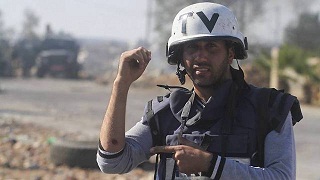
(Photo By: AP) photographer Majdi Eshtayye
Abu Arafa reported to MADA: “Samer and I were going back from Bethlehem and drove past a checkpoint manned by the Palestinian security forces at the northern entrance of the city of Hebron. They examined the car and seized our IDs although we told them we were journalists. They asked us to go on the next day (Saturday) to the security forces headquarters in Hebron. We went, and there we were interrogated by a person called Imad who told us that we were accused of mocking the security forces when they had stopped us at the checkpoint the day before. That was not true and we denied. He told us that they can chase us and detain us whenever they want. Eventually they gave us back our IDs and released us.”
